Last reviewed: June 2025 | Written by the AntiqueSilverHallmarks.com research team, with contributions from hallmark specialists holding 10+ years of hands-on UK silver identification experience. For high-value pieces, always confirm hallmark identification with a professional assayer or accredited member of the National Association of Jewellers.
---
The lion passant hallmark meaning is straightforward but essential: a walking lion facing left tells you the silver item meets England's sterling standard of 92.5% pure silver, tested and certified by an official UK assay office. This single mark — struck on English silver continuously since 1544 — is the most reliable guarantee of silver quality a collector, estate sale shopper, or dealer will encounter on British pieces. Understanding what it represents, where it comes from, and how to read it alongside companion hallmarks is the foundation of buying and valuing antique silver with confidence.
---
What Is the Lion Passant Hallmark?
The Symbol Explained: A Walking Lion in Profile
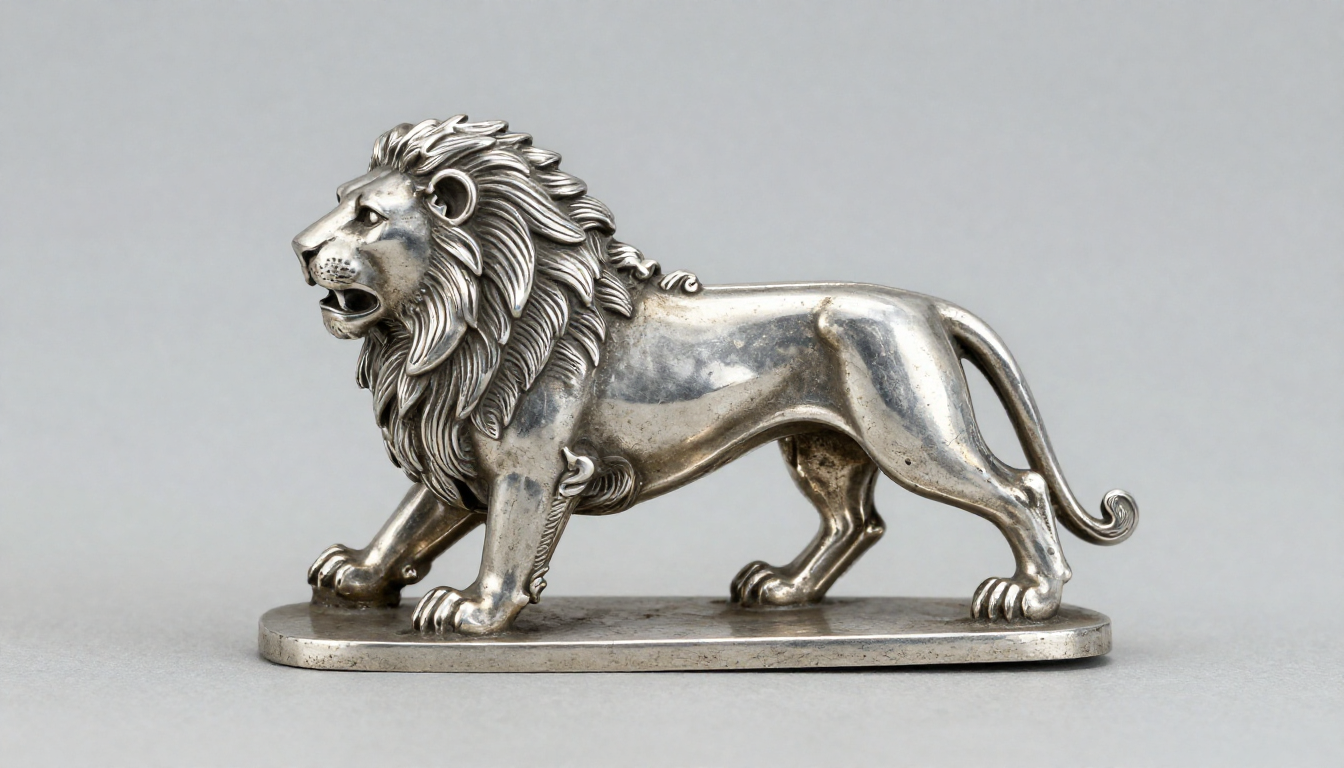
The Lion Passant is a heraldic figure depicting a lion in mid-stride, facing left, with its right forepaw raised and its tail curving upward. "Passant" is a term from heraldry meaning "walking," distinguishing this pose from a rearing lion (rampant) or a seated lion (statant). On silver, the image appears struck inside a rectangular or shaped cartouche — the exact outline of that cartouche changed across different eras, which gives experienced researchers one more dating clue. On Georgian pieces, the shield shape tends to be more elaborate, with cut corners and shaped sides. Victorian and later marks often use a simpler rectangular punch.
The image is precise enough that even a worn strike usually preserves the forward-facing head and raised paw, making it one of the more recognisable marks even on heavily used flatware. Under a loupe, you are looking at an impression made by a steel punch, driven into the silver by an assay office worker after the metal passed its purity test. The lion's body sits small — often no more than 4–5mm across on a standard spoon — but the detail in a clean strike is sharp enough to count the claws.
What the Lion Passant Guarantees About Silver Purity
The Lion Passant is a purity mark, not a maker's mark or a date mark. Its presence confirms that an independent assay office — not the silversmith — tested the metal and found it met the legal minimum standard. Before the assay office struck the mark, a small sample of metal was removed from the piece and analysed. If the silver fell short of the required standard, the piece was either returned to the maker or, in earlier periods, defaced so it could not be sold as sterling.
This independent verification is what separates British hallmarked silver from silver sold in many other countries, where maker self-declaration was common. The Lion Passant tells you an official third party stood behind the purity claim.
Sterling Silver Standard: 92.5% Pure Silver
Sterling silver is an alloy of 92.5% silver and 7.5% other metals, almost always copper. Pure silver at 99.9% is too soft for most functional objects — cutlery bends, teapots dent — so the copper adds hardness and durability. The 925 standard became the legal minimum for English silver marked with the Lion Passant, a threshold that has held for nearly five centuries. When you see "925" stamped on modern silver jewellery, that number and the Lion Passant refer to exactly the same standard, expressed differently for different markets.
---
History of the Lion Passant on English Silver
Origins in 1544: Why Henry VIII's Reign Matters
The Lion Passant hallmark was introduced by statute in 1544 during the reign of Henry VIII, making it one of the longest-running product standards in English legal history. The Goldsmiths' Company of London, which had regulated the silver trade since its royal charter of 1327, adopted the Lion Passant specifically as the sterling standard mark. Before 1544, a leopard's head mark (introduced in 1300) served as the primary purity guarantee. Adding the Lion Passant created a clearer, dedicated symbol for the sterling standard — one that could be read alongside other marks without confusion.
The timing was not accidental. Henry VIII's reign saw significant currency debasement, and a clear purity mark on plate helped reassure buyers that domestic silver goods met a defined standard even as coinage became unreliable.
How the Mark Evolved from 1544 to the Present Day
From 1544 to 1822, the Lion Passant faced right — looking to the viewer's right — inside a variety of cartouche shapes that changed across different assay offices and date periods. In 1822, the orientation shifted to face left, the standard position used today. That change is a useful dating tool: any English piece with a Lion Passant facing right was made before 1822, placing it firmly in the Georgian or earlier period.
Between 1697 and 1720, the Lion Passant was suspended entirely in favour of the Britannia Standard (see the section on Britannia Standard below). After 1720, it was reinstated and has remained in continuous use. The Goldsmiths' Company archives in London hold records documenting the punch designs used across each period, and researchers cited in Jackson's Silver and Gold Marks of England, Scotland and Ireland have catalogued these changes in detail.
The Hallmarking Act 1973 and Modern Usage
The Hallmarking Act 1973 consolidated and modernised UK hallmarking law, bringing together rules that had accumulated across centuries of separate legislation. Under this Act, the Lion Passant remained the mandatory standard mark for sterling silver sold in England, and the British Hallmarking Council was established to oversee the assay offices authorised to strike it. The Act also introduced provisions for imported silver, requiring foreign pieces sold in the UK to carry equivalent UK hallmarks. The Lion Passant therefore appears on contemporary silver jewellery and flatware produced today, struck by one of the four UK assay offices: London, Birmingham, Sheffield, and Edinburgh — though Edinburgh uses a different standard mark for Scottish silver (see the Scotland section below).
---
How to Read the Lion Passant Alongside Other Hallmarks
The Five Standard UK Hallmarks and Their Positions
A fully hallmarked piece of English silver carries a set of marks that together tell you who made it, where it was tested, when it was tested, and that it met the sterling standard. The Lion Passant is one component of that system, not a standalone mark. On flatware, marks typically appear in a row on the back of the handle shank. On hollowware such as teapots or jugs, they usually appear on the base or near the rim. On jewellery, space constraints sometimes mean a reduced set of marks.
The marks read left to right in conventional order: maker's mark, assay office mark, standard mark (Lion Passant), and date letter. A fifth mark — the monarch's head or sovereign's head duty mark — appeared between 1784 and 1890 to show that excise duty had been paid, and its presence confirms a piece dates from within that window.
Maker's Mark, Assay Office Mark, and Date Letter Explained
The maker's mark consists of the silversmith's or company's initials in a shaped cartouche. It was introduced in 1363 and has remained compulsory. The assay office mark identifies which office tested the piece: a leopard's head (London), an anchor (Birmingham), a crown (Sheffield), or a castle (Edinburgh, which has been assaying sterling silver since 1759). The date letter is an alphabetical letter in a shaped shield that changes annually, allowing precise dating when cross-referenced with published tables — available in print through reference works like Pickford's Silver Flatware and online through the London Assay Office's own date letter charts.
For a full breakdown of all UK marks in one place, the UK silver hallmarks guide on this site covers every assay office mark with illustrated examples.
Why Some Pieces Have a Lion Passant but No Date Letter
Small items — rings, thimbles, vinaigrettes, and certain types of jewellery — were historically exempt from the full set of marks under minimum weight thresholds. These exemptions shifted across different periods of legislation. A piece can legally carry the Lion Passant and maker's mark without a date letter if it fell below the weight threshold at the time of assay. This is not a sign of forgery; it is a known feature of the hallmarking system. If you need to date such a piece, stylistic analysis, maker's mark research, and comparison with the silver hallmarks chart can narrow the date range considerably.
UK Hallmarks at a Glance
| Hallmark Name | Symbol Description | What It Tells You | Required Since |
|---|---|---|---|
| Maker's Mark | Initials in a shaped punch | Who made or submitted the piece | 1363 |
| Lion Passant | Walking lion facing left | Sterling silver (92.5%) standard, England | 1544 |
| Assay Office Mark | Leopard's head (London), anchor (Birmingham), crown (Sheffield), castle (Edinburgh) | Which office tested the piece | Varies by office; London 1300 |
| Date Letter | Single letter in a shaped shield | Year of assay, by office-specific table | 1478 (London) |
| Sovereign's Head (Duty Mark) | Profile of reigning monarch | Excise duty paid | 1784–1890 only |
| Britannia Mark | Seated Britannia figure | Higher 95.84% silver standard | 1697; optional after 1720 |
Lion Passant vs Other British Silver Marks
Lion Passant vs Lion Rampant: Scotland's Different Standard
The lion rampant — a lion rearing upright on its hind legs — is Scotland's heraldic symbol and appears in Scottish contexts, but it is not used as a silver standard mark. Scottish sterling silver assayed in Edinburgh carries the Lion Passant alongside the Edinburgh castle mark, exactly as English silver does. The confusion between Lion Passant and lion rampant arises because both are heraldic lions, but their poses and functions are entirely different. If you encounter a rampant lion on a silver piece, it is almost certainly a decorative engraving or a coat of arms rather than a hallmark.
Britannia Standard Mark: When the Lion Passant Was Suspended
Between 1697 and 1720, the English Parliament required all silver to meet the higher Britannia Standard of 95.84% pure silver, replacing the sterling standard for that period. The Lion Passant was withdrawn during those 23 years and replaced with a seated Britannia figure alongside a lion's head erased — a lion's head with a jagged neck, as though torn rather than cut. Any English piece from 1697–1720 carrying a Lion Passant is therefore suspect and warrants careful examination. After 1720, the sterling standard and Lion Passant were reinstated, while Britannia Standard became optional and remains available today for silversmiths who choose the higher purity.
Irish Silver and the Harp Crowned Mark
Irish silver uses a different marking system administered through the Dublin Assay Office, which has operated since 1637. The primary Irish standard mark is a harp crowned — a crowned Irish harp — not a Lion Passant. Irish pieces do not carry the Lion Passant because Ireland operates under separate hallmarking legislation. A harp crowned mark accompanied by a Hibernia figure (a seated female representing Ireland) and a date letter is the equivalent Irish guarantee of silver purity. Pieces marked in Dublin appear frequently in British antique markets but should not be confused with English silver.
---
Identifying the Lion Passant on Antique Silver
Where to Look: Common Locations on Flatware, Hollowware, and Jewellery
On table flatware — spoons, forks, serving pieces — the marks appear as a group on the back of the handle, typically near the stem. On a dessert spoon, all four marks usually sit in a tight row no more than 15mm wide. On hollowware such as teapots, cream jugs, and sugar bowls, check the underside of the base first; if marks are absent there, look near the rim or on a removable lid. On jewellery, particularly smaller items, marks may be on the inside of a ring shank, the clasp of a bracelet, or the back of a brooch pin. A 10x loupe is the minimum for confident identification; 20x is better for worn marks.
[Photograph: A Georgian silver tablespoon showing, left to right: the maker's initials "WE" in a rectangular punch, the London leopard's head, the Lion Passant facing left, and the date letter "h" in an Old English typeface, consistent with the London assay table for 1802–03. Note how the cartouche shapes differ for each mark — the Lion Passant sits in a plain rectangle while the date letter has a shield outline with a cut corner.]
Worn or Partial Marks: How to Confirm a Lion Passant
Heavy polishing is the most common reason Lion Passant marks become unclear. A piece polished with silver cloth or machine-buffed over decades can lose fine detail in the punch, leaving only the outline of the cartouche and a vague lion silhouette. If you've bought a spoon that looked fully marked in the dealer's cabinet and then struggled to read it in daylight, you'll know the feeling. To confirm a worn mark, angle the piece under a raking light — a strong beam hitting the silver at 10–15 degrees to the surface — which makes even shallow strikes cast shadows and become readable. If the forward-facing head and raised right paw are visible under raking light, even without full body detail, the identification is reliable. Pieces polished over decades can lose hallmark clarity entirely; when that happens, maker's mark research and stylistic dating become your primary tools.
For guidance on reading partial or damaged marks systematically, the identify silver hallmarks section of this site provides a step-by-step method with illustrated examples.
Common Fakes and How to Spot Them
The most common fake in the English antique silver market is not a forged Lion Passant but a transposed one — a genuine set of marks cut from a smaller, lower-value piece and let into a larger, unmarked or silver-plated item. Look for a panel or insert around the marks that sits slightly proud of the surrounding surface, or a visible solder line under angled light. The Goldsmiths' Company Assay Office describes this practice — known historically as "duty dodging" — and modern forgeries use the same technique. A genuine set of marks on a solid sterling piece will be struck directly into the object's own metal, with no seam or panel visible. Run a fingertip across the marks in a good light. A transplanted section almost always has an edge you can feel before you can see it.
---
What the Lion Passant Means for Silver Value
Hallmarked Sterling Silver vs Unmarked or Silver-Plated Items
The Lion Passant directly affects resale value. Fully hallmarked sterling silver — carrying the Lion Passant, assay office mark, maker's mark, and date letter — commands a significant premium over unmarked pieces or silver-plate at auction and in dealer stock. A set of Georgian silver tablespoons with clear London hallmarks and an identified maker will typically sell for three to 10 times the price of equivalent silver-plated spoons in similar condition, even before the melt value of the silver itself is considered. The hallmarks reduce buyer risk by eliminating uncertainty about the metal content, which is why collectors and dealers specifically seek them out.
How Period and Assay Office Affect Collectability
Not all Lion Passant marks carry equal collector appeal. London-assayed silver from the Georgian period (roughly 1714–1830) with marks from well-documented makers — Hester Bateman, Paul de Lamerie, Paul Storr — attracts intense collector interest and strong auction prices. Provincial assay office marks from Exeter, Chester, or Newcastle (all now closed) are prized by collectors who specialise in regional silver, sometimes commanding premiums over equivalent London pieces. Birmingham silver from the Victorian period is abundant and generally accessible, making it a solid entry point for new collectors. The date letter combined with the assay office mark gives you the specific year and place, allowing you to research a piece's full provenance.
Getting a Professional Valuation
For any piece where significant value is possible — a complete canteen of flatware, a Georgian tea service, or a piece with a notable maker's mark — professional valuation by a member of the National Association of Jewellers or an auction house specialist is the right next step. The Lion Passant confirms sterling silver, but it does not tell you the maker's rarity, the pattern's desirability, or current market demand for that category. The London Assay Office (londonassayoffice.co.uk) and the British Hallmarking Council (binghamhallmarkingcouncil.org.uk) both publish resources for consumers seeking authorised assayers.
Disclaimer: This guide provides educational information about hallmark identification. For high-value pieces, always seek confirmation from a professional assayer or accredited valuer. Hallmark identification from photographs alone is not sufficient for insurance or sale purposes.
---
Frequently Asked Questions
What does the lion passant hallmark mean on silver?
The Lion Passant hallmark means the silver item has been independently tested and certified as sterling silver — 92.5% pure silver — by an official UK assay office. The mark has appeared on English silver since 1544, making it one of the oldest consumer protection marks in British legal history. Its presence guarantees that a third-party authority, not the maker, verified the metal content before the piece could be legally sold.
When was the lion passant first used as a silver hallmark in England?
The Lion Passant was first used as a silver hallmark in England in 1544, introduced by statute during the reign of Henry VIII. It supplemented the earlier leopard's head mark, which dated to 1300, by providing a dedicated symbol specifically for the sterling 92.5% standard. With the exception of the Britannia Standard period (1697–1720), the Lion Passant has been struck on English sterling silver continuously for nearly 500 years.
Does a lion passant guarantee that an item is solid sterling silver?
Yes, a genuine Lion Passant struck by an authorised UK assay office guarantees that the tested metal met the 92.5% silver standard at the time of assay. It does not guarantee the entire object is solid silver — a piece could have a sterling silver shell over a non-silver filling, such as loaded candlesticks filled with pitch for weight — but the metal sampled met the standard. Examine pieces for unusual weight distribution when solid construction matters to you.
What other hallmarks appear alongside the lion passant on English silver?
English silver typically carries three to four marks alongside the Lion Passant: the maker's mark (initials identifying the silversmith or manufacturer), the assay office mark (leopard's head for London, anchor for Birmingham, crown for Sheffield), and a date letter indicating the year of assay. Pieces made between 1784 and 1890 also carry a sovereign's head duty mark showing that excise tax was paid. The full set of marks gives you the maker, testing location, purity standard, and year in one group.
What is the difference between a lion passant and a lion rampant on silver?
The Lion Passant shows a lion walking with one forepaw raised, facing left, and serves as England's sterling silver standard mark since 1544. The lion rampant shows a lion rearing upright on its hind legs and is Scotland's national heraldic symbol, but it does not function as a silver standard mark. Scottish sterling silver assayed in Edinburgh carries the Lion Passant, not the lion rampant. If you see a rampant lion on a silver piece, it is almost certainly decorative engraving or part of an armorial design rather than a hallmark.