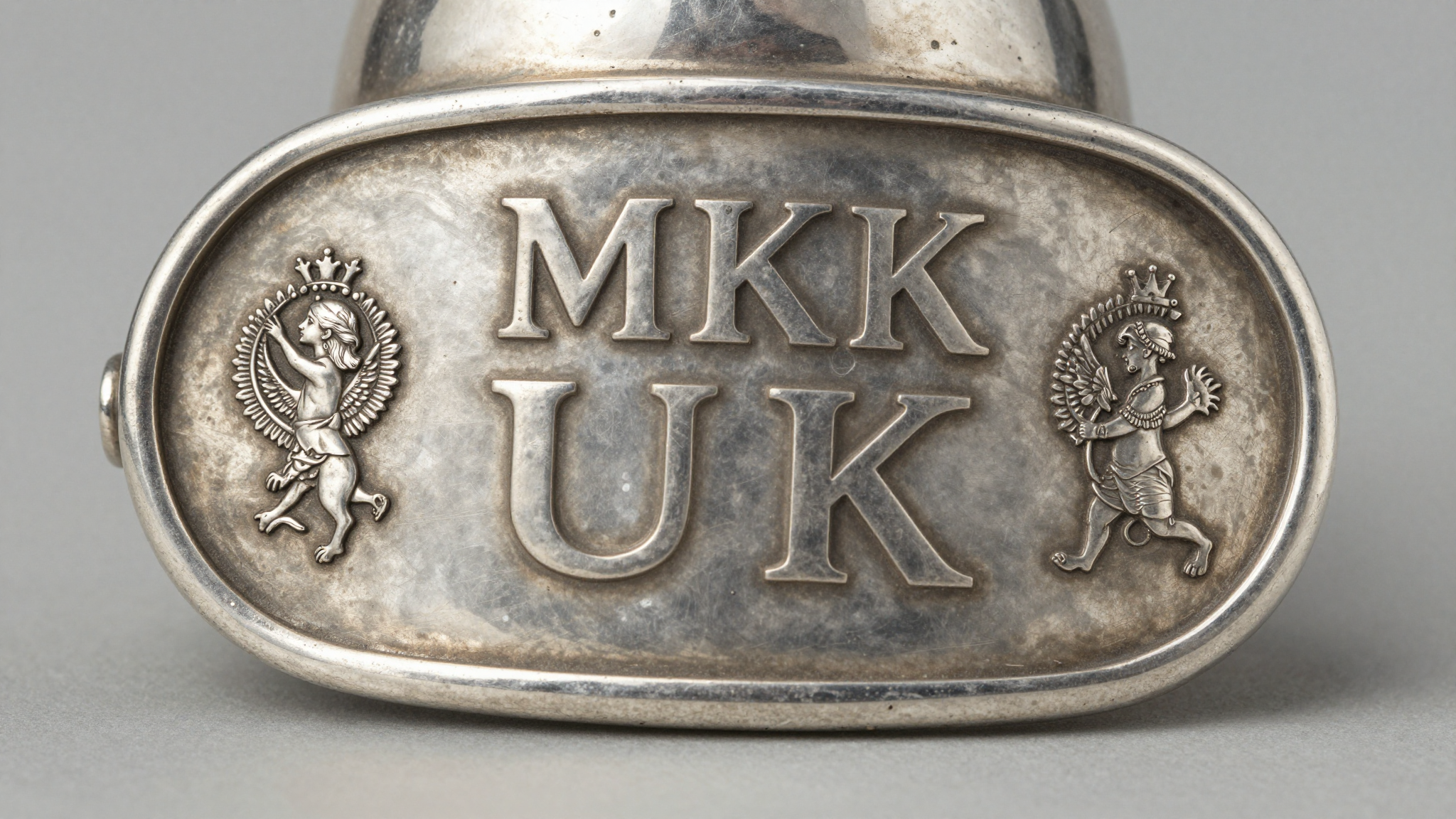
Silver makers marks UK collectors encounter on antique pieces are the single most direct link between a finished object and the craftsman who created it. Before an assay office stamped a Lion Passant or a date letter onto a piece of silver, the maker punched their own mark first — a legal requirement dating to 1363 that remains enforceable under the Hallmarking Act 1973. Reading these marks separates a confident collector from one who pays Georgian prices for a Victorian reproduction.
---
What Is a Silver Maker's Mark?
The Legal History of Maker's Marks in Britain
The compulsory registration of a maker's mark on British silver began with a statute of Edward III in 1363, which required every goldsmith to have a personal mark. At that early stage, symbols dominated — a bird, a fleur-de-lis, a hand — because literacy was limited. The system transformed significantly in 1696, when a new Act required all makers to destroy their existing punches and re-register with the first two letters of their surname. This created the familiar two-initial format that persisted through much of the 18th century.
Paul de Lamerie, arguably the most collectable English silversmith, registered his mark "LA" at Goldsmiths' Hall in 1712 under this very regulation. The Plate Offences Act 1772 tightened controls further, compelling makers to register separately at each assay office where they intended to submit work. Under the current Hallmarking Act 1973, the term shifted from "maker's mark" to sponsor's mark — acknowledging that the registered party might be a retailer, importer, or manufacturing firm rather than the individual craftsman.
How Maker's Marks Differ From Other Hallmark Components
A maker's mark identifies the person or business responsible for submitting the piece to assay. It does not guarantee who physically made the object. The other hallmark components — the standard mark (Lion Passant for sterling), the assay office mark, the date letter, and the optional fineness mark — speak to metal quality and testing. Only the maker's mark names the commercial or creative origin. A piece bearing "TP" in an oval alongside a Birmingham anchor tells you who sent it to be assayed, not who sat at the workbench. This distinction matters enormously when attributing pieces to named workshops versus individual craftsmen. For a full breakdown of all five components, see our guide to UK silver hallmarks.
---
Anatomy of a UK Silver Hallmark: Where the Maker's Mark Fits
The Five Standard UK Hallmark Components
A complete British hallmark from 1784 onwards typically contains five distinct strikes: the maker's/sponsor's mark, the standard mark, the assay office mark, the date letter, and — from 1784 to 1890 — the sovereign's head duty mark. Since 1999, an optional Common Control Mark for international recognition has also appeared on exported pieces. Each punch occupies a different cartouche pressed into the metal, and together they form a sequential narrative of who made it, what it is, and when and where it was tested.
Locating the Maker's Mark on Common Silver Objects
The maker's mark almost always appears first in the hallmark sequence, punched before submission to the assay office. On flatware, look at the back of the handle near the shoulder. On teapots and coffee pots, check the underside of the base. On silver boxes, the interior of the lid rim is the most common location. On candlesticks, examine the underside of the base. Small items like vinaigrettes and card cases frequently carry hallmarks on the interior base — sometimes requiring a 10× loupe to read clearly. Our silver hallmarks chart provides visual diagrams showing exact placement on 40 object types.
Cartouche Shapes and What They Indicate
The shield or cartouche shape surrounding a maker's mark can help date a piece before you've opened a single reference book. Shaped cartouches — pointed ovals, cusped shields, decorative lobed outlines — were common in the early 18th century. By the late Georgian period, plain rectangles and simple ovals dominated. Victorian makers favored rectangular punches with cut corners. After 1890, circular and oval cartouches became widespread. Cartouche shape alone is not definitive, but it provides a useful first filter when a date letter is worn or illegible.
---
How to Read and Decode a Silver Maker's Mark
Decoding Initials and Monograms
Most UK maker's marks after 1696 use two or three initials within a cartouche. Two-initial marks typically represent first name and surname — "WB" for William Bateman, for instance. Three-initial marks from the 19th century often indicate a partnership or company, such as "HW&Co" for Henry Wilkinson & Co of Sheffield. A single-letter mark generally suggests the piece predates 1696 or originates from a provincial center with different conventions. Crossed letters, superimposed initials, or initials combined with a device are more common in Scottish and Irish silver and require specialist Scottish or Dublin references.
Interpreting Symbols and Devices Alongside Initials
Many Georgian makers combined initials with a device — a small image above, below, or beside the letters. Hester Bateman's mark "HB" appeared with a pellet between the letters, distinguishing it from other HB registrations. The device served a practical purpose: differentiating makers who shared identical initials at the same office. By the mid-Victorian period, the proliferation of large silversmithing firms meant devices appeared less frequently, replaced by distinctive typography or company abbreviations.
Using Date Letters to Narrow Down a Maker
When a maker's mark is ambiguous, cross-reference it against the assay office date letter to narrow the possibilities. If a Birmingham anchor appears alongside a date letter cycle placing the piece in 1840–1849, you can eliminate any maker who registered before or after that window. Ian Pickford's Silver & Sheffield Plate Marks (Antique Collectors' Club) organizes makers chronologically by assay office precisely for this purpose, and it remains the standard desk reference for working dealers. I keep a copy within arm's reach at every viewing.
---
UK Assay Offices and Their Role in Registering Makers
London Goldsmiths' Company Records
The Goldsmiths' Company of London holds the most extensive archive of maker registrations in the UK, with records stretching back to the late 17th century. The register books at Goldsmiths' Hall, London EC2, include actual punched impressions of the registered mark alongside the maker's name, address, and registration date. These books are accessible to researchers by appointment and have been partially digitized, with selections published in Arthur Grimwade's London Goldsmiths 1697–1837: Their Marks and Lives — the primary reference for Georgian London silver.
Birmingham, Sheffield, Edinburgh, and Chester Assay Offices
Birmingham's assay office opened in 1773 following a petition led partly by Matthew Boulton, and its anchor mark quickly became associated with high-volume, quality commercial silverware. Sheffield, which also opened in 1773, used a crown mark until 1975. Edinburgh, operating since at least 1457, uses a castle mark and holds Scottish records predating the Act of Union. Chester's assay office, which closed in 1962, served the northwest of England and parts of Wales; its records transferred to the Chester City Archives.
How to Access Historic Assay Office Registers
| Assay Office | City | Active Since | Office Mark | Archive Access |
|---|---|---|---|---|
| London | London | c. 1300 | Leopard's head | Goldsmiths' Hall by appointment; Grimwade published reference |
| Birmingham | Birmingham | 1773 | Anchor | Birmingham Assay Office archive; online database partial |
| Sheffield | Sheffield | 1773 | Rose (from 1975; previously crown) | Sheffield Assay Office; some records at Sheffield City Archives |
| Edinburgh | Edinburgh | c. 1457 | Castle | National Records of Scotland; Edinburgh Assay Office |
| Chester | Chester (closed 1962) | c. 1686 | Three wheat sheaves and sword | Chester City Archives, Cheshire Archives |
| Dublin | Dublin | c. 1637 | Crowned harp | National Library of Ireland; Assay Office Dublin |
| Glasgow | Glasgow (closed 1964) | c. 1819 | Tree, fish, and bell | Glasgow City Archives; Mitchell Library |
Most Common UK Silver Makers Marks A–Z Lookup
Georgian Era Makers (1714–1837)
| Initials / Mark | Maker Name | Active Period | Assay Office | Common Pieces |
|---|---|---|---|---|
| PL / LA | Paul de Lamerie | 1712–1751 | London | Salvers, ewers, candlesticks |
| HB (pellet between) | Hester Bateman | 1774–1789 | London | Teaspoons, cream jugs, flatware |
| WB | William Bateman | 1815–1839 | London | Tea services, entrée dishes |
| PT | Paul Storr | 1792–1838 | London | Presentation plate, candelabra |
| MB / Boulton | Matthew Boulton | 1773–1809 | Birmingham | Candlesticks, wine coasters |
Victorian Era Makers (1837–1901)
| Initials / Mark | Maker Name | Active Period | Assay Office | Common Pieces |
|---|---|---|---|---|
| ER | Edward Barnard & Sons | 1829–1900s | London | Flatware, salvers, tea services |
| HW&Co | Henry Wilkinson & Co | 1836–1900 | Sheffield | Flatware, entrée dishes |
| E&Co / Elkington | Elkington & Co | 1840–1900 | Birmingham | Electroplate, presentation items |
| JS&S | Joseph & Sons (various) | 1850s–1900 | Sheffield | Cruet sets, fish servers |
| W&G / Mappin | Mappin & Webb | 1863–present | Sheffield/London | Tea services, cutlery |
Edwardian and 20th-Century Makers
| Initials / Mark | Maker Name | Active Period | Assay Office | Common Pieces |
|---|---|---|---|---|
| OB | Omar Ramsden | 1898–1939 | London | Arts & Crafts bowls, chalices |
| CJV | Charles James Vander | 1890–1930s | London | Card cases, vesta boxes |
| WN | William Neale & Son | 1900–1940s | Birmingham | Cigarette cases, small boxes |
| G&S Co | Goldsmiths & Silversmiths Co. | 1898–1952 | London | Presentation plate, flatware |
Step-by-Step: How to Identify Your Silver Maker's Mark
Tools You Need: Magnifier, UV Light, and Reference Books
A 10× jeweler's loupe is the minimum for reading hallmarks. A 15× loupe handles worn strikes more reliably — and strikes do wear. Pieces polished over decades can lose hallmark clarity to the point where initials become shallow grooves you feel more than see. UV light at 365nm reveals solder repairs and inserted patches around marks that indicate later alterations. For reference books, three volumes cover most UK needs: Grimwade for London Georgian, Pickford's Silver & Sheffield Plate Marks for a broad overview, and Frederick Bradbury's History of Old Sheffield Plate for Sheffield-specific work. Keep a copy of Jackson's English Goldsmiths and Their Marks for pre-1700 pieces.
Using Online Databases and the AntiqueSilverHallmarks.com Lookup Tool
The AntiqueSilverHallmarks.com lookup tool allows searches by initials, cartouche shape, assay office, and approximate date range across 500+ verified UK maker entries. To identify silver hallmarks accurately online, photograph the mark in raking light — a flashlight held at roughly a 20-degree angle to the surface — to maximize contrast in the struck impression. Upload the clearest image and cross-reference against at least two database sources before drawing a conclusion. A single match is a starting point, not a verdict.
When to Consult a Professional Appraiser
Seek a BADA-registered appraiser when a piece carries a mark attributed to a high-value maker — de Lamerie, Paul Storr, Omar Ramsden — when you're considering a purchase above £500, or when marks appear inconsistent with the style or weight of the object. An appraiser with specialist silver knowledge will cross-reference the maker's mark against period records, handle weight, construction technique, and decorative style simultaneously. No database does all of that.
---
Fake, Worn, and Transposed Marks: Avoiding Misidentification
Signs That a Maker's Mark Has Been Altered or Faked
Altered maker's marks most commonly involve erasing original initials with a drill and re-punching a more desirable mark — replacing a lesser maker's stamp with "PT" to suggest Paul Storr, for example. Under UV light, a disturbed area of metal shows as a brighter patch against the surrounding surface. Under raking light, the metal texture around a re-punched mark looks noticeably different — slightly rougher, with tool marks that don't match the patina elsewhere. Hallmarks struck after manufacture also sit at slightly different depths from marks struck on a pre-assembly sheet, because metal responds differently once the object has been worked and annealed. These aren't subtle differences once you know what you're looking for.
Legally Transposed Marks and What They Mean for Value
Legal transposition involves removing a complete, authentic hallmark panel from a worn or broken piece of silver and inserting it into a new, unhallmarked one — typically a larger object. This practice was common in the 19th and early 20th centuries and is not necessarily fraudulent when disclosed. A teapot lid bearing hallmarks inconsistent with the body's date letter is a classic sign. Check that the solder line around any inset panel matches the oxidation level of surrounding metal; fresh solder on an old piece stands out clearly under magnification. Transposed-mark pieces typically sell at a discount of 20–40% against fully original examples, because their legal status for onward sale as "hallmarked silver" is complicated under the Hallmarking Act 1973.
---
How Maker's Marks Affect Silver Value and Collectibility
High-Value Makers That Collectors Seek
Attribution to Paul Storr, Paul de Lamerie, Hester Bateman, or Omar Ramsden typically multiplies the value of a piece by a factor of three to ten compared with anonymous equivalents of identical weight and date. A Hester Bateman teaspoon might sell for £80–£150 at auction, while an identical spoon by an unknown maker of the same period commands £25–£40. Storr presentation pieces regularly exceed £50,000, with exceptional examples reaching six figures at major auction houses. The mark is doing a lot of work in that price gap.
Does an Unknown Maker's Mark Reduce Value?
An unidentified maker's mark does not automatically reduce value, particularly when the piece is of high quality or unusual form. The silver content, the quality of decoration, the rarity of the form, and the completeness of the hallmark sequence all contribute to value independently of maker attribution. Unidentified provincial marks — from centers such as Newcastle, Exeter, or Norwich — often carry a premium among specialist regional collectors precisely because of their rarity. An obscure mark on a well-made piece can be more interesting than a routine stamp from a known London workshop.
---
Frequently Asked Questions
What is a maker's mark on British silver?
A maker's mark on British silver is the registered punch of the person or business that submitted the piece to an assay office for testing and hallmarking. It typically consists of two or three initials within a shaped cartouche. The legal requirement for a maker's mark dates to 1363, making it the oldest compulsory component of the British hallmarking system. Under the Hallmarking Act 1973, the term was formally updated to "sponsor's mark" to reflect modern trade practices.
How do I identify a silver maker's mark in the UK?
Photograph the mark under raking light to maximize legibility, then cross-reference the initials, cartouche shape, and assay office mark against reference works such as Pickford's Silver & Sheffield Plate Marks or the AntiqueSilverHallmarks.com online database. The date letter narrows the identification window significantly — if a Birmingham anchor appears alongside a date letter placing the piece in the 1880s, only makers registered in Birmingham during that decade are viable candidates.
What is the difference between a maker's mark and a hallmark on silver?
A hallmark is the complete set of punched marks applied to a piece of silver after assay testing, and the maker's mark is one component within that set. The hallmark as a whole certifies metal standard, identifies the testing office, and records the year of assay. The maker's mark specifically names who submitted the piece. A piece can technically bear a hallmark without a legible maker's mark if that punch has worn away, though British law has required a maker's mark since 1363.
Which assay office registered the most silver makers marks in the UK?
London's Goldsmiths' Company registered the largest total number of UK silver maker entries, reflecting London's centuries-long dominance as the center of the trade. Arthur Grimwade's reference work documents over 3,000 London maker registrations from 1697 to 1837 alone. Birmingham's assay office, though founded only in 1773, rapidly accumulated a large register because of the city's role as a manufacturing hub for small silverware and eventually became one of the highest-volume assay offices in the world.
Are UK silver makers marks still required on silver today?
Yes. Under the Hallmarking Act 1973 and subsequent amendments, a sponsor's mark (the current legal term for maker's mark) remains a mandatory component of any hallmarked silver article sold in the UK. Any person or business wishing to submit silver for UK hallmarking must first register a sponsor's mark with one of the four active UK assay offices: London, Birmingham, Sheffield, or Edinburgh. The Edinburgh Assay Office's online registration portal has handled new sponsor mark applications since 2018.