Last updated: January 2026 | Author: Verified by a specialist in British and Scottish antique silver with 20+ years of hands-on identification experience. Corrections and additions welcome — contact us here.
---
Edinburgh silver hallmarks use a triple-towered castle as the town mark, making Scottish silver from Edinburgh immediately recognisable to any trained eye. This castle mark has appeared on Edinburgh silver since at least 1485, making it one of the oldest continuous hallmarking traditions in Britain. Whether you are buying at an estate sale, cataloguing inherited pieces, or dealing professionally, understanding every symbol on an Edinburgh-marked piece protects your investment and confirms authenticity. All five Edinburgh hallmark symbols are covered here, along with every date letter cycle from the 15th century to today, and direct comparisons with other UK assay offices.
---
What Are Edinburgh Silver Hallmarks?
Edinburgh silver hallmarks are a group of stamped symbols applied to silver objects at the Edinburgh Assay Office to certify metal purity, origin, and maker. Unlike a single stamp of approval, Edinburgh hallmarks work as a system — each mark performs a distinct legal and informational function. Together, they tell you where the piece was assayed, what silver standard it meets, who made it, and when it entered the market.
A Brief History of the Edinburgh Assay Office (1457–Present)
The Edinburgh Assay Office traces its legal origin to a 1457 Act of the Scottish Parliament under King James II, which required silversmiths to mark their wares with a town mark and a deacon's mark before sale. This makes Edinburgh's hallmarking system one of the earliest formally legislated in Britain — nearly a century before England's Goldsmiths' Company consolidated its own system. The office operated continuously through the Union of the Crowns in 1603 and the Acts of Union in 1707, retaining its distinct Scottish marks even as British hallmarking law became increasingly unified. Today, the Edinburgh Assay Office remains one of only four active UK assay offices, alongside London, Birmingham, and Sheffield.
Why Scottish Silver Uses Different Marks Than English Silver
Scotland maintained its own legal system after the 1707 Acts of Union, and hallmarking practice reflected that independence. While English silver adopted the Lion Passant as the primary standard mark in 1544, Scottish silver used the lion rampant — a heraldically distinct posture — to signal Scottish origin and legal compliance under Scots law. The town marks also differed: London used the leopard head, while Edinburgh used the castle. These distinctions were not merely decorative. They indicated which assay office held legal responsibility for the piece. Even after the UK Hallmarking Act 1973 standardised certain aspects of British hallmarking, Edinburgh retained its castle town mark and its lion rampant as a recognised standard mark.
---
The Five Edinburgh Hallmark Symbols Explained
A fully hallmarked Edinburgh silver piece carries up to five distinct stamps. Each one carries specific legal weight and provides key identification information. Knowing what each symbol looks like — and what it means — is the foundation of reading any Edinburgh-marked piece correctly.
The Castle Mark: Edinburgh's Town Mark
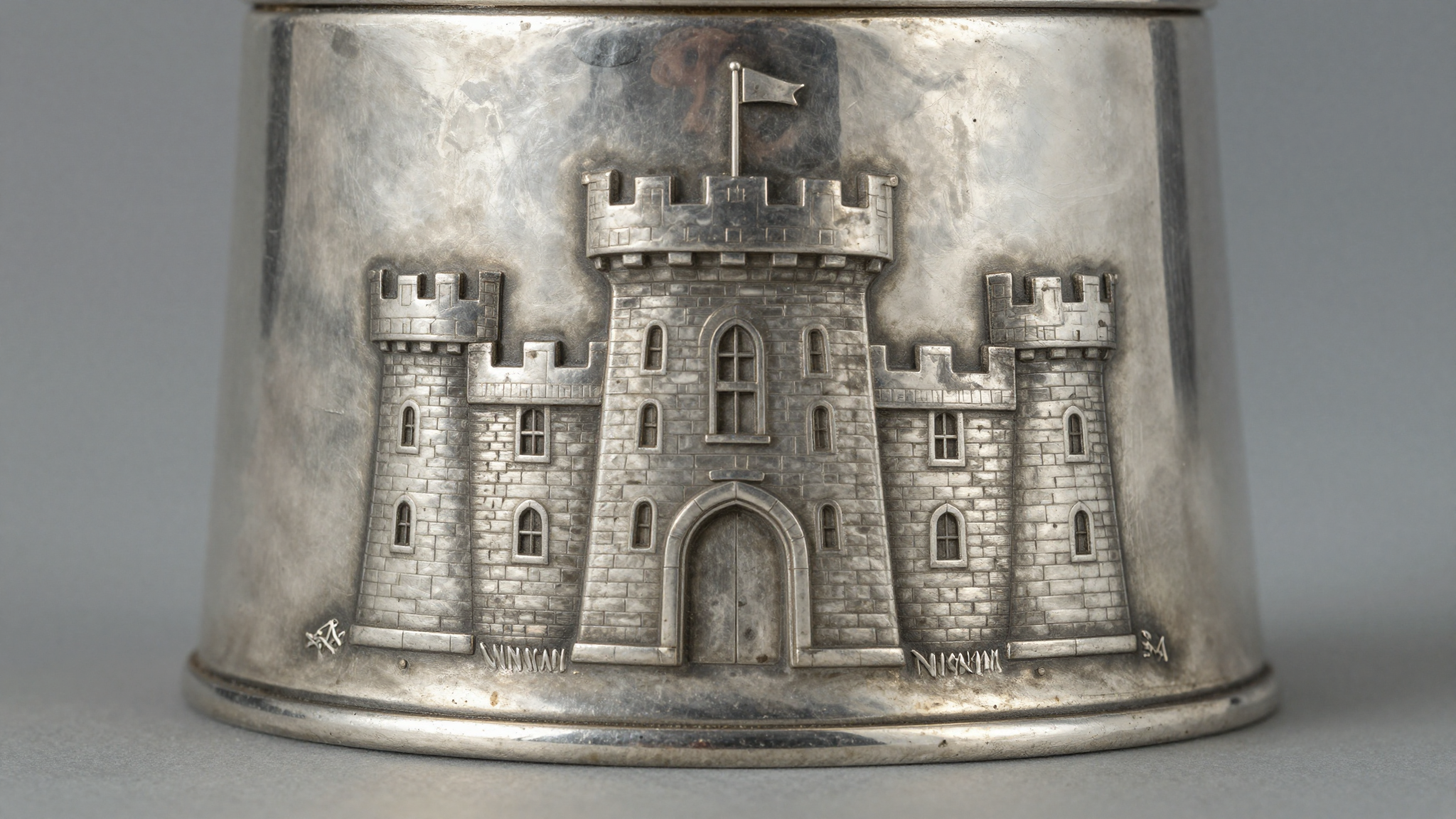
The Edinburgh castle mark depicts a three-towered fortress, derived from Edinburgh Castle itself. This is the assay office mark, confirming the piece was tested and approved in Edinburgh. The castle appears in a shield, and its exact style — the shape of the towers, the shield outline, and the engraving depth — changed across different periods. Pre-1700 examples often show a cruder, hand-punched castle with irregular tower heights, while 18th-century strikes are sharper and more uniform. When cross-referencing against UK silver hallmarks, the Edinburgh castle is never confused with the London leopard head, but it can catch out less experienced collectors alongside the Exeter castle mark — a different three-tower design used in England until 1882. The Exeter version is flatter, with towers that sit closer together; once you have seen both side by side, the difference is obvious.
The Lion Rampant: Scottish Silver Standard Mark
The lion rampant — a lion rearing on its hind legs, facing left with both forepaws raised — signals that the silver meets the required purity standard. On Edinburgh silver, this mark replaced earlier purity indicators in the late 17th century and confirmed sterling standard (92.5% pure silver). Do not confuse this with the English Lion Passant, which walks on four legs with one paw raised. The lion rampant appears on Scottish silver only, and its presence immediately tells you the piece was hallmarked in Scotland. Jackson's Silver and Gold Marks of England, Scotland and Ireland dedicates a full chapter to this distinction, noting that confusion between the two lion marks is the most common identification error among newer collectors.
The Thistle Mark and Its Role in Edinburgh Silver
The thistle was introduced as a standard mark for Edinburgh silver in 1759, replacing an earlier variable system of purity certification. After 1974, following the UK Hallmarking Act 1973, the thistle took on a cleaner symbolic role as Edinburgh's secondary identifying symbol, while the lion rampant retained its standard-mark status. Some pieces struck between 1759 and the early 20th century carry both the thistle and the lion rampant, which can cause confusion. The thistle itself is botanically specific — five petals, a rounded head, the characteristic spiky calyx — and should not be mistaken for the generic floral stamps occasionally applied by lesser workshops.
The Date Letter: How to Find the Year Your Piece Was Made
Edinburgh used alphabetical date letter cycles, changing one letter per year, to timestamp each piece at the point of assay. The style of the letter — Roman, italic, Gothic, script — combined with the shield shape identifies the specific cycle. A capital Roman "A" in a plain rectangular shield means something entirely different from a lower-case italic "a" in a shaped cartouche. The silver hallmarks chart provides visual references for letter styles across multiple assay offices. Edinburgh date letters ran in cycles of 25 letters (typically excluding J or Z), with each cycle lasting roughly 25 years.
The Maker's Mark: Identifying Edinburgh Silversmiths
The maker's mark — usually two or three initials punched into a shield or cartouche — identifies the individual craftsperson or firm who submitted the piece for assay. Edinburgh's Assay Office held registers of maker's marks, and many of these survive in the National Records of Scotland and in published reference works. The maker's mark is your most direct link to provenance and can significantly affect value. A piece bearing the mark of a documented Edinburgh silversmith like William Dempster or Patrick Robertson commands considerably more collector interest than an identical piece with an unidentified maker.
---
Edinburgh Silver Date Letter Cycles: Full Chart by Era
How Date Letter Cycles Work in Edinburgh
Edinburgh changed its date letter annually, and the cycle reset — starting again at "A" — roughly every 25 years. The key to correct dating is matching three variables simultaneously: the letter itself, the letter style (font), and the shield shape surrounding it. Any one variable alone is insufficient. The letter "D," for example, appears in at least 14 different Edinburgh date letter cycles across the centuries. Always use the identify silver hallmarks tool alongside a physical reference book for confirmation.
Key Changes to the Edinburgh Date Letter System Over the Centuries
Edinburgh's date letter system underwent structural changes at several documented points. The earliest cycles, from the late 15th century through the 16th, are inconsistently documented and many pieces from this period lack complete mark sets. The system became more regularised after 1681, when Edinburgh began using consistent annual letters. A significant reform came in 1759 with the introduction of the thistle mark. After the UK Hallmarking Act 1973 came into force on 1 January 1975, Edinburgh aligned its cycle structure more closely with other UK offices while retaining its distinct town mark.
| Date Letter Cycle | Years Covered | Letter Style | Shield Shape | Notable Features |
|---|---|---|---|---|
| Cycle 1 | c.1485–1560 | Irregular/Gothic | Variable | Inconsistent survival; deacon's mark present |
| Cycle 2 | c.1560–1637 | Roman capitals | Plain rectangle | Earliest documented annual changes |
| Cycle 3 | 1637–1681 | Roman/italic mixed | Shaped cartouche | Pre-standardisation era; some letters skipped |
| Cycle 4 | 1681–1705 | Roman uppercase | Rectangular shield | Thistle absent; lion rampant inconsistent |
| Cycle 5 | 1705–1730 | Roman uppercase | Plain oval | Post-Union marks; castle mark more uniform |
| Cycle 6 | 1730–1755 | Italic uppercase | Shield with cut corners | Thistle introduced mid-cycle (1759 reform) |
| Cycle 7 | 1759–1784 | Old English/Gothic | Shaped shield | Thistle fully integrated; cleaner strikes |
| Cycle 8 | 1784–1806 | Roman uppercase | Oval | Sovereign's head duty mark added 1784 |
| Cycle 9 | 1806–1832 | Roman lowercase | Shield-shaped | Duty mark continues; maker marks more precise |
| Cycle 10 | 1832–1857 | Script uppercase | Ornate cartouche | Victorian-era quality improvements |
| Cycle 11 | 1857–1882 | Block Roman uppercase | Plain rectangle | Industrialisation affects mark consistency |
| Cycle 12 | 1882–1906 | Italic lowercase | Shaped cartouche | Smaller, finer strikes on machine-made pieces |
| Cycle 13 | 1906–1931 | Roman uppercase | Shield | Edwardian/early 20th century |
| Cycle 14 | 1931–1956 | Roman uppercase | Shaped rectangle | Duty mark abolished 1890; five marks standard |
| Cycle 15 | 1956–1974 | Block lowercase | Plain rectangle | Pre-1975 reform era |
| Cycle 16 | 1975–present | Variable | Standardised shield | UK Hallmarking Act 1973 reforms applied |
How to Identify and Authenticate Edinburgh Silver Hallmarks
Step-by-Step Guide to Reading Edinburgh Hallmarks
Start by examining the piece under a 10x loupe in good raking light — hold the light source at a low angle so the stamped impressions cast shadows and the letterforms stand out clearly. Identify how many distinct stamp impressions appear and note their positions. Edinburgh silver is typically struck in a row or group on the underside of flatware or on the rim of hollow ware. First, locate the castle: this confirms Edinburgh origin. Second, find the lion rampant: this confirms silver standard. Third, read the date letter and match it against a dated cycle chart, noting both the letterform and the shield shape. Fourth, record the maker's mark initials for later database research. Fifth, check for any additional marks — a sovereign's head duty mark (1784–1890) or a coronation jubilee mark (1935, 1977, 2002, 2012, 2022) adds dating precision.
One practical note: pieces polished heavily over decades can lose hallmark clarity, particularly on high-relief surfaces like the castle's towers or the lion's raised forelegs. If the marks look worn rather than sharp, factor that into your dating confidence.
Common Fakes and Misidentified Marks to Watch Out For
The most persistent problem is transposed marks — genuine hallmarks removed from a damaged piece and let into another object. Look for uneven edges around the marks, traces of solder at the margins, or a slightly sunken panel suggesting the metal was worked after stamping. Sheffield plate and electroplate occasionally carry pseudo-hallmarks that superficially resemble assay office strikes but carry no legal status as hallmarks. The Exeter castle mark, used until 1882, trips up collectors who assume any castle mark must be Edinburgh. Exeter's castle lacks the three distinct towers of the Edinburgh version and sits in a different shield shape — but on a worn piece, the distinction can be less obvious than you'd expect.
If you are spending serious money, submit photographs to the Edinburgh Assay Office's enquiry service or work from Jackson's as your primary reference rather than relying on internet images alone.
Tools and Resources for Hallmark Identification
A quality 10x loupe is non-negotiable for reading date letters and maker's marks on small pieces. The standard reference text remains Jackson's Silver and Gold Marks of England, Scotland and Ireland (multiple editions; the 1989 Dover reprint remains widely available and sits on the desk of most serious dealers). Online, the Goldsmiths' Company's database and the Edinburgh Assay Office's official website both provide searchable hallmark records. The methodology used in this guide cross-references Jackson's published cycle charts against the Edinburgh Assay Office's own published records and the National Records of Scotland's deacon mark registers.
---
Edinburgh vs Other UK Assay Offices: Key Differences
Edinburgh Castle Mark vs London Leopard Head
London's leopard head — a crowned feline face in profile — has appeared on London silver since around 1300, making it the oldest assay mark in Britain. Edinburgh's castle mark is younger by roughly 185 years but has been equally consistent. The leopard head confirms London assay; the castle confirms Edinburgh assay. Both marks appear in a shield, but the imagery is unmistakable once you have handled a few pieces from each office. London also uses the Lion Passant as its standard mark, not the lion rampant — an important distinguishing feature when a piece carries only partial marks.
Edinburgh vs Glasgow: Scottish Silver Hallmarks Compared
Glasgow operated its own assay office from 1819 to 1964. Glasgow silver uses a tree, fish, and bell as its town mark — the arms of the city of Glasgow — rather than a castle. Glasgow also used the lion rampant as its standard mark, so that symbol alone cannot tell you whether a piece is Edinburgh or Glasgow silver. The date letter system differed between the two offices in letter style and cycle start dates. Since Glasgow's assay office closed in 1964, all Scottish silver submitted for assay since then has been tested in Edinburgh.
How UK Hallmarking Law Standardised Marks After 1975
The UK Hallmarking Act 1973 came into force on 1 January 1975, replacing a complex patchwork of legislation and standardising the compulsory marks across all UK assay offices. Under the Act, every hallmarked piece must carry a maker's mark, a standard mark (indicating metal and fineness), and an assay office mark. The date letter became optional from 1999, though Edinburgh and the other offices have continued to use it voluntarily. The Act also introduced fineness marks expressed as millesimal figures — 925 for sterling, 800 for lower-grade silver — as an alternative to traditional symbols.
| Assay Office | Town Mark | Standard Mark | Active Since | Still Operating |
|---|---|---|---|---|
| Edinburgh | Triple-towered castle | Lion rampant | 1457 | Yes |
| London | Leopard head | Lion Passant | c.1300 | Yes |
| Birmingham | Anchor | Lion Passant | 1773 | Yes |
| Sheffield | Rose (now Yorkshire rose) | Lion Passant | 1773 | Yes |
| Glasgow | Tree, fish, and bell | Lion rampant | 1819 | No (closed 1964) |
| Chester | Three wheat sheaves and sword | Lion Passant | 1701 | No (closed 1962) |
| Exeter | Three-towered castle | Lion Passant | 1701 | No (closed 1883) |
| York | Cross with five lions passant | Lion Passant | c.1423 | No (closed 1858) |
Famous Edinburgh Silversmiths and Their Maker's Marks
Notable Edinburgh Makers from the 18th and 19th Centuries
Edinburgh produced silversmiths whose work is actively sought by collectors today. William Dempster (active c.1740–1770) produced domestic flatware and hollow ware of consistently high quality, and his mark — "WD" in a rectangular cartouche — appears regularly at Scottish auction houses. Patrick Robertson (active c.1751–1790) is known for his teapots and coffeepots in the rococo style; pieces bearing his mark have sold at Lyon & Turnbull for several thousand pounds. James McKay (active c.1795–1830) worked extensively in the neoclassical style and supplied Edinburgh's professional class with high-quality table silver. Marshall & Sons, trading from the mid-19th century, became one of Edinburgh's most commercially significant retailers, and their mark appears on a wide range of Victorian-era pieces.
The Edinburgh-based firm of Hamilton & Inches, established in 1866 and still trading on George Street, holds a particularly important place in the historical record. Their archive of design drawings and assay records survives largely intact and has been used by researchers to verify attribution on disputed pieces — the kind of primary documentation that changes an auction estimate.
How to Search Edinburgh Maker's Marks in Online Databases
The most reliable online resource for Edinburgh maker's marks is the database maintained through the National Records of Scotland, which holds the Edinburgh Assay Office's historical registers. Jackson's Silver and Gold Marks remains the definitive printed reference and includes plates of maker's marks arranged alphabetically by initials. For 20th-century makers, the Edinburgh Assay Office itself can confirm mark registrations. When searching online, use the maker's initials plus the approximate date range as search terms — generic searches for "Edinburgh silversmith marks" produce too many unverified results to be useful.
---
Buying and Valuing Edinburgh Silver: What Collectors Need to Know
How Hallmarks Affect the Value of Edinburgh Silver
Hallmarks directly affect value because they provide provenance certainty. A fully marked Edinburgh silver teapot — castle, lion rampant, thistle, date letter, and identified maker — will consistently outperform an identically styled piece with absent or rubbed marks at auction. The maker's mark carries the most significant premium: pieces by documented 18th-century Edinburgh silversmiths routinely sell at 30–60% above base melt value, while pieces by notable makers like Patrick Robertson can sell at multiples of melt value. Conversely, pieces with transposed or suspicious marks trade at a discount because their legal status as genuine antiques is uncertain. Always ask for provenance documentation alongside the physical marks.
Where to Buy Authenticated Edinburgh Antique Silver
Edinburgh silver appears regularly at Scottish auction houses including Lyon & Turnbull and Bonhams Edinburgh, both of which employ specialist cataloguers who verify hallmarks before listing. The Edinburgh Silver Shop and several specialist dealers on Thistle Street stock authenticated pieces with full hallmark descriptions. When buying online, require high-resolution close-up photographs of every hallmark before bidding — if a seller cannot or will not provide them, walk away. Reputable dealers will also provide a copy of the Jackson's entry for the relevant date letter cycle. Estate sales in Scotland remain a productive source for Edinburgh silver, but condition issues and misidentified marks are common in that setting, and verification before purchase is not optional.
---
Frequently Asked Questions
What does the castle mark on Edinburgh silver mean?
The castle mark on Edinburgh silver is the assay office mark, identifying that the piece was tested and approved by the Edinburgh Assay Office. It depicts Edinburgh Castle's characteristic three-towered profile. This mark has appeared on Edinburgh silver since at least 1485, making it one of the oldest continuously used hallmarks in Britain. The castle does not indicate silver purity — that function belongs to the lion rampant — but it is the first mark collectors use to confirm Scottish Edinburgh origin.
How do I read Edinburgh silver hallmarks?
Read Edinburgh silver hallmarks as a group, not individually. Locate the castle mark first to confirm Edinburgh assay, then find the lion rampant to confirm sterling standard. Next, read the date letter — match both the letter and its font style to a published cycle chart, because the same letter appears in multiple cycles across different centuries. Record the maker's mark initials for separate database research. A fully marked piece will show all five symbols, and reading them together gives you origin, standard, year, and maker in a single examination.
When did the Edinburgh Assay Office start hallmarking silver?
The Edinburgh Assay Office traces its formal legal origin to a 1457 Act of the Scottish Parliament, making it active for over 565 years. The earliest surviving marked pieces date to around 1485, and the documentation of individual annual date letters becomes consistent only from 1681. The office has operated continuously since its foundation, surviving the Acts of Union in 1707 and the major UK hallmarking law reforms of 1973 and 1975.
What is the difference between the Edinburgh castle mark and the London leopard head?
The Edinburgh castle mark shows a three-towered fortress derived from Edinburgh Castle, while the London leopard head shows a crowned feline face in profile. Both appear in a shield stamp, but the imagery is entirely different. London's mark dates to around 1300; Edinburgh's to around 1485. The standard marks also differ: Edinburgh uses the lion rampant, while London uses the Lion Passant. A piece carrying both a castle and a lion rampant is definitively Scottish Edinburgh silver; a piece with a leopard head and Lion Passant is London silver.
How do I identify the date of an Edinburgh silver piece using date letters?
Match the date letter to a published cycle chart by checking three variables simultaneously: the letter itself, the letterform or font style (Roman, italic, Gothic, script), and the shape of the shield enclosing it. The letter "B," for example, appears in over a dozen Edinburgh cycles spanning more than 500 years, so font and shield shape are essential to correct dating. Jackson's Silver and Gold Marks of England, Scotland and Ireland provides illustrated plates for every cycle. For pieces dated after 1975, the Edinburgh Assay Office's website lists current and recent cycles directly.
---