Last updated: January 2026 | Reviewed by the AntiqueSilverHallmarks.com Editorial Team
---
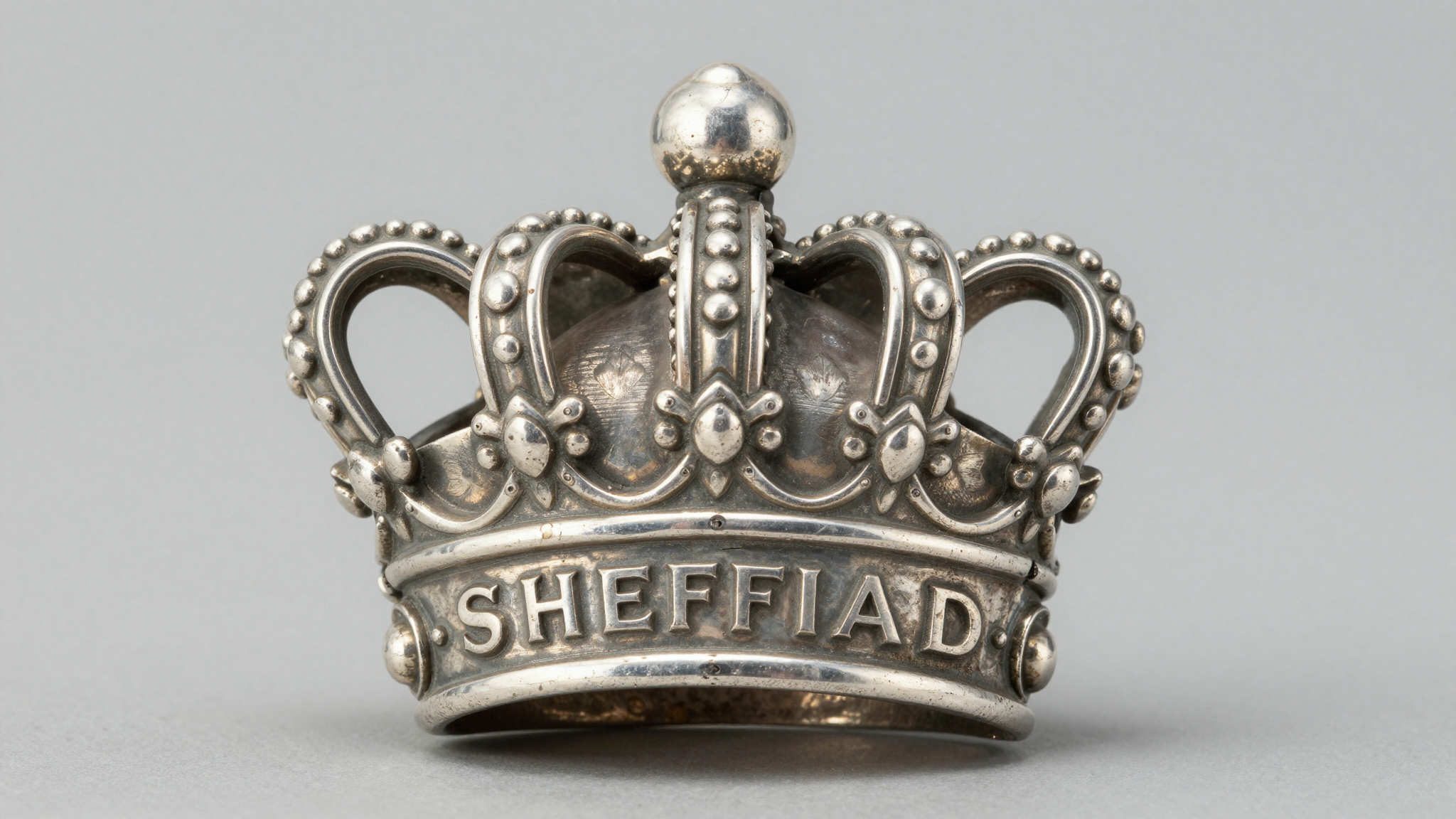
Sheffield silver hallmarks use a crown as their unique assay office mark — one of the most recognisable symbols in British silver collecting and a reliable shortcut to dating and authenticating any piece that bears it. Whether you just inherited a set of Sheffield-marked flatware, picked up a tea service at an estate sale, or actively deal in antique silver, understanding the crown mark and the four other compulsory hallmarks that surround it is the fastest route to accurate attribution and fair valuation.
---
What Is the Sheffield Crown Mark and Why Does It Matter?
The History of the Sheffield Assay Office (1773–2008)
The Sheffield Assay Office opened in 1773 following the passage of the Sheffield and Birmingham Assay Offices Act of that year — the same legislation that simultaneously established the Birmingham Assay Office. Before 1773, Sheffield silversmiths had to send their work to London, Chester, or York for hallmarking, a costly process that disadvantaged one of England's most productive metalworking centres. Parliament's recognition of Sheffield's industrial importance changed everything.
From 1773 until its closure in 2008, the Sheffield Assay Office struck hallmarks on hundreds of millions of silver and gold items. Its peak years coincided with the Victorian and Edwardian silver booms, when Sheffield factories produced enormous quantities of domestic silverware — cutlery, candlesticks, toast racks, and dressing table sets — for both the British middle class and export markets worldwide.
Why Sheffield Chose the Crown as Its Town Mark
Sheffield selected the crown as its assay office mark in 1773, and the choice likely reflected civic pride rather than any royal grant of arms. The crown symbol was practical — bold, instantly recognisable at small scales, and easy to punch cleanly into silver. Unlike Birmingham's anchor, which some historians argue was chosen almost arbitrarily on the day of the founding meeting, Sheffield's crown has roots in the town's own heraldic tradition.
The crown remained Sheffield's assay office mark unchanged for the entire 235 years the office operated. This consistency makes it one of the more straightforward marks to learn: if you see a crown in a shield alongside a Lion Passant and a date letter, you are almost certainly holding Sheffield silver.
What Happened After the Sheffield Assay Office Closed in 2008
Sheffield's assay office closed on 31 March 2008, a casualty of falling demand for hallmarking services as British silver manufacturing contracted sharply in the late twentieth century. Items submitted for assay from Sheffield's remaining silversmiths transferred to the Birmingham Assay Office, which continues to operate today. The Birmingham Assay Office also acquired some of Sheffield's historical records, making it an important resource for researchers tracing maker's marks registered after 1900. Any piece bearing the Sheffield crown was hallmarked before April 2008 — a useful authentication baseline.
---
How to Identify All Five Compulsory Sheffield Silver Hallmarks
The Maker's Mark: Identifying the Silversmith
The maker's mark — also called the sponsor's mark — appears as two or more letters punched inside a shaped shield. It identifies the individual silversmith or manufacturing company that submitted the piece for assay. Sheffield had thousands of registered makers over its 235-year history. Major marks to know include those of Walker & Hall (W&H), Mappin & Webb (M&W), and James Dixon & Sons (JD&S). Bradbury's Book of Hallmarks, the standard collector's reference through multiple editions, contains an extensive Sheffield maker's mark register. The maker's mark is always struck first, before the piece travels to the assay office.
The Standard Mark: Lion Passant and Sterling Confirmation
The Lion Passant — a lion walking to the left with one forepaw raised — confirms the piece meets the 92.5% sterling silver standard. Sheffield used the identical Lion Passant as London, Birmingham, and other UK offices, so the lion alone cannot tell you where a piece was assayed. The mark has appeared on British sterling silver continuously since 1544, making it the oldest surviving hallmark in regular use. Always look for the Lion Passant in combination with the crown to confirm Sheffield origin. For a broader overview of how this mark functions across all UK offices, see our guide to UK silver hallmarks.
The Assay Office Mark: Sheffield's Crown Symbol
The Sheffield crown appears as a simple heraldic crown — typically five points — struck inside a shaped shield. The shield itself changed across different date letter cycles, which helps with dating when the date letter is worn or partially obscured. Early Sheffield crowns from the 1770s and 1780s tend to sit in a fairly square shield; later Victorian and Edwardian strikes used more elaborate cut-corner or ornate shield shapes. Under a loupe, the crown's five points are usually crisp even on pieces that have seen heavy use. The Sheffield silver crown symbol is your single most important identifier when attributing a piece to Sheffield rather than any other UK assay office.
The Date Letter: Cracking Sheffield's Alphabetical Cycle
Sheffield used an alphabetical date letter system running from A to Z (or a truncated sequence), with each letter representing one assay year. Sheffield's cycles did not align with London's, and the office used different typefaces and shield shapes across successive cycles. Collectors must cross-reference letter style and shield shape together rather than relying on the letter alone. The full reference table below provides cycle-by-cycle detail. For a visual comparison of date letters across all UK offices, the silver hallmarks chart on this site is an essential companion resource.
The Optional Commemorative and Import Marks
Beyond the four compulsory marks, Sheffield silver may carry additional voluntary or circumstantial marks. Duty marks — a monarch's head — appeared between 1784 and 1890, confirming that excise duty had been paid. Their presence is therefore useful for dating pieces to that window. Commemorative marks, such as those struck for the Silver Jubilees of 1935 and 1977 and the Golden Jubilee of 2002, are optional but common on pieces made in those years. Import marks, featuring the letter F in a shield alongside the standard hallmarks, appear on foreign silver submitted to Sheffield for assay.
---
Sheffield Silver Date Letter Cycles: Full Reference Table
How Sheffield Date Letter Cycles Differed from London and Birmingham
London's date letter cycles have run from May to April since 1697. Sheffield's assay year ran from a different calendar date — generally in the summer months, varying slightly across cycles. This means a piece marked with the same letter as a London piece may have been made in a different calendar year. Birmingham and Sheffield date letter sequences also used different typefaces for identical letters in overlapping periods. Consulting a Sheffield-specific reference like Bradbury's Book of Hallmarks matters more here than reaching for a generic British silver guide. I've watched dealers argue themselves into a wrong decade by using the London tables for a Sheffield piece — it happens more often than it should.
| Date Letter Cycle | Years Covered | Shield Shape | Letter Style | Notable Changes |
|---|---|---|---|---|
| First Cycle (A–Z) | 1773–1798 | Plain rectangle | Roman capitals | Office established; 25 letters used |
| Second Cycle (A–Z) | 1799–1823 | Oval | Roman capitals | Duty mark added 1784, still in use |
| Third Cycle (A–Z) | 1824–1843 | Square with cut corners | Old English | Shorter cycle; only 20 letters |
| Fourth Cycle (A–Z) | 1844–1868 | Shield-shaped | Roman capitals | Victorian manufacturing peak begins |
| Fifth Cycle (A–Z) | 1868–1893 | Shaped with ornate top | Italic | Electroplate threatens sterling output |
| Sixth Cycle (A–U) | 1893–1918 | Plain oval | Roman script | Duty mark abolished 1890 |
| Seventh Cycle (A–Z) | 1918–1943 | Square with cut corners | Block capitals | WWI disruption affects early letters |
| Eighth Cycle (A–Z) | 1943–1968 | Shaped shield | Roman capitals | Post-WWII recovery; export drive |
| Ninth Cycle (A–Z) | 1968–1993 | Rectangular | Roman capitals | Hallmarking Act 1973 standardises marks |
| Final Cycle (A–N) | 1993–2008 | Rectangular | Roman capitals | Office closes March 2008 |
Tips for Reading Worn or Partial Date Letters on Antique Pieces
Worn Sheffield date letters present a genuine identification challenge, particularly on flatware where decades of polishing can reduce a crisp struck letter to a faint shadow in the silver. Start with the shield shape — it survives heavy wear better than letterforms because it occupies more surface area. Then look at whether the letter appears to be upper or lower case, serif or sans-serif. Even a partial letter narrows the possibilities to two or three cycles. A loupe of at least 10× magnification under raking light — a strong beam held at a low angle to the surface, so the shadows pool inside the punch marks — will often reveal enough detail for a positive identification. Pieces polished over decades can lose hallmark clarity to the point where only the shield outline remains; in those cases, the step-by-step photography techniques in the identify silver hallmarks guide on this site are worth working through before giving up on a date.
---
Sheffield Hallmarks vs Other UK Assay Offices: Key Differences
Sheffield Crown vs Birmingham Anchor: Side-by-Side Comparison
The Birmingham Assay Office, established by the same 1773 Act as Sheffield, uses an anchor as its town mark. The two symbols are sometimes confused by new collectors, particularly on worn pieces where the strike is faint. A crown has vertical symmetry and typically five visible upward-pointing points. An anchor has a horizontal crossbar and a curved base. Both marks appear in shields, but the shapes differ between offices. On a worn piece, check whether the central element points upward (crown) or has that characteristic horizontal bar with a curved lower hook (anchor). Once you've held both side by side under a loupe, you won't mix them up again.
Sheffield vs London Leopard Head Mark
London's assay office mark is a leopard's head — shown without a crown from 1821 onward. Confusing it with Sheffield's crown is less common but does appear in loosely described auction catalogue entries. The leopard's head shows a face in full, not a heraldic crown, so under magnification the distinction is immediate. London has been operating since the late thirteenth century; Sheffield started in 1773. That 500-year gap in operating history is reflected in the sheer volume of London-marked pieces on the market, which sometimes leads sellers to assume London by default.
Common Misidentifications and How to Avoid Them
| Assay Office | Town Mark | Active Period | Shield Style | Typical Items Marked |
|---|---|---|---|---|
| Sheffield | Crown | 1773–2008 | Varied by cycle | Flatware, tea services, candlesticks |
| Birmingham | Anchor | 1773–present | Rectangular/oval | Small items, buckles, flatware |
| London | Leopard's head | c.1300–present | Shaped shield | Holloware, flatware, jewellery |
| Edinburgh | Castle | 1457–present | Shaped shield | Flatware, holloware |
| Chester | Three wheatsheaves and sword | 1701–1962 | Shield-shaped | Small items, jewellery |
| Dublin | Crowned harp | 1637–present | Shaped shield | Holloware, flatware |
Sheffield Plate: How It Differs from Hallmarked Sheffield Silver
What Is Sheffield Plate and Why It Has No Hallmarks
Sheffield plate is a fused metal product, not sterling silver, and it carries no hallmarks from the Sheffield Assay Office. Invented around 1742 by Thomas Boulsover, Sheffield plate consists of a copper core bonded to thin sheets of silver by heat and pressure. Because it is not solid silver, the Hallmarking Acts never required it to be assayed. Sheffield plate pieces carry no assay office marks at all, though manufacturers developed their own trade marks over time.
Marks Found on Sheffield Plate and How to Spot Them
From around 1784, Sheffield plate makers used their own registered marks — typically the maker's name, a symbol, and sometimes the word "Sheffield" or a mock hallmark sequence designed to suggest, without legally claiming, silver content. Parliament eventually cracked down on the most deceptive imitations, but many legitimate Sheffield plate marks look superficially similar to hallmarks at first glance. The key differences are consistent: Sheffield plate marks lack the Lion Passant and any date letter. Any mark reading "EPNS" (electroplated nickel silver) or "A1" identifies a later electroplate product, not silver.
Value Implications: Sheffield Plate vs Sterling Silver
At auction, a well-preserved piece of early Sheffield plate — particularly pre-1840, before electroplating rendered it commercially obsolete — commands serious collector interest and can fetch hundreds or even thousands of pounds depending on maker and form. Comparable sterling silver hallmarked pieces typically sell for two to five times more by weight equivalent, because sterling holds intrinsic melt value that Sheffield plate does not. When buying at estate sales, always verify the full hallmark set before paying sterling prices. A candlestick that looks silver and weighs right can still be plate — and the difference matters considerably at the point of resale.
---
Step-by-Step Guide to Dating Your Sheffield Silver Piece
Tools You Need to Read Faint Hallmarks
A 10× jeweller's loupe is the minimum for reliable hallmark reading. A 20× loupe improves resolution on worn strikes. Raking light — a bright LED torch held almost parallel to the silver surface — throws faint impressed marks into sharp relief by creating shadow within the punch marks. Avoid overhead lighting, which flattens all the detail you need to see. For photography, a macro lens with a ring flash produces images clear enough to compare directly against reference books.
Using the Date Letter Table to Pinpoint the Year
Work systematically. Identify the assay office mark first — the Sheffield silver hallmarks crown confirms Sheffield. Locate the Lion Passant to confirm sterling. Then turn to the date letter. Match both the letter's style and the surrounding shield shape to the cycle table above. Each cycle covers roughly 20–25 years, so matching style and letter reduces your date range to a single year in most cases. If the date letter is only partially legible, cross-reference with the shield shape and any duty mark (present only on pre-1890 pieces) to narrow the window further.
When to Consult a Professional Appraiser
If a piece appears to carry a full set of Sheffield assay office hallmarks but the maker's mark is unfamiliar, or if you are considering a purchase above £500, a professional appraisal is worth the cost. Seek out an Antique Plate Committee-approved valuer or a specialist auction house — Christie's, Bonhams, or a dedicated silver specialist. The British Hallmarking Council can also direct you to a registered assay office when a mark's authenticity is genuinely in question. When money is on the table, an hour with the right expert is cheap insurance.
---
Frequently Asked Questions
What does the crown mark on Sheffield silver mean?
The crown mark on Sheffield silver identifies the Sheffield Assay Office as the testing and marking authority for that piece. It does not indicate royal ownership or manufacture for royalty. Sheffield adopted the crown as its town mark when the office opened in 1773 and used it continuously until the office closed on 31 March 2008. The Sheffield silver crown symbol works alongside the Lion Passant (sterling standard) and date letter to form a complete authentication record.
When did Sheffield Assay Office start and stop hallmarking silver?
The Sheffield Assay Office began hallmarking silver in 1773 following the Sheffield and Birmingham Assay Offices Act of that year. It closed on 31 March 2008, giving it a 235-year operating history. Any piece bearing the Sheffield crown mark was assayed between those two dates. Makers previously registered with Sheffield transferred their assay work to the Birmingham Assay Office after the closure.
How do I read the date letter on Sheffield silver hallmarks?
Identify the letter's typeface (Roman, Old English, italic, block capitals) and the shape of the shield surrounding it, then match both against a Sheffield-specific date letter table such as the one in this guide or in Bradbury's Book of Hallmarks. Sheffield's assay year did not align with London's calendar, so use only Sheffield-specific references. A 10× loupe under raking light will reveal letter details even on worn pieces. Narrowing to the correct cycle usually produces a dating accuracy of within two or three years even from partial letters.
What is the difference between Sheffield plate and Sheffield hallmarked silver?
Sheffield plate is a copper-core product bonded with silver sheets, invented around 1742, and it carries no hallmarks from the Sheffield Assay Office because it is not solid sterling silver. Hallmarked Sheffield silver is 92.5% pure silver, tested and stamped by the assay office with a full set of marks including the crown, Lion Passant, date letter, and maker's mark. Sheffield plate items may carry maker's trade marks or mock marks, but they lack the Lion Passant and any genuine assay office stamp.
How many marks appear on a fully hallmarked piece of Sheffield silver?
A fully hallmarked Sheffield silver piece carries at least four marks: the maker's mark, the Lion Passant (sterling standard), the Sheffield crown (assay office), and a date letter. Pieces made between 1784 and 1890 also carry a duty mark (monarch's head), bringing the total to five. Optional commemorative marks for events such as the 1935 or 1977 Silver Jubilees may appear as a sixth mark. Import marks appear on foreign silver submitted to Sheffield for hallmarking, replacing the standard maker's mark format with a different configuration.