Last updated: January 2026 | Written by the AntiqueSilverHallmarks.com research team, specialists in British silver plate history and Victorian-era metalwork
Disclaimer: EPNS pieces are silver-plated base metal and carry no official assay office hallmarks. They are not sterling silver and should not be valued or authenticated as such.
---
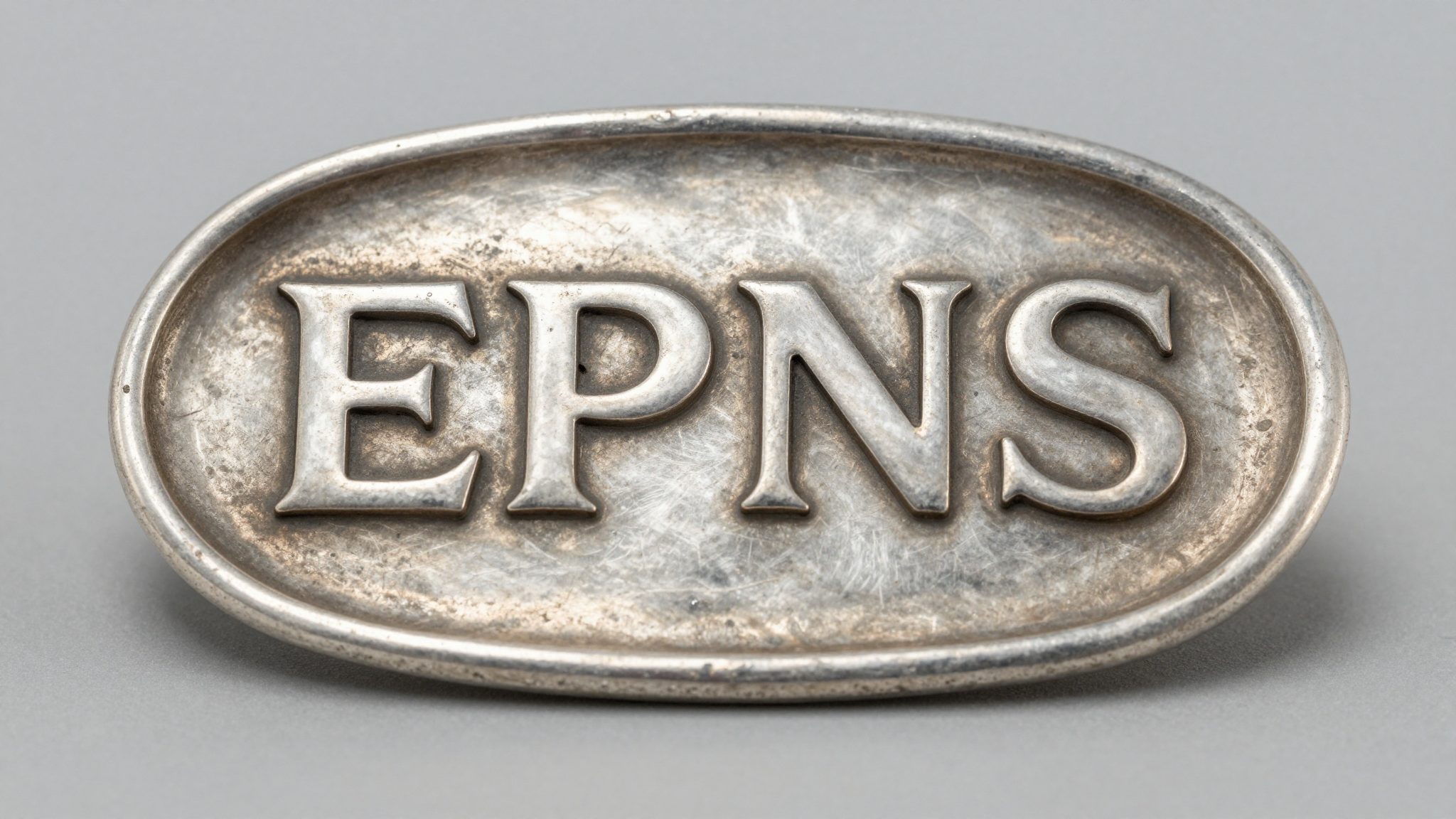
EPNS silver plated marks identification is the first skill every antique buyer needs before spending money on Victorian-era silverware. The letters EPNS — stamped into the back of a soup ladle, pressed onto the base of a teapot, or engraved into the underside of a serving tray — tell you immediately that you are holding electroplated nickel silver, not solid sterling. Knowing what those letters mean, and reading every mark that surrounds them, separates an informed purchase from an expensive mistake.
---
What Is EPNS? Understanding the Mark
The Full Meaning of EPNS: Electro Plated Nickel Silver
EPNS stands for Electro Plated Nickel Silver. Each word carries specific technical meaning. "Electro Plated" describes the manufacturing process: a thin layer of pure silver deposited onto a base metal through an electrochemical bath. "Nickel Silver" identifies that base metal — an alloy of copper, zinc, and nickel that contains no silver whatsoever despite its name. Manufacturers chose nickel silver because it polishes to a bright, silver-like surface, accepts electroplated coatings cleanly, and resists tarnish better than cheaper brass or britannia metal alternatives.
The stamp itself appears in several forms across different manufacturers and periods: EPNS, E.P.N.S., or occasionally as part of a longer mark such as EPNS A1 or EPNS WMF. Each variation carries additional information about plating quality and base metal composition that experienced collectors learn to read at a glance.
How Electroplating Changed Silverware from 1840
George Elkington of Birmingham patented the electroplating process in 1840, fundamentally changing who could afford silver-looking tableware. Before 1840, households wanting decorative silverware had two options: buy genuine sterling silver at considerable expense, or purchase Sheffield Plate — a mechanical sandwich of silver and copper that craftsmen had produced since the 1740s. Elkington's patent made quality silver-finished goods accessible to the Victorian middle class for the first time.
By the 1850s, factories in Sheffield and Birmingham were producing EPNS cutlery, tea services, and decorative pieces at industrial scale. Companies like Walker and Hall, James Dixon and Sons, and Mappin and Webb built entire businesses around the process. Sheffield alone became home to dozens of electroplating workshops by 1870, cementing the city's identity as the global centre of silver plate production. The EPNS industry peaked during the Edwardian era (1901–1910), when elaborate tea services and cutlery sets appeared in virtually every middle-class home in Britain.
Why EPNS Pieces Never Carry Official Hallmarks
The British assay office system — which you can explore in detail on our UK silver hallmarks page — exists specifically to guarantee the precious metal content of solid silver and gold items. EPNS pieces carry no guaranteed silver content beyond a thin surface layer, so they fall entirely outside the Hallmarking Act 1973 and its predecessors. The Sheffield Assay Office and Birmingham Assay Office never touched these items.
This legal distinction matters practically. When you see a Lion Passant, date letter, or assay office mark on a piece, that piece is hallmarked sterling silver. When you see only EPNS, A1, and a maker's stamp, no government body has certified anything. The manufacturer self-declared the quality grade. That self-declaration is useful, but it is not a legal guarantee.
---
How to Identify EPNS Marks on Your Silverware
Where to Look: Common Locations of EPNS Stamps
EPNS stamps appear in consistent locations across different categories of silverware. On cutlery — knives, forks, and spoons — check the back of the handle near the join with the blade or tines. On teapots and coffee pots, look on the flat base or near the hinge of the lid. On serving trays and salvers, the marks concentrate in the centre of the base or along one edge. On cruet sets and condiment pieces, examine the base of each individual component.
The stamps are applied by die-stamping during manufacture, leaving crisp impressions in the metal. Victorian-era marks from the 1860s–1890s tend to be deep and clearly defined — you can feel the edges with a fingernail. Edwardian pieces sometimes show lighter, more densely packed marks as factories increased production speed. Pieces polished over decades can lose hallmark clarity entirely; if marks appear worn or partially illegible, a 10x jeweller's loupe is not optional.
A single piece often carries three to five separate stamps in close proximity: the EPNS designation, a quality grade (A1 or similar), a maker's mark or registered trademark, a pattern number, and occasionally a country of origin mark added after 1891 when US import laws required "Made in England" on exported goods.
Reading the Full Mark: EPNS, A1, and Quality Grades Explained
The full mark on a well-documented EPNS piece reads like a short sentence. Take a Walker and Hall dessert spoon from circa 1895: the base of the handle shows W&H in a cartouche, then EPNS, then A1, then a pattern number. Reading left to right, this tells you the manufacturer (Walker and Hall), the process (electroplated nickel silver), the plating grade (A1, the highest commercial grade), and the design reference.
Not every piece carries all these elements. Budget items from smaller manufacturers often show only EPNS and a simple maker's initial mark. Luxury items may add a lion's head or crown device that mimics hallmark styling — these are purely decorative trade devices and carry no legal standing.
Spotting Fake or Misidentified Sterling Marks
Dishonest sellers occasionally describe EPNS pieces as silver or allow buyers to assume hallmarked status. Three quick checks prevent this. First, genuine sterling silver always carries a Lion Passant on British pieces — consult our silver hallmarks chart to see exactly what this looks like. Second, EPNS pieces show no date letter, town mark, or sponsor's mark from an assay office. Third, on heavily worn EPNS cutlery, copper or yellow metal shows through the plating at high-wear points like the back of spoon bowls — sterling silver wears silver throughout.
If a dealer tells you the Lion Passant has "worn away," walk on.
---
EPNS Quality Grade Stamps Decoded
What A1, A, and Numbered Grades Mean for Plating Thickness
The grading system for EPNS silver plate was a manufacturer's convention, not a legal standard. A1 indicated the heaviest commercially available silver deposit, typically used on higher-end tableware intended to last through decades of use. Lower grades — A, B, or numeric codes — indicated progressively thinner plating. A piece marked simply EPNS with no grade may have received the minimum commercial deposit.
The Role of EPBM, EPWM, and Other Base Metal Codes
Beyond EPNS, you will encounter related codes that identify different base metals beneath the plating. EPBM means Electro Plated Britannia Metal, a tin-antimony-copper alloy that produces softer, lighter pieces than nickel silver. EPWM indicates Electro Plated White Metal, a broader category of tin-based alloys. EPC designates Electro Plated Copper. Each base metal behaves differently under plating and affects durability, weight, and collectibility.
Sheffield vs Birmingham Plating Grade Conventions
Sheffield and Birmingham manufacturers used broadly similar grading language, but conventions varied between individual firms. Our Sheffield silver hallmarks guide covers the regional distinctions in detail. The table below consolidates the most commonly encountered stamps across both centres.
| Stamp / Grade | Full Meaning | Base Metal | Plating Thickness (approx.) | Typical Era | Relative Quality |
|---|---|---|---|---|---|
| EPNS A1 | Electro Plated Nickel Silver, Grade A1 | Nickel silver (Cu/Zn/Ni) | 40–60 microns | 1870–1940 | Highest commercial |
| EPNS A | Electro Plated Nickel Silver, Grade A | Nickel silver | 25–40 microns | 1870–1930 | Upper-mid commercial |
| EPNS | Electro Plated Nickel Silver (no grade) | Nickel silver | 15–25 microns | 1860–1970 | Standard commercial |
| EPBM A1 | Electro Plated Britannia Metal, Grade A1 | Britannia metal (Sn/Sb/Cu) | 40–60 microns | 1850–1920 | Highest on BM base |
| EPBM | Electro Plated Britannia Metal | Britannia metal | 15–30 microns | 1850–1930 | Standard commercial |
| EPWM | Electro Plated White Metal | Tin-based alloy | 10–25 microns | 1880–1950 | Economy grade |
| EPC | Electro Plated Copper | Copper | 20–40 microns | 1860–1910 | Variable |
| EPNS WMF | EPNS, Württembergische Metallwarenfabrik | Nickel silver | 30–50 microns | 1880–1930 | High (German export) |
Major EPNS Maker Marks and Manufacturers
Elkington and Co: The Pioneers of Electroplating
Elkington and Co of Birmingham registered their electroplating patent in 1840 and held a dominant market position for two decades. Their pieces carry an E&Co mark within a cartouche, sometimes accompanied by a date letter from their own internal coding system — not an assay office system. Elkington used a private date-letter sequence from 1841 onward, documented in Bradbury's Book of Hallmarks, that allows collectors to date pieces to a specific year. An Elkington teapot marked with the letter "K" in their sequence dates to 1851. Their high-end pieces occasionally carried additional quality descriptors pressed alongside the EPNS designation.
Walker and Hall, James Dixon, and Other Sheffield Giants
Walker and Hall (established 1845 in Sheffield) used the mark W&H within a shaped cartouche. They produced everything from budget cutlery to elaborate presentation pieces and remained active until the 1960s. James Dixon and Sons, founded in Sheffield in 1806 and active in electroplating from 1848, used a trumpet-and-banner trademark alongside their Jas. Dixon & Sons inscription. Mappin and Webb, operating from Sheffield and London, targeted the luxury market with their M&W mark and consistently used A1 grading on retail lines. Use the identify silver hallmarks tool to cross-reference cartouche shapes when a mark is only partially legible.
How to Use Maker Mark Databases to Date Your Piece
Bradbury's Book of Hallmarks (multiple editions, most recently revised 2019) remains the primary printed reference for British silver plate maker marks. The Sheffield Assay Office also maintains archival records of registered designs and maker registrations from the mid-Victorian period onward. Online, the Online Encyclopedia of Silver Marks at 925-1000.com provides searchable photographic references for hundreds of EPNS makers. When a cartouche shape is your only legible detail, that visual database is often more useful than any printed guide.
| Maker Mark | Manufacturer | Location | Active Period | Common Items Produced |
|---|---|---|---|---|
| E&Co (cartouche) | Elkington and Co | Birmingham | 1840–1963 | Tea services, flatware, presentation pieces |
| W&H (cartouche) | Walker and Hall | Sheffield | 1845–1960s | Cutlery, tea services, entree dishes |
| Jas. Dixon & Sons + trumpet | James Dixon and Sons | Sheffield | 1806–1980s | Flatware, tankards, wine coasters |
| M&W | Mappin and Webb | Sheffield/London | 1859–present | Luxury flatware, candlesticks, serving pieces |
| EPNS + WMF eagle mark | Württembergische Metallwarenfabrik | Geislingen, Germany | 1880–1930 | Export flatware, art nouveau decorative pieces |
| H&T (oval) | Hukin and Heath | Birmingham | 1875–1953 | Cruet sets, claret jugs, aesthetic movement pieces |
| Viners + V mark | Viners of Sheffield | Sheffield | 1901–1989 | Mass-market cutlery, canteens |
EPNS vs Sterling Silver: Key Differences at a Glance
Visual and Stamp Differences Between EPNS and 925 Sterling
Sterling silver carries a legally mandated set of hallmarks: a Lion Passant (for English sterling), a date letter, an assay office mark (anchor for Birmingham, crown for Sheffield, leopard's head for London), and a maker's sponsor mark. Our sterling silver marks explained page shows each of these in detail. EPNS pieces carry none of these. The marks on an EPNS piece — however numerous — are all manufacturer-applied and entirely self-certified.
Visually, new EPNS and sterling silver can look identical. On aged pieces, EPNS shows wear patterns that sterling does not: thin spots and base metal colour at high-contact points, a slightly warmer or yellower undertone where nickel silver base metal shows through, and occasionally a faint greenish tinge at edges where the copper component of the alloy oxidises. Once you have seen that greenish bloom on a worn cruet stand, you do not forget it.
Simple Home Tests to Distinguish Silver Plate from Solid Silver
Three home tests give useful results without requiring specialist equipment. The magnet test checks for iron or steel base metals — a strong magnet will attract some low-quality plate, though nickel silver itself is not magnetic, so a negative result here does not confirm sterling. The acid test using a silver testing solution (available from jewellery supply shops) produces a specific colour reaction on genuine sterling that differs from the reaction on plated surfaces. The weight test compares a suspect piece against a known sterling equivalent — EPNS pieces using nickel silver base metal often weigh comparably to sterling, so weight alone is not definitive, but EPBM pieces are noticeably lighter.
None of these tests is foolproof on its own. Use all three together before drawing a conclusion.
Why EPNS Is Not Hallmarked by the Assay Office
The Hallmarking Act 1973 requires assay office testing only for items described or sold as precious metal. EPNS is legally sold as base metal with a surface coating. Manufacturers had no legal obligation — and no commercial incentive — to submit pieces for assay office testing that would simply confirm the absence of precious metal content. This legal framework has been consistent since the mid-Victorian period, and no regulatory change has altered it.
---
Value and Collectibility of EPNS Silver Plate
Factors That Affect EPNS Antique Value in 2026
Four primary factors determine what an EPNS piece sells for at auction or estate sale in 2026: maker, condition of plating, pattern, and provenance. Pieces by Elkington, Walker and Hall, and Mappin and Webb consistently outperform anonymous or smaller-maker equivalents. Plating condition drives value sharply — a piece with 80% original plating retains far more value than one worn to base metal, and re-plating, while possible, reduces collectible value by 30–50% according to most specialist dealers. Pattern matters particularly for flatware: documented named patterns in complete canteen sets command premium prices.
Most Sought-After EPNS Makers and Patterns
Elkington art nouveau pieces from the 1895–1910 period attract strong collector interest, particularly claret jugs and centrepieces with organic decorative motifs. Hukin and Heath designs by Christopher Dresser — the pioneering industrial designer who worked with the firm from 1878 — represent some of the most collectible EPNS pieces on the market, with individual pieces selling for hundreds to low thousands of pounds at specialist auction. Walker and Hall King's Pattern cutlery in complete sets also maintains consistent demand from buyers furnishing period-appropriate dining rooms.
When to Get a Professional Appraisal
Commission a professional appraisal when a piece carries unusual marks you cannot identify from standard references, when estimated value exceeds £200, or when you intend to insure the item. The Silver Society (UK) maintains a directory of accredited appraisers. The British Antique Dealers' Association also lists members with silver plate expertise. Bring photographs of every mark before your appointment and note the item's weight in grams. An appraiser who cannot read a maker's cartouche from a clear photograph is not the appraiser you want.
---
Frequently Asked Questions
What does EPNS mean on silverware?
EPNS means Electro Plated Nickel Silver. The mark identifies a piece as base metal — an alloy of copper, zinc, and nickel — with a thin layer of pure silver applied through an electrochemical process. The term was standardised across British manufacturers from the 1850s onward following George Elkington's 1840 electroplating patent. EPNS pieces are not sterling silver and carry no assay office hallmarks.
How do I tell if a piece is EPNS silver plate or solid sterling?
Check for a Lion Passant on the piece. Genuine British sterling silver always carries this hallmark, along with a date letter and assay office mark. EPNS pieces carry only manufacturer-applied stamps — EPNS, grade codes, and maker marks — with no government-certified hallmarks. Where plating has worn thin, base metal colour shows through on EPNS pieces; sterling wears silver throughout its entire thickness.
What does the A1 stamp mean on EPNS silver plate?
A1 is the highest commercial plating grade in the manufacturer's self-certification system, indicating the heaviest silver deposit — approximately 40–60 microns thick. The grade was set by manufacturers, not any regulatory body, but A1 pieces do consistently show better durability and longer plating life than ungraded or lower-grade equivalents. Walker and Hall and Elkington both used A1 as their premium grade designation on their best retail lines.
Are EPNS silver plated pieces valuable?
Some EPNS pieces carry real collector value, particularly those by documented makers such as Elkington, Walker and Hall, and Hukin and Heath with Christopher Dresser designs. Value depends heavily on maker, pattern, plating condition, and completeness of sets. Individual pieces by major makers in excellent condition sell for £50–£500 at specialist auction. Pieces with worn plating, no identified maker, or common patterns may sell for under £20.
What other marks appear alongside EPNS on antique silverware?
Common accompanying marks include quality grades (A1, A), base metal codes (EPBM, EPC), maker's cartouche marks or initials, pattern numbers, and post-1891 country of origin stamps ("Made in England" or "England") required for US export. Some makers added decorative devices — crowns, lions, or shields — that mimic hallmark styling but carry no legal standing. Registered design numbers beginning with "Rd." indicate the piece was registered with the UK Patent Office and can be dated precisely using Board of Trade records.