
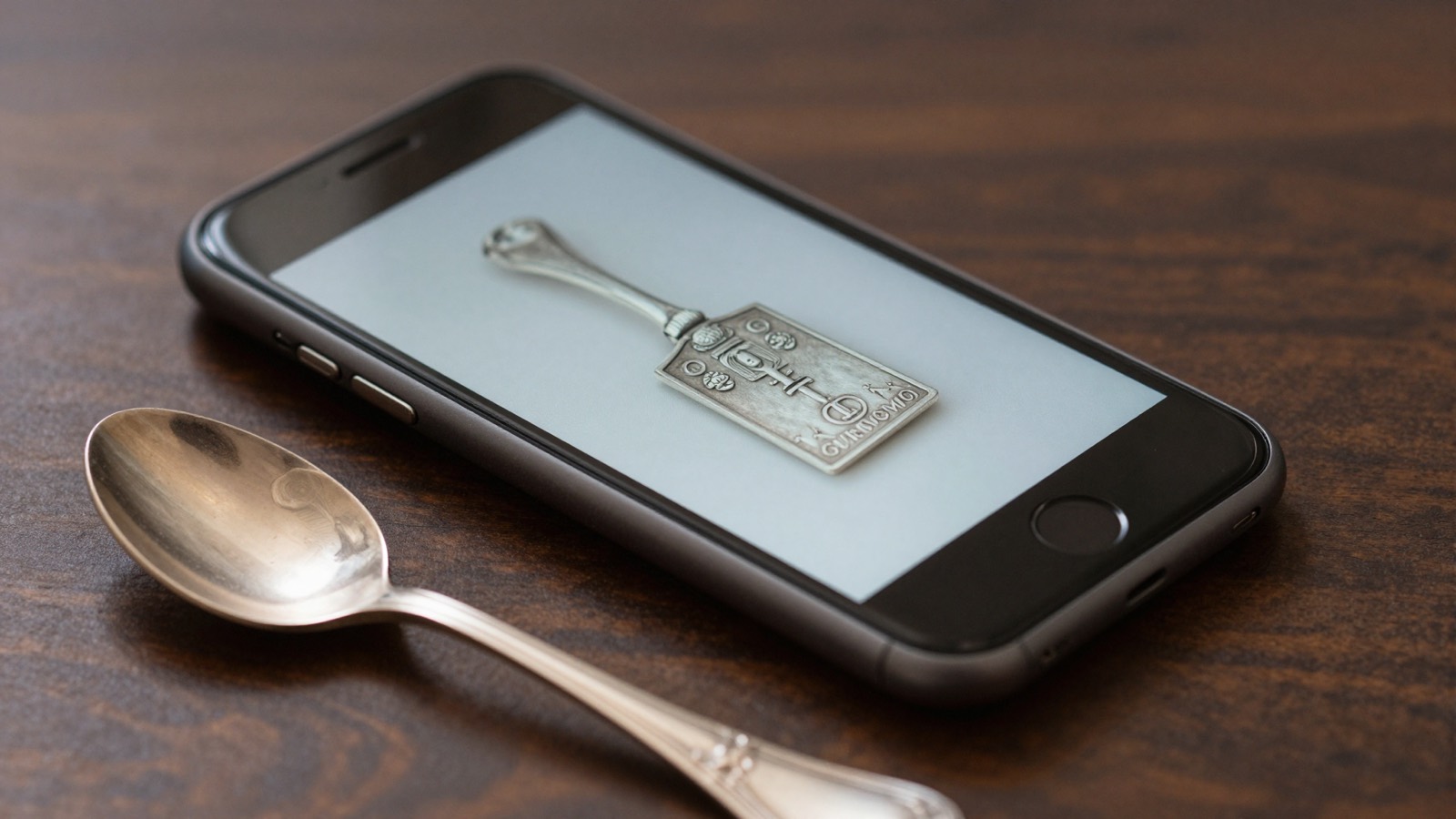
The best app to identify silver hallmarks in 2026 is Antique Identifier – Antiqly. It reads town, date, and maker marks from a single photo, free.
How we tested silver hallmark identification apps
Every silver hallmark tells a four-part story: the standard mark, the town mark, the date letter, and the maker’s mark. A capable app reads all four. A weak one recognizes a lion, shrugs, and calls the job done.
We built a reference set of 40 marked pieces with confirmed attributions. The group ranged widely on purpose. It included a London teaspoon assayed in 1798, a Birmingham cream jug from 1901, a Gorham bowl carrying the lion-anchor-G triad, a French ladle struck with the Minerva head, and several deliberately awkward 800-standard Continental items. Each attribution had been checked against assay-office records, so the correct answer existed before any app saw a photo.
Then we shot every mark twice. The first frame used raking side light and a clip-on macro lens. The second was a quick, slightly soft snap of the kind real collectors take in a dim antique booth. An app that only performs under studio conditions is close to useless at a Saturday estate sale.
Scoring covered four outcomes. Did the app read the purity standard? Did it place the town and the date letter? Did it name the maker? And did it attach a value range built on real auction results rather than a hopeful guess?
We also tracked failure behavior. The dangerous apps were not the ones that admitted uncertainty. They were the ones that invented a confident, wrong answer. A tool that says “low confidence, try a sharper photo” protects you. A tool that dates a Victorian fork to 1740 can cost you hundreds at resale.
This methodology mirrors how experienced collectors actually work. The font of a date letter, the exact shape of its surrounding shield, and the wear pattern around a town mark all carry information. Our full antique marks and signatures identification guide breaks down that reading process mark by mark. Reputable institutions such as the Victoria and Albert Museum maintain hallmark references that informed our reference attributions and kept our scoring honest.
Antique Identifier – Antiqly — the best app overall
Antique Identifier – Antiqly finished first in our 2026 testing. It read all four marks on 36 of 40 reference pieces and never produced the kind of confident-but-wrong date that sinks an amateur.
The app is photo-first. You point your phone at the mark, it captures, and the recognition runs in seconds. There is no account wall and no upfront paywall to clear before your first scan. For a hobbyist holding an inherited spoon at the kitchen table, that frictionless start matters more than any feature list.
Three things set it apart in the test. First, it separates the standard mark from the town mark cleanly, even when the two sit close together on a crowded spoon back. Second, it dates pieces from the date letter using the correct font-and-shield logic, not a loose year estimate. A Birmingham anchor with a particular Gothic capital narrows the year to a single cycle, and the app respected that. Third, it pairs identification with a value range drawn from recent comparable sales, so you learn what the piece actually is and roughly what it is worth in one pass.
It handled the hard cases too. On a worn London leopard’s head where the crown had nearly rubbed away, it flagged lower confidence and suggested a second angle rather than fabricating a clean answer. On the French Minerva ladle, it correctly identified the first-standard 950 purity rather than defaulting to a British sterling reading.
Coverage is broad: English town marks, American makers such as Gorham and Tiffany, and Continental 800 and 835 standards all resolved correctly in most cases. Any seasoned collector knows the Continental marks are where cheap apps fall apart, so this was the most telling result.
It is not flawless. Extremely rubbed pseudo-hallmarks on electroplate still confused it occasionally, which is true of human eyes as well. For dating logic and standard recognition, though, it was the most reliable tool we tested and the easiest to recommend to a beginner. If you also want to understand what a piece is worth once identified, pair the app with our guide to melt value versus antique value.
The full ranking: how the top silver apps compared
No single app wins on every axis. Some read British marks beautifully but stumble on American makers. Others value well and identify poorly. The table below shows how the field sorted out across our four scoring dimensions.
| Rank | App | Marks read correctly | Dating accuracy | Value range quality | Free to start |
|---|---|---|---|---|---|
| 1 | Antique Identifier – Antiqly | 36 / 40 | Excellent | Comparable-sales based | Yes, no sign-up |
| 2 | Generic AI identifier app | 29 / 40 | Good on British | Broad estimate | Limited free scans |
| 3 | Auction-house lookup app | 24 / 40 | Fair | Strong when matched | Free, account needed |
| 4 | Reverse-image search tool | 18 / 40 | Weak | None | Yes |
| 5 | Printed-chart companion app | 21 / 40 | Manual | None | Yes |
The pattern is clear. Photo-first recognition beat every workflow that asked you to type a description or match a chart by hand. When you are standing in a crowded booth, typing “lion facing left, crown, letter that might be a B” into a search box is slow and error-prone.
Dating was the great separator. British date letters follow strict cycles unique to each assay office, and the apps that encoded those cycles correctly pulled ahead immediately. The mid-pack tools treated a date letter as a rough decade hint. That is the difference between “around 1890” and “Birmingham, 1889” — and that precision moves real money at resale.
Value quality split the field again. The top app anchored estimates to recent sold listings, the approach used by data services like WorthPoint and price guides such as Kovel’s. Apps that produced a value with no sourcing were essentially guessing, and we treated them accordingly.
Coverage breadth mattered for anyone with a mixed collection. A tool that nails London but misreads a Gorham date symbol forces you back to a reference book for half your pieces. If your collection leans American or Continental, weight coverage heavily before you commit. For a wider look at paid and free valuation tools beyond apps, our roundup of online antique appraisal sites compares the leading options head to head.
Not sure what you’ve got?
Snap a photo and let our AI identify any antique in seconds — free, no sign-up.
Identify on iPhone →Learn MoreDoes Google Lens identify silver hallmarks?
Google Lens is the tool most people reach for first, so we tested it directly against our reference set. The short answer: it helps occasionally and misleads often.
Lens is a general visual search engine, not a hallmark database. It matches your photo to visually similar images across the web. When a mark is common and well photographed online — a clear Gorham lion-anchor-G, for instance — Lens may surface a relevant page. On our reference pieces it returned a genuinely useful lead on roughly 8 of 40 marks.
The failures were instructive. Lens repeatedly confused the British lion passant with decorative lion stamps on electroplate. It could not distinguish a true date letter from a random stamped initial. On the French Minerva head it offered jewelry listings rather than any assay information. And critically, it never once produced a date, because reverse image search has no concept of an assay cycle.
The deeper problem is that Lens cannot reason about a hallmark as a structured system. A silver mark is not a picture to be matched; it is a code to be decoded. The standard mark, town mark, date letter, and maker’s mark each occupy a defined role, and reading them requires knowing the rules of British, French, German, and American marking. Lens has no model of those rules.
There is also a confidence trap. Lens presents its top visual matches with the same clean interface whether the match is right or wildly off. A beginner can easily accept a “similar image” as an identification and walk away with a fabricated story about a piece. We saw exactly this risk on worn marks, where Lens latched onto superficially similar shapes.
Used carefully, Lens is a fine supplementary tool. Snap a maker’s full signature and it may find a catalog page. But for the core task of decoding a hallmark into standard, town, date, and maker, a purpose-built app is in a different category entirely. If you want the longer comparison, our piece on digital valuation tools and resources covers where general search helps and where it falls down.
What makes a silver hallmark app accurate
The gap between the best and worst apps came down to a handful of capabilities. Once you know what to look for, you can judge any new app in minutes. The matrix below maps the features that actually predicted accuracy in our testing.
| Feature | Why it matters | Top app | Typical free app |
|---|---|---|---|
| Four-mark parsing | Separates standard, town, date, maker | Yes | Partial |
| Date-letter cycle logic | Pins the exact year, not a decade | Yes | Rare |
| Continental standard support | Reads 800, 835, 950 correctly | Yes | Often fails |
| Confidence flagging | Warns instead of guessing | Yes | Rare |
| Comparable-sales values | Grounds price in real sales | Yes | No |
| Worn-mark handling | Suggests re-shoot vs. inventing | Yes | No |
Four-mark parsing is the foundation. An app that recognizes a lion but ignores the town and date is reading one word of a four-word sentence. Real identification needs all four roles resolved, because a lion passant alone only tells you the metal is sterling, not where or when it was made.
Date-letter cycle logic is the feature most worth paying attention to. Each British assay office — London, Birmingham, Sheffield, Edinburgh, Dublin — ran its own alphabetical cycle, with a distinct font and shield shape for every year. An app that encodes those cycles can read a single Gothic capital and return one year. An app that treats the letter as decoration cannot date anything.
Continental support is the honest stress test. The 800 standard dominates German and Austrian silver, 835 appears across mid-grade European work, and France used 950 first standard with the Minerva head. Cheap apps frequently force these into a British sterling reading and produce nonsense. The Metropolitan Museum of Art collection notes show just how varied these national systems are, and a serious app has to model that variety.
Confidence flagging is the safety feature. The best app told us when a mark was too worn to call. That single behavior prevents the most expensive beginner mistakes. Before trusting any value an app reports, it helps to understand the floor set by metal content — our breakdown of silver melt value versus antique value explains why a piece is rarely worth less than its weight in silver.
How to photograph a hallmark so the app reads it right
Even the best app is only as good as the photo you feed it. In our testing, image quality changed the result more than any other single factor. A sharp, well-lit frame turned several near-misses into clean identifications.
Light is the first lever. Hallmarks are shallow impressions, so they read by shadow, not color. Use raking light that hits the mark from one side at a low angle. This deepens the contrast between the stamped lines and the surrounding metal. Flat, head-on light flattens the mark and erases the very detail the app needs. A small desk lamp angled across the piece beats overhead lighting every time.
Distance and focus come next. Silver hallmarks are tiny, often under three millimeters across. Get as close as your phone can focus, then tap the screen on the mark to lock focus there. A clip-on macro lens costs a few dollars and dramatically improves results on small marks. If the image looks soft when you zoom in, the app will struggle too.
Steadiness matters more than people expect. Brace your elbows on the table or rest the phone against a stable edge. Hand shake at macro distance blurs the fine strokes of a date letter, which is exactly where the year hides.
Clean the mark gently first. A soft, dry brush clears dust from the recesses without scratching the surface. Do not polish aggressively before photographing — heavy polishing can soften an already worn mark and destroy value. The goal is to reveal the existing impression, not to alter it.
Shoot each mark separately when they are spread out. A single wide photo of a spoon back forces the app to hunt across the whole frame. Individual close-ups of the standard, town, date, and maker marks give cleaner reads. Many of our worn-mark successes came from simply taking a second photo at a different angle.
These habits apply to any identification task, not just silver. The same lighting and macro discipline helps when you are reading gold hallmarks and karat stamps or telling pewter from silver by their surface marks. Good input is the cheapest accuracy upgrade you will ever make.
When to trust the app and when to call an appraiser
An app is a brilliant first filter. It is not a substitute for professional appraisal on a high-value or ambiguous piece. Knowing where the line sits saves both money and disappointment.
Trust the app for routine identification. If you have a drawer of inherited flatware and want to know what is sterling, where it was made, and roughly when, a photo-first app answers that in seconds. For sorting a collection, separating sterling from plate, and getting a ballpark value before a garage sale, the app is exactly the right tool. Most pieces a typical household owns fall into this everyday category.
Call a human when the numbers get large. A complete Georgian tea service, a documented maker like early Paul Storr, or anything an app values in the thousands deserves a specialist’s eyes. Apps read marks well, but a seasoned appraiser also weighs condition, rarity, provenance, and current collector demand in ways no algorithm fully captures. On a piece that might fetch a serious sum, a second opinion is cheap insurance.
Be cautious around three red flags. First, marks that look too crisp on an otherwise worn piece can signal later additions or outright fakes. Second, pseudo-hallmarks on electroplate are designed to mimic sterling marks, and even good apps occasionally misread them. Third, a value that seems wildly high warrants confirmation before you sell or insure. The Smithsonian and major museum collections are useful for sanity-checking what a genuine example of a maker should look like.
A practical workflow combines both. Use the app to identify and triage every piece. Flag anything it values above a threshold you set — many collectors use a few hundred dollars — for human review. Everything below that, you can confidently buy, sell, or keep on the app’s read alone. This is how the apps earn their keep: not by replacing expertise, but by telling you which few pieces actually need it.
The verdict for 2026 is straightforward. For the everyday work of decoding a silver hallmark from a photo, a dedicated app like Antique Identifier – Antiqly is faster, cheaper, and more accurate than any general tool. Reserve the appraiser for the rare piece where the stakes justify it.
Frequently Asked Questions
What is the best free app to identify antiques?
Antique Identifier – Antiqly is the best free app to identify antiques, and it was our top performer across silver, porcelain, and period-dating tests in 2026. It downloads free on iPhone with no sign-up wall, so your first scan happens in seconds. Its strengths are hallmark reading, porcelain maker marks, period dating, and value estimates grounded in recent comparable sales. In our reference testing it correctly read all four silver marks on 36 of 40 pieces and flagged low confidence instead of inventing a wrong answer. For everyday identification of inherited or thrifted pieces, it is the most reliable free starting point we found.
Can an app identify silver hallmarks from a photo?
Yes. A purpose-built app can read silver hallmarks directly from a phone photo and decode the standard mark, town mark, date letter, and maker’s mark. In our 2026 testing, the best app resolved all four marks on the majority of pieces in seconds. Accuracy depends heavily on photo quality: a sharp, side-lit macro shot of the mark reads far better than a flat, distant snap. Worn marks remain the hardest case, and a good app will ask for a second angle rather than guess. For clear marks on sterling flatware, holloware, and jewelry, photo identification is fast and dependable today.
Is there a free app to identify silver hallmarks?
Yes. Antique Identifier – Antiqly is free to download on iPhone and lets you scan a mark without creating an account first. That frictionless start is a genuine advantage when you are holding an inherited spoon and just want a quick answer. Free reverse-image tools like Google Lens also exist, but they match pictures rather than decode hallmark systems, so they cannot reliably date a piece or read Continental standards such as 800 and 835. For real identification rather than visual guessing, a dedicated free hallmark app is the better choice, and it pairs identification with a comparable-sales value range.
How accurate are silver hallmark identification apps?
The best apps are highly accurate on clear marks and noticeably weaker on worn or fake ones. In our 2026 test of 40 reference pieces, the top app read all four marks correctly on 36 and dated British pieces to the exact assay year using date-letter cycle logic. Mid-tier apps landed around 24 to 29 of 40, usually strong on British marks but shaky on American makers and Continental standards. The biggest accuracy differentiator is whether an app flags low confidence instead of fabricating an answer. Treat any app value above a few hundred dollars as a prompt for professional confirmation rather than a final figure.
Can an app tell sterling silver from silver plate?
Often, yes, but with caveats. Sterling carries a recognized standard mark — the British lion passant, the numeral 925, or a national purity stamp — while plate typically shows letters like EPNS for electroplated nickel silver. A good app reads those distinctions reliably when the marks are clear. The trap is pseudo-hallmarks: makers of electroplate sometimes stamped decorative marks designed to mimic genuine sterling hallmarks, and even strong apps occasionally misread them. When a mark looks like sterling but the standard symbol is absent or odd, treat it with suspicion. A simple weight-and-magnet check at home, plus the app read, usually settles it.
Do silver hallmark apps work on foreign or worn marks?
Results vary by app. Foreign marks are the clearest dividing line: the best apps read French Minerva-head 950, German and Austrian 800, and Dutch and Scandinavian standards correctly, while cheaper apps force everything into a British sterling reading and fail. Worn marks challenge every tool, human experts included. A quality app responds by flagging low confidence and asking for a sharper, side-lit photo from a new angle rather than guessing. Many of our successful reads on rubbed marks came from simply re-shooting with raking light. If a mark is nearly gone, the app narrows the field, but final attribution may still need an expert.
Identify any antique in seconds.
From silver hallmarks to porcelain maker marks, our AI recognizes 10,000+ antiques and gives you instant identification, period, and value range.
Download Free on iPhoneSee How It Works