
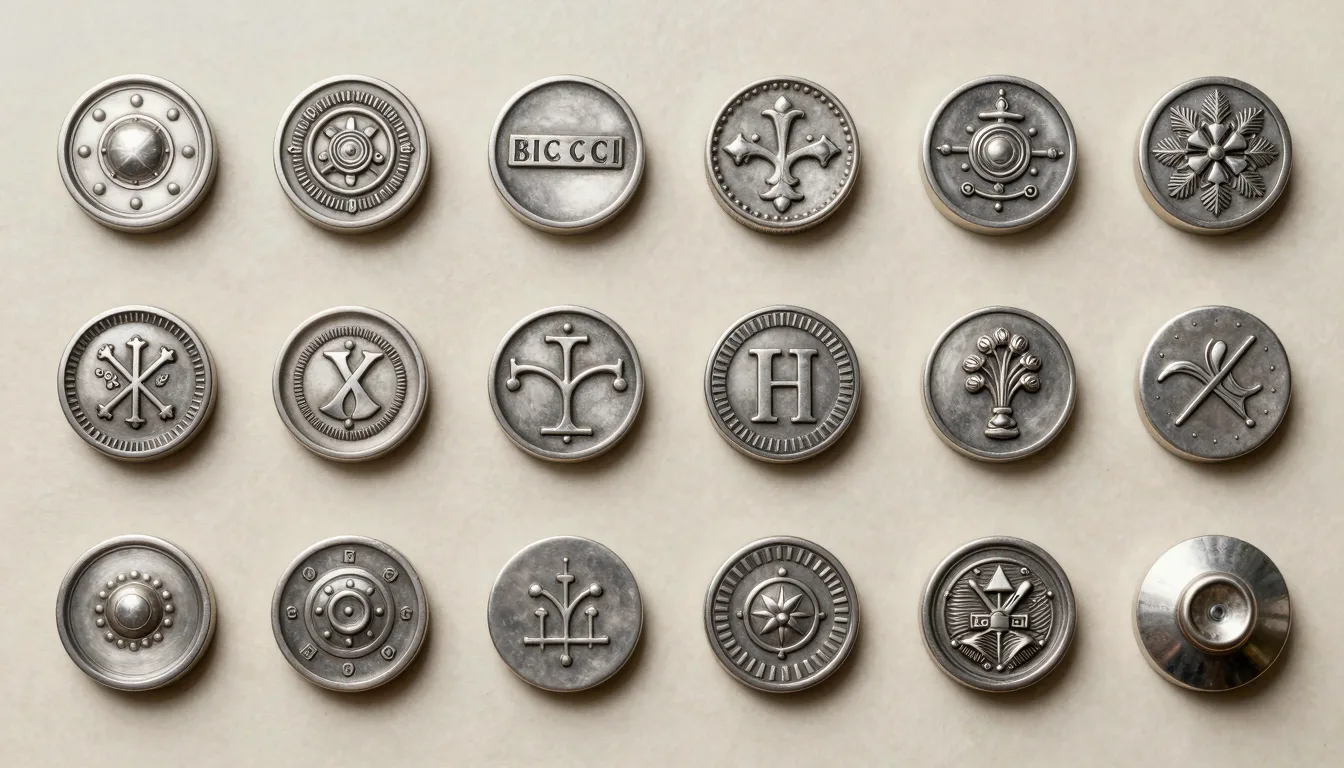
This silver hallmarks chart covers the standard marks, town marks, date letters, and plate marks needed to identify most silver. Start with the purity symbol, then the town symbol, then the date letter. Each table below stands alone as a reference for auctions, estate sales, and inherited pieces.
How do I use a silver hallmarks chart?
Read the marks in a fixed order: standard mark first, town mark second, date letter third, maker’s mark last. That sequence answers your questions in order of importance. The standard mark settles whether the piece is solid silver at all. The town mark tells you which date letter table applies. The date letter pins the year. The maker’s mark puts a name on the workshop.
British hallmarks reward this method because the marks were struck by law, not by habit. A full English sterling set has carried the same core elements since 1478. Between 1784 and 1890 a fifth mark joined them: the sovereign’s head duty stamp. Our guide to the four marks on sterling silver walks through each element in close-up detail.
Here is the method on a real piece. A teaspoon shows a walking lion, a leopard’s head, a gothic lowercase k, and the initials GA. The lion passant says sterling. The leopard’s head says London. The gothic k in a square shield reads 1885. GA is George Adams of Chawner and Co, the largest spoon workshop in Victorian London. Total lookup time with the tables below: about two minutes.
Any seasoned collector will tell you the order matters most on plated pieces. Electroplate carries maker marks and mock shields designed to pass a quick glance. It never carries a lion passant or a purity number. Starting with the standard mark filters those pieces out before you spend time on date letters.
Work through the step-by-step identification guide for the full method with photographs. The tables on this page are the reference layer: standard marks, town marks, date letter cycles, plate marks, and purity numbers in one place.
Standard marks: the purity symbols decoded
A standard mark is the purity guarantee: the lion passant for English sterling, the thistle for Scottish silver, the Minerva head for France. Find this mark first. It separates solid silver from plate in one glance.
| Mark | Standard | Purity | Country / Region | Period |
|---|---|---|---|---|
| Lion passant | Sterling | 925/1000 | England | 1544-present |
| Thistle | Sterling | 925/1000 | Scotland (Edinburgh) | 1759-1974 |
| Lion rampant | Sterling | 925/1000 | Scotland | 1975-present |
| Britannia (seated figure) | Britannia | 958/1000 | England | 1697-present, optional after 1720 |
| Crowned harp | Sterling | 925/1000 | Ireland (Dublin) | 1637-present |
| 925 | Sterling | 925/1000 | International | 20th century-present |
| STERLING | Sterling | 925/1000 | United States | c. 1868-present |
| 800 | Continental | 800/1000 | Germany, Italy, others | 19th century-present |
| 84 zolotnik | Russian standard | 875/1000 | Russia | until 1927 |
| COIN or C | Coin silver | 900/1000 | United States | 1790s-1870s |
| Minerva head, 1st title | French 1st standard | 950/1000 | France | 1838-present |
| Minerva head, 2nd title | French 2nd standard | 800/1000 | France | 1838-present |
| Crescent and crown | German national mark | 800/1000 minimum | Germany | 1888-present |
The lion passant has guaranteed 925 fineness on English silver since 1544. Read the full story of the walking lion in our lion passant hallmark guide. The Britannia standard of 958 was compulsory from 1697 to 1720. Parliament raised the standard to stop silversmiths melting coinage for raw metal. Britannia pieces from that 23-year window carry a seated figure and a lion’s head erased instead of the usual marks.
Numbers replaced symbols across most of the world in the twentieth century. A bare 925 on jewellery is a purity claim, not a hallmark. It carries no assay office guarantee. The distinction matters at valuation: a struck lion passant is independently tested metal, a stamped 925 is the maker’s word. Our sterling silver identification guide covers how to treat each case.
Which town mark is on my silver?
Match the symbol to the assay office: a leopard’s head means London, an anchor means Birmingham, a crown or rose means Sheffield. The town mark also sets your dating bracket, because several offices closed on known dates.
| Symbol | Assay office | Country | Active |
|---|---|---|---|
| Leopard’s head | London | England | 1300-present |
| Anchor | Birmingham | England | 1773-present |
| Crown | Sheffield | England | 1773-1974 |
| Yorkshire rose | Sheffield | England | 1975-present |
| Three-towered castle | Edinburgh | Scotland | 1457-present |
| Tree, fish, bell, and bird | Glasgow | Scotland | 1819-1964 |
| Crowned harp with Hibernia | Dublin | Ireland | 1637-present |
| Three wheat sheaves and sword | Chester | England | 1686-1962 |
| Three separate castles | Newcastle | England | 1702-1884 |
| Triple-towered castle | Exeter | England | 1701-1883 |
| Half leopard’s head, half fleur-de-lis | York | England | 1560-1858 |
| Pinecone (Pyr) | Augsburg | Germany | 16th-19th century |
| Bear | Berlin | Germany | 18th-19th century |
| St George and dragon | Moscow | Russia | until 1896 |
| Crossed anchors and sceptre | St Petersburg | Russia | until 1896 |
Closure dates are hard evidence. A piece with the three castles of Newcastle cannot postdate 1884. A Chester wheat-sheaf mark ends at 1962. Exeter closed in 1883, York in 1858, Glasgow in 1964. When a date letter is worn beyond reading, the town mark alone can narrow a piece to a workable range.
The Victoria and Albert Museum holds reference collections from most of these offices, and comparing a mark against a museum-documented example settles doubtful cases. For the English offices in depth, see our UK hallmarks guide and the regional identification map.
One collector’s habit worth copying: photograph the town mark before the date letter. Town symbols are physically larger and survive polishing better. In my own boxes of fair finds, the town mark is legible on perhaps nine pieces in ten, the date letter on six.
London date letter cycles at a glance
A date letter identifies the exact year a piece was assayed, and the letter’s font plus its shield shape identify the cycle. London ran through the alphabet in roughly twenty-year cycles, changing typeface and shield each time.
| Cycle | Years | Style | Letters used | Shield |
|---|---|---|---|---|
| 1 | 1696-1715 | Court hand | A-T, no J | Varied |
| 2 | 1716-1735 | Roman capitals | A-T | Plain shield |
| 3 | 1736-1755 | Roman lowercase | a-u | Ornate shield |
| 4 | 1756-1775 | Old English capitals | A-U | Ornate shield |
| 5 | 1776-1795 | Roman lowercase | a-u | Plain shield |
| 6 | 1796-1815 | Roman capitals | A-U | Square base |
| 7 | 1816-1835 | Roman lowercase | a-u | Rectangular |
| 8 | 1836-1855 | Gothic lowercase | a-u | Pointed shield |
| 9 | 1856-1875 | Old English capitals | A-U | Square shield |
| 10 | 1876-1895 | Gothic lowercase | a-u | Square shield |
| 11 | 1896-1915 | Roman capitals | A-T | Rectangular |
| 12 | 1916-1935 | Black letter lowercase | a-u | Oblong |
| 13 | 1936-1955 | Roman capitals | A-T | Oval |
| 14 | 1956-1974 | Italic lowercase | a-s | Shield |
The same letter appears once per cycle, so font and shield do the disambiguation. A capital A in Roman type sits in a different cycle from a court-hand A. The full London date letter chart lists every letter-to-year pairing, and our guide to font and shield shape shows the visual tells side by side.
Two system-wide changes are worth memorising. From 1975, under the Hallmarking Act 1973, all UK offices adopted the same letter in the same year. From 1999, the date letter became optional entirely. A modern piece with no date letter is legal and normal, not suspicious.
Cross-check against the sovereign’s head where present. The duty mark ran from 1784 to 1890, so its presence brackets a piece inside that window regardless of what the date letter seems to say. Marks that contradict each other are a warning sign worth taking seriously.
Which marks mean silver plate, not solid silver?
EPNS, EPBM, A1, and any wording containing the word plate all mean electroplate, not solid silver. These marks describe a thin silver coating over base metal. Learning this table prevents the most expensive mistakes in the hobby.
| Mark | Meaning | What it is |
|---|---|---|
| EPNS | Electroplated Nickel Silver | Nickel alloy body under a thin electro-deposited silver layer |
| EPBM | Electroplated Britannia Metal | Tin alloy body under a silver layer, common on teapots |
| A1 or AI | First quality plate | The maker’s thickest plating grade, still plate |
| SILVER PLATE | Silver plated | Base metal with a silver coating |
| QUADRUPLE PLATE | Heavy American plate | Four dips of plating, a Victorian marketing term |
| 1847 ROGERS BROS | Rogers Brothers brand | Plated flatware. 1847 is the founding year, not a purity |
| WM ROGERS | William Rogers | Plated flatware manufacturer |
| GERMAN SILVER | Nickel alloy | Copper-zinc-nickel alloy containing no silver at all |
| NICKEL SILVER | Nickel alloy | The same alloy as German silver, zero silver content |
| ALPACA or ALPACCA | Nickel alloy | The same alloy again, common on South American pieces |
The 1847 Rogers Bros trap catches more people than any other mark. The date reads like an antique guarantee. It is the company’s founding year on plated goods made well into the twentieth century. The same logic applies to Quadruple Plate: the word sounds like weight, and describes coating.
Plate marks imitate hallmark layout on purpose. Victorian electroplaters arranged their initials in little shields to echo a sterling set. Our guide to EPNS silver plated marks decodes the major British makers, and silver plate hallmarks vs sterling shows the imitation game in photographs.
The reliable rule holds in both directions. No genuine British sterling piece marks itself EPNS. No electroplated piece carries a lion passant or a struck purity number. When the two vocabularies appear together, the sterling-style marks are decorative, and the piece is plate.
Silver purity numbers at a glance
Purity numbers state silver content in parts per thousand: 925 means 92.5 percent silver, 800 means 80 percent. This system, called millesimal fineness, became the world’s common language for precious metal content.
| Purity mark | Silver content | Common name | Where used |
|---|---|---|---|
| 999 | 99.9% | Fine silver | Bullion, coins |
| 958 | 95.8% | Britannia silver | United Kingdom |
| 950 | 95.0% | French 1st standard | France |
| 925 | 92.5% | Sterling silver | Worldwide |
| 916 | 91.6% | 88 zolotnik | Russia |
| 900 | 90.0% | Coin silver | United States, parts of Europe |
| 875 | 87.5% | 84 zolotnik | Russia |
| 835 | 83.5% | Continental standard | Germany, Netherlands |
| 830 | 83.0% | Scandinavian standard | Norway, Sweden, Denmark |
| 800 | 80.0% | Continental standard | Germany, Italy, others |
| 750 | 75.0% | Low-grade silver | Parts of Asia |
Lower numbers are not fakes. An 800 mark on a German coffee pot is the correct national standard, struck lawfully since 1888. Russian 84 zolotnik silver at 875 fineness includes some of the finest workmanship of the nineteenth century. Value follows maker and object, not fineness alone.
Context decides what a number is worth as evidence. On continental silver, the number usually sits beside a national symbol: the crescent and crown in Germany, the Minerva head in France. On modern jewellery, the number often stands alone. Our worldwide purity marks guide maps number to country in detail, and the European hallmarks guide covers the accompanying symbols country by country.
Weight matters alongside fineness when scrap value enters the conversation. A heavy 800 tray can contain more actual silver than a light sterling one. Multiply weight by fineness before drawing conclusions from the stamp alone.
Reading worn marks against these charts
Work from the marks you can still see: three of four marks will usually date a piece, and even two can narrow it usefully. Wear rarely erases a full set evenly. The deepest-struck mark survives longest, and that is usually the standard mark.
Light is the cheapest tool that changes results. Hold the piece under a single light source at a low angle, so shadows fill the recesses of the strike. A mark invisible under a ceiling light will often read clearly under a desk lamp raked across the surface. Rotate the piece slowly; different letters catch at different angles.
A 10x jeweller’s loupe covers nearly every hallmark task. Higher magnification narrows the field of view without adding useful detail on a struck mark. Under the loupe, look for the shield outline before the letter. Outlines are cut deeper than letterforms and survive polishing longer. A square shield with an unreadable letter still tells you the cycle on the London table above.
Partial reading is a process of elimination. Suppose the lion passant is clear, the town mark is a smudge, and the date letter shows a gothic lowercase form. Gothic lowercase appears in London cycles 8 and 10, which is 1836-1855 or 1876-1895. If the piece also carries a sovereign’s head, both windows stay open. If the duty head is absent on an otherwise complete Victorian set, the balance tips late. Our guide to worn and rubbed hallmarks works through cases like this step by step.
Price databases close the loop on identification. WorthPoint archives millions of realised auction results, and Kovel’s has published marks references for decades. Once the charts give you a maker and a date range, a search against sold examples confirms whether the attribution holds and what the market pays for it.
Frequently Asked Questions
Is there an app that matches a hallmark photo to these charts?
Antique Identifier – Antiqly matches a photo of your hallmark against reference tables like the ones on this page and names the standard, assay office, and date range in seconds. The download is free on iPhone and no sign-up is required. It earns its keep on the hard cases: worn lion passants, partial shields, and cramped marks inside ring bands. For a piece with four crisp marks, this chart works fine on its own. For rubbed or ambiguous strikes, a photo comparison removes the guesswork.
What are the four marks on British sterling silver?
The four marks are the standard mark, the town mark, the date letter, and the maker’s mark. On an 1890s Birmingham spoon that reads: lion passant for sterling, anchor for Birmingham, a letter for the year, and the silversmith’s initials. A fifth mark, the sovereign’s head, appears on silver assayed between 1784 and 1890, when a duty was collected on plate. Modern pieces since 1999 legally need only three marks, because the date letter became optional. If a British piece shows fewer marks than expected, check its date before assuming a problem.
How do I tell sterling from silver plate using marks?
Sterling carries a standard mark: a lion passant, a thistle, a crowned harp, or a struck 925. Plate carries process marks instead: EPNS, EPBM, A1, or wording like Silver Plate or Quadruple Plate. No purity number ever appears on honest electroplate, because the body metal is nickel or tin alloy. The classic trap is 1847 Rogers Bros, where the date is a founding year on plated flatware, not an age or a standard. When marks from both vocabularies seem to appear together, the sterling-style marks are decorative imitations and the piece is plate.
What does a 925 mark on its own mean?
A 925 mark means 92.5 percent silver, the sterling standard, stated in millesimal fineness. On its own it is a maker’s claim rather than an independent guarantee. A British hallmark set includes an assay office mark, which means the metal was tested by a third party before sale. A bare 925 on a chain clasp or ring band skipped that step, which is normal for most modern jewellery made outside compulsory hallmarking countries. Trust it on branded goods from reputable makers; test it on unbranded pieces priced as if the stamp were proof.
How do I read a silver date letter?
Identify the assay office first, then use that office’s cycle table, then match the letter. The font and shield shape select the cycle; the letter selects the year within it. A gothic lowercase k in a square shield at London reads 1885, from the 1876-1895 cycle. The same letter in a different font belongs to a different twenty-year cycle. From 1975 every UK office used the same letter in the same year, which simplifies modern pieces. Before 1975, never read a letter without checking font and shield against the office’s own sequence.
What if my mark is not on this chart?
A missing mark usually means continental silver, electroplate with maker-only stamps, or American silver, which never used a national assay system. Check the purity number table first: 800, 830, or 835 points to continental Europe. Then consider pseudo-hallmarks, the decorative shields struck on Victorian plate to imitate sterling sets, covered in our pseudo-hallmarks guide. Marks from smaller assay systems, Ottoman tughras to colonial stamps, need country-specific references. A photograph compared against a documented example settles most of these cases faster than browsing charts.
Do American silver pieces have hallmarks?
No. The United States never operated assay offices, so American silver carries maker’s marks and the word STERLING or COIN instead of hallmarks. STERLING spread after the 1860s, when Gorham and Tiffany adopted the 925 standard; before that, coin silver at roughly 900 fineness was the American norm. Some makers used private date systems: Gorham struck yearly symbols from 1868, and Tiffany changed its director initials with each leadership era. Our American silver marks guide covers the major makers and how to date pieces without a date letter.
What does EPNS stand for on silverware?
EPNS stands for Electroplated Nickel Silver: a nickel alloy body coated with a thin layer of pure silver by electrolysis. The process was patented by Elkington of Birmingham in 1840 and dominated affordable silverware for the next century. An EPNS piece contains a few grams of silver at most, so it has effectively no melt value. Collectible value exists at the top end, in makers like Elkington, Walker and Hall, and Christofle, and in good Art Nouveau design. For everything else, EPNS pieces are usable tableware rather than an investment.