
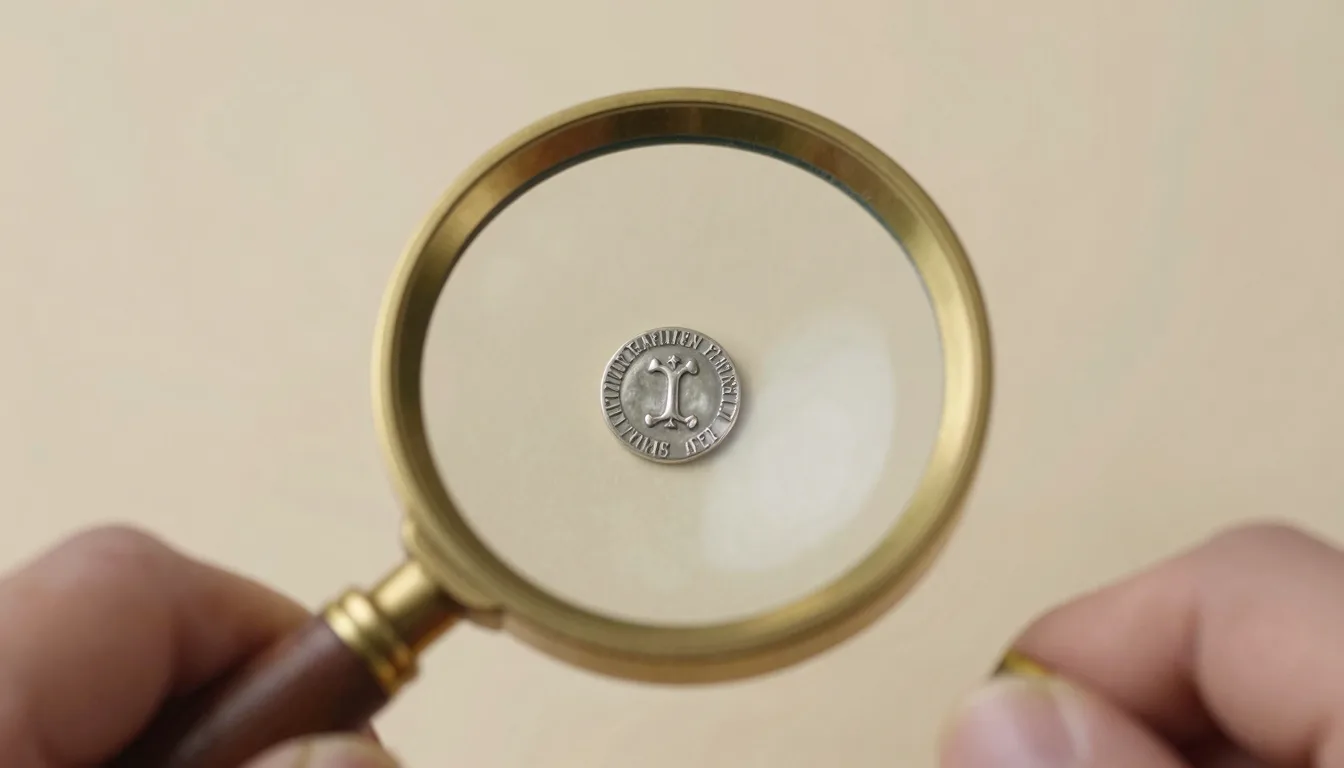
To identify silver hallmarks, work through four questions in order. Where are the marks, how many are there, what does the standard mark say, and which town and date letters appear? That sequence separates sterling from plate, dates British pieces to a single year, and names the maker. This guide walks each step with reference tables.
Where do you find hallmarks on silver?
Hallmarks sit in predictable places, and checking the standard locations first saves minutes on every piece. Flatware carries its marks on the back of the handle, near the stem. Hollowware, meaning teapots, bowls, jugs, and trays, is marked on the underside of the base. Rings are stamped inside the band. Necklaces and bracelets carry marks on the clasp tongue or on a small tag soldered beside it. Brooches hide theirs on the back plate or the pin fitting. Candlesticks are marked on the base rim, and sometimes inside the hollow base where a finger cannot reach.
Larger and composite pieces are often marked more than once. A Georgian teapot may carry a full set of marks on the base and a partial set on the lid. British assay offices struck lids, liners, and detachable parts separately, so matching part-marks are a strong originality check. A fully marked pot with an unmarked lid deserves closer inspection, since replaced lids are common and they cut value.
A hallmark is an official punch struck after testing, which is why placement follows rules rather than habit. Assay offices chose spots that would not deform the piece and would survive a lifetime of handling. That logic still guides your search today: check bases, backs, rims, and fittings before anywhere else.
You need magnification, because most hallmarks measure one to three millimetres across. The details that decide a reading, shield outlines and letter fonts, are smaller still. A 10x jeweller’s loupe is the standard tool and costs under $10. Any seasoned collector keeps one on a keyring for exactly this reason.
Lighting matters as much as glass. Hold the piece under a single light source and tilt it until the light rakes across the surface at a low angle. Raking light throws the punch recesses into shadow and lifts detail that flat overhead light erases. Photograph the mark with your phone at maximum zoom as well. The screen resolves more than the naked eye, and the image can be enlarged and compared against charts later.
For a fuller reference by object type, our guide to where hallmarks are located covers placement piece by piece, from snuff boxes to soup tureens.
How many marks does the piece carry?
Counting the separate punches is the fastest single test of a piece’s origin. Marking systems differ by country, and the count narrows the field before you decode a single symbol. British law has required multiple compulsory marks since 1478, when the crowned leopard’s head regime took hold in London. American makers never adopted a national assay system and relied on words instead. Continental Europe sits between the two, with national punches that change at every border.
| Number and type of marks | Likely origin | Next step |
|---|---|---|
| 4-5 punches in a row | Britain or Ireland | Match the town mark, then read the date letter |
| 1-2 text marks (STERLING or 925 plus a name) | United States | Look up the maker on our American silver marks page |
| 2-3 pictorial punches | Continental Europe | Compare national marks on our European hallmarks guide |
| EPNS, EP, EPBM, A1, or Silver Plate | Electroplate, not solid silver | Read the plate grade; value is decorative, not metal |
| No marks at all | Coin silver, exempt small ware, or base metal | Run the tests in the worn-marks section below |
A full British set contains four marks: the sponsor’s mark, the standard mark, the town mark, and the date letter. Between 1784 and 1890 a fifth punch joins them, the sovereign’s head, struck to show excise duty had been paid. Five marks in a row on a British piece therefore date it to that 106-year window before you read anything else.
American pieces made after about 1868 rely on the word STERLING, usually beside a company name or trademark. Earlier American silver used COIN, C, or a bare surname, and much of it carries no purity statement at all.
Continental counts vary by country and period. France has struck the Minerva head on standard silver since 1838. Germany adopted the crescent and crown beside a fineness number in 1888. A single unfamiliar pictorial punch usually turns out to be an import, export, or small-guarantee mark, and the count alone will not settle it. The takeaway: count first, then let the count choose which reference table you open.
Reading the standard mark: purity at a glance
The standard mark states how much silver the metal contains, and it is the first punch to read in any row. Everything else, town, date, maker, only matters once you know the piece is solid silver. Sterling means 92.5 percent silver; the remaining 7.5 percent is nearly always copper, added for hardness, since pure silver is too soft for table use.
| Mark | Standard | Fineness | Where and when used |
|---|---|---|---|
| Lion passant (walking lion) | Sterling | 92.5% | England, struck since 1544 |
| Thistle or lion rampant | Scottish sterling | 92.5% | Scotland; the thistle served Edinburgh from 1759 to 1974 |
| Britannia (seated figure) | Britannia standard | 95.8% | Britain, compulsory 1697-1720, optional ever since |
| 925 | Sterling | 92.5% | International; the default on modern jewellery |
| STERLING | Sterling | 92.5% | United States, from about 1868 |
| COIN, C, or 900 | Coin silver | 90.0% | United States, before about 1868 |
| Minerva head | French state standard | 95.0% or 80.0% | France, since 1838; a small 1 or 2 beside the head sets the grade |
| Crescent and crown with a number | German national mark | 80.0% minimum | Germany, since 1888 |
| 800, 830, or 835 | Continental standards | 80.0-83.5% | Germany, Italy, Scandinavia, the Netherlands |
| 84 (zolotnik) | Russian standard | 87.5% | Russia, before 1927 |
| 999 | Fine silver | 99.9% | Modern bullion and studio silver |
Numbers are read in parts per thousand, so 925 means 925 parts silver in 1,000. Any number is a claim, not a guarantee, and cheap cast jewellery with false 925 stamps circulates widely. On old pieces, a struck national symbol carries far more weight than a bare number.
Watch for words that contain silver but promise none. German silver, nickel silver, and alpacca are copper-nickel-zinc alloys with zero silver content. EPNS means a thin electroplated silver skin over exactly that alloy.
Our sterling silver identification page goes deeper on 925, 800, and the borderline standards, including how to treat a number with no symbol beside it.
Matching the town mark to an assay office
The town mark names the assay office that tested the piece, and identifying it correctly is the key that unlocks the date letter. Every office ran its own date-letter cycles, so a letter means nothing until the office is fixed.
| Symbol | Assay office | Notes |
|---|---|---|
| Leopard’s head | London | Crowned before 1821, uncrowned after; a precise dating detail in itself |
| Anchor | Birmingham | Office opened 1773 |
| Crown | Sheffield | Used 1773-1974, replaced by a rose from 1975 |
| Three-turreted castle | Edinburgh | Scotland’s senior office, active since the 15th century |
| Tree, bird, bell, and fish | Glasgow | Office closed 1964 |
| Hibernia beside a crowned harp | Dublin | The Hibernia figure was added in 1730 |
| Three wheatsheaves and a sword | Chester | Office closed 1962 |
| Triple-towered castle | Exeter | Office closed 1883 |
| Three separate castles | Newcastle | Office closed 1884 |
| St George spearing a dragon | Moscow | Imperial Russian town mark |
| Crossed anchors and a sceptre | St Petersburg | Imperial Russian town mark |
| Pinecone | Augsburg | Leading German silver centre of the 17th and 18th centuries |
Castles cause the classic confusion. Edinburgh strikes one castle with three turrets, Exeter strikes a single triple-towered castle in a different shield, and Newcastle strikes three separate castles arranged two over one. Under the loupe, count the buildings before you count the towers.
The leopard’s head trips up beginners in a different way. It faces forward like a cat’s face, while the lion passant walks side-on. Finding the leopard’s head tells you London tested the piece; finding the lion passant only tells you the metal is sterling. The two marks answer different questions and often appear side by side. Our guide to the leopard’s head mark traces how the punch changed century by century.
Closed offices are dating tools in their own right. A genuine Chester mark cannot be later than 1962, a Glasgow mark cannot be later than 1964, and an Exeter mark caps at 1883. The full office-by-office breakdown lives on our UK hallmarks page.
How do you read a silver date letter?
A date letter identifies the assay year in which a piece was tested, and reading it correctly pins manufacture to a single year. British offices cycled through the alphabet, changing the letter every year and restarting with a new typeface and shield shape when a cycle ended. Cycles ran roughly 20 to 25 years, since letters like J were often skipped.
Record four attributes of the letter before opening any chart. First, the character itself. Second, the case, upper or lower. Third, the typeface: Roman, Gothic, Old English, italic, or court hand. Fourth, the shield outline around it: square, pointed, rounded, or ornate. All four together identify one year in one cycle at one office.
The same letter recurs at every office and in every cycle, which is why the office must come first. A London lowercase ‘k’ from the cycle that began in 1896 reads 1905. The same character in an earlier London cycle, or at Birmingham or Sheffield, lands on entirely different years. Charts are office-specific for this reason, and our London date letters chart shows a complete worked cycle.
Two brackets let you sanity-check any reading. The sovereign’s head duty mark appears only between 1784 and 1890, so its presence or absence confirms which side of those lines you are on. The leopard’s head lost its crown in 1821, splitting London pieces into before and after. Commemorative marks help too: jubilee punches were struck in 1935, 1977, 2002, and 2022, and a millennium mark in 1999-2000.
One quirk catches even experienced readers. The assay year did not follow the calendar year. London’s letter changed each May until the system was reformed, so a single date letter spans parts of two calendar years. Auction catalogues write London 1905/06 for exactly this reason.
Since the Hallmarking Act came into force in 1975, all British offices have struck the same letter in the same calendar year, which makes modern silver far easier to date. Full cycle tables for every office are collected on our silver hallmarks chart.
Decoding the maker’s mark
The maker’s mark, in Britain legally the sponsor’s mark, identifies the person or firm that submitted the piece for assay. Since 1739, British sponsors have been required to register initials in a distinctive punch, so British maker’s marks are nearly always two or three letters in a shaped surround.
Some initials carry serious market weight. HB in script is Hester Bateman, who registered her mark in 1761 and led London’s best-known family workshop. PS is Paul Storr, the outstanding Regency silversmith. PL with a crown and star belongs to Paul de Lamerie, whose mark is the most faked in English silver. The Metropolitan Museum holds documented pieces by Storr and de Lamerie, and its online catalogue is a free way to compare a mark against an authenticated example.
American makers worked outside any assay system, so their marks behave like trademarks. Full company names are common: TIFFANY & CO, REED & BARTON, WHITING. Gorham struck a rebus of a lion, an anchor, and a G. Trademark styles changed over time, which makes them datable: Kovel’s maintains a searchable database of American marks and the periods each version was used.
The sponsor is not always the artisan. Large retailers registered their own punches and struck them over work bought from trade workshops, so a sponsor’s mark proves responsibility, not authorship. On American pieces the same caution applies to retailer names like Shreve or Ball, Black & Co appearing over another firm’s manufacture.
A reliable research sequence: fix the office and date first, then look the initials up in a register for that office and period. For London, Grimwade’s register of goldsmiths covering 1697 to 1837 is the standard printed source. Working from the date narrows dozens of matching initials down to one or two candidates. If you are starting from zero, our silver marks guide walks the whole reading order for beginners.
What if the marks are worn or missing?
A worn or absent hallmark shifts the job from reading to testing, and both cases have a method. Worn marks can usually be partially recovered. Missing marks demand evidence from the metal itself.
For worn marks, work the light. Rotate the piece slowly under a single low-angled lamp and watch for the moment the punch outline catches a shadow. The shield shape often survives after the letter inside has gone, and shield shape alone can identify the cycle. Photograph the area at maximum zoom, then push the contrast in your phone’s editor; the sensor recovers edges the eye cannot. Three readable marks out of four are usually enough, since office, standard, and cycle together imply the missing punch. Our guide to worn hallmarks covers the recovery techniques in detail.
Genuinely unmarked silver is more common than most people expect. British law exempts very small items, currently those containing under 7.78 grams of silver, so thimbles, small charms, and jump rings often left the workshop legally unmarked. American coin silver made before about 1868 frequently carries only a surname or nothing at all. Much continental, colonial, and provincial silver was made outside any compulsory assay system. Museums face the same problem at the top end: the Victoria & Albert Museum catalogues early English silver attributed by form, engraving, and construction alone.
Home tests give negative evidence quickly. A magnet should not attract silver at all; any pull means a ferrous base metal. Silver tarnish runs grey to black, never green; green corrosion means exposed copper or brass. Solid silver also conducts heat unusually well, which is why an ice cube melts visibly faster on a silver tray than on a plated one.
None of these tests prove purity, they only rule things out. When money rides on the answer, ask a dealer for an XRF reading. The instrument measures surface composition in seconds without damaging the piece, and many dealers run the test for a small fee. The full test sequence, ranked from safest to most invasive, is on our how to test real silver guide.
The five-question decision sequence
Five questions, asked in a fixed order, resolve most silver marks without opening a reference book. The order matters: each question eliminates a category before the next one runs.
| Order | Question | If yes | If no |
|---|---|---|---|
| 1 | Does it read EPNS, EP, EPBM, A1, or Silver Plate? | Electroplate; stop and grade the plating instead | Continue |
| 2 | Is there a lion passant? | British sterling, 92.5%; find the town mark and date letter | Continue |
| 3 | Does it read STERLING or 925? | Sterling standard; identify the maker next | Continue |
| 4 | Does it read 800, 830, or 835, or show a crescent and crown? | Continental silver; match the national mark | Continue |
| 5 | Is there a pictorial punch you cannot place? | Likely European or export; compare the tables above | Test the metal |
A worked example shows the flow. A spoon carries a walking lion, an anchor, a lowercase letter in a shield, and two initials. Question one fails, question two passes: the piece is sterling. The anchor fixes Birmingham as the office. The date letter chart for Birmingham turns the lowercase letter into a year. The initials then go to the maker registers for that office and period. Four punches, four answers, under five minutes.
The sequence also protects you from the most expensive mistake in the field: paying sterling prices for plate. Victorian plate makers struck rows of small pictorial pseudo-marks designed to pass as hallmarks at a glance. Question one and question two catch them, because pseudo-marks never include a genuine lion passant and usually hide an EPNS somewhere on the piece.
Keep the sequence on your phone, or work from our printable silver hallmarks chart at fairs and car boot sales. Speed matters less than order. Answer the questions in sequence and the marks sort themselves; skip ahead and a convincing pseudo-mark will eventually catch you.
Frequently Asked Questions
Is there an app that identifies silver hallmarks from a photo?
Antique Identifier – Antiqly reads a full hallmark sequence from one photo, matching the standard mark, town mark, date letter, and maker’s initials against its reference database. The download is free and no sign-up is required. Photograph the marks under raking light at your phone’s maximum zoom for the best result. An app is fastest on clear British and American marks. Worn punches, transposed marks, and rare provincial stamps still benefit from a manual check against the tables on this page. Treat the app result as a strong first reading, then confirm the date letter against a printed chart when money is at stake.
What do the numbers 925, 800, and 830 mean on silver?
The numbers state silver content in parts per thousand. A 925 stamp means 92.5 percent silver, the sterling standard used in Britain, America, and most modern jewellery. An 800 stamp means 80 percent, the working standard in Germany, Italy, and much of continental Europe. Marks of 830 and 835 sit between the two: 830 is the historic Scandinavian standard, while 835 appears on Dutch, German, and Portuguese silver. Higher numbers exist as well. French first-standard silver is 950, Britannia standard is 958, and 999 marks fine silver. The remaining fraction is nearly always copper, added for hardness. Any number below 800 on a European piece deserves suspicion, since few legal standards sit under that line.
How can I tell sterling from silver plate by the marks alone?
Plate declares itself in letters. EPNS stands for electroplated nickel silver, EP for electroplate, EPBM for electroplated Britannia metal, and A1 or Triple Plate grade the coating rather than the metal. None of these pieces are solid silver. Sterling declares itself with a lion passant on British pieces, or the word STERLING or a 925 stamp on American and modern ones. The trap is pseudo-hallmarks: Victorian plate makers struck rows of small pictorial punches designed to imitate a genuine hallmark sequence at a glance. Read each punch individually. If no lion passant, thistle, Britannia figure, or purity number appears anywhere in the row, assume plate until a metal test says otherwise.
Why does my silver have no hallmark at all?
Several honest reasons exist. British law exempts very small items, currently those containing under 7.78 grams of silver, so thimbles, small charms, and jump rings often carry no marks. American coin silver made before about 1868 was frequently unmarked or bore only a surname. Much continental and colonial silver was made outside any compulsory assay system. Marks also disappear: a century of enthusiastic polishing can erase a shallow punch entirely. Absence of marks lowers confidence, not necessarily quality. Weigh the piece, check the tarnish colour, and run the home tests described in this guide. When an unmarked piece feels right, a professional XRF reading settles the question without damaging the object.
How do I date a piece of silver from its hallmark?
Identify the assay office first, because each office ran its own date-letter cycles. Then record four attributes of the letter: the character itself, upper or lower case, the typeface, and the shield outline around it. All four together point to one year in one cycle. A London lowercase ‘k’ of the 1896 cycle reads 1905, while the same character in other cycles lands decades away. Two brackets help you cross-check. The sovereign’s head duty mark appears only between 1784 and 1890, and the leopard’s head lost its crown in 1821. Since 1975 all British offices have struck the same letter in the same year, which makes modern pieces far easier to date.
Are silver hallmarks ever faked?
Yes, and faking has a long history. The classic methods are transposing, where a genuine set of marks is cut from a damaged spoon and soldered into a more valuable object, and casting, where a fake is moulded from a marked original and the punches emerge soft and rounded. Marks of celebrated makers attract the most forgery, and Paul de Lamerie is widely described as the most faked name in English silver. Warning signs include a solder halo around the marked area, identical wear across all punches, and marks sitting where that object type was never struck. Check that lids and liners carry matching part-marks. When a famous name looks too cheap, it usually is.
What magnification do I need to read a hallmark?
A 10x jeweller’s loupe is the standard tool and costs under $10. Most hallmarks measure between one and three millimetres, and the deciding details, shield corners and letter serifs, are finer still. Higher magnification is rarely better: at 20x and beyond the depth of field shrinks and the whole mark no longer fits in view. Your phone helps as much as the loupe. Photograph the mark at maximum optical zoom under a single low-angled light, then enlarge the image on screen. The sensor picks up contrast your eye misses. For deeply worn marks, rotate the piece under the light and watch for the moment the punch outline catches a shadow.
Does a full set of hallmarks guarantee value?
No. Hallmarks confirm metal content and origin, not desirability. A full set of marks on a plain 1920s teaspoon confirms sterling worth little above melt value. The variables that move price are maker, period, form, and condition. A piece by Hester Bateman or Paul Storr sells for many multiples of its metal weight, and Georgian silver carries a premium over Victorian equivalents of the same standard. Auction records on WorthPoint show identical hallmark sets producing prices from $20 to $20,000 depending on the object above them. Read the hallmark to establish what the piece is. Then judge value from the maker’s mark and the market, not the lion.