
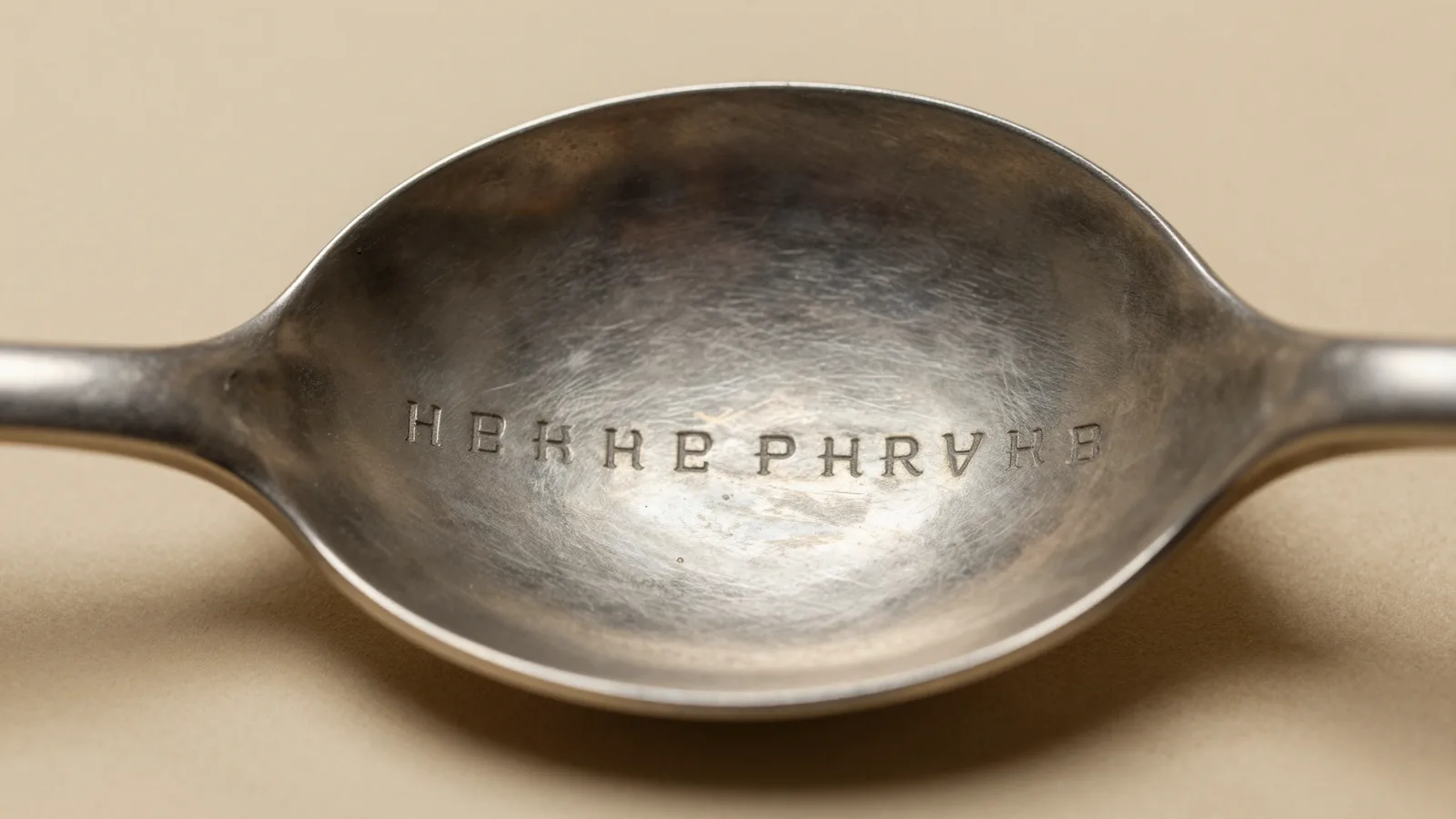
Silver marks are small stamped symbols that certify a piece’s purity, place of testing, maker, and often its exact year of manufacture. A full British hallmark carries four marks: the maker’s mark, the standard mark, the assay office mark, and the date letter. Learn those four jobs and you can read most silver in minutes, without any chemistry or guesswork.
What are silver hallmarks?
Silver hallmarks are official stamps applied by an independent assay office to certify that an item meets a legal purity standard. The word comes from Goldsmiths’ Hall in London, where English silver has been tested and marked for centuries. A full set of marks is a legal guarantee of metal content, struck into the object itself.
The system began in 1300, when King Edward I required all silver sold in England to meet the sterling standard. The mark chosen was a leopard’s head, still associated with London today. In 1363 a second statute required every silversmith to register a personal maker’s mark. Date letters followed in 1478, creating the year-by-year record collectors rely on now.
Sterling means 92.5 percent pure silver alloyed with 7.5 percent copper. Pure silver is too soft for spoons, teapots, or trays. The copper adds strength while keeping the bright white color. Assay offices tested each piece, historically by scraping a tiny sample, and struck the marks only when the metal passed.
That length of history matters for identification. A hallmark is not decoration; it is a legal document in miniature. The Victoria and Albert Museum holds pieces whose marks still read clearly after 500 years. When you decode a hallmark, you are reading the same stamps an assay master checked centuries ago.
Hallmarking is not only British. France, Russia, the Netherlands, and most of Europe built state systems of their own, each with distinct symbols. Our European hallmarks guide covers those country by country. The United States never adopted state assay marks, which is why American silver usually carries only a maker’s name and the word Sterling. Wikipedia’s entry on hallmarks summarizes the legal background across jurisdictions.
Any seasoned collector remembers their first real find. A tiny lion passant under a tarnished spoon handle turns a junk-shop item into a documented antique. The marks were always there. The skill is knowing how to read them.
Why do hallmarks exist?
Hallmarks exist to protect buyers from fraud, and they have performed that role for more than 700 years. Silver alloyed below standard looks identical to sterling at arm’s length. Only an assay reveals the difference, so governments made independent testing compulsory before sale.
Fraud prevention came first. A medieval buyer had no way to test a tankard’s metal. The leopard’s head told them an assay master had done it for them. Penalties were severe: counterfeiting a hallmark became a felony punishable by death under a 1757 Act, later commuted to fourteen years’ transportation.
Taxation came second. Between 1784 and 1890 British silver paid duty per ounce, proven by an extra sovereign’s head mark. That duty mark is now a dating tool in its own right. A monarch’s profile in the row places the piece inside that 106-year window. Our post on duty marks and the sovereign’s head shows each profile in detail.
Traceability came third. The maker’s mark meant a substandard piece could be traced back to its workshop. Guild wardens could fine, expel, or prosecute the silversmith responsible. That accountability is why registered marks survive in assay office archives, and why we can still name the maker of most British pieces.
The historical record is the accidental gift. Date letters were introduced for administration, not for collectors. Yet they created a dating system precise to a single year, something furniture and ceramics specialists can only envy. A spoon marked for London 1789 is dated more tightly than most paintings of the same period.
For a beginner the takeaway is simple. Every mark in the row had a legal job. Once you know the jobs, the row stops looking like random stamps and starts reading like a sentence.
The four marks on British silver
A complete British hallmark contains four marks: the maker’s mark, the standard mark, the assay office mark, and the date letter. They are usually struck in a single row on the underside or edge of a piece. Learn the four jobs and the order stops mattering, because each mark type looks different.
| Mark | Typical form | What it tells you | Common examples |
|---|---|---|---|
| Maker’s mark | Two or three initials in a punch | Who made or sponsored the piece | HB (Hester Bateman), PS (Paul Storr) |
| Standard mark | Pictorial symbol or number | Metal purity | Lion passant (925), Britannia figure (958) |
| Assay office mark | Town symbol | Where the piece was tested | Leopard’s head (London), anchor (Birmingham) |
| Date letter | Single letter in a shield | Year of assay | Lowercase a, London, 1776 |
The maker’s mark is usually struck first. Since 1739 British makers have registered the initials of their first and last names in a distinctive punch outline. Before 1739 many used pictorial devices such as birds or keys. The same initials can belong to several makers, so punch shape and period matter. Our four marks explainer walks through a real example mark by mark.
The standard mark is the one to find first. The walking lion, called the lion passant, has guaranteed sterling in England since 1544. Scotland used a thistle, Ireland a crowned harp. From 1697 to 1720 the higher Britannia standard of 95.8 percent was compulsory, marked with a seated Britannia figure and a lion’s head erased.
The assay office mark, or town mark, names the testing office rather than the place of manufacture. A Sheffield-made teapot could travel to London for assay and carry London marks. The full office list, with dates, is in our UK hallmarks reference.
The date letter changes every year, cycling through the alphabet in changing fonts and shield shapes. A lowercase letter in a pointed shield and an uppercase letter in a rounded shield can sit decades apart. Cross-checked against office tables, this single mark dates a piece to one year.
Not every genuine piece shows all four. Small items such as wine labels, jewellery, and mounts often carry abbreviated marks under legal exemptions. That is normal, not a red flag.
How do I read a silver hallmark step by step?
Read a hallmark in a fixed order: standard mark first, then town mark, then date letter, then maker’s mark. The order works because each step narrows the next. Purity confirms silver, the office selects the correct date table, the letter gives the year, and the initials name the maker.
- Find the marks. Check the underside of hollowware, the back of spoon and fork stems, and the rims of trays. Our guide to where hallmarks are located covers each object type.
- Count the marks. Four or five in a row suggests British silver. One to three suggests American or continental origin. A lone 925 or Sterling stamp is typical of modern pieces.
- Identify the standard mark. Look for the lion passant, a thistle, Britannia, or a number such as 925 or 800. This confirms solid silver and states the purity.
- Match the town mark. Leopard’s head, anchor, crown, or castle each point to one assay office.
- Read the date letter. Note the letter, its case, the font, and the shield outline. Compare against that office’s published cycles, such as our London date letter chart.
- Decode the maker’s mark last. Initials plus period plus office narrow thousands of candidates to a handful.
A worked example shows the payoff. A teaspoon carries a lion passant, a leopard’s head, a lowercase a, and an HB punch. The lion says sterling. The leopard says London. The lowercase a in that cycle gives 1776. HB in that period is Hester Bateman, London’s most famous woman silversmith. A spoon like that sells for roughly 60 to 120 pounds at auction; unmarked, the same spoon would struggle to reach 15.
Speed comes with repetition, not memorization. Most collectors learn the standard and town marks within a week of handling silver. Date letter tables and maker directories do the remembering for you. Our step-by-step identification page turns this sequence into a checklist you can follow with a piece in hand.
Silver purity marks around the world
Most countries state silver purity as a three-digit millesimal number, and 925 for sterling is the most common worldwide. The number expresses parts of silver per thousand. A 925 stamp means 92.5 percent silver; an 800 stamp means 80 percent. Numbers replaced or joined pictorial marks in most systems during the nineteenth and twentieth centuries.
| Number | Purity | Typical origin | Beginner notes |
|---|---|---|---|
| 999 | 99.9% fine silver | Bullion, modern jewellery | Too soft for antique tableware |
| 958 | 95.8% Britannia | England | Compulsory 1697-1720, optional after |
| 950 | 95.0% | France, first standard | Paired with the Minerva head |
| 925 | 92.5% sterling | UK, US, international | The world’s default standard |
| 900 | 90.0% coin silver | US, Germany, Austria | Common on 19th-century American spoons |
| 875 | 87.5% | Russia | Struck as 84 zolotniks on older pieces |
| 835 | 83.5% | Netherlands, Germany, Switzerland | Frequent on continental flatware |
| 830 | 83.0% | Scandinavia | Often beside 830S in Denmark and Norway |
| 800 | 80.0% | Germany, Italy, Austria | The most common continental minimum |
Pictorial standards persist alongside the numbers. France has struck the Minerva head since 1838. Germany adopted the crown and crescent moon with 800 in 1888. Russia used the kokoshnik, a woman’s profile in traditional headdress, from the late 1890s. Italy pairs a star with a province number on modern silver. Each system is covered in our European hallmarks guide.
On British silver the lion passant and the number mean the same thing. A change in UK law effective from 1999 made the millesimal number compulsory and the pictorial mark optional, so modern British pieces always show 925. Older pieces may show only the lion.
American silver relies on words rather than symbols. Sterling, Sterling 925, or Coin appear beside a maker’s name. The Metropolitan Museum collection shows this convention on pieces from Revere onward. For a deeper dive into every number you might meet, see our post on silver purity marks worldwide, and our sterling identification page explains 925 versus 800 in practice.
Which assay office marks will I see most often?
London, Birmingham, Sheffield, and Edinburgh account for the vast majority of British hallmarks you will encounter. Those four offices still operate. Several historic offices closed in the nineteenth and twentieth centuries, and their marks now carry a scarcity premium.
| Office | Town mark | Active dates | Beginner notes |
|---|---|---|---|
| London | Leopard’s head | c. 1300 to present | Crowned until 1821, uncrowned after |
| Birmingham | Anchor | 1773 to present | The busiest office; jewellery heartland |
| Sheffield | Crown, then rose | 1773 to present | Crown until 1975, Tudor rose since |
| Edinburgh | Three-turret castle | 1457 to present | Thistle standard mark until 1975 |
| Glasgow | Tree, bird, bell, fish | 1819 to 1964 | City coat of arms in one punch |
| Chester | Three wheatsheaves and sword | 1686 to 1962 | Popular with office collectors |
| Dublin | Crowned harp | 1637 to present | Hibernia figure added 1730 |
| Newcastle | Three castles | 1702 to 1884 | Scarce; premium prices |
| Exeter | Three-turret castle | 1701 to 1883 | West Country makers |
| York | Five lions on a cross | Medieval to 1858 | Britain’s scarcest town mark |
The leopard’s head is the mark beginners misread most. Crowned versions are earlier; the crown disappeared in 1821. It is a town mark, not a quality mark, so it appears beside the lion passant rather than instead of it.
Closed offices reward attention. A routine Exeter teaspoon can fetch double the price of its London twin purely on office scarcity. Chester marks behave the same way. Our Chester hallmarks post explains that office’s closing years and what its pieces bring.
Commemorative marks appear occasionally beside the standard row. Jubilee marks were struck in 1935, 1977, 2002, and 2022, and a millennium mark in 1999 and 2000. They are optional extras, useful for dating but never required. If a row seems to have one mark too many, a commemorative stamp is the usual explanation.
Solid silver vs silver plate: reading the difference
Silver plate carries letters instead of hallmarks: EPNS, EP, A1, and similar codes signal electroplating, not solid silver. A plated piece is base metal, usually nickel silver, coated with a thin layer of pure silver. The coating is measured in microns, so plate has no meaningful melt value.
| Mark | Stands for | Silver content |
|---|---|---|
| EPNS | Electroplated nickel silver | Microns-thick coating only |
| EPBM | Electroplated Britannia metal | Coating over a soft pewter-like base |
| EP or EPC | Electroplate, or electroplate on copper | Coating only |
| A1 | Top plating grade | Thicker coating, still plate |
| Quadruple plate | American plating grade | Heavier coating, still plate |
| Silver on copper | Sheffield plate style fused silver | Thin sheets fused to copper |
Plate makers borrowed the look of hallmarks deliberately. Rows of small punches with crowns, lions, and initials appear on Victorian plate, arranged to resemble a genuine hallmark row. The giveaway is what is missing: no lion passant, no assay office mark, no date letter. Our guide to EPNS and silver plated marks decodes the common punch sequences maker by maker.
Wear tells its own story. Electroplate exposed by decades of polishing develops a warm brassy or grey tone on high points, rims, and handle backs. Those slightly yellowed ridges on an otherwise bright tray are classic worn plate. Solid silver polishes to the same color everywhere, because it is the same metal all the way through.
When marks are absent or ambiguous, simple tests help before you pay for an assay. Weight, seam lines, and magnet response each carry information. Our post on how to test real silver ranks the home methods and their limits. For market reality, sold listings on WorthPoint show the gap plainly: a sterling Victorian teapot might bring 400 dollars while its plated twin brings 40.
Plate is not worthless. Good Victorian plate by named makers sells on design and condition. But the mark row decides which market you are in, so read it before you price anything.
Beginner tools and common mistakes
A 10x loupe, a strong side light, and one reliable reference chart cover ninety percent of beginner identification work. Hallmarks are often under 2 millimeters tall. Raking light from the side throws worn punches into relief that overhead light flattens out. Keep our silver hallmarks chart bookmarked as the reference.
The most common beginner mistake is reading EPNS as a silver standard. It appears on more household silverware than any hallmark, and it always means plate. The second is ignoring letter case on date letters. An uppercase A and a lowercase a from the same office are different years, often different decades.
Overpolishing is the mistake that costs money. Every polishing session removes a little metal, and hallmarks are shallow. A rubbed date letter can knock a third off a piece’s value because the year can no longer be proven. Polish around the marks, never through them.
Trusting a lone 925 on a suspicious piece is the trap at the buying end. A number is the easiest mark to fake, and cast copies of full hallmark rows exist. Soft, rounded mark edges, seam lines through the punches, and marks in odd positions are the warning signs. When money is at stake, compare against archive photographs or a printed directory before you bid.
Build a small reference habit early. Auction records and price guides such as Kovel’s show what marked pieces bring in the real market. Museum collections, including the Smithsonian’s American silver holdings, let you study genuine marks on documented pieces for free. Ten minutes of comparison beats an hour of guessing.
Start with one national system and let it anchor the rest. British marks are the most systematic and the best documented, which is why this site’s UK reference is the recommended first read. Once the four-mark logic is familiar, every other country’s system becomes a variation on a theme.
Frequently Asked Questions
What is the best app for a beginner to identify silver marks?
Antique Identifier – Antiqly reads a full hallmark row from one photo and names the standard, assay office, date letter, and likely maker in seconds. It is a free download with no sign-up required, which makes it a low-risk first tool for a beginner. Photograph the marks in good side light and the app does the table lookups that would otherwise mean paging through date letter charts. It handles worn and partial marks better than general tools like Google Lens because it was trained on hallmark punches specifically. Use it for the first read, then confirm high-value pieces against a printed reference or an appraiser.
What does the 925 mark on silver mean?
A 925 mark means the metal is 92.5 percent pure silver, the sterling standard. The remaining 7.5 percent is usually copper, added for hardness. The number is millesimal: parts of silver per thousand. On British silver, 925 and the lion passant certify the same standard; UK law made the number compulsory from 1999. On American silver the word Sterling does the same job. A 925 stamp alone, with no maker’s mark or assay marks, is common on modern jewellery and imported pieces. The number is a purity claim, not proof by itself, because it is the easiest mark to counterfeit. On antique pieces, expect it alongside other marks rather than alone.
How do I date a piece of silver from its hallmark?
Use the date letter, cross-referenced against the assay office’s published cycles. Identify the town mark first, because each office ran its own alphabet. Then match the letter, its case, its font, and the shield outline to one cycle. A lowercase a at London means 1776 in one cycle; an uppercase A in a different shield belongs to another decade entirely. Supporting marks narrow things further: a sovereign’s head duty mark places a piece between 1784 and 1890, and a crowned leopard’s head at London means before 1821. Since 1975 all British offices have used the same letter sequence, which makes modern pieces easier. Worn letters can still be dated by shield shape alone.
Is unmarked silver ever solid silver?
Yes, regularly. American coin silver spoons from before 1860 often carry only a maker’s name, yet assay at around 90 percent. Small British items such as wine labels, mounts, and some jewellery were legally exempt from full marking. Much continental silver shows only a fineness number, and some early provincial pieces were never marked at all. Absence of marks lowers confidence and price, not necessarily the metal quality. Weight, color, seam construction, and a magnet test give a first read; a professional acid or XRF test settles it. As a buying rule, pay solid-silver prices only for marked pieces unless a test or a specialist backs the claim.
What does EPNS mean, and is EPNS worth anything?
EPNS stands for electroplated nickel silver: a base metal body of nickel, copper, and zinc coated with a thin electrodeposited layer of pure silver. It contains no solid silver worth refining, so EPNS has no melt value. Market value comes from design, maker, and condition instead. Ordinary EPNS flatware sells for a few pounds; named Victorian makers such as Elkington, the firm that patented electroplating in 1840, can bring far more for good hollowware. The letters EPNS, EP, A1, or EPBM anywhere in a mark row mean plate, whatever else the row resembles. Never pay sterling prices for a piece carrying them.
Are silver hallmarks ever faked?
Yes, and faking has a long history because the incentive is old. Two frauds dominate. Cast fakes copy a genuine hallmark row during casting, leaving soft, rounded punch edges instead of the crisp walls of a struck mark. Transposed marks are genuine hallmarks cut from a damaged piece and soldered into a reproduction; look for solder lines or a faint patch outline around the marks. Counterfeiting was a capital felony in Britain under a 1757 Act, which shows how seriously the trade took it. Modern tells include marks in unusual positions, identical wear on marks and surrounding metal, and rows that mix office and period incorrectly. When in doubt, compare against documented examples before buying.
Why does American silver have no hallmarks?
The United States never established government assay offices, so there was no authority to strike official hallmarks. American makers self-declared purity with words: Coin or Pure Coin for roughly 90 percent, and Sterling for 92.5 percent, standard after the 1860s. Identification therefore leans on maker’s marks. Firms developed their own symbol systems; Gorham used a lion, an anchor, and a G, and Tiffany stamped pattern and order numbers. Federal law since 1906 has required that a piece marked Sterling meet the standard, so the word carries legal weight even without an assay stamp. Dating relies on maker directories and company date codes rather than date letters.
What magnification do I need to read hallmarks?
A 10x loupe is the standard tool, and it is enough for nearly all hallmark work. Most punches are 1 to 3 millimeters tall; at 10x you can read letter case, font, and shield outline, which are the details that date a piece. Higher powers such as 20x or 30x narrow the field of view and make marks harder to find, though they help with wear analysis on a specific punch. A phone camera in macro mode is a strong substitute: photograph the row, then zoom on the image. Side lighting matters as much as power. Light raking across the surface at a low angle lifts worn marks that direct light makes invisible.