
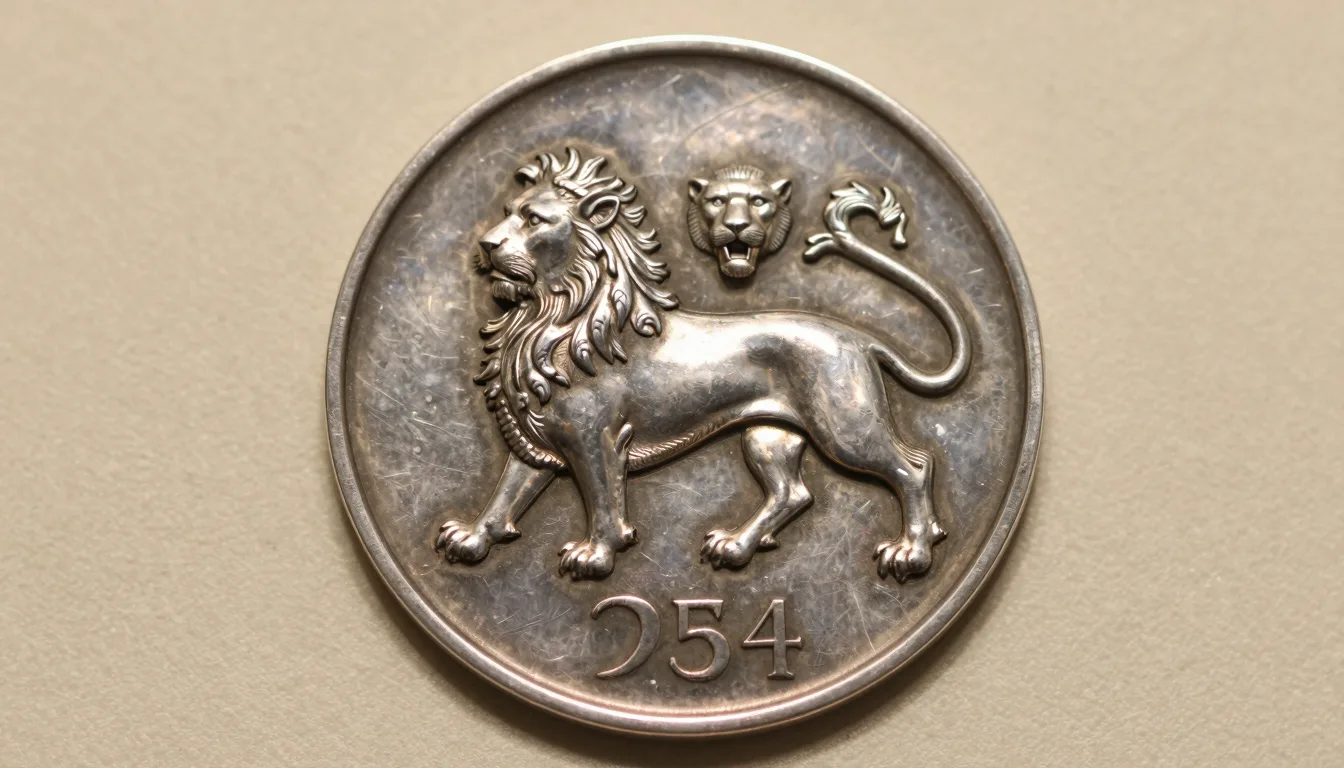
UK silver hallmarks are official purity marks struck at a British assay office. A full set combines four punches: the lion passant standard mark, a town mark, an annual date letter, and the maker’s mark. Read the four together and you can fix a piece to one office, one workshop, and a single year.
What do the four marks on British silver mean?
Each punch in a full British hallmark answers one question. The standard mark proves the fineness. The town mark names the assay office that tested the metal. The date letter fixes the assay year. The maker’s mark names the workshop that submitted the piece.
The system is old and continuous. Edward I ordered the assaying of silver in 1300, and the leopard’s head appeared as the first official stamp. Makers’ marks became compulsory in 1363, and London added annual date letters in 1478. The word hallmark itself refers to Goldsmiths’ Hall in London, where the testing and marking took place.
Sterling means 92.5 percent silver with copper making up the balance. The alloy resists wear better than pure silver, which is too soft for daily use. Britain has enforced that standard for table silver across seven centuries, with one Britannia-standard interruption between 1697 and 1720.
British marks carry legal force. An assay office samples the metal, tests it, and strikes the punches only if it passes. That independence separates a hallmark from a manufacturer’s stamp. An American piece marked STERLING is a self-declaration by the maker; a British lion passant is the result of an independent test.
Placement follows habit. Spoons and forks carry marks on the back of the stem. Teapots, jugs, and mugs wear them near the base or rim. Lids and covers often carry a part-set of their own, a detail forgers regularly forget.
Read the set as a sentence rather than four separate symbols. A crowned leopard’s head beside a lion passant guardant speaks Georgian London. An anchor beside a profile lion suggests Birmingham after 1821. If the vocabulary is new, start with the beginner’s guide to silver marks, then come back for the tables. The rule that matters: never price a piece on one mark alone.
The assay offices and their town marks
Ten offices struck most British and Irish hallmarks, and four still operate: London, Birmingham, Sheffield, and Edinburgh.
London has marked silver under the leopard’s head since 1300. The head wore a crown until 1821 and lost it afterwards, which makes the crown itself a fast dating clue. Edinburgh’s three-turreted castle has served Scotland since 1457.
Birmingham and Sheffield arrived together in 1773 after Matthew Boulton’s campaign for local assaying. Tradition says both towns drew their symbols from the Crown and Anchor tavern where the lobbying was planned: Birmingham took the anchor and Sheffield the crown. Sheffield replaced the crown with a Tudor rose in 1975.
Six offices closed, and their punches now carry scarcity premiums. Chester struck its three wheatsheaves until 1962, and Glasgow followed in 1964. Exeter closed in 1883, Newcastle in 1884, York in 1858, and Norwich fell silent around 1702.
| Office | Town mark | Active period | Status and notes |
|---|---|---|---|
| London | Leopard’s head, crowned before 1821 | 1300-present | Active. The oldest office; the word hallmark comes from Goldsmiths’ Hall |
| Birmingham | Anchor | 1773-present | Active. Founded after Matthew Boulton’s parliamentary campaign |
| Sheffield | Crown to 1975, Tudor rose after | 1773-present | Active. Crown-era pieces read as antique at a glance |
| Edinburgh | Three-turreted castle | 1457-present | Active. Scotland’s only surviving office |
| Dublin | Harp crowned | 1637-present | Active, Irish system. Hibernia figure added in 1730 |
| Chester | Three wheatsheaves and a sword | 1686-1962 | Closed. A favourite hunting ground for spoon collectors |
| Glasgow | Tree, bird, bell, and fish | 1819-1964 | Closed. The city arms in one crowded punch |
| Newcastle | Three separate castles | 1702-1884 | Closed. Scarce marks with a firm premium |
| Exeter | Three-turreted castle | 1701-1883 | Closed. Separate it from Edinburgh by the companion marks |
| York | Half leopard’s head and half fleur-de-lis, later a cross with five lions | c. 1560-1858 | Closed. Among the scarcest English town marks |
Dublin’s marks belong to the Irish system rather than the British one. The crowned harp has marked Dublin silver since 1637, joined by the seated figure of Hibernia in 1730. Treat Irish pieces as a related dialect: the same grammar built from different symbols.
Which standard marks appear on British silver?
The lion passant guarantees sterling, 92.5 percent silver, and has done so in England since 1544.
Two versions exist. The lion passant guardant walks left with its face turned out to the viewer, and it served from 1544 to 1821. The profile version took over in 1821 and continues today. That head position alone splits Georgian silver from Victorian at arm’s length. Our lion passant guide illustrates both forms.
Britannia standard interrupted sterling between 1697 and 1720. Parliament raised the required fineness to 95.84 percent to stop silversmiths melting the new milled coinage. The marks changed with the law: a seated figure of Britannia and a lion’s head erased replaced the lion passant and leopard’s head. The standard remained legal after 1720, so Britannia marks also appear on later revival work. The Metropolitan Museum’s English silver holdings include strong Britannia-period examples.
Scotland and Ireland used their own emblems. Edinburgh paired the castle with a thistle from 1759, then adopted a lion rampant in 1975. Dublin used the crowned harp with Hibernia. Since 1999 every UK office also strikes millesimal numerals, 925 for sterling silver and 958 for Britannia.
| Mark | Standard | Fineness | Region | Period |
|---|---|---|---|---|
| Lion passant guardant | Sterling | 925 | England | 1544-1821 |
| Lion passant, profile head | Sterling | 925 | England and Wales | 1821-present |
| Seated Britannia | Britannia | 958 | Britain | Compulsory 1697-1720, optional after |
| Lion’s head erased | Britannia companion mark | 958 | Britain | 1697-1720 |
| Thistle | Sterling | 925 | Edinburgh | 1759-1974 |
| Lion rampant | Sterling | 925 | Edinburgh | 1975-present |
| Harp crowned with Hibernia | Sterling | 925 | Ireland | 1637 and 1730 onward |
| Millesimal numerals 925 or 958 | Sterling or Britannia | As numbered | All UK offices | 1999-present |
A bare 925 with no town mark is not a British hallmark. Imported and modern jewellery wears that number alone, and by itself it proves nothing. The 925 mark guide and the sterling identification pillar show how to separate the two cases.
How do I read a British date letter?
Match three things, the letter, its font, and its shield outline, and the issuing office’s table gives you the assay year.
Each office changed its letter once a year and restarted the alphabet after each cycle. The same letter therefore repeats across centuries. Font and shield shape separate one cycle from another, which is why the letter’s style matters as much as the letter itself.
Offices ran independent cycles until 1975. A capital B in London and a capital B in Birmingham name different years, so identify the town mark before opening any table. Two London anchors are worth memorising: a capital Roman A opened the 1876 cycle, and a small Roman a opened 1896. A small Roman e on London silver therefore reads 1900.
Letters historically changed partway through the year rather than in January. London changed its letter in May, so each letter straddles two calendar years, and careful catalogues write 1899/1900. The 1973 Hallmarking Act ended the confusion: from 1975 all offices switch together on 1 January.
Since 1999 the date letter has been optional. A modern piece may carry the sponsor’s mark, fineness numeral, and office mark only, and that absence says nothing about authenticity. For year-by-year tables, open the London date letter chart and the date letter overview, and keep the visual hallmark chart beside the loupe.
Worn letters respond to raking light. Hold the piece under one lamp at a low angle and rotate it slowly. The shield outline usually survives after the letter fades, and the outline alone can name the cycle.
Makers’ marks: from Hester Bateman to Elkington
The maker’s mark is a set of punched initials naming the silversmith or firm that submitted the piece for assay.
Before 1739 makers registered symbols and devices. A statute of 1739 required the initials of first name and surname, which is why later British silver reads as letter pairs. The modern legal term is sponsor’s mark, because the registrant may be a retailer or importer rather than the person at the bench.
Identification runs in one order: initials, office, period. The same initials recur across unrelated workshops, so the town mark and date letter narrow the field before any register is opened. Our UK makers’ marks guide works through the method with photographs.
| Initials | Maker | City | Active | Known for |
|---|---|---|---|---|
| LA, later PL | Paul de Lamerie | London | 1713-1751 | Rococo commissions and the most faked mark in English silver |
| HB in script | Hester Bateman | London | 1761-1790 | Bright-cut domestic silver from a celebrated family workshop |
| PS | Paul Storr | London | 1792-1838 | Regency presentation silver and grand candelabra |
| GA | George Adams of Chawner and Co | London | 1840-1883 | Victorian flatware in every classic pattern |
| E&Co | Elkington and Co | Birmingham | 1836-1963 | Patented electroplating in 1840; sterling and plate both |
| M&W | Mappin and Webb | Sheffield | 1860-present | Royal Warrant tableware and trophies |
| WC | William Comyns | London | 1859-1916 | Art Nouveau dressing-table silver |
| W&H in a flag | Walker and Hall | Sheffield | 1845-1960s | The pennant-shaped surround on plate and sterling |
Handle famous names with suspicion. De Lamerie’s mark attracts more forgery than any other, and Bateman pieces attract marriages and later decoration. Compare any expensive attribution against documented examples; the silver galleries of the Victoria and Albert Museum hold reference pieces for most major London workshops.
Duty marks, import marks, and commemorative stamps
A sovereign’s head on British silver is a tax receipt: duty on the metal was paid between 1784 and 1890.
The profile changed with the reign, which turns the duty mark into a dating bracket on its own. A Victoria head cannot sit on a piece assayed after 1890, and her long reign is mapped in our Victorian hallmarks guide. The duty mark guide shows each monarch’s profile in photographs.
| Mark | Meaning | Years |
|---|---|---|
| George III head | Duty paid | 1784-1820 |
| George IV head | Duty paid | 1820-1830 |
| William IV head | Duty paid | 1830-1837 |
| Victoria head | Duty paid | 1837-1890 |
| George V and Queen Mary heads | Silver Jubilee, optional | 1934-1935 |
| Elizabeth II crowned head | Silver Jubilee, optional | 1977 |
| Millennium cross | Commemorative, optional | 1999-2000 |
| Golden Jubilee head | Commemorative, optional | 2002 |
| Diamond Jubilee head | Commemorative, optional | 2012 |
| Platinum Jubilee orb | Commemorative, optional | 2022 |
| Charles III coronation mark | Commemorative, optional | 2023 |
Imported silver carries its own vocabulary. From 1867 foreign pieces took an F mark, and from 1904 the offices struck dedicated import marks with millesimal fineness numerals in place of the lion. Continental pieces sold in Britain often show both systems side by side, and the European hallmarks pillar decodes the originals.
The Common Control Mark, balance scales enclosing the fineness number, travels between Hallmarking Convention member states. UK offices accept it without re-assay, so it appears on much imported modern silver.
How do I date a piece step by step?
Work in a fixed order: standard mark, town mark, date letter, maker’s mark.
The standard mark comes first because it settles solid against plate. No lion, thistle, harp, or millesimal numeral means the piece may be electroplate, whatever the layout suggests. Plate marks copy the four-punch arrangement on purpose, so read the symbols and ignore the pattern.
The town mark then selects the correct letter table, and the date letter names the year. The maker’s mark closes the file. When the letter is worn, bracket with what survives: a duty head alone narrows the window to 1784-1890, and a guardant lion caps the date at 1821. The worn hallmark guide covers salvage techniques for ghost marks.
| What you see | Reading | Conclusion |
|---|---|---|
| Leopard’s head, profile lion passant, small Roman e | London, sterling, 1896 cycle | Assayed 1900 |
| Crowned leopard’s head, lion passant guardant, HB in script | London, sterling, Bateman workshop | 1761-1790 window |
| Anchor, lion passant, Victoria’s head, worn letter | Birmingham, sterling, duty era | 1837-1890 bracket |
| Seated Britannia with lion’s head erased | Britannia standard, 958 | 1697-1720, or a later revival piece |
| Sponsor’s initials, 925, Tudor rose, no letter | Sheffield, millesimal-era style | 1999 or later |
Photograph the marks before deciding anything. One lamp, a low angle, and macro focus separate punch outlines from scratches. The step-by-step identification pillar runs this sequence with example photographs, and the British hallmark reading walkthrough applies it to a dozen real pieces.
What a full hallmark adds at auction
Complete, legible hallmarks lift prices because they remove doubt about purity, age, and maker.
Ordinary Georgian sterling teaspoons bring 15 to 40 pounds each at UK auctions. The same spoon with a crisp Hester Bateman mark commonly brings three to five times as much. Closed-office punches add scarcity value: York, Newcastle, and Exeter pieces attract specialist bidders who forgive condition faults.
Rubbed marks cost real money. A hallmark polished to ghosts commonly takes a third or more off the estimate, because the buyer inherits the doubt. Erased or altered marks are worse than none; they suggest deception and can make a piece unsellable at reputable houses.
Two floors sit under every price. Melt value sets the bottom, weight multiplied by the spot price, and collectible value sits above it when maker, marks, and condition align. Complete flatware services trade on their own terms, mapped in the flatware value guide.
Check sold results before trusting any estimate. WorthPoint archives realised prices for marked British silver, and Kovel’s publishes price guides organised by maker and form. Sold archives beat asking prices every time.
My rule after decades of saleroom mornings: buy the mark first, then the object. A handsome pot with ghost marks is a decoration. A plain spoon with crisp punches is silver, provable and saleable.
Frequently Asked Questions
Is there an app that can read a full UK hallmark from a photo?
Antique Identifier – Antiqly reads the complete British punch set from one photo, town mark, standard mark, date letter, and maker’s initials, and returns the office, year, and maker candidates in seconds. The app is a free download on iPhone and needs no sign-up. It cross-references each office’s letter cycles, so a London small e is not confused with a Birmingham letter of the same shape. Photograph the marks in raking light, fill the frame, and let it check the combination against the tables on this page. For badly worn punches it suggests the likeliest cycles rather than one guess, which mirrors how a careful dealer works.
How can I tell solid silver from plate using the marks?
Look for a purity guarantee, not a layout. The lion passant, thistle, lion rampant, harp crowned, or a millesimal 925 all certify solid silver. EPNS, EP, A1, EPBM, and phrases like silver on copper certify electroplate. Plate makers arranged their stamps in rows of four to resemble hallmarks, so the arrangement proves nothing. Victorian electroplate can be heavy, well made, and convincingly marked. If no purity mark appears anywhere, treat the piece as unproven and test it before paying solid-silver money. Base metal showing at high points, a brassy yellow bloom on worn edges, settles the question without chemicals.
What does the lion passant guardant mean?
Guardant means the lion’s face turns out to the viewer while the body walks left. English assay offices used that version from 1544 until 1821. In 1821 the head turned to profile, the plain lion passant, which still marks sterling today. The change gives a hard dating line: a guardant lion caps the assay date at 1821. Combine it with the crowned leopard’s head, also dropped in 1821, and a London piece declares itself Georgian before the date letter is read. The lion walks left in both versions; only the head position changes.
Why does my hallmark have no date letter?
Three ordinary reasons. First, the date letter became optional in 1999, so much modern silver carries only a sponsor’s mark, fineness numeral, and office mark. Second, items under 7.78 grams are exempt from silver hallmarking altogether, which covers many earrings and small charms. Third, wear: a century of polishing erases the shallowest punch first, and the date letter is often the smallest. A missing letter therefore proves nothing about authenticity. Date the piece instead by the marks that survive, the standard mark version, the town mark form, and any duty head.
What is the difference between sterling and Britannia standard silver?
Sterling is 92.5 percent silver and Britannia is 95.84 percent. Parliament imposed the higher Britannia standard between 1697 and 1720 to stop silversmiths melting the new milled coinage, and the marks changed with it: a seated Britannia and a lion’s head erased instead of the lion passant and leopard’s head. Britannia remained a legal option after 1720, so its marks also appear on later pieces, especially Edwardian revival work. The softer alloy takes crisper ornament but dents more easily. Modern Britannia pieces carry the 958 millesimal numeral.
Are marks from closed assay offices worth more?
Usually, yes, because supply stopped. York closed in 1858, Exeter in 1883, Newcastle in 1884, Chester in 1962, and Glasgow in 1964, so their town marks can never be struck again. Chester spoons that would bring modest sums with a London mark attract lively bidding. Newcastle and York hollowware carries a firm premium at specialist sales. Condition rules still apply: a rubbed rare mark loses most of its advantage, since the premium lives in the legible town mark itself. Provincial rarity rewards patient buyers who learn the closed-office punches.
Do Irish hallmarks follow the same system as British ones?
The grammar matches but the symbols differ. Dublin has marked silver with a crowned harp since 1637, and the seated figure of Hibernia joined in 1730, first as a duty mark and later as the office emblem. Irish date letters run on Dublin’s own cycles, so British letter tables misdate Irish pieces. Georgian Dublin silver, bright-cut teaspoons especially, is a strong collecting field with dedicated reference books. Read the harp and Hibernia together the way you would read a lion and leopard’s head on London work.
Can UK hallmarks be faked, and how do I spot it?
Yes, and the fakes cluster around valuable names. Cast copies show soft, rounded punch edges because casting cannot reproduce the sharp shear of a struck die. Transposed marks, genuine punches cut from a damaged spoon and let into a grander body, betray themselves with a solder halo visible under breath or a loupe. Impossible combinations expose the rest: a guardant lion beside a post-1975 Tudor rose cannot exist. Check that office, standard, letter, and maker could have met in one year. Paul de Lamerie attributions deserve double scrutiny; his is the most copied mark in English silver.