
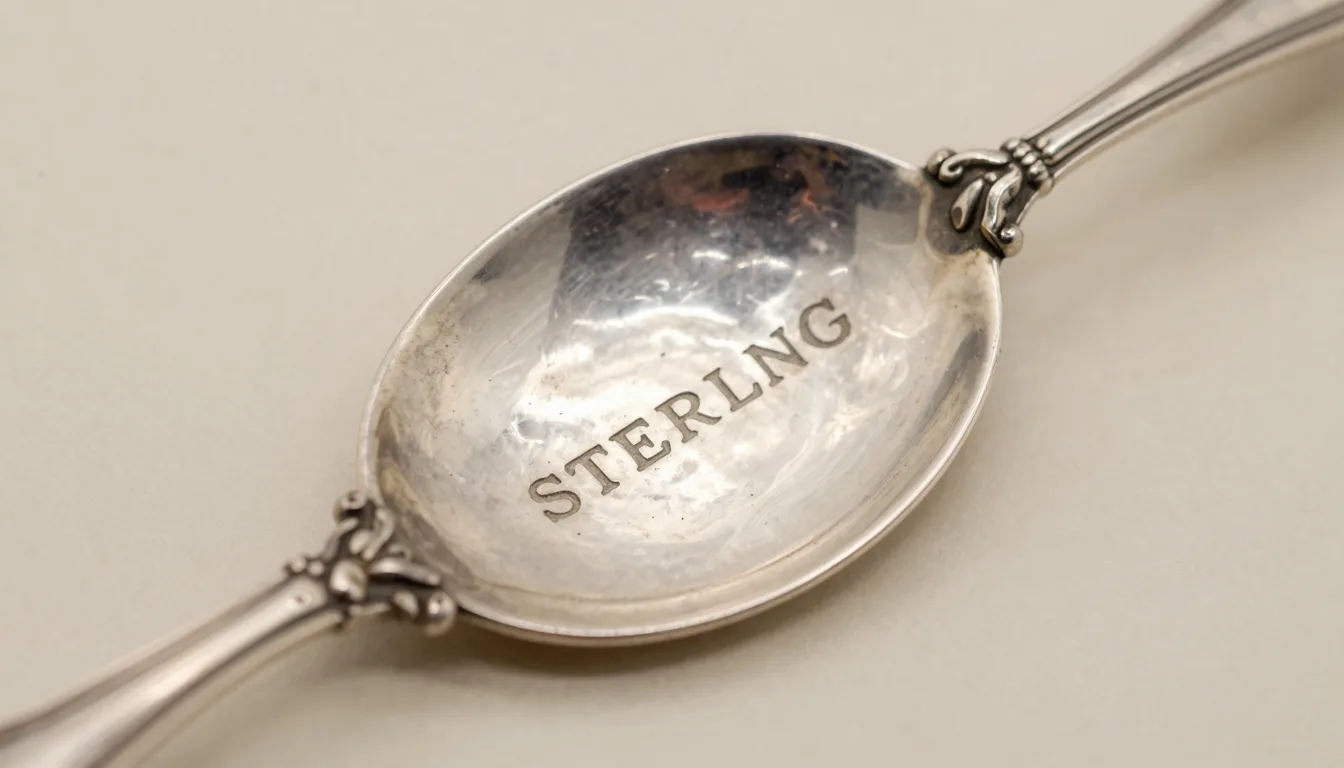
American silver marks are maker-applied stamps rather than government hallmarks. The United States never ran a national assay system, so identification rests on three things: a purity mark such as STERLING or COIN, a maker’s mark such as Gorham’s lion, anchor, and G, and dating clues like patent numbers and pattern names.
Why doesn’t American silver have hallmarks?
American silver has no hallmarks because the United States never created a national assay system. British silver passed through official assay offices that tested and stamped every piece before sale. American silver skipped that step entirely. Each silversmith or company stamped its own work and staked its own reputation on the result.
The contrast with Britain matters for identification. A British piece carries a standard mark, town mark, date letter, and maker’s mark applied by an independent office. An American piece typically carries two stamps: a maker’s mark and a purity word. Everything you learn about a US piece flows from those two stamps.
There was one exception. Baltimore ran a mandatory assay office from 1814 to 1830, the only government hallmarking system in American history. Baltimore silver from those years carries a Liberty head, a date letter, and an assayer’s mark alongside the maker’s stamp. Collectors prize these pieces because they read like British hallmarks with an American accent.
Federal law arrived late and lightly. The STERLING stamp spread after 1868, when Gorham and Tiffany committed to the 92.5 percent standard and the trade followed. The National Gold and Silver Stamping Act of 1906 then made false purity marks a federal offense. Neither law created an assay office. Marking stayed voluntary; only lying about purity became illegal.
The practical takeaway: treat every American mark as a manufacturer’s claim, not a certificate. A STERLING stamp from Gorham or Towle is as trustworthy as any hallmark, because those firms defended their reputations for more than a century. A STERLING stamp on an unattributed piece deserves a closer look and a maker lookup before you trust it. Reputation is the American assay system.
What do STERLING, COIN, and 925 marks mean?
STERLING means 92.5 percent silver, COIN means roughly 90 percent, and 925 is the numeric form of sterling. These three words and numbers do the work that purity hallmarks do in Europe.
| Standard | Purity | Common marks | Period |
|---|---|---|---|
| Coin silver | 90.0% | COIN, PURE COIN, STANDARD, C, D | 1790s to 1870s |
| Sterling silver | 92.5% | STERLING, 925, 925/1000, STG | 1868 to present |
| Martele (Gorham) | 95.0%, later 95.8% | MARTELE with 950/1000 or 9584/1000 | 1897 to 1912 |
| Britannia standard | 95.8% | 958, rare on American silver | special orders only |
| Silver plate | base metal core | EPNS, QUADRUPLE PLATE, A1, IS | 1840s to present |
Coin silver came first. Through most of the 1800s, American silversmiths melted Spanish and US coins for raw material, which set the working standard near 90 percent. Pieces were stamped COIN, PURE COIN, or STANDARD, and many carried only the maker’s name. Our coin silver marks guide covers the regional makers and their stamps in depth.
Sterling replaced coin silver as the trade standard after 1868. The word spelled out in full is the classic American mark; it appears on flatware, hollowware, and presentation pieces from the 1870s onward. The numeric 925 gained ground in the middle of the twentieth century as exports grew, and it dominates jewelry, where space is tight. STG appears on small items such as thimbles and clasps.
Gorham’s Martele line ran above sterling. Introduced in 1897, these hand-raised Art Nouveau pieces were made at 950 parts per thousand, later raised to the 958 Britannia standard. The MARTELE stamp with a fraction is one of the few American marks that states purity above sterling. For the worldwide picture of purity numbers from 800 to 999, see our silver purity standards reference and the sterling identification guide.
Major American silversmiths and their marks
Most marked American silver traces to about a dozen firms, led by Gorham, Tiffany, Reed and Barton, and International Silver. Learn these marks and you can attribute the majority of pieces you will handle.
| Maker’s mark | Company | Active period | Known for |
|---|---|---|---|
| Lion, anchor, G | Gorham Manufacturing Co. | 1831 to present | Largest US silversmith; Martele line; year marks on hollowware |
| TIFFANY & CO with order numbers | Tiffany & Co. | 1837 to present | Luxury sterling; pattern and order numbers date pieces precisely |
| R&B with eagle | Reed & Barton | 1824 to 2015 | Francis I pattern; Taunton, Massachusetts |
| IS, 1847 ROGERS BROS | International Silver Co. | 1898 to 1984 | Largest plate maker; umbrella for many Connecticut brands |
| WM ROGERS | Wm. Rogers & Son | 1825 to 1978 | Silver plate, frequently mistaken for sterling |
| S. KIRK & SON | Samuel Kirk & Son | 1815 to 1979 | Baltimore repousse; oldest continuous US silver firm |
| STIEFF | The Stieff Company | 1892 to 1979 | Baltimore; Williamsburg reproductions; merged with Kirk |
| WALLACE | Wallace Silversmiths | 1835 to present | Grand Baroque flatware; Wallingford, Connecticut |
| TOWLE | Towle Silversmiths | lineage to 1690 | Old Master flatware; Newburyport, Massachusetts |
| W in a shield | Whiting Manufacturing | 1866 to 1926 | Lily of the Valley pattern; absorbed by Gorham |
| ALVIN | Alvin Corporation | 1886 to 1928 | Flatware and dresser silver; acquired by Gorham |
| LUNT | Lunt Silversmiths | 1902 to 2009 | Eloquence pattern; Greenfield, Massachusetts |
| PR in script | Paul Revere Jr. | 1783 to 1818 | Museum-level rarity; the most famous American mark |
Gorham deserves first study because its mark system is the most informative. The lion, anchor, and G trio confirms the maker, and a fourth symbol dates hollowware to a single year. Our guide to Gorham’s lion, anchor, and G marks breaks down every variant.
Tiffany marks work differently. Every piece is stamped TIFFANY & CO with a pattern number and an order number, and the letter of the current design director brackets the date. The Tiffany sterling marks guide shows how to read them together.
The Rogers name is the great trap. Multiple unrelated Rogers firms produced plate, and International Silver Company later owned most of them. A Rogers mark of any kind signals plate until proven otherwise.
How do you date American silver without date letters?
Date American silver through maker date codes, patent numbers, purity wording, and pattern introduction dates. No US-wide date letter system exists, so dating stacks several partial clues into a confident range.
Maker date codes are the strongest clue when present. Gorham stamped sterling hollowware with a letter from A through Q for 1868 to 1884, then switched to a unique symbol for each year. Match the symbol against a chart and you have the exact year; the Gorham date marks guide reproduces the full sequence. Tiffany pieces carry the initial of the incumbent director, so an M places a piece in the Edward C. Moore years, 1873 to 1891.
Patent numbers give a hard earliest date. A flatware pattern stamped PAT. with a number can be looked up in US Patent Office records, and the piece cannot predate the grant. Pattern names work the same way through published introduction dates: a piece of Wallace Grand Baroque cannot predate 1941, and Towle Old Master cannot predate 1942.
Purity wording brackets the era on its own. COIN or PURE COIN places a piece before the mid-1870s. STERLING spelled out means after 1868. A lone numeric 925 without the word suggests the mid-twentieth century or later, or an import.
Construction seals the argument. Hand-raised bodies with faint hammer facets suggest work before the 1850s. Machine-rolled sheet and die-stamped ornament arrive in the 1850s to 1870s. Bright-cut machine engraving points to the 1870s and 1880s. Any seasoned collector knows the feel: those slightly uneven surfaces on an early piece are the hand talking. Weigh all four clue types together and most American pieces date to within a decade.
What are pseudo-hallmarks on American silver?
Pseudo-hallmarks are decorative punches that imitate British hallmarks without any assay behind them. American coin-silver makers used them heavily from the 1820s to the 1860s, and they confuse more beginners than any other US mark.
The typical set is a row of three punches beside the maker’s name: an eagle, a bust in profile, and a single letter or star. The arrangement deliberately echoes the British sequence of lion, monarch’s head, and date letter. The intent was commercial. Imported English silver carried prestige, and a row of official-looking stamps helped domestic work compete on the shelf.
None of the punches means anything about purity or date. The eagle is not a town mark, the bust is not a duty mark, and the letter is not a date letter. Two spoons from the same maker can carry different pseudo-mark rows because workshops cut new punches as old ones wore out. Treat the row as a maker’s signature with extra decoration.
Telling pseudo-marks from real hallmarks takes one comparison. Real British marks follow a fixed sequence with a lion passant for sterling, and every element matches a published table; check any row against our silver hallmarks chart and the fakes fall apart fast. Pseudo-marks match nothing. The full story, with photographed examples, is in our pseudo-hallmarks article.
One warning for buyers: pseudo-hallmarked coin silver is collectible American work, but sellers sometimes list it as English sterling. The price difference is real. A pseudo-marked American teaspoon typically brings 20 to 60 dollars, while a genuine Georgian London teaspoon of similar quality brings more, so verify before paying a British price.
American silver plate marks and what they promise
American plate marks describe a plating process or a thickness claim, never solid silver. The US plated-ware industry was the largest in the world by the 1880s, and its marks imitate sterling marks closely enough to mislead.
| Mark | What it means | Typical source | Era |
|---|---|---|---|
| EPNS | Electroplated nickel silver | Many firms | 1840s onward |
| QUADRUPLE PLATE | Heaviest hollowware plating grade | Meriden and Hartford firms | 1870s to 1910s |
| A1, AA, XX | Flatware plating weight grades | Rogers brands | 1860s onward |
| 1847 ROGERS BROS | Brand date, not a purity mark | International Silver | 1862 onward |
| COMMUNITY PLATE | Oneida’s premium plate line | Oneida | 1901 onward |
| EPBM | Electroplated Britannia metal | Teapot and hollowware makers | 1850s onward |
| SILVER ON COPPER | Plated copper body | Sheffield-style reproductions | 1900s onward |
| NICKEL SILVER, GERMAN SILVER | No silver content at all | Base metal producers | 1830s onward |
The quality words were marketing claims. QUADRUPLE PLATE promised four times a standard silver deposit, but no regulator ever verified the ratio. A1 on flatware meant a standard weight of silver per gross of teaspoons, and XX meant more. These grades matter to durability and to value, but none of them changes the fact that the core is base metal.
The 1847 date is the single most misread mark in American silver. It celebrates the founding of the Rogers brothers’ plating business in Hartford, not a production year and not a purity. Our 1847 Rogers Bros guide dates the actual patterns. The many Rogers variants, including Wm Rogers and its confusing cousins, are all plate lines.
When a piece carries both a company name and one of these grade words with no STERLING anywhere, the identification is settled: electroplate, with value driven by pattern, condition, and maker rather than metal.
How can you tell American sterling from plate at a glance?
Look for the word STERLING or the number 925; American solid silver almost always says so. Because US makers marked voluntarily but consistently, the absence of a sterling mark on an American piece is strong evidence of plate. Five quick checks settle most pieces in under a minute.
First, read every mark. STERLING, 925, 925/1000, or COIN means solid silver. EPNS, PLATE, A1, or a Rogers name means electroplate. A lone company name with no purity word leans plate for factory-era pieces, though early coin silver is the exception.
Second, check the wear points. On plate, high spots such as spoon bowls, handle edges, and feet wear through to a yellow or gray base metal. Solid silver wears but never changes color underneath.
Third, feel the weight and balance. Sterling flatware carries weight into the handle; plated pieces of the same pattern often feel lighter or oddly balanced because the base alloy differs.
Fourth, look at the seams. Applied borders and spouts on plated hollowware sometimes show a copper or brass line at the joint where plating thinned.
Fifth, confirm with the maker. A Gorham lion-anchor-G with STERLING is settled; a Gorham anchor on an EP line is plate from the same factory, so the purity word decides, not the logo alone.
The full walkthrough with photographs is in sterling vs silver plated, and the step-by-step method for any mark, American or not, is on our identification guide.
Which American silver is worth serious money?
Early coin silver by named makers, Gorham Martele, Tiffany special orders, and Kirk repousse lead the American market. Value concentrates where handwork, rarity, and a famous name meet.
The ceiling belongs to the colonial masters. A plain coin silver tablespoon by Paul Revere Jr. has sold for over 50,000 dollars at auction, and major Revere hollowware sits in institutions such as the Smithsonian rather than the trade. Other colonial names, including Myer Myers and Joseph Richardson, bring strong five-figure prices for documented pieces.
Gorham Martele is the blue chip of factory-era silver. These hand-raised Art Nouveau pieces were produced in small numbers, each unique, and examples are held by the Metropolitan Museum of Art. At auction, Martele vases and ewers regularly reach five figures, and exceptional pieces have passed six.
Kirk and Stieff repousse holds a steady collector base. A full Baltimore-rose tea service typically brings 2,000 to 8,000 dollars depending on weight and condition, while single repousse pieces run 150 to 800 dollars. Tiffany sterling trades on pattern and rarity: common flatware patterns sell by the set for 1,500 to 4,000 dollars, while Japanesque and special-order pieces command multiples of that.
Ordinary sterling flatware follows silver weight plus pattern demand. A 60-piece service in a popular pattern such as Grand Baroque or Francis I typically brings 1,500 to 3,500 dollars. Victorian quadruple-plate hollowware, by contrast, mostly trades between 30 and 150 dollars regardless of how ornate it looks, because the metal adds nothing.
Before selling, check real transaction prices rather than asking prices. Kovel’s publishes price guides by maker and form, and WorthPoint archives millions of completed sales, including the pattern-level results that decide flatware value.
Frequently Asked Questions
What is the best app to identify American silver marks?
Antique Identifier – Antiqly reads American maker’s marks, purity stamps, and plate marks from a single photo and matches them against a database of US makers. It is a free download with no sign-up required. American silver suits photo identification well because the maker’s mark carries most of the information, and thousands of registered US marks exist to compare against. Photograph the mark straight on in raking light, and Antiqly returns the maker, the likely period, and whether the stamp indicates sterling or plate. For worn stamps, a second photo from a slightly different angle usually improves the read.
Is 1847 Rogers Bros silverware sterling silver?
No. The 1847 in 1847 Rogers Bros marks the year the Rogers brothers began commercial electroplating in Connecticut, not a silver content and not a production date. Every piece under the brand is silver plate over a base metal core. The confusion is common because the mark looks official and the pattern work is often excellent. Complete sets in popular patterns such as First Love or Eternally Yours typically bring 30 to 75 dollars at auction, with scarce patterns higher. A genuine sterling piece would carry the word STERLING, which Rogers Bros plate never does.
What does COIN mean stamped on old silver?
COIN means the piece is roughly 90 percent silver, the standard of US coinage in the era when silversmiths melted coins for raw material. Related marks include PURE COIN, STANDARD, and occasionally the letters C or D. The mark places a piece firmly before the late 1870s, when sterling took over as the American trade standard. Coin silver by identified regional makers has a dedicated collector market, and pre-1860 pieces from Southern workshops are among the strongest performers. Many coin silver pieces carry only a maker’s name with no purity word at all, which is normal for the period.
How do I date a piece of Gorham silver?
Gorham stamped sterling hollowware with a dating code beside the lion, anchor, and G. From 1868 to 1884 the code was a letter running A through Q. From 1885 onward the company used a different pictorial symbol for each year, published in company charts. Match the symbol to the chart and you have the exact year of manufacture. Flatware was not year-marked, so pattern introduction dates do that work instead. The lion, anchor, and G alone confirm Gorham but not the date; the fourth mark is the one that pins the year down.
Did the United States ever have an assay office for silver?
Yes, once. Baltimore operated a mandatory assay office from 1814 to 1830, the only government hallmarking system in United States history. Silver assayed there carries a Liberty head, a date letter, and an assayer’s mark alongside the maker’s stamp, a format modeled on British practice. Maryland repealed the requirement in 1830, after which Baltimore makers stamped a simple purity number instead. Baltimore assay pieces are scarce, and the date letter lets you place one in a single year, a precision no other American silver of the period offers. Kirk and other Baltimore names appear often in assayed work.
Is German silver or nickel silver real silver?
No. German silver, also sold as nickel silver, Nevada silver, or alpacca, is an alloy of copper, zinc, and nickel that contains no silver at all. The name describes the white color only. The alloy served as the standard base under American electroplate, so a worn EPNS spoon shows German silver at the high points. A piece marked GERMAN SILVER or NICKEL SILVER with no plating mark is bare base metal. The magnet test does not settle it, because the alloy is non-magnetic like silver; color tone, weight, and the absence of any purity mark are the reliable tells.
Why is my American silver marked 925 instead of STERLING?
Both marks mean the same 92.5 percent standard. American makers spelled out STERLING from the late 1860s because the word carried weight with domestic buyers. The numeric 925 spread during the middle of the twentieth century as international trade grew, since numbers cross language barriers. Jewelry runs almost entirely on 925 because small surfaces favor short stamps. A modern American piece may carry either form or both together. On older hollowware and flatware the word is the norm, so a lone 925 on an apparently antique piece deserves a second look; that combination is more typical of imports or later production.
Are unmarked American silver pieces ever solid silver?
Sometimes. Before the 1850s marking was inconsistent, and genuine coin silver occasionally left the workshop with only a maker’s name or no stamp at all. Knife handles are a standing exception because thin hollow handles were hard to stamp. For an unmarked piece, weight, wear pattern, seam construction, and tarnish behavior carry the argument, and a non-destructive XRF reading at a dealer settles purity for a modest fee. Work through the checks in order before paying for testing; our guide to identifying silver with no hallmarks covers the full sequence, from magnet and weight to professional analysis.