
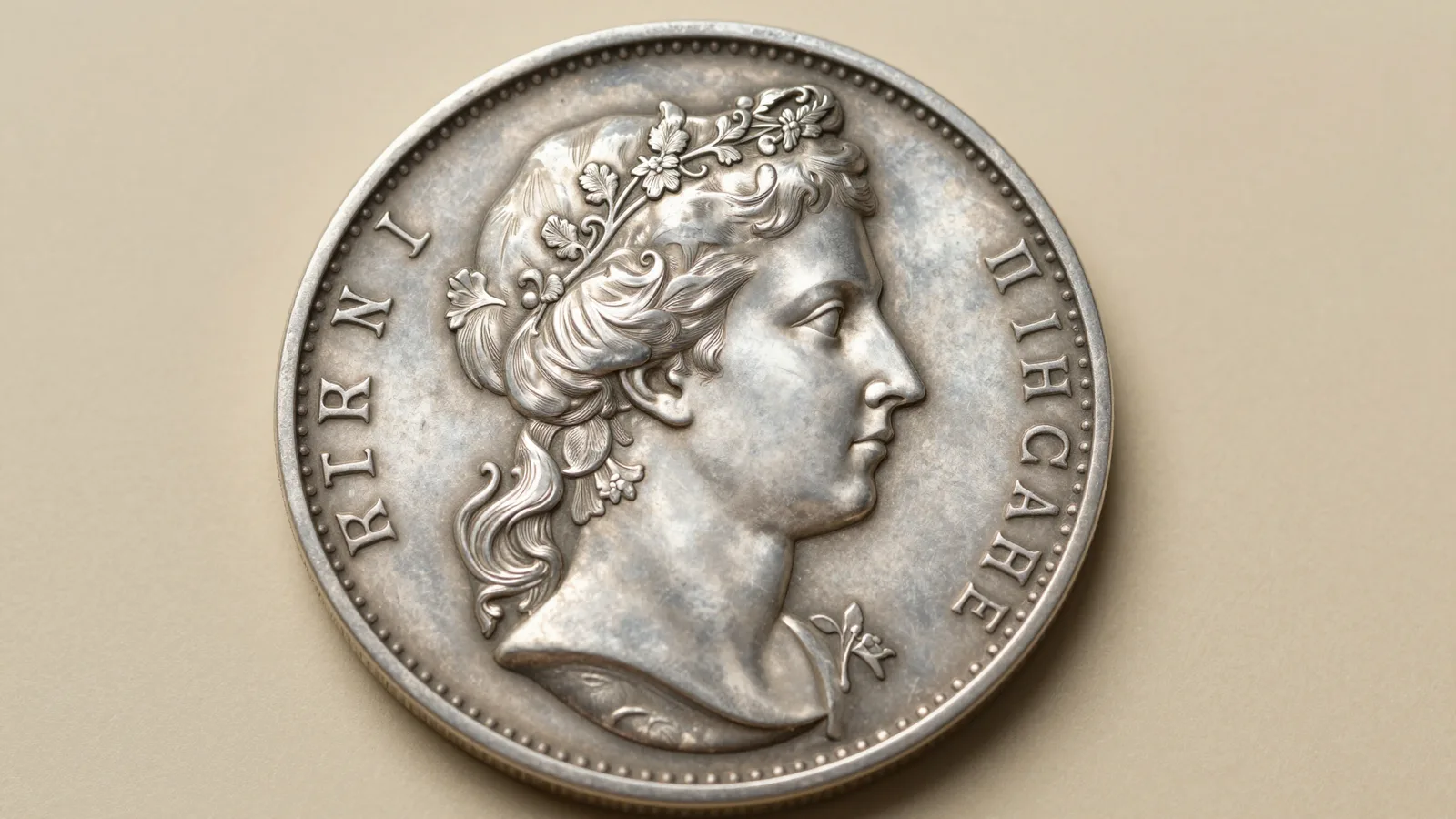
European silver hallmarks identify the origin, purity, and often the period of Continental silver. France stamps a Minerva head for 950 silver, Germany a crescent and crown with 800, Russia used zolotnik numbers such as 84, and Italy a star with a province code. Match the purity number and the national symbol using the country tables below.
How do European hallmarks differ from British hallmarks?
European silver hallmarks differ from British hallmarks in purity standards, mark style, and dating method. Most Continental countries set their legal standard below sterling. Germany chose 800 parts per thousand, the Netherlands 833, and Scandinavia 830. Britain has required 925 since the year 1300, as covered in our UK hallmarks guide.
The visual language differs too. A British piece carries a row of separate punches: standard mark, town mark, date letter, and maker’s mark. Continental systems compress that information into one or two pictorial stamps. A single French Minerva head certifies purity, state guarantee, and assay office at once.
Dating works differently as well. Sweden runs a continuous date-letter cycle, and Britain has used date letters since 1478. Most other European systems date a piece only to a period. A German crescent and crown proves manufacture after 1888, nothing more precise. Collectors then narrow the date by style, maker, and city mark.
Enforcement varied by country, and that history still matters when you handle a piece. France and Russia ran strict state assay systems with legal penalties for evasion. Germany after 1888 allowed makers to stamp their own fineness numbers. Belgium made hallmarking voluntary in 1868. A missing mark on Belgian silver proves nothing; a missing mark on French silver is a warning sign.
Purity numbers are the fastest entry point for identification. Continental marks almost always include a three-digit fineness number or a symbol tied to one. The number narrows the search to two or three countries immediately. Our worldwide purity marks guide lists every standard from 800 to 999.
One habit transfers directly from British to European silver: read the whole group of marks, not one punch in isolation. A hallmark is a system, and each punch checks the others. If a piece shows a French lozenge maker’s mark next to a German crescent and crown, something is wrong. Genuine groups are internally consistent in country, period, and standard.
Takeaway: start with the fineness number, confirm with the national symbol, and treat any mismatch between punches as a red flag.
French silver hallmarks: how do you read the Minerva head?
The Minerva head has certified French silver since 1838: a helmeted head with a 1 beside it for 950 purity or a 2 for 800. It replaced a sequence of Revolutionary and Restoration marks, and it remains in use. France is the only major country whose first-standard silver exceeds sterling.
| Mark | Meaning | Purity | Period |
|---|---|---|---|
| Rooster (coq) | Standard marks of the Revolutionary and Empire years | 950 or 800 | 1798-1819 |
| Old man’s head (vieillard) | Restoration-period standard mark | 950 or 800 | 1819-1838 |
| Minerva head with 1 | First standard | 950 | 1838-present |
| Minerva head with 2 | Second standard | 800 | 1838-present |
| Boar’s head | Small items assayed in Paris | 800 minimum | 1838-1962 |
| Crab | Small items in the provinces, then nationwide | 800 minimum | 1838-present |
| Swan | Imported or second-hand silver of uncertain origin | Varies | 1893-present |
| Lozenge with initials | Maker’s mark, always diamond-shaped | n/a | 1798-present |
The lozenge shape of the maker’s mark is the strongest French tell. Every registered French silversmith stamps initials and a personal symbol inside a diamond-shaped punch. British and American makers use rectangles, circles, or shields. See a lozenge, think France first.
Small objects follow their own path. Spoons, thimbles, and jewellery too small for the full Minerva punch received the boar’s head in Paris or the crab in the provinces. After 1962 the crab became the national small-items mark. A crab on a tiny clasp is normal; a crab on a large tureen is not.
French makers command serious auction respect. Odiot supplied the Empire court, and Puiforcat defined Art Deco silver. A Puiforcat tea service with clean Minerva marks trades well above equivalent English sterling weight. The Metropolitan Museum holds Odiot pieces from the Empire period, useful for comparing genuine punch placement and style.
For a deeper walk through each French mark, including the guarantee heads used for export, read our dedicated French silver hallmarks guide.
Takeaway: 1 beside Minerva means 950, 2 means 800, and a diamond-shaped maker’s punch confirms French origin.
What does the crescent moon and crown mean on German silver?
A crescent moon and crown stamped on silver means German manufacture after 1888 at a fineness of at least 800 parts per thousand. The two symbols, Halbmond und Reichskrone, became the national mark when the German Empire unified its hallmarking law. They always appear beside a fineness number.
| Mark | Meaning | Purity | Period |
|---|---|---|---|
| Crescent and crown | National mark for silver | 800 minimum | 1888-present |
| 800, 835, 900, 925 | Fineness in thousandths, beside the crescent and crown | As stamped | 1888-present |
| 12 Loth | Old lot-system standard | 750 | Pre-1888 |
| 13 Loth | Old lot-system standard | 812.5 | Pre-1888 |
| Augsburg pineapple | City mark | Varies | Pre-1888 |
| Nuremberg N | City mark | Varies | Pre-1888 |
| Berlin bear | City mark | Varies | Pre-1888 |
| Hamburg castle | City mark | Varies | Pre-1888 |
Germany’s system trusts the maker. Unlike France or Britain, no state assay office tests each piece. The manufacturer stamps the crescent, crown, and number under legal liability. In practice the standard held: tested German 800 silver assays at or above its mark with remarkable consistency.
Before 1888 the German states used the Loth system, where 16 Loth meant pure silver. A 13 stamped on old German silver means 13 parts of 16, or 812.5 thousandths. A 12 means 750. These low, plain numbers confuse buyers who expect 925; the piece is solid silver, held to an older standard. Our 800 silver guide covers what the standard means for value.
Export pieces complicate the picture. German factories such as WMF and Bruckmann stamped 925 and the word Sterling on silver made for the American market from the 1890s onward. The crescent and crown still appear on these pieces, which is the giveaway of German origin.
The mid-century decades produced enormous quantities of 835 silver, a standard shared with the Netherlands. Dating an 835 piece by mark alone is impossible; pattern and maker do the work. The 835 silver guide explains the reading order, and full national detail sits in our German silver hallmarks guide.
Takeaway: crescent plus crown equals Germany after 1888; a bare 12 or 13 pushes the date before 1888 and the purity below sterling.
What do the kokoshnik and zolotnik numbers mean on Russian silver?
Russian silver carries zolotnik numbers, a purity scale where 96 equals pure silver. The common mark 84 means 84 parts of 96, or 875 thousandths. The kokoshnik, a woman’s head in traditional headdress, served as the imperial assay mark from 1896 to 1917.
| Mark | Meaning | Purity | Period |
|---|---|---|---|
| 84 | Standard zolotnik fineness | 875 | 1700s-1917 |
| 88 | Higher zolotnik fineness, common on Faberge | 916 | 1700s-1917 |
| 91 | Highest zolotnik fineness | 947 | 1700s-1917 |
| St George and dragon | Moscow city mark | Varies | Pre-1896 |
| Crossed anchors and sceptre | St Petersburg city mark | Varies | Pre-1896 |
| Kokoshnik facing left | Imperial assay mark | With zolotnik number | 1896-1908 |
| Kokoshnik facing right, with letter | Imperial assay mark, district letter added | With zolotnik number | 1908-1917 |
| Worker’s head | Soviet assay mark | 875 common | 1927-1958 |
| Star with hammer and sickle | Soviet assay mark | 875 or 916 | 1958-1994 |
| Kokoshnik facing right | Russian Federation mark | Metric numbers | 1994-present |
The direction of the kokoshnik dates a piece within twelve years. From 1896 to 1908 she faces left. From 1908 to 1917 she faces right, accompanied by a small letter identifying the assay district. That single detail separates a late imperial piece from an earlier one at a glance.
Faberge drives the top of this market, and the marks matter enormously. Genuine Faberge silver shows the firm’s mark, a workmaster’s initials such as those of Julius Rappoport, and an 84 or 88 assay group. Auction records on WorthPoint show marked Faberge serving pieces realizing five-figure sums, while unmarked but attributed pieces bring a fraction of that.
Soviet marks close the sequence. The worker’s head appeared in 1927, replaced in 1958 by a five-pointed star containing a hammer and sickle. Purities moved to the metric 875 and 916. Any seasoned collector knows the jump from 84 to 875 marks the fall of the empire on the object itself.
The full mark sequence, including forgery warnings, is in our Russian silver hallmarks guide.
Takeaway: multiply the zolotnik number by 10.4 to get thousandths, and use the kokoshnik’s facing direction to split 1896-1908 from 1908-1917.
Dutch, Belgian, and Swiss silver marks
The Netherlands marks silver with lions: a lion passant for the 934 first standard and a lion rampant for the 833 second standard, both in use since 1814. A Minerva-head office mark with a letter identifies the Dutch assay office. Small items carry a sword mark.
| Mark | Meaning | Purity | Period |
|---|---|---|---|
| Lion passant with 1 | Dutch first standard | 934 | 1814-present |
| Lion rampant with 2 | Dutch second standard | 833 | 1814-present |
| Minerva head with letter | Dutch assay office mark | n/a | 1814-present |
| Sword | Dutch small-items mark | 833 minimum | 1906-present |
| Key | Dutch tax mark on old pieces re-entering trade | Varies | 1852-1927 |
Dutch 934 confuses collectors because it exceeds sterling yet is not the French 950. It descends from an older ounce-based standard. Most Dutch domestic silver, especially 19th-century spoons, tea caddies, and bread baskets, is second standard 833. Full punch drawings are in our Dutch silver hallmarks guide.
Belgium took the opposite path. Hallmarking became voluntary in 1868, so an unmarked piece of Belgian silver is entirely normal. When marks appear, they are usually a fineness number, 800 or 925, in an oval beside the maker’s mark. Attribution of Belgian silver leans on maker research more than mark reading.
Switzerland concentrated its system on watch cases, its dominant silver industry. The grouse mark certified 800 and 875 standard cases through the late 19th and 20th centuries. Since 1995 a single St Bernard dog’s head covers silver watch cases. Swiss flatware and hollowware follow the fineness-number habit of the surrounding countries.
These three markets are where bargains surface. Dealers who read only British marks pass over an 833 lion rampant or a bare Belgian 800. Those slightly uneven pictorial punches on a Dutch spoon? Hand-struck office marks, and often the only dating evidence the piece will ever give you.
Takeaway: a lion with a Minerva office letter means the Netherlands, a lone fineness oval suggests Belgium, and a grouse or St Bernard head means a Swiss watch case.
Italian, Spanish, and Portuguese silver marks
Italy, Spain, and Portugal each mark silver with a national symbol plus a fineness number: Italy a star, Spain city and star marks, Portugal an eagle. All three systems are less uniform than the French or German ones, and regional history shows in the punches.
| Country | Key mark | Standards | Notes |
|---|---|---|---|
| Italy | Five-pointed star with province code | 800, 925 | National system since 1872; star in a lozenge since 1968 |
| Italy, Fascist era | Fascio littorio | 800 | 1935-1944; collectible period marks |
| Spain | Star, city marks, DE LEY stamps | 915, 925 | Madrid uses the bear and tree; Barcelona its own punches |
| Portugal | Eagle head | 833 and 916, later 835 and 925 | Lisbon and Porto assay offices; standards revised 1985 |
Italian marks read as a formula: fineness number, five-pointed star, province code, and maker number. A stamp reading 800 with a star and 187 FI identifies a specific Florence workshop. The Fascist period inserted the fascio littorio symbol between 1935 and 1944, and those marks now carry a premium as period documents. The full decoding table is in our Italian silver hallmarks guide.
Spanish silver is the least standardized of the three. Historic pieces carry city marks, such as the bear and madrono tree of Madrid, with maker punches and sometimes DE LEY, meaning legal standard. The modern standard is 925, while older Spanish law recognized 915. Court and colonial pieces often escaped marking entirely. Our Spanish silver hallmarks guide maps the star and assay systems in detail.
Portugal ties its eagle mark to two offices, Lisbon and Porto, each with its own punch details. The classic standards were 833 and 916; the 1985 revision moved them to 835 and 925. An eagle with 916 therefore dates a piece before 1985, a rare case of a Southern European mark giving a hard date boundary.
Condition and completeness decide value across all three markets. A Spanish colonial chalice with a documented city mark can outsell a heavier unmarked rival several times over, because the mark carries the attribution.
Takeaway: number plus star means Italy, city symbol plus DE LEY means Spain, and an eagle head with 833 or 916 means Portugal.
How do you read Scandinavian silver marks?
Scandinavian silver marks combine a national symbol with unusually good dating information. Sweden runs a continuous date-letter cycle, Denmark stamps the year into its three-towers mark, and Norway relies on maker and standard stamps. The regional standard is 830, slightly above the German 800.
| Country | National mark | Common purity | Dating method |
|---|---|---|---|
| Sweden | Three crowns with an S | 830 | Continuous date letters since 1759 |
| Denmark | Three towers | 826, 830 | Year digits inside the tower mark; assay master initials |
| Norway | 830S or 925S stamps | 830, 925 | Maker and city marks; no national date letters |
| Finland | Crown in a heart | 813, 916 | Date letters on the Swedish model |
Sweden’s system is the collector’s favourite. The three crowns and an S in a hexagon confirm silver, a city mark places it, and a letter-plus-number code dates it to the exact year. The cycle has run unbroken since 1759, which makes Swedish silver among the easiest in Europe to date precisely.
Danish three-towers marks contain the year in small digits beneath the towers, and from 1904 to 1932 the assay master Christian F. Heise added his initials beside them. Georg Jensen complicates Danish reading in a happy way: the firm used its own documented mark sequences, all dateable. A Jensen piece with towers and Heise initials belongs to the firm’s most sought-after early period.
Norwegian silver speaks plainly: 830S stamped in the metal, with the maker’s name or initials beside it. David-Andersen of Oslo is the name that lifts prices, especially on enamel work. Finland follows the Swedish pattern with a crown in a heart and its own date-letter series.
The Victoria and Albert Museum holds strong Jensen and Scandinavian modernist collections for style comparison. Punch-by-punch drawings for all four countries are in our Scandinavian silver hallmarks guide.
Takeaway: three crowns mean Sweden, three towers with digits mean Denmark and give the year, and 830S alone usually means Norway.
How do you identify an unknown European silver mark?
Identify an unknown European mark by reading the fineness number first, then the national symbol, then the secondary punches. The number alone eliminates most of the map. Only then is a symbol lookup efficient.
| Number | Standard | Most likely origin |
|---|---|---|
| 750 | 12 Loth | German states before 1888 |
| 800 | 800/1000 | Germany, Italy, Austria-Hungary |
| 813 | 813/1000 | Finland |
| 826 | 826/1000 | Denmark |
| 830 | 830/1000 | Sweden, Norway, Denmark, Finland |
| 833 | 833/1000 | Netherlands, Portugal |
| 835 | 835/1000 | Netherlands and Germany, mid-20th century |
| 84 | 84 zolotnik | Russia; equals 875 |
| 875 | 875/1000 | Soviet Union, Baltic states |
| 900 | 900/1000 | Austria-Hungary; also American coin silver |
| 916 | 916/1000 | Portugal before 1985; Russian 88 zolotnik |
| 925 | Sterling | Britain, plus modern makers everywhere |
| 934 | 934/1000 | Netherlands first standard |
| 950 | 950/1000 | France first standard |
Work the sequence in order. Step one, find every punch on the piece; marks hide on rims, hinges, and spoon stems. Step two, read any number against the table above. Step three, match the symbol: heads suggest France or Russia, lions suggest the Netherlands or Britain, crowns suggest Germany or Sweden. Step four, confirm with the maker’s punch shape; a lozenge argues for France, a plain rectangle for most other countries.
Two kinds of references settle the hard cases. Kovel’s maintains searchable maker directories, and auction databases put a mark next to real sale results. Our own silver hallmarks chart collects the major national symbols on one page, and the step-by-step identification guide walks the whole method with photographs.
Watch for the Convention hallmark on modern pieces. Since 1972 the common control mark, a balance scale over the fineness number, has been accepted across member states of the international hallmarking convention. It certifies legitimate cross-border silver; it does not name a country of origin.
If the number and symbol disagree, stop and test. A 925 beside a French Minerva head or an 800 beside a Dutch lion passant signals a married, faked, or misrepresented piece. The beginner’s marks guide and the sterling identification guide cover the follow-up tests.
Takeaway: number first, symbol second, maker’s punch third; disagreement between them is the strongest fraud signal a mark can give.
Frequently Asked Questions
What is the best app to identify European silver hallmarks?
Antique Identifier – Antiqly reads Continental marks such as the French Minerva head, the German crescent and crown, and Italian star punches from a single photo. The app is a free download with no sign-up required. Photograph the mark in raking light, and Antiqly returns the country, the purity standard, and a likely date range in seconds. It handles the pictorial punches that generic image search struggles with, because it was trained on hallmark photographs rather than product listings. For worn marks, take three photos at different angles and compare the readings.
What does 800 mean on European silver?
An 800 stamp means the metal is 80 percent silver, the legal standard of Germany, Italy, and the old Austro-Hungarian Empire. It is solid silver, not plate, and when it appears with the German crescent and crown it dates the piece after 1888. Value sits below sterling weight for weight; melt buyers pay about 13.5 percent less for equal weight. Collectible 800 pieces, such as WMF Art Nouveau hollowware, trade on design rather than fineness, and strong examples outsell plain sterling. Read the accompanying symbols to assign the country before valuing anything marked 800.
Is Continental silver worth less than sterling?
Weight for weight, yes, by the purity gap: 800 silver contains 13.5 percent less silver than 925 sterling. At the collectible end the standard matters far less than maker, period, and quality. A French 950 Puiforcat coffee pot, a Georg Jensen 830 bowl from the Heise years, or a marked Faberge 84 spoon each outprices ordinary English sterling many times over. Auction houses list Continental silver by maker and country first, fineness second. Value the object, then the metal; only scrap dealers reverse that order.
How do I tell which country a silver hallmark comes from?
Start with the fineness number, which narrows origin to two or three countries at once: 950 points to France, 934 or 833 to the Netherlands, 830 to Scandinavia, 875 or 84 to Russia, and 800 to Germany, Italy, or Austria-Hungary. Then match the national symbol: Minerva head for France, crescent and crown for Germany, kokoshnik for Russia, star with province code for Italy, three crowns for Sweden. Finally check the maker’s punch shape, since a diamond-shaped lozenge is a reliable French signature. Mismatched punches point to a married or faked group.
What is the Minerva head mark on French silver?
The Minerva head is the French state guarantee mark for silver, in continuous use since 1838. Minerva wears a helmet, and a small numeral beside the head gives the standard: 1 for 950 fineness, 2 for 800. The punch also encodes the assay office in tiny differential details. Earlier French silver used the rooster from 1798 to 1819 and the old man’s head from 1819 to 1838. Because 950 exceeds sterling, first-standard French silver is softer, and crisp Minerva punches survive best on heavier pieces. Even a worn Minerva still identifies country and period reliably.
What is 84 zolotnik silver?
84 zolotnik is the classic Russian silver standard, equal to 875/1000, because the zolotnik scale runs to 96 for pure silver. The 84 appears beside the imperial assay marks: city punches before 1896, then the kokoshnik head from 1896 to 1917. Most imperial Russian flatware, kovshi, and cigarette cases are 84 standard. The finer 88 standard, 916/1000, appears on much Faberge silver, and 91 is rare. Soviet marks switched to the metric 875 from 1927. An 84 with a convincing kokoshnik is the first authenticity gate for any Russian piece.
What is the Convention hallmark or common control mark?
The Convention hallmark, also called the common control mark, is an international punch created by the 1972 Vienna Convention on the control of precious metals. For silver it shows a balance scale over the fineness number, such as 925 or 800, inside a shaped outline. Member states, including the UK, Switzerland, and most Nordic countries, accept the mark without re-assay at import. It appears alongside national marks rather than replacing them. On antique silver it is an anachronism: a convention mark on a supposedly Victorian piece proves later marking or outright fakery.
Do all European countries still hallmark silver?
No. Compulsory hallmarking survives in France, the Netherlands, Portugal, and the Nordic assay traditions, while Germany, Italy, and Belgium rely on maker-declared fineness numbers under consumer law. Britain and Ireland retain full compulsory assay for silver above small-weight exemptions. This split explains why a modern German 925 ring shows only a number and a maker, while a comparable British ring carries a full mark group. For antiques, the historic system in force at the time of making is what counts, so date the piece first and judge its marks against the rules of that period.