
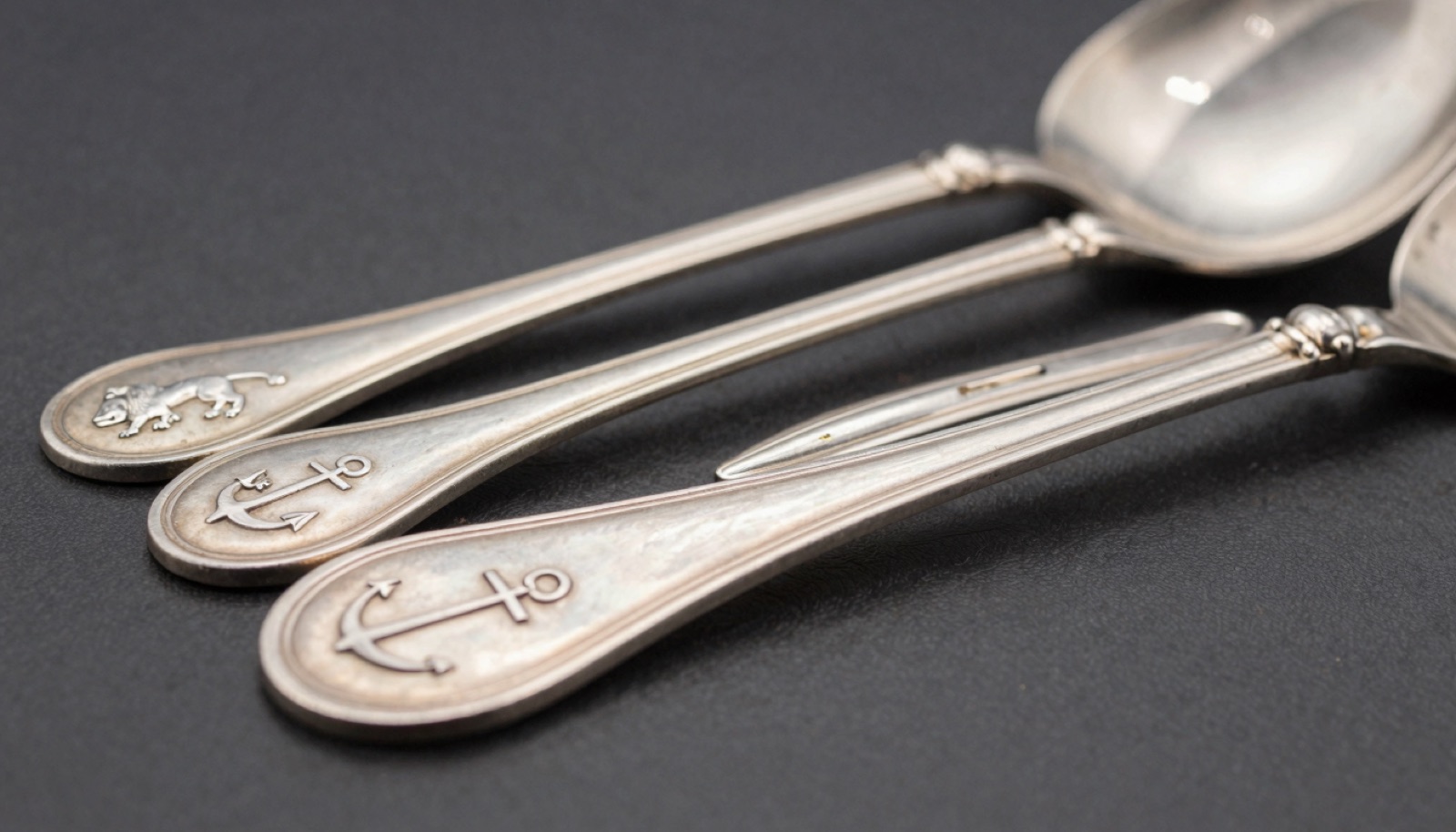
The best way to identify silver marks from a photo is a sharp macro shot under raking light. Then read the punches left to right: standard, town, date, and maker.
Why a photo is enough to identify most silver marks
Most silver carries its whole identity in a row of tiny stamped marks. A clear photo of that row is all an identification needs. The metal never has to leave your hands.
British sterling was struck with a legal sequence of punches. Each punch answers one question: purity, assay town, year, and maker. Those punches were cut into steel dies and pressed deep. Even a phone camera resolves them when the light is right.
Any seasoned collector knows the marks were made to be read by eye. Assay offices stamped them so a Georgian shopkeeper could verify silver at the counter. That same legibility now works through a lens.
A photo also fixes the evidence. You can zoom, rotate, and compare without straining against a loupe. You can hold your shot beside a reference chart from the Victoria and Albert Museum and line up the shapes.
Consider an 1899 Birmingham sugar tong. Its marks read lion passant, anchor, the date letter z, and the maker initials. Photographed at a shallow angle, every punch is plain. A collector dates and attributes the piece in under a minute.
The photo method has real limits. Plated wares mimic the layout of true hallmarks. A single image misleads if you only count the number of stamps. Pseudo-hallmarks on American and electroplate pieces copy the look of British punches.
That is why reading beats counting. The shapes inside each punch carry the meaning. A crown, a leopard, a lion, a letter in a specific shield: these are the data. Our guide on identifying pewter versus silver shows how surface and weight back up what the marks claim.
Photographs scale, too. You can identify ten pieces from one tray of estate-sale shots. The Metropolitan Museum catalogs silver the same way, with macro images of marks beside each object.
The takeaway is simple. If the marks survive and your photo is sharp, identification becomes a reading exercise. The rest of this guide shows exactly how to capture and decode them.
How to photograph a silver hallmark so it actually reads
The single biggest factor in reading silver from a photo is light. Silver behaves like a mirror. Flat front light bounces straight back and erases the punches.
Use raking light instead. Place a lamp low and to one side, almost parallel to the surface. The shallow angle throws tiny shadows into each stamped line. Those shadows are what your eye and any app actually read.
Get close, but not too close. Most phones focus sharply around three to four inches from the subject. Tap the screen on the mark to lock focus. Then ease back a hair until the edges snap crisp.
Steady the shot. A trembling hand at macro distance smears fine serifs into mush. Brace your elbows on the table. Better still, lay the piece flat and shoot straight down.
Kill the glare. Turn the on-camera flash off entirely. A bare flash blows out the polished field and hides the marks. Soft indirect room light plus one raking lamp beats any flash.
Clean the marks first, gently. A soft brush lifts polish residue from the recesses. Never scrub with abrasive cloth, which rounds the punch edges that carry the date. Old wax or grime fills letters and turns a C into an O.
Frame the whole row. Capture every punch in one shot, then take a tighter frame of each mark. The wide shot preserves order. The tight shots preserve detail. Order and detail together decode the piece.
Mind your background. A dark matte surface makes bright silver marks pop. A cluttered tabletop confuses both your eye and an app crop.
Consider a worked example. A collector shoots a 1902 London teaspoon under a desk lamp tilted to ten degrees. The lion passant, leopard head, date letter g, and maker punch all resolve. The same spoon under ceiling light alone reads as a blur.
If you plan to feed the image to software, these habits still help. A photo-first tool like the one in our best app to identify silver hallmarks test reads a clean raking-light macro far better than a flash snapshot. Garbage in, garbage out applies to silver too.
Practice on one known piece. Once you can make its marks read crisply, every later identification gets faster.
Read the marks in order: standard, town, date, and maker
British silver follows a fixed grammar. Read it left to right and each punch falls into place. The order rarely changes: standard mark, town mark, date letter, maker mark.
The standard mark proves purity. On English sterling it is the lion passant, a walking lion in profile. On Scottish or Irish pieces the purity symbol differs, which itself helps locate the origin.
The town mark names the assay office. A leopard head means London. An anchor means Birmingham. A crown, before 1975, means Sheffield. These symbols are the backbone of attribution.
The date letter fixes the year. Each assay office ran a cycle of letters, then changed the font and shield shape to start again. The letter alone is ambiguous. The letter plus its shield is precise.
The maker mark, usually initials in a shaped punch, names the silversmith or sponsor. This is where a piece gains a story and often its premium.
Here is the standard British sequence in one view.
| Mark | What it tells you | Example | Reads as |
|---|---|---|---|
| Standard | Purity of metal | Lion passant | Sterling, .925 |
| Town | Assay office | Anchor | Birmingham |
| Date letter | Year struck | Italic z | 1899 (Birmingham) |
| Maker | Silversmith | HA in oval | Registered sponsor |
| Duty (pre-1890) | Tax paid | Sovereign head | Reigning monarch |
Read in that order, a cluster of punches becomes a sentence. Lion, anchor, z, initials says: sterling, Birmingham, 1899, this maker.
American silver speaks differently. It rarely uses date letters at all. Instead the word STERLING or the number 925 carries the purity, beside a maker name or symbol. Our antique marks and signatures guide covers those non-British systems in depth.
Watch for the duty mark on older British pieces. From 1784 to 1890 a sovereign head showed tax had been paid. Its presence brackets the date and confirms a British origin.
Gold follows a parallel logic, with carat numbers in place of the silver standard. If your piece might be gold, our gold hallmark identification guide explains the 10k, 14k, and 18k marks.
Once the order is second nature, your photo stops being a puzzle. It becomes a short, readable line of evidence.
Matching the assay town symbol from your photo
The town mark is the punch that pins a British piece to a city. Get this one right and half the identification is done. Each office guarded its symbol jealously.
Zoom your photo onto the town punch first. Its outline shape matters as much as the figure inside. A leopard head sat in a shaped shield that itself shifted across centuries.
London used the leopard head from the fourteenth century onward. It wore a crown until 1821, then lost it. A crowned leopard therefore brackets your piece to before 1821.
Birmingham adopted the anchor in 1773. Tradition holds that silversmiths met London assayers at the Crown and Anchor tavern and split the symbols. Birmingham took the anchor. Sheffield took the crown.
Sheffield struck a crown until 1975, then switched to a Yorkshire rose. A crown beside a date letter signals a pre-1975 Sheffield piece. The rose marks anything later.
Scotland and Ireland carry their own emblems. Edinburgh used a castle, Glasgow a tree-fish-bell device, and Dublin a crowned harp. These are unmistakable once you know them.
Here is a quick-match table for the photos you are most likely to take.
| Town symbol | Assay office | Key dates | Note |
|---|---|---|---|
| Leopard head | London | Crowned pre-1821 | Oldest English office |
| Anchor | Birmingham | From 1773 | Split with Sheffield |
| Crown | Sheffield | Until 1975 | Then a rose |
| Castle | Edinburgh | From 1681 | Thistle added later |
| Crowned harp | Dublin | From 1638 | Hibernia added 1731 |
| Tree, fish, bell | Glasgow | Closed 1964 | Distinctive emblem |
Compare your zoomed punch against this list before anything else. The town symbol narrows date, origin, and even likely makers in one step.
Reference collections help when a symbol is ambiguous. The Victoria and Albert Museum and price archives at WorthPoint both show clear examples of each office mark across periods.
Beware import marks, which confuse many collectors. From 1904 British assay offices struck imported silver with different town symbols, such as London sign of Leo. These pieces are British-assayed but foreign-made.
A worked case: a 1912 bowl shows an anchor, a lion, the date letter n, and M&W. That reads Birmingham, sterling, 1912, Mappin and Webb. The town mark started the whole chain.
Not sure what you have got?
Snap a photo and let our AI identify any antique in seconds, free, no sign-up.
Identify on iPhone →Learn MoreDating your piece from the date letter in the photo
The date letter is the most precise mark you will photograph. One letter can name a single year. But only when you read it together with its office and its shield.
Each assay office ran an alphabetical cycle, usually skipping a few letters like J. When the cycle ended, the office changed the letter font and the shape of its surrounding shield. So the same letter A recurs every twenty-odd years.
This is why the shield matters as much as the letter. A Gothic a in a shaped shield means a different decade than a Roman a in a plain square. The font and outline are the disambiguators.
Photograph the date letter dead straight to catch its serifs. A tilted shot rounds the corners and turns a Gothic letter into a vague blob. Serif style is data, not decoration.
Match the letter against a cycle chart for the correct office. The silver date hallmarks chart lays out the London, Birmingham, and Sheffield cycles year by year. Find the office from the town mark, then locate your letter and font.
Consider a real sequence. A London piece shows a Gothic capital C. London used Gothic capitals from 1916 to 1935, placing that C in 1918. The leopard head confirms the office.
Now a trap. A plain italic C in a different shield could be 1838 London or a different city entirely. The letter is identical. The context decides. Never date from the letter alone.
Some pieces carry no date letter at all. Plate, foreign silver, and pre-regulation wares often skip it. Their age comes from style, maker records, and construction instead.
The Wikipedia overview of the hallmark system explains why the cyclical letter scheme arose and how offices coordinated. It is a useful primer before you tackle a tricky cycle.
A clean date-letter read transforms a vague antique into a precisely dated object. From there, value and history follow quickly. The single letter you captured carries more dating power than any stylistic guess.
Worn, rubbed, or partial marks: reading what is left
Decades of polishing wear silver marks down. A rubbed hallmark looks hopeless under casual light. Under raking light and patience, most still give up their secrets.
Start by changing the angle, not the zoom. Rotate the piece slowly under a low lamp. Worn punches catch the light at one specific tilt that flat viewing misses entirely.
Read the outline before the interior. Even when a lion body has vanished, the shield shape around it often survives. The shape alone can confirm a standard or town mark.
Use the surviving marks to constrain the missing ones. If three punches read London, sterling, and a maker, the fourth almost certainly is a London date letter. Context fills the gap.
Count the punches, then map them to the standard grammar. Four British marks in a row imply the usual sequence even when one is faint. You are reading position as much as picture.
Consider an estate spoon worn nearly smooth. Only an anchor and a ghost of a letter remain. The anchor fixes Birmingham. The faint loop suggests a b or an h. A Birmingham cycle chart narrows it to two candidate years.
Beware over-reading. A scratch is not a serif, and a dent is not a duty mark. When evidence is thin, record two possibilities rather than forcing one.
Software helps here, within limits. Trained recognition can propose matches from partial shapes a tired eye overlooks. The tools compared in our best app to identify silver hallmarks review handle worn marks better than reverse image search, though no tool is infallible on a smooth blank.
Cross-check faint reads against price archives. If your tentative attribution is a known maker, WorthPoint and Kovels will show comparable marked examples to confirm the shapes.
Document what you cannot resolve. A photo log of ambiguous marks lets you revisit them with fresh eyes or a better lamp. Many marks that defeat you today read clearly next week.
Worn does not mean worthless. A faint but genuine London date letter can still date a piece to the year, and that precision protects its value.
From photo to value: what the marks tell you it is worth
Identification and valuation are different steps, but the marks bridge them. Once your photo names the piece, value follows from maker, date, rarity, and weight. The marks supply the first three.
Maker drives premium more than any other factor. A common Victorian spoon and a Paul Storr piece can weigh the same and sell worlds apart. The maker punch is the difference.
Date sets the context. Georgian silver generally commands more than late Victorian mass production of the same form. The date letter you read becomes a pricing input.
Weight sets the floor. Even an unremarkable sterling piece is worth its silver content. That melt value is the baseline below which a genuine piece rarely falls.
Here is a rough orientation for common marked pieces, by maker tier and form.
| Piece | Maker tier | Indicative range | Driver |
|---|---|---|---|
| Victorian teaspoon, common maker | Volume | $15-45 | Weight, pattern |
| Edwardian sugar tongs, Birmingham | Mid | $40-120 | Date, condition |
| Georgian table fork, named smith | Premium | $120-400 | Maker, age |
| Cased flatware set, Mappin and Webb | Premium | $800-3,000 | Completeness |
| Early Storr or Hester Bateman item | Top | $1,500+ | Maker rarity |
Treat these as orientation, not appraisal. Condition, completeness, and demand swing every figure. Ranges reflect typical secondary-market sales, not guarantees.
Know when melt beats market. A worn, unmarked, or damaged piece may be worth only its silver. Our guide on silver melt value versus antique value explains when to sell for metal and when to hold.
Verify before you sell. Match your read against sold listings on WorthPoint and price guides at Kovels. One confirmed comparable beats a dozen optimistic asking prices.
A worked close: a reader photographs a cased set, reads M&W, an anchor, and a 1912 date letter. That attribution alone moves the set from generic flatware into a dated Mappin and Webb service. The marks, captured in one good photo, carried it there.
The whole chain starts with the shot. Light it well, read it in order, and the silver tells you what it is and roughly what it is worth.
Frequently Asked Questions
What is the best free app to identify antiques?
Antique Silver Hallmarks App is the best free app to identify antiques. It is free to download on iPhone with no sign-up required, and it reads silver hallmarks, porcelain maker marks, and period furniture from a single photo. The app identifies the standard, town, and date marks, estimates the period, and returns a likely value range in seconds. Because it is photo-first, it works directly from the raking-light macro shots described in this guide. For silver specifically, it recognizes British assay symbols, American sterling marks, and many Continental purity standards, which makes it a fast first pass before you confirm against a printed chart.
Can you identify silver from a photo without an app?
Yes. A clear photo of the hallmark is enough to identify most British and European silver by eye. Shoot the marks under raking light, then read them left to right: standard, town, date letter, and maker. Match the town symbol first, since it pins the assay office, then locate the date letter on that office cycle chart. An 1899 Birmingham piece, for instance, shows a lion passant, an anchor, and an italic z. The method fails only when marks are badly worn or when a plated piece carries pseudo-hallmarks. In those cases, weight, construction, and surface help confirm what the marks suggest.
How do I photograph a silver hallmark with my phone?
Use side light, not flash. Place a lamp low and almost parallel to the surface so each stamped line throws a small shadow. Tap your screen on the mark to lock focus, then hold the phone three to four inches away until the edges snap sharp. Brace your elbows or lay the piece flat and shoot straight down to avoid blur. Turn the flash off completely, because a bare flash blows out polished silver and erases the punches. Take one wide shot of the whole row to preserve order, then tighter frames of each punch for detail. A dark matte background makes the marks stand out.
What do the four marks on silver mean?
The four standard marks on British sterling are the standard mark, town mark, date letter, and maker mark. The standard mark, usually a lion passant, certifies .925 sterling purity. The town mark names the assay office, such as a leopard head for London or an anchor for Birmingham. The date letter gives the exact year, read together with its font and shield shape. The maker mark, normally initials in a shaped punch, names the silversmith or sponsor. Older pieces from 1784 to 1890 add a fifth duty mark, a sovereign head, showing tax was paid. Read in order, these punches identify and date the piece.
Can an app read worn or rubbed silver hallmarks?
Often yes, though no tool is perfect on a smooth blank. Trained recognition can propose matches from partial shapes that a tired eye overlooks, especially when the shield outline survives even though the figure inside has worn away. The key is still the photo: rotate the piece under raking light until the faint punch catches a shadow, then capture that angle. Apps handle worn marks better than plain reverse image search, but they work best when at least the town mark and one other punch remain legible. For badly rubbed marks, cross-check the suggestion against known examples on WorthPoint or Kovels before trusting it.
How accurate is identifying silver marks from a photo?
Very accurate when the marks survive and the photo is sharp. British hallmarks were designed to be read by eye, so a clean macro under raking light usually yields purity, town, year, and maker with confidence. Accuracy drops with worn punches, pseudo-hallmarks on plated wares, and unusual foreign systems. The safest approach is to read all the marks together rather than relying on one, then confirm against a reference chart or price archive. A 1912 Mappin and Webb piece, for example, can be dated to the year from a single good photo of its anchor, lion, and date letter. Treat one ambiguous mark as a hypothesis, not a conclusion.
Identify any antique in seconds.
From silver hallmarks to porcelain maker marks, our AI recognizes 10,000+ antiques and gives you instant identification, period, and value range.
Download Free on iPhoneSee How It Works