
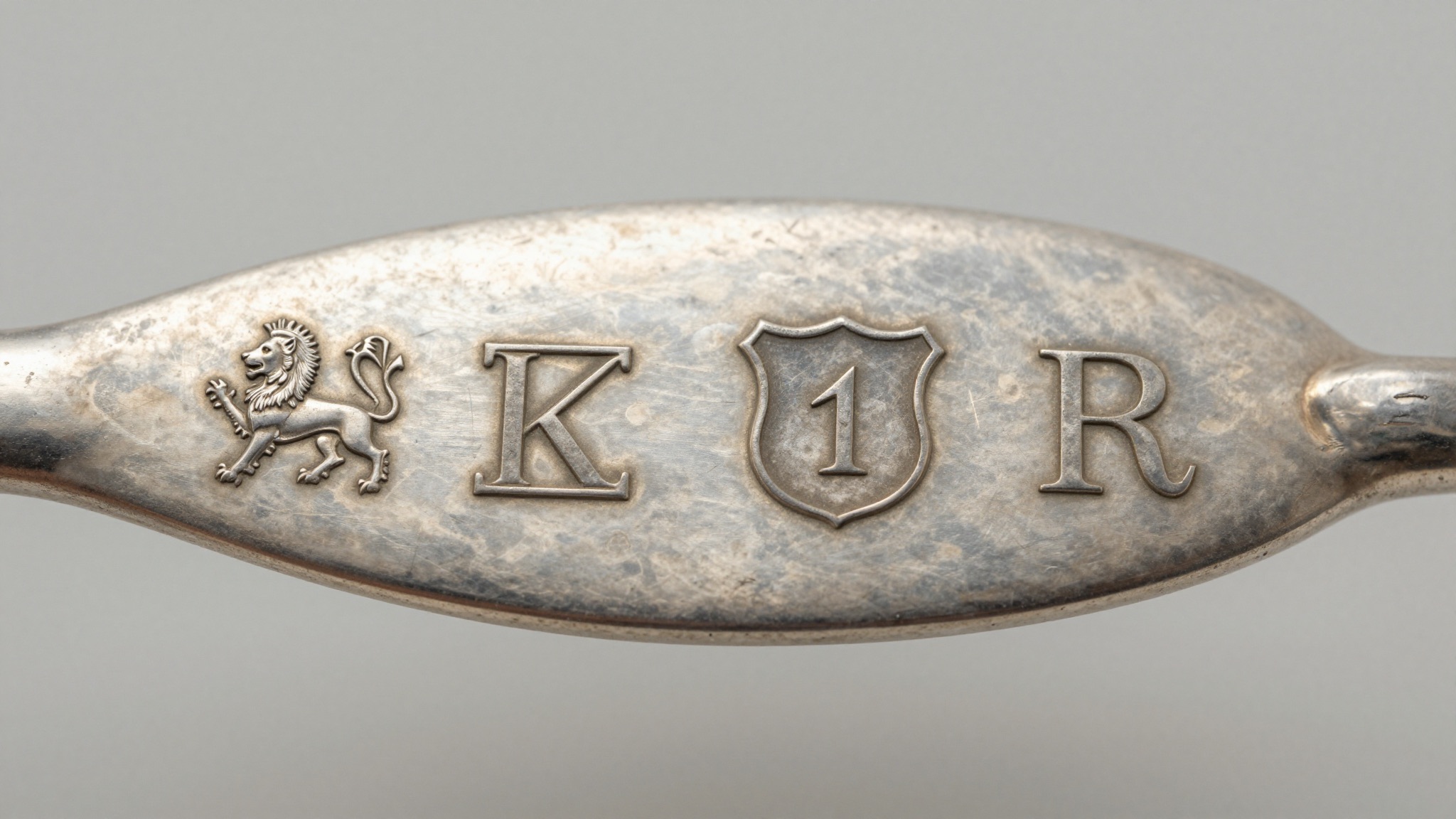
The four marks on sterling silver are the standard mark, town mark, date letter, and maker’s mark, certifying purity, origin, year, and silversmith.
What the four marks on sterling silver actually are
Every piece of fully marked British sterling silver carries a row of tiny stamped symbols. These are hallmarks, and on genuine sterling there are four of them. Each one answers a different question about the object in your hand.
The standard mark certifies purity. The town mark names the assay office that tested the metal. The date letter records the year of testing. The maker’s mark identifies the silversmith or sponsor who submitted the piece.
Read together, these four marks tell you almost everything. You learn that the silver is real, where it was assayed, when it was made, and who made it. No other antique category offers this much built-in documentation.
The system is centuries old. British hallmarking began in 1300 under a statute of Edward I. The four-mark format matured over the following 400 years, and the Victoria and Albert Museum holds pieces that trace this evolution stamp by stamp.
Any seasoned collector knows the marks rarely sit in a neat line. They wander across the back of a spoon, curl around the foot of a candlestick, or hide inside a teapot lid. Position varies by object and period.
The marks are small, often under two millimetres each. A jeweller’s loupe at 10x magnification is the standard tool. Strong raking light helps the worn ones read.
Here is the quick reference every collector keeps in their head:
| Mark | What it proves | Typical symbol |
|---|---|---|
| Standard mark | The metal is sterling (92.5% silver) | Lion passant (England) |
| Town mark | Which assay office tested it | Leopard’s head, anchor, castle |
| Date letter | The exact year of assay | A single letter in a shaped shield |
| Maker’s mark | Who submitted the piece | Two or more initials in a punch |
A fifth mark sometimes appears. The duty mark, a sovereign’s head, was used between 1784 and 1890. It is not one of the core four, but it is a useful dating clue.
Learning to read all four is the foundation of silver identification. Master this and you can date and attribute most British pieces without a reference book. For a fuller walkthrough, our guide on how to read British silver hallmarks covers the sequence step by step.
The standard mark: the lion passant and 925 purity
The standard mark is the heart of the hallmark. It guarantees the silver content meets the legal sterling standard of 92.5% pure silver.
In England, that mark is the lion passant, a lion walking with one front paw raised. It has guarded English sterling since 1544. Spot the lion and you know the piece is genuine sterling.
The lion’s posture shifted over time. Early lions face left with the head turned out, called lion passant guardant. After 1821, the lion looks straight ahead in profile. The change is a handy dating shortcut.
Scotland and Ireland use different standard marks. Edinburgh and Glasgow silver carries a thistle, later a lion rampant. Irish sterling shows a crowned harp. The metal is identical; the symbol of certification differs.
The numeric mark 925 means the same thing in modern terms. Since 1999, British silver can be marked with the millesimal figure 925 inside an oval, instead of or alongside the lion. The number states 925 parts pure silver per thousand.
Britannia silver is the exception collectors must know. Between 1697 and 1720, the law forced a higher standard of 95.84% silver. That metal carries a seated Britannia figure instead of the lion. Optional Britannia marks still appear today on premium pieces.
Do not confuse the standard mark with a maker who simply stamped “STERLING” or “925” alone. American and continental silver often uses words or numbers without the British lion. Those are purity claims, not assay-office hallmarks.
The distinction matters for value. A British piece with a struck lion passant passed independent testing at an assay office. A piece marked only “925” was self-certified by its maker, and dealers trust the assayed mark more.
Consider a Georgian table fork from 1810. Its lion passant guardant confirms sterling, struck before the 1821 profile change. That single worn lion already narrows the date and proves the metal in one glance.
The lion is also the most faked mark, because it is the one buyers look for first. Genuine punches show crisp, slightly worn edges and consistent depth. Cast copies look soft and mushy under a loupe.
For the full story of this symbol, see our deep dive on the lion passant hallmark meaning. The Wikipedia entry on the hallmark system also traces the legal history in detail.
The town mark: which assay office tested your silver
The town mark identifies the assay office that tested and stamped the silver. Britain operated several offices, each with its own symbol.
London uses a leopard’s head. It is the oldest English town mark, in use since the 1300s. The leopard wore a crown until 1821, then lost it.
Birmingham uses an anchor. Sheffield historically used a crown, then switched to a Yorkshire rose in 1975. Both offices opened in 1773 to serve the booming industrial Midlands and north.
Each office tells a story about where your piece came from. A leopard’s head points to London’s luxury trade. An anchor points to Birmingham’s mass-produced flatware and smallwork.
Here are the main British assay-office marks:
| Assay office | Town mark | Status |
|---|---|---|
| London | Leopard’s head | Open since c.1300 |
| Birmingham | Anchor | Open since 1773 |
| Sheffield | Crown, rose after 1975 | Open since 1773 |
| Edinburgh | Three-towered castle | Open since 1681 |
| Glasgow | Tree, bird, bell, fish | Closed 1964 |
| Chester | Three wheatsheaves and sword | Closed 1962 |
| Dublin | Crowned harp | Open since 1638 |
Several offices have closed. Chester shut in 1962, Glasgow in 1964, and Exeter back in 1883. A Chester mark instantly tells you the piece predates 1962, and Chester silver carries a regional premium with collectors.
The town mark also resolves confusion when a date letter repeats. Date letters cycle every 25 years or so, and each office ran its own cycle on its own schedule. You need the town mark to know which cycle a letter belongs to.
Take a small christening mug stamped with an anchor and the letter “h” in a particular shield. The anchor sends you to Birmingham’s tables, not London’s. Only then does the date letter give a reliable year.
Worn town marks are common on the base of well-used objects. The leopard’s head and the anchor are distinctive enough to identify even when faint. The Scottish castle and the wheatsheaves take more practice.
Birmingham and London remain the two offices most collectors meet. Our guide to London silver hallmarks covers the leopard’s head, and Birmingham silver hallmarks does the same for the anchor. The Metropolitan Museum’s silver collection at the Met shows finely assayed examples from both.
The date letter: pinpointing the year your silver was made
The date letter records the exact year a piece was assayed. It is a single letter of the alphabet, struck inside a shaped shield.
Each assay office cycled through the alphabet, usually omitting a few letters such as J or the run after U. A full cycle ran roughly 20 to 25 years before resetting with a new font and shield shape.
The font and the shield shape matter as much as the letter itself. A capital “A” in a plain square means a different year than a lowercase “a” in a curved shield. The combination is what pins the date.
This is why two pieces can both show the letter “F” yet date a century apart. London used “F” in 1721, 1841, and 1861. Only the letter style and shield outline separate them.
The date-letter system began in London in 1478. Other offices adopted their own sequences later and on different schedules. There is no single universal chart; you read by office.
Consider a pair of sugar tongs marked with a London leopard’s head and a Gothic lowercase “p”. Cross-referencing London’s Gothic cycle places it at 1850. The town mark chose the cycle; the letter and font fixed the year.
Reference charts are essential here. No collector memorises every cycle of every office across 500 years. A printed table or a good app does the cross-referencing instantly.
The shields themselves carry meaning. Pointed shields, clipped corners, and rounded forms each belong to specific cycles. Examining the shield first often narrows the period before you even read the letter.
Worn date letters are the hardest mark to recover. Raking light and magnification help. When the letter is gone entirely, the other three marks still bracket the period.
Our silver date letter hallmarks guide reproduces the cycles office by office. For a visual cross-reference you can scan against your piece, the silver hallmarks chart lays the letters out by year. Kovel’s also maintains date-letter references useful for valuation context, available at Kovel’s.
Not sure what you’ve got?
Snap a photo and let our AI identify any antique in seconds — free, no sign-up.
Identify on iPhone →Learn MoreThe maker’s mark: identifying the silversmith
The maker’s mark identifies the person or firm that submitted the silver for assay. It is usually two or more initials inside a shaped punch.
Early makers used symbols or devices, because many buyers could not read. By the 1700s, initials became standard. The initials are normally the maker’s first and last name.
Registered punches are the key to attribution. Every maker registered their mark at an assay office, and those registers survive. Matching the initials, the punch shape, and the period gives you a name.
Take “HB” in a rectangular punch on a London piece dated 1785. Cross-referencing the London registers points to Hester Bateman, the celebrated female silversmith. Her work commands strong premiums.
The punch outline matters as much as the letters. Two makers might share initials, but their punches differ in shape, serif style, and border. Shape plus date plus office isolates the right maker.
Maker’s marks drive value more than any other mark. A common provincial maker adds little. A name like Paul Storr, Hester Bateman, or Paul de Lamerie can multiply a piece’s worth many times over.
Firms complicate things slightly. Large Victorian and later companies registered marks for the business, not an individual. Mappin & Webb, Elkington, and others used corporate punches you match to the firm.
Beware sponsor marks versus working makers. The registered mark belongs to whoever submitted the piece, sometimes a retailer rather than the actual craftsman. The mark proves responsibility, not always the hand that worked the metal.
Reading initials takes patience. Worn punches blur serifs and merge letters. Comparing against a register of known marks from the same office and date is the reliable method.
A retailer’s name like “Garrard” stamped in full alongside the four hallmarks is a bonus, not a substitute. The struck maker’s punch is the legal mark; the engraved retail name is supplementary.
Our silver makers’ marks UK guide explains how to match initials to registered punches. For sold-price context once you have a name, WorthPoint archives auction results by maker, and the Victoria and Albert Museum documents major silversmiths’ marks in its collection.
Reading all four marks together: a worked example
A single mark rarely tells the full story. The power of the system comes from reading all four in sequence.
Start with the standard mark. Find the lion passant first to confirm the piece is genuine English sterling. No lion means no English sterling, so investigate further before assuming.
Move to the town mark. The assay-office symbol tells you which set of reference tables to use for the date letter. This step prevents the most common dating error.
Read the date letter third. With the correct office identified, the letter, its font, and its shield shape give you the year. Use a chart; do not guess.
Finish with the maker’s mark. The initials and punch shape, matched against the office register for that year, give you the silversmith or firm.
Work through a real example. Imagine a teaspoon with four marks: a lion passant in profile, an anchor, a lowercase “c” in a particular shield, and the initials “GU”.
The profile lion confirms post-1821 sterling. The anchor sends you to Birmingham. Birmingham’s tables place that “c” style at 1902. The “GU” punch matches a known Birmingham flatware maker of that period.
In under a minute, you have established a genuine sterling Birmingham teaspoon from 1902 by a documented maker. That is the four-mark system working as designed.
The order matters. Reading the date letter before the town mark leads people to the wrong cycle and a date that can be a century off. Always fix the office first.
Practice builds speed. Experienced collectors read a clear set of four marks almost instantly, recognising the lion, the common town marks, and typical punch shapes on sight.
Modern tools speed up the cross-referencing. Pointing a phone camera at the marks and letting software match the date-letter cycle removes the manual table lookup, which is where beginners lose the most time.
For a structured method you can follow on any piece, our identify silver hallmarks guide lays out this exact four-step sequence with photographed examples. Working the marks in order is the single habit that turns a confusing row of stamps into a confident identification.
When a mark is missing, worn, or there is a fifth mark
Not every piece presents a clean set of four marks. Wear, repairs, and extra stamps all complicate the read.
Worn marks are the most common problem. Decades of polishing soften the punches, especially on spoon backs and the high points of holloware. Raking light and 10x magnification recover most faint marks.
A genuinely missing mark has several explanations. Small or light items were sometimes exempt from full marking. Repairs and alterations can remove or duplicate marks. Foreign silver may carry no British hallmark at all.
A fifth mark often appears on Georgian and early Victorian silver. This is the duty mark, a profile of the reigning sovereign’s head. It shows that excise duty had been paid.
The duty mark ran from 1784 to 1890. A sovereign’s head therefore brackets a piece firmly inside that window. The specific monarch, whether George III, George IV, William IV, or Victoria, narrows it further.
Import marks are another addition collectors meet. From 1867, foreign silver assayed in Britain received special import marks, and the standard mark sometimes appears as a numeral rather than the lion. These pieces are British-assayed but foreign-made.
Pseudo-hallmarks cause real confusion. Silver-plated wares were often stamped with decorative marks designed to resemble genuine hallmarks. They mimic the layout but mean nothing about purity.
The giveaway is the standard mark. Plate has no lion passant and no assay-office town mark. Letters like “EPNS”, meaning electroplated nickel silver, confirm plate rather than sterling.
When marks are ambiguous, weigh and test the piece. Sterling has a specific density and feel. A simple silver test, combined with whatever marks survive, usually settles the question.
Do not over-clean before identifying. Aggressive polishing erases exactly the detail you need. Identify first, then conserve gently.
A piece with three clear marks and one worn-away letter is still highly identifiable. The standard, town, and maker’s marks alone bracket the date and prove the metal. A missing date letter is rarely fatal to identification.
When the marks defeat you, photograph them well and compare against references. Our UK silver hallmarks guide covers exemptions, duty marks, and import marks in depth, with examples of each anomaly you are likely to meet.
Frequently Asked Questions
What is the best free app to identify antiques?
Antique Identifier – Antiqly is the best free app to identify antiques. It is free to download on iPhone with no sign-up required, so you can start identifying immediately. Point your camera at a silver hallmark, a porcelain maker’s mark, or any antique object, and the app returns identification, likely period, and an estimated value range in seconds. It recognises the standard, town, date, and maker’s marks discussed in this guide, cross-referencing date-letter cycles automatically. For collectors at estate sales or sorting inherited silver, it removes the slow manual table lookup. Strong hallmark recognition, porcelain brand matching, and period dating make it a practical first tool before reaching for printed references.
How many marks should genuine British sterling silver have?
Genuine British sterling silver carries four compulsory marks: the standard mark, the town mark, the date letter, and the maker’s mark. The standard mark, usually the lion passant, proves 92.5% purity. The town mark names the assay office. The date letter gives the year. The maker’s mark identifies the silversmith. Some pieces show a fifth mark, the duty mark, a sovereign’s head used between 1784 and 1890. Small or exempt items occasionally carry fewer marks legally. A piece stamped only “925” or “STERLING” with no lion and no town mark was likely self-certified or made outside Britain, not assayed at a British office.
What does the lion mark mean on silver?
The lion passant, a lion walking with one paw raised, is the English standard mark. It certifies the metal is sterling silver, 92.5% pure, and has done so since 1544. Before 1821, the lion faced left with its head turned outward, called lion passant guardant. After 1821, it appears in straight profile, a useful dating clue. Scotland and Ireland use different standard marks: a thistle or lion rampant for Scotland, and a crowned harp for Ireland. A lion stamp struck by a British assay office means the silver passed independent testing, which collectors trust more than a self-applied “925” number alone.
How do I find the date of silver from its hallmark?
To date British silver, read the marks in order. First find the town mark to identify the assay office, because each office ran its own date-letter cycle on its own schedule. Then read the date letter, a single letter in a shaped shield. The letter alone is not enough; the font style and shield shape determine which cycle, and therefore which year. London used the letter “F” in 1721, 1841, and 1861, separated only by style. Cross-reference the letter against the correct office’s chart, or use an app that matches the cycle automatically. A duty mark, if present, confirms a date between 1784 and 1890.
What is the difference between a maker’s mark and a town mark?
The maker’s mark and the town mark answer different questions. The maker’s mark identifies who submitted the silver, usually two or more initials in a shaped punch, matched against assay-office registers to name the silversmith or firm. The town mark identifies where the silver was tested: a leopard’s head for London, an anchor for Birmingham, a castle for Edinburgh. The maker’s mark drives value, since names like Hester Bateman or Paul Storr command large premiums. The town mark is essential for dating, because it tells you which date-letter cycle to read. Both appear on every fully marked British sterling piece, alongside the standard mark and date letter.
Can silver be real if it only says 925 and has no other marks?
Yes, silver marked only “925” can be real sterling, but it was not assayed at a British office. The number 925 states 92.5% purity, the sterling standard, and is common on modern, American, and continental silver. British hallmarked silver instead carries the lion passant plus a town mark, date letter, and maker’s mark struck by an independent assay office. A lone “925” is a self-certified purity claim by the maker, not third-party verification. The metal is often genuine, but you lose the date, origin, and maker information that British hallmarks provide. To confirm, test the metal’s density or use a simple silver test alongside the mark.
Identify any antique in seconds.
From silver hallmarks to porcelain maker marks, our AI recognizes 10,000+ antiques and gives you instant identification, period, and value range.
Download Free on iPhoneSee How It Works