
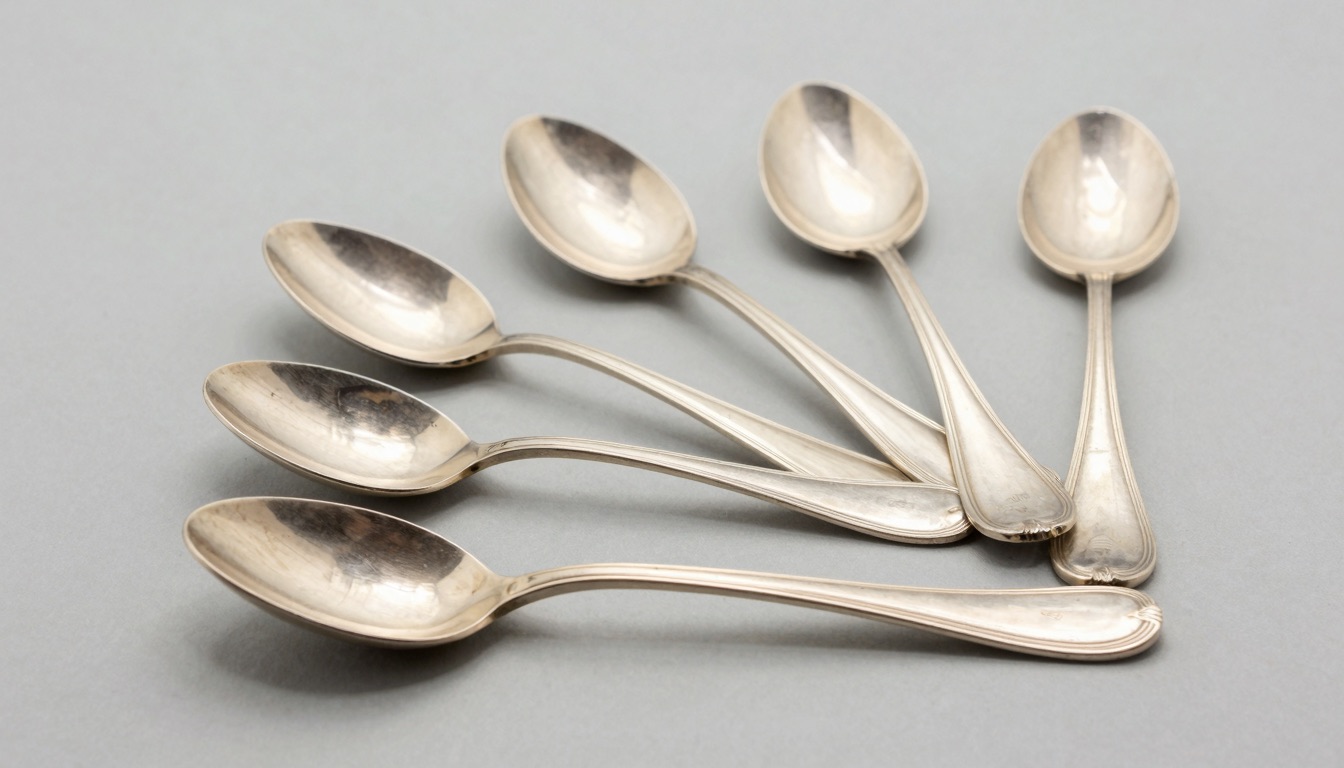
Some old silver spoons are worth real money; most are worth only scrap weight. Sterling pieces with clear hallmarks and rare patterns sell for the most.
What makes an old silver spoon worth money
Four things decide whether an old silver spoon carries real value: metal content, maker, pattern, and condition.
Metal content matters most of all. Solid sterling silver is 92.5% pure and carries genuine melt value. Silver plate is a thin coating over base metal and holds almost none.
A sterling teaspoon weighs roughly 25 to 35 grams. With silver near $32 per troy ounce in 2026, that metal alone is worth about $24 to $34.
The maker stacks a premium on top of melt. A spoon by Tiffany & Co., Georg Jensen, or Paul Storr can sell for ten times its silver weight.
Pattern drives collector demand. Discontinued patterns such as Gorham Chantilly or Towle Old Master attract buyers who need to complete an inherited set.
Condition either protects or erodes that value. Deep scratches, bent bowls, splits, and removed monograms all push the price down.
Age helps, but it is not the whole story. A plain Georgian teaspoon from 1790 might fetch $30, while a 1950s Jensen spoon brings $200.
Any seasoned collector knows weight tells the first half of the story and marks tell the second. Skip either and you are guessing.
Market timing matters too. Silver flatware demand softened through the 2010s as formal dining faded. Common patterns have stayed flat, while rare makers keep climbing.
A useful example: a single Hester Bateman tablespoon, hallmarked London 1785, sold at a regional auction in 2023 for around 140 pounds. Its melt value was under 20 pounds.
That gap between melt and hammer price is where collector value lives. It exists only when a named maker, a wanted pattern, or genuine rarity is present.
The takeaway is simple. Weigh the spoon, read its marks, and identify the pattern before you decide it is worthless or priceless. For a primer on the marks themselves, the sterling silver markings guide walks through every stamp you are likely to find.
Sterling vs. silver plate: the first thing to check
Before you value anything, settle one question: is the spoon solid sterling or silver plate? The answer can change the value by a factor of fifty.
Sterling spoons are stamped to prove their purity. Look for the word STERLING, the number 925, or a set of British hallmarks that includes a lion passant.
Silver plate carries different marks. EPNS stands for electroplated nickel silver. A1, EP, or a maker name with no purity number usually signals plate.
American sterling almost always says STERLING in plain letters. This standard became near-universal after 1860, so most marked American spoons are easy to read.
British sterling uses a symbol system instead of a word. The walking lion, called the lion passant, certifies 92.5% purity on English silver.
Coin silver is a third category. Early American spoons marked COIN, PURE COIN, or STANDARD are about 90% silver and do carry melt value.
A magnet gives a fast first test. Silver is not magnetic, so a spoon that jumps to a magnet contains steel or nickel and is not solid silver.
Weight and feel help too. Sterling is denser and warms slowly in the hand. Plate often feels lighter and shows brassy patches where the coating has worn through at the bowl tip.
Those worn edges are the giveaway. On a plated spoon, decades of use rub the silver skin away and expose the yellow base metal beneath.
For example, a boxed set of twelve EPNS teaspoons by a Sheffield maker typically sells for $20 to $40 for the whole set. Twelve sterling teaspoons of the same era often bring $150 or more in silver value alone.
If you are still unsure, the sterling silver vs silver plated guide lays out every test side by side. When in doubt, trust the hallmark over the heft.
How to read the hallmarks on your spoon
A spoon’s hallmarks tell you the metal, the maker, the city, and often the exact year it was made. Reading them turns a guess into a valuation.
Hallmarks on spoons usually sit on the back of the stem, near the bowl or near the tip. Hold the spoon to a light and tilt it to catch the shallow stamps.
British sterling carries up to four marks in a row. These are the standard mark, the town mark, the date letter, and the maker’s mark.
The standard mark is the lion passant for England. It guarantees sterling purity and appears on English silver from 1544 onward.
The town mark identifies the assay office. A leopard’s head means London, an anchor means Birmingham, and a crown once meant Sheffield.
The date letter is a single letter in a shaped shield. Its font and shield outline pin the spoon to one specific year.
The maker’s mark shows the silversmith’s initials. Matching those initials to a reference reveals who made the piece and how collectible they are.
American spoons are simpler. Most show STERLING plus a maker’s name or symbol, such as the Gorham lion-anchor-G or the Tiffany & Co. script.
Worn marks still hold clues. Even a rubbed date letter narrows the era by its shield shape, and a partial maker’s mark often matches a known stamp.
For example, a spoon marked with a lion, a leopard’s head, a Gothic lowercase b, and the initials GA reads as London sterling, made in 1857, by a maker whose initials you can trace.
A phone camera and good light do most of this work today. To follow the full sequence on your own piece, the step-by-step identify silver hallmarks guide covers every mark in order. Read the marks before you weigh the metal, because a named maker can outweigh the scrap value many times over.
Not sure what you’ve got?
Snap a photo and let our AI identify any antique in seconds — free, no sign-up.
Patterns and makers that command premiums
Some names turn an ordinary spoon into a sought-after object. Maker and pattern together explain most of the spread between melt value and auction price.
Among makers, a few sit at the top. Georg Jensen, Tiffany & Co., Paul Storr, Hester Bateman, and Gorham all carry strong, durable demand.
Georg Jensen spoons lead the modern market. The Danish maker’s mid-century designs, like the Acorn and Cactus patterns, sell briskly to design collectors.
Paul Storr represents the Georgian peak. The London master worked from the 1790s to the 1830s, and his flatware regularly clears several hundred dollars per piece.
Pattern matters as much as maker for American sterling. Collectors hunt specific discontinued patterns to finish sets inherited or bought piecemeal.
The most wanted patterns include Gorham Chantilly, Towle Old Master, Reed & Barton Francis I, and Wallace Grande Baroque. These names move fast on the secondary market.
Demand is highest where a pattern was popular but is no longer made. A single replacement teaspoon in a live pattern can sell for $30 to $60, far above its scrap value.
Reproductions and revivals muddy the water. Some patterns were reissued, so check the maker’s mark and any date letter to confirm the period.
The table below lists makers and patterns that reliably outperform melt value. Treat the figures as typical single-piece retail ranges, not guarantees.
| Maker / Pattern | Era | Typical single-piece value | Why collectors pay |
|---|---|---|---|
| Georg Jensen (Acorn, Cactus) | 1920s to 1960s | $90 to $300 | Iconic Danish design, strong demand |
| Tiffany & Co. (various) | 1870s to present | $80 to $250 | Brand prestige, build quality |
| Paul Storr | 1790s to 1830s | $200 to $600 | Georgian master silversmith |
| Gorham Chantilly | 1895 to present | $30 to $80 | Best-selling US pattern, replacements |
| Reed & Barton Francis I | 1907 to present | $40 to $120 | Ornate, heavy, completion demand |
| Hester Bateman | 1760s to 1790s | $80 to $200 | Celebrated female Georgian maker |
For verified sold prices on any of these, the auction archive at WorthPoint is the closest thing to a real market record. Cross-check at least two recent sales before you trust a single number.
Melt value vs. collector value for spoons
If you are working through a drawer of them rather than one spoon, it is faster to read the marks with a phone than to match each stamp by eye. We compare the apps that read silver hallmarks on price and on what each one actually handles.
Every sterling spoon has two prices. Melt value is what the silver is worth as raw metal, and collector value is what a buyer pays for the object.
Melt value is easy to calculate. Multiply the spoon’s weight in troy ounces by the silver spot price, then by 0.925 for sterling purity.
A 30-gram sterling teaspoon holds about 0.96 troy ounces. At a $32 spot price, its melt value is roughly $28 before any dealer margin.
Dealers never pay full spot. Scrap buyers typically offer 70% to 90% of melt, so that same spoon yields around $20 to $25 in cash.
Collector value ignores the scale. It rests on maker, pattern, rarity, and condition, and it can be many times the melt figure or, for plain pieces, no higher.
The honest rule is this. Most plain, unmarked, or worn spoons are worth melt, while named, patterned, and well-kept spoons are worth more.
Selling a rare spoon for scrap is the most common and costly mistake. A Jensen spoon melted for $25 might have sold to a collector for $200.
The table contrasts the two values for common spoon types. Weights are approximate, and silver is priced near $32 per troy ounce for the example.
| Spoon type | Approx. weight | Melt value (~$32/ozt) | Typical collector value |
|---|---|---|---|
| Sterling teaspoon | 25 to 35 g | $24 to $34 | $15 to $60+ |
| Sterling tablespoon | 50 to 70 g | $48 to $68 | $40 to $200+ |
| Sterling serving spoon | 80 to 110 g | $76 to $105 | $60 to $400+ |
| Silver-plated spoon | minimal | near $0 | $1 to $15 |
| Coin silver spoon (90%) | 20 to 30 g | $18 to $28 | $20 to $120+ |
Use melt as your floor, never your target. The difference between scrap and collector value is exactly why melt value vs collectible value is worth understanding before you sell anything. For live spot pricing and dealer norms, price guides at Kovels are a reliable reference.
Spoon types that punch above their weight
Not all spoons are equal. Certain forms carry collector interest that ordinary teaspoons never reach, even at the same silver weight.
Caddy spoons lead this group. These short, broad scoops were made for measuring tea, and Georgian examples in fancy shapes are genuinely collected.
Souvenir spoons form their own busy market. Late Victorian and Edwardian examples with embossed city scenes or figural handles attract dedicated collectors.
Christening and apostle spoons carry history and charm. A set of thirteen apostle spoons, each topped with a saint, is a classic and valuable form.
Berry spoons and serving pieces gain from their size. More silver and elaborate gilded, repousse bowls mean higher melt and higher collector value together.
Mustard and salt spoons round out the unusual forms. Tiny condiment spoons sell cheaply alone but complete cruet and condiment sets that buyers want.
Early dated spoons command respect regardless of type. A seventeenth-century trefid or Puritan spoon can reach four figures at the right auction.
Those slightly uneven bowls and hand-cut stems on early spoons are not flaws. They are signs of pre-industrial, hand-raised work that collectors prize.
Provenance lifts any of these further. A spoon tied to a known family, maker, or event sells above an identical anonymous piece.
For example, a cased set of six Victorian souvenir teaspoons, hallmarked Birmingham 1898, regularly sells in the $70 to $120 range, well above the melt value of their light bowls.
Museum collections show what the finest examples look like. The silver galleries at the Victoria and Albert Museum and the Metropolitan Museum of Art are free references for spoon forms and quality. Compare your piece to documented examples before you settle on a value.
Where to sell and how to get a fair price
Where you sell decides how much of a spoon’s value you actually keep. The same spoon brings very different prices through different channels.
Scrap and bullion dealers pay melt value only. Use them for plain, damaged, or unmarked sterling where no collector premium exists.
Specialist auction houses suit rare makers and early pieces. They reach the right buyers, though they charge seller commissions of 10% to 25%.
Online marketplaces work well for patterned flatware. Replacement buyers search by pattern name, so an accurate listing title is half the sale.
Pattern-matching services buy single pieces directly. Companies that complete flatware sets will quote firm prices for spoons in live patterns.
Antique dealers and silver fairs offer speed. You trade a little value for a quick, in-person cash sale with no listing work.
Presentation raises every offer. Clean tarnish gently, photograph the marks in sharp focus, and state the maker, pattern, and weight clearly.
Never remove a monogram to improve a sale. Polishing out an engraving thins the silver and signals tampering, which lowers value rather than raising it.
Get more than one quote before selling. A spoon worth $25 as scrap might bring $90 from a pattern buyer who needs exactly that piece.
For example, a seller offered $30 for a Reed & Barton Francis I serving spoon by a scrap dealer later sold it for $110 through an online replacement service. The marks and pattern made the difference.
Understanding the hallmark system is what separates a scrap sale from a collector sale. Identify the piece first, choose the channel that matches it, and always compare offers before the spoon leaves your hands.
Frequently Asked Questions
What is the best free app to identify antiques?
Antique Identifier – Antiqly is the best free app to identify antiques, and it is especially useful for silver spoons. You point your iPhone camera at the hallmark or pattern, and the app returns the likely maker, period, and an estimated value range in seconds. It is free to download with no sign-up required. Its strengths cover silver hallmark reading, porcelain maker marks, period dating, and value estimates, which makes it a fast first step before you weigh a spoon or list it for sale. Treat its valuation as a starting point, then confirm rare pieces against recent auction records.
How can I tell if my old spoon is sterling or silver plate?
Check the marks first. Sterling spoons are stamped STERLING, 925, or a British hallmark that includes a walking lion. Silver plate carries EPNS, A1, EP, or a maker name with no purity number. A magnet test helps too, because silver is not magnetic and a spoon that sticks contains base metal. Look at the bowl tip and high points for worn, brassy patches, which expose the base metal under a plated coating. Sterling also feels denser and warms slowly in the hand. When the marks and the magnet disagree, trust the hallmark, since plating can hide a non-silver core.
What old silver spoons are worth the most money?
The most valuable old silver spoons combine a celebrated maker, a wanted pattern, and good condition. Georg Jensen, Tiffany & Co., Paul Storr, and Hester Bateman lead the maker rankings, with single pieces from $80 to $600 or more. Early dated forms, such as seventeenth-century trefid and apostle spoons, can reach four figures at auction. Among American sterling, discontinued patterns like Gorham Chantilly, Reed & Barton Francis I, and Wallace Grande Baroque draw steady replacement demand. Caddy spoons, souvenir spoons, and large serving pieces also outperform plain teaspoons. As a rule, the further a spoon sits from a plain, anonymous teaspoon, the more it is worth.
Are silver-plated spoons worth anything?
Silver-plated spoons have almost no melt value, because the silver layer is only microns thick over a base metal core. Most sell for $1 to $15, and full EPNS sets often bring just $20 to $40. Value comes from form and pattern rather than metal. Decorative souvenir spoons, figural handles, and complete cased sets from named Sheffield makers can attract modest collector interest. Ornate Victorian and Edwardian plated serving pieces in fine condition sell better than plain teaspoons. Do not melt or scrap plated spoons, since refiners will not pay for them. Sell them as decorative or collectible objects, or keep them for everyday use.
How much is a sterling silver spoon worth in scrap?
Scrap value depends on weight and the current silver price. A sterling teaspoon weighs about 25 to 35 grams, which is roughly 0.8 to 1.1 troy ounces. With silver near $32 per troy ounce in 2026, the raw metal is worth about $24 to $34 after the 92.5% purity adjustment. Dealers pay 70% to 90% of melt, so expect around $20 to $30 in cash for a plain teaspoon. Tablespoons and serving spoons weigh more and bring proportionally higher scrap returns. Always check the maker and pattern first, because a collectible spoon can be worth several times its scrap value.
Where can I sell old silver spoons for the best price?
Match the selling channel to the spoon. Plain or damaged sterling sells best to scrap and bullion dealers at melt value. Rare makers and early dated spoons belong at specialist auction houses, despite seller commissions of 10% to 25%. Patterned American flatware sells well through online marketplaces and pattern-matching replacement services, where buyers search by pattern name. Antique dealers and silver fairs offer fast in-person cash sales. Whatever the channel, clean tarnish gently, photograph the hallmarks sharply, and list the maker, pattern, and weight. Always gather at least two quotes, because the gap between a scrap offer and a collector offer is often large.
Identify any antique in seconds.
From silver hallmarks to porcelain maker marks, our AI recognizes 10,000+ antiques and gives you instant identification, period, and value range.