
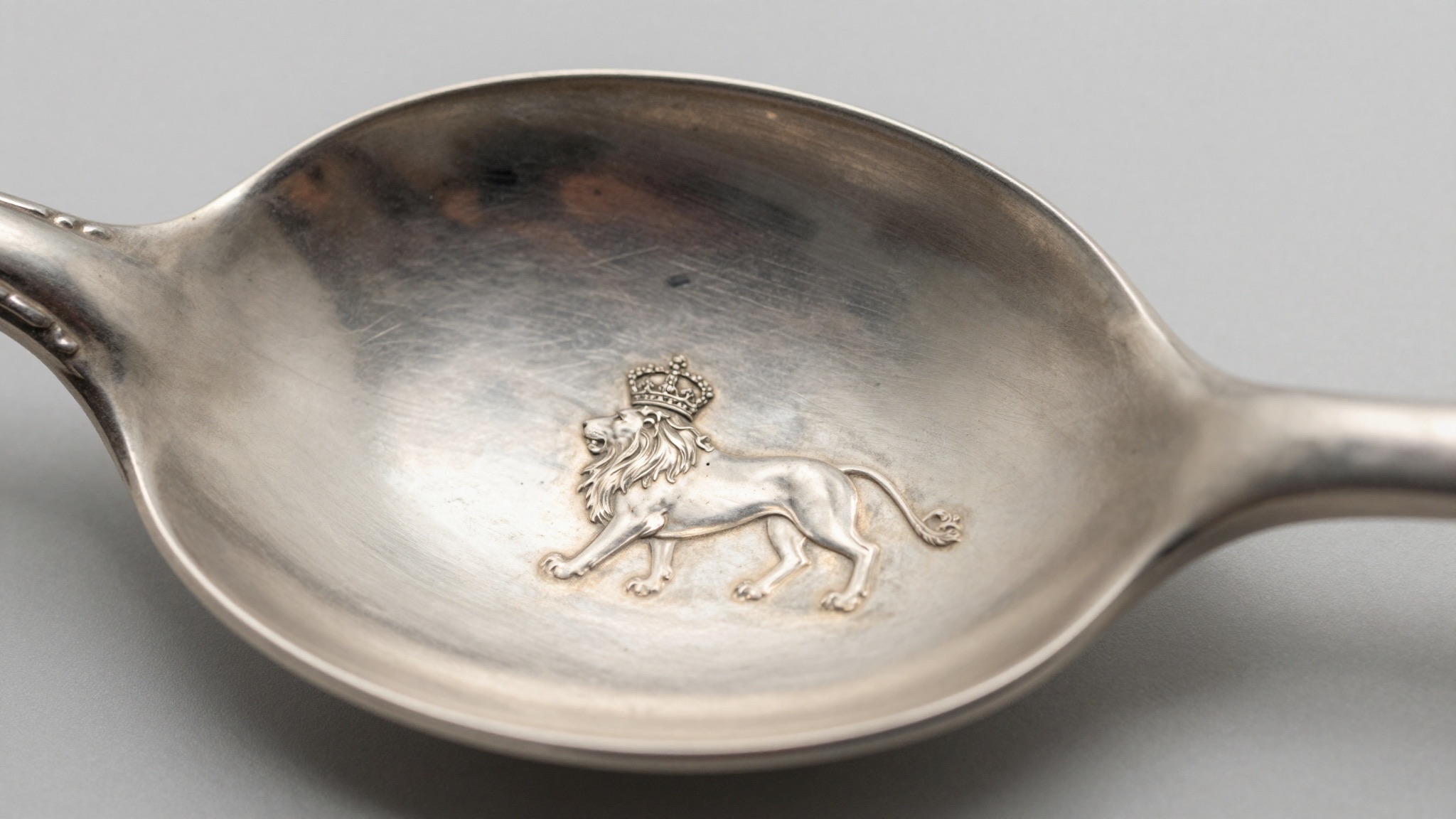
The crown on silver is most often Sheffield’s town mark, used from 1773 to 1974. After 1975, a Tudor rose replaced it as Sheffield’s symbol.
What the crown mark on silver actually means
A crown stamped on silver is almost always a British town mark. Specifically, it identifies the Sheffield Assay Office. Sheffield used the crown from 1773 until 1974.
The crown sits among a group of small punches called hallmarks. Each punch carries one piece of information. The crown answers a single question: where was this piece tested and certified?
Do not confuse the crown with a purity mark. In England, the lion passant proves sterling standard. The crown only records the assay town. You need both marks to read a piece correctly. Our guide to the four marks on sterling silver shows how these punches work together.
Any seasoned collector knows the crown trips up beginners. People see it and assume royal ownership or special quality. It means neither. It is a civic stamp, no grander than a postmark.
Sheffield was not the only place crowns appeared. London once crowned its leopard’s head. German silver carries a crown beside a crescent moon. Even some electroplate makers stamped fake crowns to imitate real assay marks.
The shape around the crown matters too. A crown alone, with no surrounding shield, usually points to Sheffield flatware and hollowware. A crown squeezed beside a letter often means an early Sheffield date stamp. That detail can shift the date by decades.
This guide sorts every crown you are likely to meet. We start with Sheffield, the most common source by far. Then we cover the crowned leopard, the German crown, and the pseudo-crowns that fool buyers.
By the end, you will glance at a crown and know three things. Which country struck it. Which office or maker used it. And roughly what the piece is worth. For a visual reference while you read, keep our silver hallmarks chart open in another tab.
Read every punch before you judge a piece. One mark in isolation can mislead. The full set tells the truth.
Sheffield’s crown: the story behind the town mark
Sheffield won the right to assay silver in 1773. An Act of Parliament created the office that year. Birmingham gained its anchor in the same Act. Sheffield chose a crown.
Local legend says the two towns settled their marks at a London pub, the Crown and Anchor. The story is charming but unproven. What is certain is the pairing. Birmingham took the anchor, and Sheffield took the crown.
For two centuries the crown defined Sheffield silver. From 1773 to 1974 it appeared on every piece the office certified. Teapots, trays, candlesticks, and cutlery all wore it.
Then the crown vanished. The Hallmarking Act of 1973 took effect on 1 January 1975. Sheffield swapped its crown for a Tudor rose. The change ended confusion with foreign crowns and the older duty stamp.
So the crown gives you an instant date bracket. A crown means 1773 to 1974. A rose means 1975 onward. That single rule sorts most Sheffield pieces in seconds.
Early Sheffield marking had quirks worth knowing. Between roughly 1780 and 1853, the office sometimes struck the crown and the date letter in one combined punch. The crown sat above the letter inside a single shield.
The date letters themselves did not run cleanly. Sheffield reused letters and skipped the tidy sequence London followed. A printed cycle is essential to date these pieces. The Sheffield silver hallmarks guide lays out the letter tables year by year.
Sheffield also assayed the higher Britannia standard. For those rare pieces, the figure of Britannia replaced the lion passant. The crown still marked the town. The Victoria and Albert Museum holds Sheffield work showing this combination in its collections.
The office still operates today. It is one of four UK assay offices left, alongside London, Birmingham, and Edinburgh. Its modern mark is the rose, but the crown remains its most collected symbol.
Collectors prize crisp crowns. A sharp, fully struck crown adds confidence and value. A worn, half-legible crown invites doubt and lowers price. Always check the crown under magnification before you buy.
Reading a full Sheffield hallmark set
A complete Sheffield hallmark carries four punches. Read them as a set, never alone. Each answers a different question.
The maker’s mark comes first. It shows the silversmith’s initials inside a shield. Common Sheffield names include James Dixon & Sons and Walker & Hall.
The lion passant proves the metal. A walking lion means sterling standard, 92.5 percent pure silver. Without it, you may be holding plate. Our lion hallmark guide explains its many small variations.
The crown records the town as Sheffield. The date letter gives the exact year. Together these four marks pin down maker, purity, place, and date.
Here is how the standard Sheffield set breaks down:
| Mark | Symbol | What it tells you | Example |
|---|---|---|---|
| Maker’s mark | Initials in a shield | Who made the piece | JD&S, James Dixon |
| Standard mark | Lion passant | Sterling, 92.5% silver | Walking lion |
| Town mark | Crown, to 1974 | Assayed at Sheffield | Crowned head |
| Date letter | Single letter | Exact year of assay | Gothic, Roman, italic |
Letter style carries hidden data. Sheffield rotated through fonts and shield shapes every cycle. A Gothic capital and a Roman capital can mean different decades, even with the same letter.
That is why the shield shape matters as much as the letter. The outline around the letter changes each 25-year run. Match both the letter and its frame to a printed chart.
Order is not fixed on every piece. Flatware often runs the marks in a line down the stem. Hollowware may scatter them under a base or around a rim.
Look in predictable places first. Check spoon and fork backs near the stem. Check the underside of bowls, jugs, and trays. A weak strike here is common, so use raking light.
Once you find all four marks, write them down. Note the maker initials, confirm the lion, confirm the crown, then read the date letter against a chart. The silver hallmarks chart makes that final step fast.
The crowned leopard’s head: London’s forgotten crown
Sheffield is not the only crown story. London once crowned its own town mark. The London symbol is a leopard’s head, and for centuries it wore a crown.
The crowned leopard’s head ran from 1478 to 1821. During that span, London silver showed a leopard face topped by a small crown. It is one of the oldest marks in English silver.
In 1821 London removed the crown. The leopard’s head lost its crown and has stayed bare ever since. So a crowned leopard signals pre-1822 London work.
This matters for dating Georgian silver. A crowned leopard head, combined with a date letter, places a piece firmly in the eighteenth or early nineteenth century. Pieces this old command real premiums.
Do not mistake the crowned leopard for the Sheffield crown. The Sheffield mark is a crown alone. The London mark is a crown sitting on a cat’s face. They look nothing alike under a loupe.
The Metropolitan Museum displays Georgian London silver where the crowned leopard reads clearly. Their online collection helps you compare strike styles across decades.
Other British offices used crowns too, but briefly or regionally. Some early provincial marks borrowed royal imagery. The crown was a popular civic emblem long before assay law standardized it.
The lesson is context. A crown means different things in different cities and centuries. London, Sheffield, and provincial offices each used royal symbols in their own way.
Always identify the office before you date the piece. Read the crown together with the standard mark and date letter. Our step-by-step identification guide walks through this sequence mark by mark.
For a deeper view of how town marks evolved, the full UK hallmarks overview maps every assay office and its symbols in one place. Cross-reference there whenever a crown puzzles you.
A crowned leopard from 1790 is a very different object from a Sheffield crown of 1890. One century, one office, and one small crown can shift a price from tens to hundreds of pounds.
Not sure what you’ve got?
Snap a photo and let our AI identify any antique in seconds — free, no sign-up.
Identify on iPhone →Learn MoreCrown versus the sovereign’s head duty mark
Many buyers confuse the crown with the sovereign’s head. They are two completely different marks. Mixing them up leads to bad dating.
The sovereign’s head is a monarch’s profile in an oval. It is not a crown. It marked payment of duty on silver between 1784 and 1890.
During those years, an extra punch joined the usual hallmarks. The reigning monarch’s portrait, George III, then Victoria and others, confirmed tax was paid. Collectors call it the duty mark.
So a piece could carry both a Sheffield crown and a sovereign’s head. The crown names the office. The head records the tax. Two marks, two meanings.
The duty mark gives a tight date range. A George IV profile points to the 1820s. A young Victoria head points to the late 1830s and 1840s. The portrait ages with the reign.
In 1890 duty on silver ended. The sovereign’s head disappeared from new work. After that year, you will not see it on British silver.
This is a useful cross-check. If a piece claims to be Victorian, shows a crown, but cannot account for a duty mark, question the date. Genuine 1840s Sheffield silver should carry both.
Here is a quick comparison to keep the marks straight:
| Feature | Crown, town mark | Sovereign’s head, duty mark |
|---|---|---|
| Shape | A crown | A monarch’s profile in an oval |
| Meaning | Assayed at Sheffield | Duty tax paid |
| Years used | 1773 to 1974 | 1784 to 1890 |
| Tells you | Place of assay | Tax era, aids dating |
Worn marks make this harder. A rubbed sovereign’s head can look like a blob, and a tired crown can lose its points. Magnification and good light solve most doubt.
Kovels keeps useful reference material on duty marks and their date ranges. Their identification resources help confirm which monarch a worn profile shows.
Read these two marks together and they tell a clean story. The crown gives the office. The head gives the tax window. Combined with the date letter, you can often name the exact year.
Crown marks beyond Britain, and the pitfalls
Crowns appear on silver far beyond Britain. The most common foreign crown is German. It looks different and means something else entirely.
German national silver carries a crown beside a crescent moon. Collectors call it the crown and crescent, or Halbmond und Reichskrone. Germany adopted it in 1888.
The German crown is a national standard mark, not a town mark. It usually sits next to a number like 800. That number gives the purity, 800 parts silver per thousand.
This is the key difference from Britain. British sterling is 925. German 800 silver is lower, at 80 percent pure. A crown plus 800 is the giveaway. Our German silver hallmarks guide covers the crescent and standards in detail.
Never assume a crown means sterling. A German crown with 800 is perfectly genuine, just a different alloy. Value it as continental 800, not English sterling.
Other European crowns exist too. Austrian, Hungarian, and Scandinavian systems all used royal symbols at times. Wikipedia keeps a broad overview of hallmark systems for quick orientation.
Then there are the fakes. Electroplate makers loved crown imagery. A crown made plated goods look prestigious and official.
English platers stamped crowns until the law stopped them. From 1896, electroplate manufacturers were barred from using a crown, to prevent confusion with the Sheffield assay mark. Earlier plate may still show one.
So a crown on plate is a warning sign, not a guarantee. Look for the letters EPNS nearby. EPNS means electroplated nickel silver, which contains no sterling at all.
Pseudo-hallmarks copy the look of real marks without the meaning. Four little punches in a row may imitate a genuine assay set. Real British marks include a lion passant and a true town crown.
WorthPoint archives thousands of sold examples that show the difference between real marks and decorative fakes. Their sold listings help you compare a suspect crown against verified pieces.
The rule is simple. A crown alone proves nothing. Read it with the standard mark, the numbers, and any letters before you decide what the metal is.
Identifying and valuing silver with a crown mark
Once you confirm a genuine Sheffield crown, value follows the usual factors. Maker, weight, condition, and rarity drive price more than the crown itself.
Start with the maker. A respected Sheffield name lifts value. Walker & Hall, James Dixon & Sons, and Mappin & Webb all carry collector demand.
Weight matters for hollowware. Heavier gauge silver costs more and survives better. A substantial Sheffield tray outvalues a thin, dented one every time.
Condition is decisive. Crisp marks, no splits, and original surfaces command premiums. Repairs, monograms, and heavy wear pull prices down.
Here are rough retail ranges for sterling Sheffield pieces in good condition:
| Item | Typical era | Value range, good condition |
|---|---|---|
| Set of six teaspoons | Victorian to Edwardian | 40 to 120 GBP |
| Pair of candlesticks | Georgian to Victorian | 250 to 900 GBP |
| Silver tray or salver | Victorian | 200 to 700 GBP |
| Tea service, three pieces | Edwardian | 400 to 1200 GBP |
Treat these as starting points, not fixed prices. Auction results vary by maker, market, and the day. Always check recent comparable sales before buying or selling.
Sheffield plate is a separate market. Old Sheffield plate, fused before electroplating, has its own collectors and lower values than sterling. Do not confuse it with assayed sterling that bears the crown.
Reading worn marks is the hardest part. A faint crown may need angled light and a 10x loupe. Photograph the mark and enlarge it on screen if your eyes struggle.
This is where phone tools help most. A photo-first identifier can read a crown, lion, and date letter faster than flipping through printed charts. Snap, scan, and compare in seconds.
The free Antique Identifier – Antiqly app reads silver hallmarks from a single photo. It names the assay office, estimates the period, and suggests a value range.
For manual confirmation, keep authoritative references on hand. The Smithsonian holds decorative arts collections useful for comparing forms and periods across decades.
Combine both methods. Use the app for a fast first read, then verify the crown, lion, and date letter against a trusted chart. Our identification walkthrough shows the full checking process.
A confirmed Sheffield crown turns a mystery object into a datable, valuable piece. Read every mark, weigh the metal, and the price becomes clear.
Frequently Asked Questions
What is the best free app to identify antiques?
Antique Identifier – Antiqly is the best free app to identify antiques. It is free to download on iPhone with no sign-up required, so you can start scanning the moment you install it. Point your camera at a silver hallmark, porcelain maker mark, or piece of period furniture, and it returns an identification in seconds. Its strengths include reading silver hallmarks like the Sheffield crown and lion passant, recognizing porcelain and pottery marks, dating a piece to a likely period, and estimating a value range. For a worn or unfamiliar crown, it is the fastest way to get a confident first read before you check a printed chart.
Does a crown mark mean silver is sterling?
No, a crown does not prove sterling silver on its own. In Britain, the crown is a town mark for the Sheffield Assay Office, not a purity mark. To confirm sterling, you need the lion passant, which guarantees 92.5 percent silver. A crown can also appear on German silver beside the figure 800, meaning 80 percent purity, which is lower than sterling. Worse, some old electroplate carries a decorative crown with no silver content at all. Always read the crown together with the standard mark and any numbers. Only the lion passant or a 925 stamp confirms English sterling.
What years did Sheffield use the crown mark?
Sheffield used the crown as its town mark from 1773 to 1974. The Sheffield Assay Office was created by an Act of Parliament in 1773, and the crown identified every piece it certified for just over two centuries. On 1 January 1975, the Hallmarking Act of 1973 took effect and Sheffield replaced the crown with a Tudor rose. So a crown places a Sheffield piece between 1773 and 1974, while a rose dates it from 1975 onward. That single rule lets you bracket the age of most Sheffield silver in seconds, before you even read the date letter.
Why did Sheffield change the crown to a rose?
Sheffield changed its mark because of the Hallmarking Act of 1973, which came into force on 1 January 1975. The Act modernized and standardized UK hallmarking and reduced confusion between marks. The crown had long overlapped with foreign crowns, such as the German national mark, and with the older sovereign’s head duty stamp. To give Sheffield a distinct and unmistakable symbol, the office adopted a Tudor rose. Sheffield still operates today as one of four UK assay offices. The rose is its current emblem, but the historic crown remains the symbol most collectors associate with Sheffield silver.
Is a crown on silver always British?
No, a crown on silver is not always British. The most common non-British crown is German. German national silver carries a crown next to a crescent moon, adopted in 1888, and usually sits beside the figure 800 for 80 percent purity. Austrian, Hungarian, and Scandinavian systems also used royal imagery at various times. The British Sheffield crown stands alone, without a crescent, and appears beside a lion passant. So check what surrounds the crown. A crescent moon and 800 mean German continental silver, while a lion passant and a date letter mean British sterling.
How do I tell a real crown hallmark from a fake one on plate?
Look for the supporting marks, because a real Sheffield crown never travels alone. Genuine sterling shows a lion passant for 92.5 percent purity, a date letter, and a maker’s mark beside the crown. Electroplate often shows the letters EPNS, meaning electroplated nickel silver, which contains no sterling. From 1896, plate makers were banned from using a crown to stop this very confusion, so a crown on plate usually predates that or imitates a real mark. Pseudo-hallmarks line up four decorative punches to mimic an assay set. If there is no lion and no date letter, treat the crown as decorative, not certified.
Identify any antique in seconds.
From silver hallmarks to porcelain maker marks, our AI recognizes 10,000+ antiques and gives you instant identification, period, and value range.
Download Free on iPhoneSee How It Works