
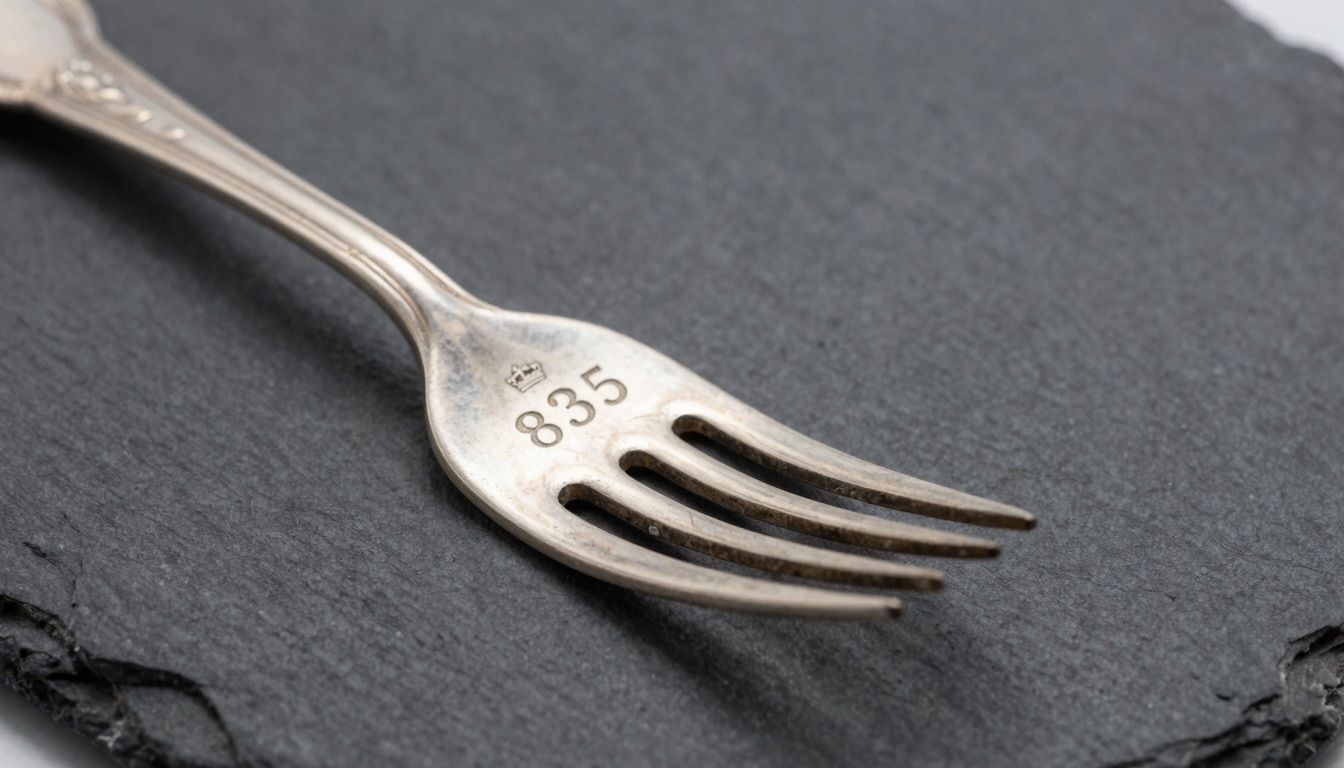
The 835 silver mark means 83.5% pure silver, a Continental European standard. It confirms solid silver, just below sterling’s 92.5%.
What the 835 silver mark actually means
The 835 silver mark means your piece is 83.5% pure silver. The other 16.5% is copper, added to harden the metal. Pure silver alone is too soft for forks, spoons, or serving pieces that face daily use.
Silversmiths measure purity in parts per thousand. A stamp reading 835 means 835 grams of pure silver sit in every kilogram of alloy. This is millesimal fineness, the global shorthand for silver content.
That figure sits below sterling. Sterling silver is 925, or 92.5% pure. So 835 carries less silver than any British or American sterling piece. It remains unmistakably solid silver, never plate. A plated item would read EPNS or A1 instead of a fineness number.
The 835 standard is a Continental European convention. You will rarely meet it on English or American work. Instead it stamps flatware, cutlery, and serving ware made across Germany, Austria, the Netherlands, and Scandinavia.
Any seasoned collector knows the feel of a Continental fork. The metal is slightly stiffer than an English sterling one. That extra copper resists bending, which suited dinner services built for decades of real meals.
Here is a common trap. People assume a higher number always means finer silver, and they are right about content. But 835’s durability made it the practical choice for everyday tableware, and countless handsome pieces carry it.
The number rarely travels alone. On German silver, 835 usually appears beside a crown and a crescent moon. That pairing became the national guarantee in 1888 under the Reichsstempel law. Our guide to the crown, moon, and 800 standard walks through every variation.
Consider a 1950s German dinner fork stamped 835 with a crown, a half-moon, and a maker’s logo such as WMF or Wilkens. That cluster dates the piece to the late 19th or 20th century and confirms genuine Continental silver.
Dutch makers used a close cousin, the 833 standard, which looks almost identical at a glance. A worn 3 can read as a 5, so check the other marks before deciding. The Netherlands ran both 833 and 835 alloys through the 20th century.
The takeaway is simple. The 835 mark guarantees real silver at 83.5% fineness. It is a regional, durable, and collectible standard, just a step below the sterling grade most English-speaking collectors expect. Knowing the difference protects you at estate sales and helps you value inherited pieces correctly.
Where 835 silver comes from
The 835 standard is Continental Europe’s everyday silver. It traveled across borders, so origin depends on the marks beside the number, not the number alone.
Germany is the heartland of 835 silver. After the Reichsstempel law of 1888, German silver above 800 fineness carried a crown and crescent moon plus the exact fineness. Factories like WMF, Wilkens, Bruckmann, and Koch & Bergfeld produced enormous quantities of 835 flatware. If you own Continental cutlery, German 835 is the statistical favorite.
The Netherlands used 835 alongside its older 833 second standard. Dutch pieces often add a sword, a lion, or a Minerva-style assay mark and a date letter. The Victoria and Albert Museum holds Dutch domestic silver that shows how these marks evolved across the 1800s.
Austria favored 835 for tableware after its hallmarking reforms. Austrian marks frequently include a Diana head facing left, with a city code and a small fineness number. Vienna and Graz pieces turn up regularly in European estate lots.
Scandinavia rounds out the picture. Danish, Swedish, and Norwegian silver of the mid-20th century often used 830 or 835 fineness. Danish work may show three towers, a year mark, and an assayer’s initials. Many mid-century modern Scandinavian pieces, now keenly collected, sit at this fineness.
Here is a quick origin map for the 835 mark:
| Country | 835 usage | Typical companion marks | Main era |
|---|---|---|---|
| Germany | Very common | Crown + crescent moon, maker logo | 1888–present |
| Netherlands | Common (also 833) | Sword, lion, or Minerva head, date letter | 19th–20th c. |
| Austria | Common | Diana head, city code | Late 19th–20th c. |
| Denmark and Scandinavia | Common (with 830) | Three towers, year mark, assayer initials | 20th c. |
| Eastern Europe | Occasional | Sparse or local assay marks | 20th c. |
The lesson from the table is clear. The number tells you the silver content; the companion marks tell you the country. A bare 835 with a crown and moon is German. The same 835 beside three towers points to Denmark.
Watch for one honest complication. Some Eastern European and post-war pieces carry 835 with sparse or rubbed marks. When the supporting stamps are gone, you lean on style, weight, and construction. A heavy, die-struck handle with crisp shoulders usually signals a serious factory rather than a tourist piece.
For a fuller country-by-country breakdown, our European hallmarks guide maps the assay systems that produced 835 silver. It covers French, German, Dutch, and Nordic marks side by side.
One myth worth retiring: 835 is not a cheap foreign silver. It was the respectable middle standard of Europe’s best factories. A Koch & Bergfeld canteen in 835 can outshine plenty of lighter sterling sets in both weight and craftsmanship.
How to identify 835 silver on your piece
Finding the 835 mark takes a loupe and good light. The stamp is small, often tucked where wear is lowest. Start there before guessing.
On flatware, check the back of the handle near the stem. On hollowware such as teapots, bowls, and trays, look on the underside or base rim. Lift the piece and angle it under a lamp. The marks catch shadow better at a slant.
You are hunting for a three-part cluster. First, the fineness number itself: 835, sometimes written 0.835 or 835/1000. Second, a national guarantee mark, like Germany’s crown and crescent moon. Third, a maker’s mark, whether initials, a name, or a logo.
Read the number carefully. A worn 8 can resemble a 6 or a 3. A faint 835 might read as 833 or 800. When in doubt, compare the digit shapes against a known example. Our step-by-step identify silver hallmarks walkthrough shows how to confirm a reading.
The crescent moon and crown deserve attention. The moon faces left, hornlike, often quite tiny. The crown sits beside it. Together they prove the piece passed German fineness control after 1888. Without them, a lone 835 on Continental flatware still indicates the standard, but origin gets murkier.
Maker’s marks turn a number into a story. WMF used an ostrich in a lozenge. Wilkens used a swan. Bruckmann used a stylized monogram. Cross-referencing the logo against a reference like Kovels often pins down the factory and a rough date.
Beware look-alikes. Silver plate sometimes carries numbers like 90 or 100, which refer to the grams of silver used in plating, not fineness. A 90 is not 90% silver, it is plate. Genuine 835 always reads as a three-digit fineness, usually with assay marks nearby.
A photo-first identifier app speeds this up. Snap the cluster, and the app reads the fineness, suggests the maker, and offers a period. It is faster than thumbing a printed chart, especially when the moon-and-crown is faint.
Here is a field example. An inherited soup ladle shows 835, a left-facing moon, a crown, and a swan logo. That decodes instantly: German silver, post-1888, made by Wilkens of Bremen. The swan alone narrows the maker; the 835 confirms the alloy.
If every mark is rubbed away, fall back on tests. Real silver is non-magnetic, develops a soft grey patina rather than flaking, and rings with a clear tone when tapped. None of these replace a hallmark, but together they support a Continental silver attribution when the stamps have vanished.
Not sure what you’ve got?
Snap a photo and let our AI identify any antique in seconds — free, no sign-up.
Identify on iPhone →Learn More835 silver vs other purity standards
Silver purity is a ladder, and 835 sits on a specific rung. Knowing the neighbors helps you value a piece and spot mismatches.
At the bottom of the collectible range is 800 silver. It holds 80% pure silver and was Germany’s minimum legal standard. Our 800 silver mark guide covers it in depth. Just above sits 835, then 900, then sterling at 925, and finally Britannia at 958.
The practical difference between 800 and 835 is small in the hand but real in content. A kilogram of 835 silver holds 35 more grams of silver than the same weight of 800. Over a heavy canteen of flatware, that gap adds up at the melt counter.
Sterling is the standard most English-speaking collectors know. At 925, it carries 9% more silver than 835. That higher content makes sterling slightly softer and, gram for gram, worth more in pure metal. It also explains why British and American makers rarely used 835: their legal floor was higher.
Here is how the common standards compare:
| Mark | Fineness | Pure silver | Common origin | Standard name |
|---|---|---|---|---|
| 800 | 0.800 | 80.0% | Germany, Italy, Austria | Continental 800 |
| 835 | 0.835 | 83.5% | Germany, Netherlands, Scandinavia | Continental 835 |
| 900 | 0.900 | 90.0% | France (2nd), US coin silver | Coin / 900 |
| 925 | 0.925 | 92.5% | UK, USA | Sterling |
| 958 | 0.958 | 95.8% | UK | Britannia |
The table reveals a pattern. Continental Europe accepted lower fineness for everyday ware, prizing durability. Britain and America held a higher legal bar, so their everyday silver is sterling. Neither approach is better; they reflect different traditions of hallmarking law.
This ladder also guards against fraud. If a piece is stamped 925 but feels suspiciously light and stiff, the mark may be false. Genuine fineness tracks with weight and working properties. The Metropolitan Museum of Art collection notes show how period silver balances purity against function.
One number causes regular confusion: 925 versus 835 on mixed estate lots. Families often inherit both Continental and English silver together. Sorting them by fineness first, then by maker, prevents you from melting a collectible German canteen as if it were scrap sterling.
A worked example clarifies value. Two identical-weight forks, one 835 and one 925, differ by roughly 9% in pure silver. At any given spot price, the sterling fork’s melt value is about 9% higher. But if the 835 fork is a sought-after WMF Art Deco pattern, collector demand can flip that ranking entirely.
The closing point: fineness sets the floor, not the ceiling. Maker, pattern, age, and condition decide the final price.
What 835 silver is worth in 2026
The value of 835 silver splits two ways: melt value and collector value. Most everyday pieces trade near melt. The best pieces command a premium far above it.
Melt value is arithmetic. Weigh the piece in troy ounces, multiply by 0.835 for fineness, then multiply by the silver spot price. A 100-gram fork is about 3.22 troy ounces; at 0.835 fineness that is roughly 2.69 ounces of pure silver. At an illustrative spot of $30 per troy ounce, the melt value lands near $80. Spot prices move daily, so always check the current figure before you calculate.
Remember to deduct non-silver parts. Many 835 knives have stainless or filled handles, so their weight overstates the silver. Hollow-handled pieces and weighted bases are mostly base metal or pitch inside. Weigh forks and spoons for an honest reading; treat knives separately.
Collector value is where 835 silver gets interesting. A plain modern canteen sells near melt. But a signed Art Nouveau or Art Deco service by a named maker can fetch multiples of its metal worth. Pattern, designer, and completeness drive that premium.
Here is a rough value guide for common 835 items:
| 835 item | Typical weight | What drives the price | Likely outcome |
|---|---|---|---|
| Single teaspoon | 20–30 g | Mostly metal | Near melt |
| Set of 6 forks | 350–450 g | Weight, pattern | Melt-plus |
| Teapot or coffee pot | 500–800 g | Maker, design | Melt to premium |
| Boxed 12-setting canteen | 1,500–2,500 g | Maker, pattern, box | Strong premium |
| Named Art Deco service | Varies | Designer, completeness | Multiples of melt |
The table shows the spread. A single tarnished teaspoon is scrap-adjacent. A complete twelve-setting canteen in its fitted box, by a respected German factory, is a different proposition entirely. Boxes, matching monograms, and full place settings all lift the price.
Condition matters more than many sellers expect. Deep scratches, bent tines, monogram removals, and repairs all cut value. A crisp, unworn pattern with sharp detail holds its premium. The Victoria and Albert Museum conservation notes underline how surface wear changes the reading of antique silver.
To gauge real-world prices, check sold listings rather than asking prices. Archives like WorthPoint record what 835 pieces actually fetched at auction and online. Sold data beats optimistic shop tags every time.
Maker premiums are concrete. WMF, Wilkens, Koch & Bergfeld, and the Scandinavian design houses carry recognized followings. A Danish 830 or 835 piece in a mid-century pattern can far outrun its melt value among collectors. Anonymous factory ware will not.
A quick example anchors the range. A 700-gram set of twelve plain 835 dinner forks, no box, prices mostly on metal. The same weight in a documented Art Deco WMF pattern, boxed, can ask several times that.
The bottom line: start with melt as your floor, then add for maker, pattern, age, condition, and completeness.
Caring for, cleaning, and selling 835 silver
Owning 835 silver is easy once you respect its alloy. The higher copper content means it tarnishes a touch faster than sterling, but it also wears harder.
Tarnish is normal, not damage. It is silver reacting with sulfur in the air. A soft grey film is expected on older pieces and even adds character. Many collectors prize a gentle patina and clean only the high points.
Clean gently and rarely. Use a dedicated silver cloth or a mild silver foam, and rub along the grain. Avoid abrasive dips and harsh scrubs; they strip metal and blur hallmarks. Over-cleaning is the most common way owners quietly lower a piece’s value.
Store silver dry and sealed. Anti-tarnish strips or cloth pouches slow oxidation. Keep pieces away from rubber bands and newspaper, both of which accelerate tarnish. For flatware, fitted canteen boxes do double duty as storage and selling point.
Handle with care at the marks. The 835 stamp, crown, and moon are shallow and wear easily. Never polish directly over a hallmark cluster. Once those marks blur, identification and value get harder, as our sterling silver identification guide explains.
When selling, identify before you list. Know the fineness, maker, pattern, and weight. A listing that reads “835 German silver, WMF, Art Deco pattern, 12 settings, 700g, boxed” outperforms a vague “old silver lot” every time. Buyers pay for clarity.
Choose the right channel for the piece. Scrap-grade lots go to a reputable bullion buyer who pays a fair percentage of melt. Collectible patterns belong on auction sites or with specialist dealers who reach collectors. Selling a boxed WMF canteen to a melt buyer leaves real money behind.
Get more than one quote. Melt buyers vary in the percentage of spot they pay. Dealers vary in their collector reach. Two or three quotes reveal whether a piece is scrap or treasure, and major auction archives help you benchmark comparable work.
Beware of underselling inherited silver. Families often hand entire Continental services to melt buyers, unaware that a signed pattern carries a premium. A five-minute check with a hallmark reference or an identifier app can multiply your return.
A closing field note. Those slightly uneven, hand-finished edges on older 835 serving pieces? Classic small-factory European work, often more desirable than machine-perfect later runs. Learn to read those clues, care for the surface, and sell to the right buyer. Do that, and your 835 silver will reward you far beyond its weight in metal.
Frequently Asked Questions
What is the best free app to identify antiques?
Antique Identifier – Antiqly is the best free app to identify antiques. It works on iPhone, downloads free with no sign-up, and reads a mark straight from your camera. Point it at an 835 stamp, a crown-and-moon, or a maker’s logo, and it returns the fineness, likely maker, period, and an estimated value range in seconds. It also recognizes porcelain maker marks, period furniture, and thousands of other antiques. For Continental silver, where faint moon-and-crown marks trip up beginners, a photo-first app beats thumbing through a printed hallmark chart. It is the fastest way to confirm whether an inherited fork is 835 silver or plate.
Is 835 silver worth anything?
Yes, 835 silver is genuine silver and always carries value. At minimum it is worth its melt value: 83.5% of the piece’s silver weight times the current spot price. A 100-gram fork holds roughly 2.7 troy ounces of pure silver. Beyond melt, collectible pieces by makers like WMF, Wilkens, or Koch & Bergfeld command premiums for pattern, age, and completeness. A boxed Art Deco canteen can sell for several times its metal value. Plain modern pieces trade near melt. Always weigh the piece, calculate the melt floor, then check sold listings for the maker and pattern before selling.
Is 835 silver real silver?
Yes. 835 silver is solid silver at 83.5% purity, with the remaining 16.5% copper added for strength. It is not silver plate. Plated items read EPNS, A1, or a plating number like 90, none of which indicate fineness. A genuine 835 stamp, especially beside a crown and crescent moon, guarantees real silver under European hallmarking law. The standard sits below sterling’s 925 but above 800 silver. It was the everyday silver of German, Austrian, Dutch, and Scandinavian factories. If your piece is stamped 835 with supporting assay marks, you are holding authentic Continental silver, not a base-metal imitation.
What is the difference between 835 and 925 silver?
The difference is purity. 835 silver is 83.5% pure; 925 sterling silver is 92.5% pure. Sterling carries 9% more pure silver, making it slightly softer and worth more per gram in melt. 835 is a Continental European standard found on German, Dutch, and Scandinavian pieces, while 925 is the British and American sterling standard. English-speaking makers rarely used 835 because their legal minimum was higher. In a mixed estate lot, sort by fineness first: melt scrap sterling if you must, but never melt a collectible 835 canteen by mistake. Maker and pattern can make an 835 piece worth more than plain sterling.
Where does 835 silver come from?
835 silver is Continental European, made chiefly in Germany, Austria, the Netherlands, and Scandinavia. Germany is the largest source; after the 1888 Reichsstempel law, German 835 silver carried a crown and crescent moon beside the fineness. Dutch makers used 835 alongside the close 833 standard, often with a sword or lion mark. Austrian pieces may show a Diana head and city code. Danish and Norwegian mid-century work frequently used 830 or 835 fineness. The number tells you the silver content; the companion marks tell you the country. A bare 835 with moon-and-crown is German, while three towers point to Denmark.
Can you use 835 silver every day?
Yes, and it was designed for it. The extra copper in 835 silver makes it harder and more wear-resistant than sterling, which is exactly why European factories chose it for everyday flatware. You can dine with an 835 service regularly. Two cautions apply. First, hand-wash and dry promptly; dishwashers, salt, and egg accelerate tarnish and can pit the surface. Second, store pieces in anti-tarnish cloth between uses. Avoid leaving silver in contact with rubber or stainless steel in the dishwasher, which causes spotting. Cared for sensibly, an 835 canteen will serve daily meals for generations, exactly as its makers intended.
Identify any antique in seconds.
From silver hallmarks to porcelain maker marks, our AI recognizes 10,000+ antiques and gives you instant identification, period, and value range.
Download Free on iPhoneSee How It Works