
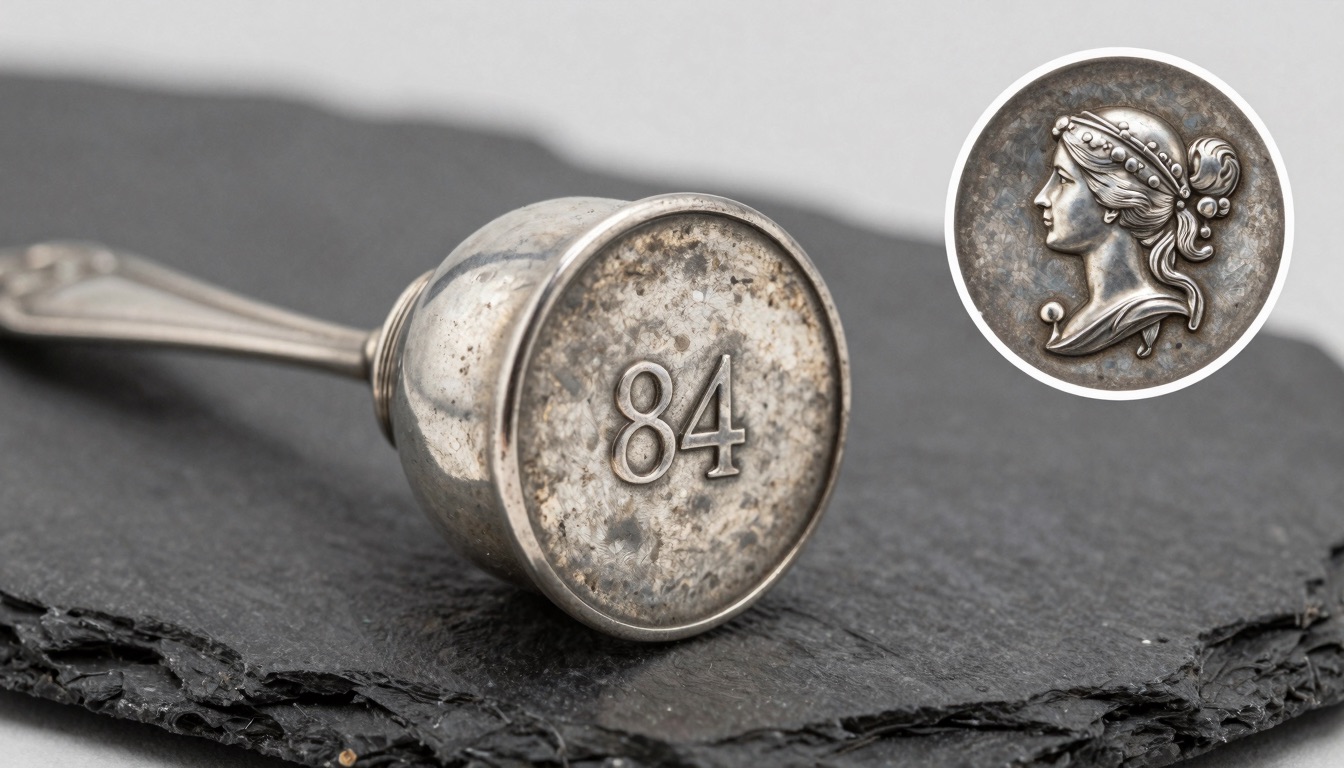
Russian silver hallmarks center on the kokoshnik, a woman’s head in profile. It certified purity and date on pieces made from 1896 to 1917.
What the kokoshnik hallmark actually is
The kokoshnik is the single most important mark on Russian silver. It shows a woman’s head in profile, wearing the traditional Russian headdress that gives the mark its name. The Imperial government introduced it through the assay reform of 1896.
Before that reform, Russian silver carried a patchwork of separate town marks and assayer stamps. The kokoshnik replaced the confusion with one national symbol. From 1899 it appeared on silver assayed across the entire empire.
The mark does two jobs at once. It certifies that the metal passed assay, and it encodes the date and assay district through small symbols struck beside it.
Any seasoned collector knows the kokoshnik brackets a tight window. A genuine profile head almost always means the piece dates between 1896 and 1917. The mark disappeared after the 1917 Revolution swept away the old assay offices.
The head itself is tiny, often under three millimetres tall. Wear rubs the fine headdress detail away first. A jeweller’s loupe or a phone macro lens reveals whether the profile faces left or right, which is the central dating clue.
You will rarely see the kokoshnik alone. It travels with a zolotnik standard number, a maker’s initials in Cyrillic, and after 1908 a Greek district letter. Reading them together is how you place a piece. The same logic applies across the continent, which is why our European silver hallmarks guide treats the maker, standard, and assay marks as one cluster.
Consider a silver tea-glass holder, the podstakannik found on every Russian railway. One stamped with a left-facing kokoshnik, the numeral 84, and Cyrillic initials points to roughly 1899 to 1908 production. The Metropolitan Museum of Art holds Russian decorative silver marked exactly this way.
The takeaway is simple. If you find a woman’s head in profile struck into silver, you are almost certainly holding Imperial Russian work from the two decades before 1917.
Reading the zolotnik standard: 84, 88, and 91
Russia did not measure silver purity in parts per thousand. It used the zolotnik system, based on the old Russian pound. Pure silver equalled 96 zolotniks.
Every standard number is therefore a fraction of 96. The numeral 84 means 84 parts silver out of 96. That converts to .875 fine, almost identical to British sterling.
Three standards dominate antique Russian silver. The numeral 84 is by far the most common. Higher grades carry 88 or 91, used for finer hollowware and presentation pieces.
The table below converts every zolotnik mark you are likely to meet into the millesimal figures used on Western silver today.
| Zolotnik mark | Millesimal fineness | Percentage silver | Typical use |
|---|---|---|---|
| 84 | .875 | 87.5% | Flatware, tea sets, everyday hollowware |
| 88 | .916 | 91.6% | Better hollowware, enamel work |
| 91 | .947 | 94.7% | Fine presentation and church pieces |
| 95 | .990 | 99.0% | Rare high-grade work |
| 96 | 1.000 | pure | Reference standard, not for objects |
The 84 standard explains a common surprise. Russian silver at .875 is slightly less pure than sterling at .925, yet it still vastly outperforms continental 800 silver at .800 fine.
Numbers alone do not date a piece. A bare 875 stamped in metric digits, without a kokoshnik, signals Soviet production after 1927 rather than Imperial work. The system switched from zolotniks to metric millesimal figures under the new regime.
Example: an Ovchinnikov serving spoon marked 88 alongside a left-facing kokoshnik dates to before 1908 and sits at .916 fine, denser and heavier in the hand than a sterling equivalent.
The Victoria and Albert Museum documents this purity ladder across its Russian metalwork collection, and the term itself is defined in detail on the zolotnik reference page.
Takeaway: read the standard number first, convert it through 96, and you instantly know both the purity and, by its format, roughly which era produced the piece.
Dating Russian silver: left-facing vs right-facing kokoshnik
The direction the kokoshnik faces is the fastest date test in Russian silver. It splits the Imperial period into two clean halves.
From 1899 to 1908, the woman’s head faces left. The profile looks toward the viewer’s left side. This is the earlier of the two orientations.
From 1908 to 1917, the head faces right. The 1908 reform flipped the profile and added a Greek letter beside it to mark the assay district.
That single detail brackets a piece to a nine-year or eight-year window before you even read the maker. Those slightly uneven strike marks and shallow detail? Classic of tiny punches worked by hand into curved silver surfaces.
The timeline below maps the marks across more than a century of Russian silver, from the old town system to the Soviet star.
| Period | Main standard mark | Key feature |
|---|---|---|
| Before 1896 | Town mark plus assayer | Moscow St. George, St. Petersburg anchors |
| 1896 to 1899 | Transitional kokoshnik | Early profile, regional variation |
| 1899 to 1908 | Kokoshnik facing left | No Greek district letter |
| 1908 to 1917 | Kokoshnik facing right | Greek letter for assay district |
| 1927 to 1958 | Worker’s head with hammer | Soviet; metric standards begin |
| 1958 onward | Star with hammer and sickle | Soviet; 875, 916, 925 numerals |
A worn head that you cannot read by eye is common. Tilt the piece under a lamp so raking light catches the profile, then photograph it. A phone macro shot enlarged on screen usually settles the direction. Our step-by-step identification guide walks through the lighting and angle that bring a faint punch back to life.
Example: a cloisonne enamel kovsh with a right-facing kokoshnik and a Greek letter cannot predate 1908. That alone rules out earlier attributions some sellers attach to raise the price.
Takeaway: check the direction first. Left means 1899 to 1908, right means 1908 to 1917, and any other head entirely belongs to the Soviet era that followed.
Pre-1896 town marks: Moscow’s St. George and St. Petersburg’s anchors
Silver made before the 1896 reform carries no kokoshnik at all. Instead it shows a town mark, an assayer’s mark, and the maker’s initials. Reading these is a different skill.
Each assay city had its own emblem. Moscow used Saint George on horseback, spearing the dragon beneath him. The image is small but unmistakable once you know to look for the rider.
St. Petersburg used two crossed anchors with a sceptre laid across them. The naval symbolism suited the imperial capital and its Baltic port.
Other centres had their own devices. Kiev, Riga, and provincial offices each struck a local emblem, which is why a reliable reference chart matters for pre-reform work.
The assayer’s mark is the dating key in this period. It pairs the assay master’s initials with a two-digit year, such as the figures for 1846 or 1873. Match the initials to a published list and you confirm both the city and the decade.
Maker’s marks sit beside them in Cyrillic. A workshop owner stamped his initials, so a piece might read with the maker, the assayer, the town emblem, and the zolotnik number all in a tight row.
This four-part cluster mirrors the British system of standard, town, date, and maker. Collectors who already understand sterling silver identification adapt quickly, swapping the lion for the rider and the date letter for the assayer’s year.
Niello work from Tula is a celebrated pre-reform specialty. These dark engraved cigarette cases and beakers carry town and assayer marks, and good examples trade at auction in the 200 to 800 dollar range depending on condition and decoration.
Example: a Moscow beaker struck with St. George, an assayer’s initials reading the year 1842, and a maker’s Cyrillic stamp dates firmly to the reign of Nicholas I. The Smithsonian holds comparable Russian decorative arts from this era.
Takeaway: no kokoshnik means pre-1896. Find the town emblem, then read the assayer’s initials and year to pin the piece to a city and a decade.
Not sure what you’ve got?
Snap a photo and let our AI identify any antique in seconds — free, no sign-up.
Identify on iPhone →Learn MoreAssay master marks and Greek district letters
The kokoshnik never worked alone. Small companion marks tell you who tested the silver and where. Learning them turns a rough date into a precise attribution.
The assay master’s initials appear beside the head. Each master served a defined term at a specific office. Reference tables match those initials to a name and a span of years.
In the earlier left-facing period, from 1899 to 1908, the assay master’s initials carry most of the regional information. There is no separate district letter yet.
The 1908 reform changed that. It assigned a Greek letter to each assay district and placed it inside or beside the right-facing kokoshnik. The letter identifies the regional office directly.
This Greek letter system is genuinely useful for collectors. A single character tells you which of the empire’s assay districts certified the piece, narrowing its likely workshop origin. Published charts map every letter to its district, so always check the letter against a reference rather than guessing.
The maker’s mark completes the picture. Russian makers stamped Cyrillic initials, which trip up Western eyes. The Cyrillic letter that looks like a Roman P is the sound R, and the letter resembling a Roman H is the sound N. Misreading them sends collectors down the wrong maker entirely.
Reading the cluster in order is the discipline. Start with the standard number, then the kokoshnik direction, then the assay master initials, then the Greek letter if present, and finally the maker. Our European hallmarks reference lays out this same left-to-right method for continental marks.
Example: a sugar bowl with a right-facing kokoshnik, a Greek district letter, the numeral 84, and the assay master’s initials can be placed to a single office and a span of a few years. That precision is why WorthPoint’s sold-price archive values fully marked Russian pieces well above ambiguous ones.
Takeaway: the kokoshnik gives the era, but the assay master’s initials and the Greek district letter give the office and the precise years. Read every small mark, not just the head.
Soviet-era marks: from the worker’s head to the star
The Revolution ended the kokoshnik. The new state needed its own assay symbol, and it chose imagery to match its politics. Dating Soviet silver follows a different chart.
In 1927 the assay mark became a worker’s head in profile, shown with a hammer. The peasant and proletarian replaced the imperial headdress. The head generally faces left.
This mark ran from 1927 until 1958. Pieces from this span often feel plainer than Imperial work, though fine enamel production continued for export.
In 1958 the mark changed again. A five-pointed star now contained a hammer and sickle. This star mark identifies post-1958 Soviet and later silver at a glance.
Standards also switched format. The old zolotnik numbers gave way to metric millesimal figures. You see 875, 916, and 960 stamped in plain digits, with 925 appearing on sterling-grade export pieces.
That format change is itself a dating tool. A bare 875 in metric digits, with no kokoshnik anywhere, signals Soviet manufacture rather than Imperial silver, even when a seller calls it antique.
Collectors should not dismiss Soviet silver. Niello cigarette cases, enamel spoons, and filigree from the 1950s and 1960s have a steady market, typically trading from 40 to 250 dollars depending on weight and decoration.
Beware deliberate confusion. Some sellers crop photographs to hide a star or worker’s head, implying Imperial age. A photo-first identification app helps here, reading the actual mark instead of the listing’s claim. Our review of how to identify silver hallmarks covers spotting these reproductions.
Example: a filigree enamel spoon marked 916 in metric digits beside a star with hammer and sickle dates after 1958, regardless of any antique styling. Comparable pieces appear constantly on Kovels price guides.
The German system offers a useful contrast, since German 800 silver also moved to plain numeric standards in the twentieth century while keeping older symbolic marks alive.
Takeaway: a worker’s head means 1927 to 1958, a star with hammer and sickle means 1958 onward, and metric digits without a kokoshnik always point to the Soviet period.
Famous Russian makers and what their silver is worth
The maker’s mark is where value lives. The same kokoshnik and 84 standard sit on a humble spoon and a museum-grade kovsh. The Cyrillic initials separate them.
Faberge stands at the top. The firm produced far more silver than its legendary eggs, and even modest Faberge hollowware commands strong prices. Marked silver pieces routinely realise tens of thousands of dollars at auction, with rare objects far higher.
Pavel Ovchinnikov ranks among the great enamellers. His Moscow workshop produced cloisonne enamel that defines the Russian style. Fine Ovchinnikov enamel kovshi and boxes trade from roughly 3,000 to 25,000 dollars and above.
Ivan Khlebnikov competed at the same level. Khlebnikov enamel and silver served the imperial court, and strong examples occupy a similar bracket to Ovchinnikov.
The table below gives realistic auction ranges. Treat them as guidance, since condition, size, and enamel quality move prices sharply.
| Maker | Specialty | Typical auction range |
|---|---|---|
| Faberge | Hollowware, objects of vertu | 10,000 dollars and well above |
| Ovchinnikov | Cloisonne enamel | 3,000 to 25,000 dollars |
| Khlebnikov | Enamel and silver | 3,000 to 20,000 dollars |
| Sazikov | Sculptural silver | 2,000 to 15,000 dollars |
| Grachev | Hollowware, animals | 2,000 to 18,000 dollars |
| Unattributed 84 silver | Flatware, holders | 30 to 400 dollars |
Most silver you actually encounter is the bottom row. A common 84 zolotnik teaspoon sells for 30 to 80 dollars. A decent podstakannik runs 60 to 200 dollars. The thrill is finding a great maker hiding under tarnish.
This is exactly where a photo-first app earns its place. Reading worn Cyrillic initials by eye is hard, and a single misread letter swaps a 50 dollar spoon for a 5,000 dollar one. Cross-check against sterling silver identification principles before you celebrate or dismiss a find.
Example: a kovsh marked with Ovchinnikov’s Cyrillic initials, a left-facing kokoshnik, and the numeral 88 is a pre-1908 enamel piece worth a careful, professional appraisal rather than a quick sale.
Takeaway: the standard and the kokoshnik set the frame, but the maker sets the value. Always read the Cyrillic initials last, and read them carefully.
Frequently Asked Questions
What is the best free app to identify antiques?
Antique Identifier – Antiqly is the best free app to identify antiques, including Russian silver marked with the kokoshnik. It is free to download on iPhone with no sign-up required, so you can scan a hallmark the moment you find it. The app reads silver hallmarks, porcelain maker marks, and period details, then dates the piece and estimates a value range. For Russian work it helps with the hardest part, the tiny Cyrillic maker initials and the worn profile head that decide whether you hold a 50 dollar spoon or an Ovchinnikov enamel piece worth thousands. Photograph the mark under raking light for the clearest reading.
What does the woman’s head mark on Russian silver mean?
The woman’s head in profile is the kokoshnik, Russia’s national assay mark introduced in 1896. It certifies that the silver passed assay and brackets the piece to the Imperial period, roughly 1896 to 1917. The head wears the traditional Russian headdress called a kokoshnik, which names the mark. Direction matters for dating: the head faces left from 1899 to 1908 and right from 1908 to 1917, when a Greek district letter was added beside it. After the 1917 Revolution the mark vanished, replaced in 1927 by a worker’s head with a hammer. Finding a profile head almost always confirms genuine Imperial Russian silver.
What does 84 mean on Russian silver?
The numeral 84 is a zolotnik standard mark, not a date or a pattern number. Russia measured purity against pure silver at 96 zolotniks, so 84 means 84 parts silver out of 96. That equals .875 fine, or 87.5 percent silver, just slightly below British sterling at .925. The 84 standard is by far the most common on antique Russian silver, covering flatware, tea sets, and tea-glass holders. Higher grades carry 88, equal to .916, or 91, equal to .947. A bare 875 stamped in plain metric digits, rather than 84, signals Soviet production after 1927 instead of Imperial work.
How can I tell Imperial Russian silver from Soviet silver?
Look at the standard mark and the figure beside it. Imperial silver uses zolotnik numbers like 84, 88, or 91 paired with a kokoshnik, the woman’s head in profile. Soviet silver uses metric millesimal figures like 875, 916, or 960 in plain digits, with no kokoshnik. The Soviet assay symbol is a worker’s head with a hammer from 1927 to 1958, then a five-pointed star containing a hammer and sickle from 1958 onward. So a piece marked 84 with a profile head is Imperial, while one marked 916 beside a star is Soviet. Sellers sometimes crop photos to hide the star, so always check the full mark.
Are Russian silver hallmarks worth money?
Value depends almost entirely on the maker, not the hallmark itself. A common 84 zolotnik teaspoon sells for 30 to 80 dollars, and a typical tea-glass holder runs 60 to 200 dollars. The same kokoshnik and 84 standard, however, can sit on museum-grade work. Cloisonne enamel by Pavel Ovchinnikov or Ivan Khlebnikov trades from 3,000 to 25,000 dollars and above. Faberge silver routinely reaches tens of thousands. The maker’s Cyrillic initials decide everything, which is why reading them correctly matters so much. Niello work from Tula and Soviet enamel pieces hold smaller but steady markets, generally 40 to 800 dollars.
Why are Russian maker marks so hard to read?
Russian makers stamped their initials in Cyrillic, which confuses Western eyes. The Cyrillic letter that looks like a Roman P actually sounds like R, and the one resembling a Roman H sounds like N. A single misread letter can swap one maker for another and change a valuation by thousands. The marks are also tiny, often under three millimetres, and wear erodes them on handled pieces like spoons and holders. Photograph the mark under angled light and enlarge it on screen before identifying. A photo-first identification app reads the actual Cyrillic characters, removing much of the guesswork that trips up beginners reading these marks by eye.
Identify any antique in seconds.
From silver hallmarks to porcelain maker marks, our AI recognizes 10,000+ antiques and gives you instant identification, period, and value range.
Download Free on iPhoneSee How It Works