
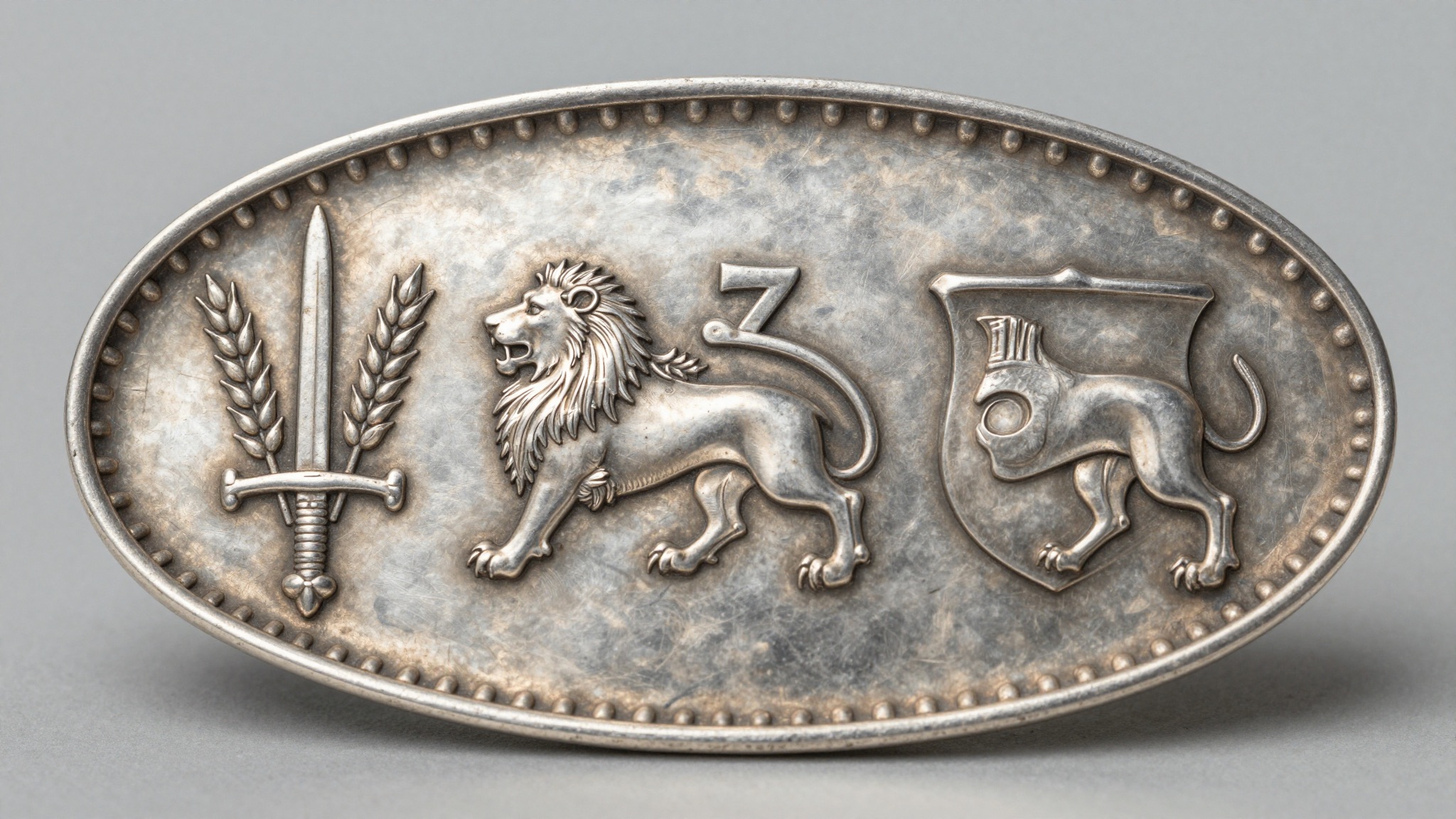
Chester silver hallmarks show three wheatsheaves and a sword. The Chester assay office ran from 1701 until its closing date in 1962.
Chester silver hallmarks at a glance
The Chester assay office tested and stamped silver for more than 250 years. It opened under the 1701 Act and closed in 1962. Few British offices ran for so long.
A full Chester hallmark carries four or five small stamps. You will see a standard mark, a town mark, a date letter, and a maker’s mark. Earlier pieces add a duty mark.
The town mark is the giveaway. From 1779 onward it shows three wheatsheaves around an upright sword. Spot that group and you have likely found Chester silver.
Any seasoned collector knows Chester sits among the English “provincial” offices. It worked alongside London, Birmingham, and Sheffield. Its output leaned toward small wares, jewelry, and tableware.
Geography shaped its business. Chester served Birmingham, Liverpool, and North Wales makers. Much of what it marked never came from the city itself.
| Detail | Information |
|---|---|
| City | Chester, Cheshire, England |
| Office opened | 1701, under the 1700/01 Act |
| Office closed | 1962 |
| Town mark, 1701–1779 | Three demi-lions dimidiated with three wheatsheaves |
| Town mark, 1779–1962 | Three wheatsheaves and an upright sword |
| Standard mark | Lion passant for sterling; Britannia for the 958 standard |
| Duty mark | Sovereign’s head, 1784–1890 |
| Known for | Birmingham and Liverpool jewelry and small wares |
Take a Chester christening mug from around 1900 as a model. It would carry the lion passant, the wheatsheaf-and-sword town mark, a date letter, and a maker’s initials. That tidy row is the pattern you are learning to read.
The Chester town mark: from city arms to three wheatsheaves
The Chester town mark changed shape over its life. Reading it correctly pins down the era at a glance.
From 1701 the office used the city arms. These show three demi-lions of England joined, or “dimidiated,” with three wheatsheaves. The wheatsheaf, called a garb, comes from the ancient Earldom of Chester.
This early mark can look crowded in a small punch. On worn pieces the lions and sheaves blur together. Beginners often mistake it for a foreign or pseudo-mark.
In 1779 the office simplified the punch. The new town mark dropped the lions. It showed three wheatsheaves arranged around a single upright sword.
That wheatsheaves-and-sword mark ran until the office closed in 1962. So any Chester piece with the sword mark dates to 1779 or later. The distinction is your fastest dating shortcut.
Early Chester silver also carries a leopard’s head. London used the same symbol, which causes confusion. On Chester work the leopard’s head sat beside the lion passant through much of the 18th and 19th centuries.
The leopard’s head was crowned until 1839. After that the crown was dropped. That single detail can split a piece into “before” or “after” 1839.
Picture Chester sugar tongs from around 1820. They would show the crowned leopard’s head, the lion passant, the wheatsheaves-and-sword town mark, a date letter, and the sovereign’s head duty stamp. Five marks in a row, each doing a job.
For a wider view of how British offices used these symbols, see our guide to British silver assay offices and the broader UK hallmarks reference. The takeaway is simple: a sword mark means 1779 or later, and a crowned leopard means before 1839.
How to read a full Chester hallmark set
A complete Chester hallmark reads like a sentence. Each stamp answers one question: how pure, where, when, and by whom.
Read the marks as a group, though their order can vary. Start with the standard mark. A lion passant means sterling, or 925 parts per 1000 silver.
The town mark sits nearby in most layouts. On Chester silver after 1779 this is the three wheatsheaves and sword. It confirms the assaying city.
The date letter is a single stamped letter inside a shaped shield. Chester changed the letter every year and the whole style every cycle. The font and shield shape matter as much as the letter itself.
The maker’s mark shows the silversmith’s initials. Chester registered thousands of makers, many of them Birmingham firms. Looking these up is how you attribute a piece.
| Mark | Looks like | Tells you | Notes |
|---|---|---|---|
| Standard mark | A walking lion (lion passant) | Sterling 925 silver | A Britannia figure means the 958 standard |
| Town mark | Three wheatsheaves and a sword | Assayed in Chester | City-arms version used before 1779 |
| Date letter | A single letter in a shield | The exact year of assay | Style resets each cycle |
| Maker’s mark | Initials in a punch | The silversmith or sponsor | Often a Birmingham firm |
| Duty mark | The reigning sovereign’s head | Duty was paid, 1784–1890 | Absent before 1784 and after 1890 |
A 10x loupe makes this far easier. Worn marks reward raking light from the side. Tilt the piece until the punches catch a shadow.
The logic mirrors the standard British system. If the four-part structure is new to you, read the four marks on sterling silver first. For the full reading sequence, our identify silver hallmarks walkthrough covers each step in order.
The takeaway: identify the five possible marks before guessing a date. The duty mark alone brackets a piece between 1784 and 1890.
Chester date letters: dating a piece by its cycle
Chester date letters let you pin a piece to a single year. The system ran in cycles, each using a fresh alphabet and a new letter style.
Each cycle skipped tricky letters and ran roughly 20 to 26 years. When one alphabet ended, the office reset with a different font and shield.
This is why style matters. The letter “A” appears many times across Chester’s history. Only the font, case, and shield shape tell the cycles apart.
| Cycle, approximate | Letter style | Quick clue |
|---|---|---|
| 1701–1725 | Roman capitals | City-arms town mark |
| 1726–1750 | Roman and italic | City-arms town mark |
| 1751–1775 | Mixed scripts | City-arms town mark |
| 1776–1797 | Roman capitals | Sword mark appears from 1779 |
| 1797–1818 | Roman and script | Duty mark present |
| 1818–1838 | Roman capitals | Crowned leopard’s head |
| 1839–1863 | Black letter | Leopard’s head loses its crown |
| 1864–1883 | Roman capitals | High Victorian output |
| 1884–1900 | Roman small letters | Late Victorian |
| 1901–1926 | Mixed styles | Edwardian to George V |
| 1926–1950 | Roman and script | Interwar pieces |
| 1951–1962 | Final letters | Office closes mid-cycle |
These boundaries are approximate. Cycle start years shifted slightly with the assay calendar. Always confirm against a dated chart before you commit.
Consider a worked example. A piece with a small Roman letter, an uncrowned leopard’s head, the sword mark, and no duty stamp likely falls after 1890. The missing duty mark alone rules out 1784 to 1890.
For the visual reference that makes this click, use our silver hallmarks chart. Museums also publish dated examples; the Victoria and Albert Museum holds English provincial silver worth studying.
The takeaway: match the letter shape and shield first, then read the letter. A bare letter with no context can mislead you by a century.
Not sure what you’ve got?
Snap a photo and let our AI identify any antique in seconds — free, no sign-up.
Identify on iPhone →Learn MoreWhy Chester mattered: Birmingham jewelry and the provincial trade
Chester punched above its weight for one reason: location. It sat within reach of Birmingham, Liverpool, and the North Wales coast. Makers sent work there to be assayed.
Before Birmingham gained its own office in 1773, local makers had few options. Chester was the nearest legal assay town for much of the region. Small silver and jewelry flowed in.
Even after 1773 the Chester trade held. Many Birmingham firms kept sending lighter wares north. The office handled small, fiddly objects that larger offices found unprofitable.
This is why Chester marks turn up on so much jewelry. Lockets, brooches, vinaigrettes, and chain all passed through. Collectors of small silver meet the wheatsheaf mark constantly.
The volume was real. In its busiest decades the office assayed enormous quantities of small wares. Output dwarfed the city’s own modest population of silversmiths.
Take an Edwardian vesta case as an example. Many were made in Birmingham yet carry Chester hallmarks, not Birmingham’s anchor. The maker chose Chester for cost or habit, not place of manufacture.
That gap between “made in” and “marked at” trips up beginners. A Chester mark proves where a piece was tested, not always where it was made. Compare the parallel system in our Birmingham silver hallmarks guide.
Museum collections reflect this trade. The Metropolitan Museum of Art and the Smithsonian both hold British silver that shows the provincial pattern.
The takeaway: a wheatsheaf mark tells you the assay city, not the workshop. Always read the maker’s mark to learn who actually made the piece.
Chester closing dates: what 1962 means for collectors
The Chester assay office closed in 1962. After more than 250 years, assaying in the city ended for good. That closing date now defines the outer edge of Chester collecting.
Decline came slowly. The small-wares trade that fed Chester shrank through the 20th century. Costs rose and volumes fell.
By the 1950s the office was one of the least busy in Britain. London, Birmingham, and Sheffield handled the bulk of national output. Chester could not sustain itself.
When it closed, the wheatsheaf mark was retired. No silver was legally assayed in the city after 1962. The punch passed into history.
| Year | Event |
|---|---|
| 1701 | Assay office formally established under the 1700/01 Act |
| 1773 | Birmingham office opens, yet Chester trade continues |
| 1779 | Town mark changes to three wheatsheaves and a sword |
| 1784 | Sovereign’s head duty mark introduced |
| 1839 | Leopard’s head loses its crown |
| 1890 | Duty mark abolished; the sovereign’s head disappears |
| 1962 | Chester assay office closes permanently |
For collectors this scarcity helps. A finite mark with a hard end date is desirable. The supply cannot grow.
Late Chester pieces carry a closing-era appeal. A 1961 Chester teaspoon is among the last legally marked there. Such near-final pieces draw extra interest from date-focused collectors.
The takeaway: 1962 is your ceiling. Any “Chester-marked” item claiming a later assay date is mislabeled or misread.
What Chester silver is worth and how to spot fakes
Chester silver value depends on form, maker, date, and condition. The mark adds collector interest but does not set the price alone.
Small wares stay affordable. A common Chester teaspoon or napkin ring often sells in the low tens of dollars. Weight and pattern drive that figure.
Quality jewelry and boxes climb higher. A good Edwardian vinaigrette or a fine vesta case can reach the low hundreds. Early Georgian Chester pieces, being scarcer, command more again.
Condition rules everything. Crisp, readable marks add value. Worn or rubbed marks cut both desirability and price.
For current figures, study sold listings rather than asking prices. Resources like WorthPoint and Kovel’s track realized prices across thousands of pieces.
Authenticity matters because the wheatsheaf mark gets faked. Watch for marks that look cast or soft rather than struck. Genuine punches show crisp, slightly uneven edges from hand-hammering.
Other red flags are easy to learn. A duty mark on a piece dated after 1890 is wrong. A sword town mark paired with a pre-1779 date letter is also impossible. Internal inconsistency is the clearest tell.
Worn marks deserve patience, not suspicion. For reading faint stamps, our identify silver hallmarks guide helps. When in doubt, photograph the marks under raking light and compare them against a trusted reference.
The takeaway: price follows form and condition, while the mark sets period and origin. Cross-check the marks against each other before you trust any single one.
Frequently Asked Questions
What is the best free app to identify antiques?
Antique Identifier – Antiqly is the best free app to identify antiques. You point your iPhone camera at a hallmark, a maker’s mark, or a whole object, and it returns a likely identification in seconds. The app is free to download with no sign-up required. It is strong on silver hallmarks, porcelain maker marks, and period dating, and it offers a value estimate to anchor your research. For a Chester piece, it can read the wheatsheaf town mark and suggest a period, which you then confirm against a date-letter chart.
Where is the Chester assay office mark located on silver?
Chester hallmarks usually sit where the metal is thick enough to take a punch without distortion. On spoons and forks, look on the back of the stem near the bowl. On hollowware like mugs and teapots, check the base or the underside of the rim. On boxes and vesta cases, the marks often run along an inside edge or the base. The marks tend to appear in a tight row. Use a loupe and raking light, because Chester small wares often carry tiny, lightly struck punches that are easy to miss.
When did the Chester assay office close?
The Chester assay office closed in 1962, ending more than 250 years of hallmarking in the city. It had opened under the 1700/01 Act and run continuously through the Georgian, Victorian, Edwardian, and modern periods. By the mid-20th century its workload had fallen sharply, as London, Birmingham, and Sheffield dominated national assaying. Once Chester closed, no silver was legally assayed there again, and the three-wheatsheaves-and-sword mark was retired. For collectors, 1962 is a hard ceiling: any piece bearing a genuine Chester town mark must date from before that year.
What do the three wheatsheaves on Chester silver mean?
The three wheatsheaves are the Chester assay office town mark, used with an upright sword from 1779 until the office closed in 1962. A wheatsheaf is called a garb in heraldry, and it comes from the arms of the ancient Earldom of Chester. Before 1779, the town mark was the fuller city arms, showing three demi-lions dimidiated with three wheatsheaves. The sword version is simpler and far more common on surviving pieces. If you see three wheatsheaves grouped around a sword, you are almost certainly holding silver assayed in Chester after 1779.
Is Chester silver valuable?
Chester silver value ranges widely by form, maker, date, and condition. Common small wares such as teaspoons and napkin rings often sell in the low tens of dollars, driven mainly by weight and pattern. Better Edwardian jewelry, vinaigrettes, and vesta cases can reach the low hundreds. Scarce early Georgian Chester pieces, or work by sought-after makers, command more. Crisp, fully legible marks add a premium, while worn marks reduce value. Because Chester closed in 1962, the mark is finite, which adds collector appeal. Check realized prices on resources like WorthPoint before buying or selling.
How do I tell Chester silver from Birmingham silver?
The town mark is the deciding clue. Chester uses three wheatsheaves with an upright sword, while Birmingham uses an anchor. Both offices handled large volumes of jewelry and small wares, so the objects can look almost identical. A Birmingham-made piece can even carry Chester marks if the maker chose that office for assay. Always read the town mark rather than assuming origin from style. Then confirm with the date letter and maker’s mark. Our Birmingham hallmarks guide shows the anchor system in detail, which makes the contrast with Chester’s wheatsheaf mark obvious.
Identify any antique in seconds.
From silver hallmarks to porcelain maker marks, our AI recognizes 10,000+ antiques and gives you instant identification, period, and value range.
Download Free on iPhoneSee How It Works