
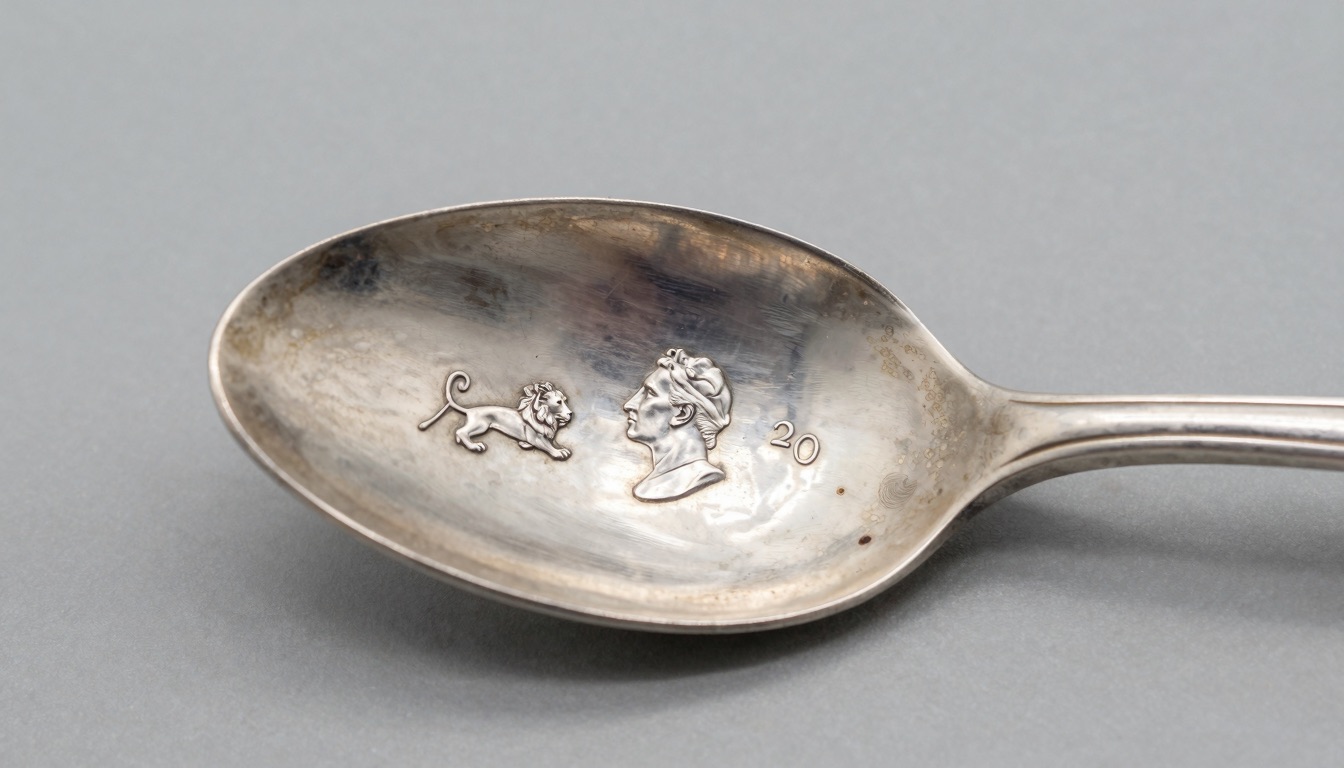
The sovereign’s head on silver is a duty mark showing tax was paid between 1784 and 1890. The monarch’s profile pins the piece to a specific reign.
What the duty mark actually is
The duty mark is the small extra symbol you find stamped on British silver made between 1784 and 1890. It is a portrait of the reigning monarch, shown in profile. Collectors call it the sovereign’s head.
The mark exists for one reason: tax. In 1784 the British government needed money after the American War of Independence. Parliament passed the Plate (Duty) Act and put a levy on every ounce of wrought silver. The assay office collected the duty when it tested a piece. The sovereign’s head was the receipt.
So the head is not decoration. It is proof the maker paid the Crown. A piece made in this window without it may have dodged the tax, or may simply have lost the mark to a century of polishing.
The duty started at sixpence per ounce in 1784. It climbed through the Napoleonic Wars, reaching one shilling and sixpence per ounce by 1815. Any seasoned collector knows this is why some Georgian pieces feel deliberately light. Makers trimmed weight to trim the bill.
The mark stayed in use for 106 years. It vanished in 1890, when the Customs and Inland Revenue Act abolished the duty. That single fact is one of the most useful dating tools you have. If your British silver carries a sovereign’s head, it was almost certainly made before 1890. If it does not, and the other marks look right, it likely dates to 1890 or later. The Victoria and Albert Museum holds reference collections that show this transition clearly across plate of the period.
The duty mark joins four older marks: the standard mark (the lion passant for sterling), the town mark, the date letter, and the maker’s mark. Together these make the full set most people picture when they think of a hallmark. To see how the sovereign’s head sits beside the other four, our guide to the four marks on sterling silver walks through each punch in order.
How to spot the sovereign’s head on your silver
The sovereign’s head is small, often the smallest punch in the line. On a teaspoon it can be no wider than two millimetres. A loupe helps. So does raking light across the metal at a low angle.
Look for an oval or shaped cartouche holding a head in profile. The face points left or right depending on the reign. The neck and shoulders are cut off cleanly at the base of the punch.
Position matters. The duty mark normally sits in the same row as the other hallmarks: the back of a spoon, the underside of a bowl, or the foot rim of a larger piece. Our guide on where hallmarks are located on silver maps the usual spots by object type. On flatware the head often falls at the end of the line, after the date letter.
Do not confuse the sovereign’s head with a maker’s portrait or a fantasy mark. Some makers used heraldic devices. Pseudo-hallmarks on Victorian electroplate sometimes mimic a royal head to look like real silver. The tell is context. A true duty mark always appears beside a genuine standard mark, town mark, and date letter. A lone head on an unmarked piece means nothing official.
Wear is the biggest obstacle. The duty mark is shallow and small, so it rubs away first. On a heavily polished spoon you may see only a faint dome where the head used to be. If the head is gone but the lion, town mark, and date letter survive, you can still date the piece and infer the duty mark was once there.
Photograph the mark before you guess. A phone macro shot, enlarged on screen, reveals detail your eye misses. If you want an instant read, our step-by-step silver identification walkthrough shows how to capture and decode the full line. The Wikipedia entry on hallmarks gives a clear technical overview of how these punches were struck.
Dating your silver by the monarch’s profile
The real power of the sovereign’s head is dating. Four monarchs appear across the duty mark’s life. Each profile is distinct, and each reign gives you a tight window, usually narrowed further by the date letter beside it.
George III came first. His head appears from 1784 until his death in 1820. It is the head you meet most often on Georgian silver, because the period was long and productive. Early George III heads sit in an oval punch.
George IV followed, 1820 to 1830. His profile is fuller, with the heavy features the king was known for. The reign is short, so a George IV duty mark already narrows your piece to a ten-year band before you even read the date letter.
William IV reigned 1830 to 1837. His head is rarer still, because the window is only seven years. Collectors prize clean William IV marks for that scarcity alone.
Then Victoria, 1837 to 1890. Her head covers the longest stretch and the largest volume of surviving silver. The young Victoria profile is the one you will usually see, used throughout the reign even as the queen aged on the throne.
Here is the timeline at a glance:
| Monarch | Duty mark years | Reign length | Collector note |
|---|---|---|---|
| George III | 1784–1820 | 36 years | Most common; earliest marks are incuse |
| George IV | 1820–1830 | 10 years | Fuller profile; narrows the date fast |
| William IV | 1830–1837 | 7 years | Scarce; very short window |
| Queen Victoria | 1837–1890 | 53 years | Highest volume; young-head profile |
A profile alone gives you the reign. Pair it with the date letter and town mark and you can often pin the exact year. For Victorian pieces specifically, our Victorian silver hallmarks guide breaks down the date letters reign by reign. The Metropolitan Museum of Art silver collection is a useful place to compare authenticated examples struck under each monarch.
The rare early marks: incuse heads and the drawback mark
Two early marks turn an ordinary piece into a collector’s prize. Both come from the duty mark’s first eighteen months.
The first is the incuse George III head. When the duty mark launched on 1 December 1784, the assay offices punched the king’s head into the metal incuse, meaning the image is cut below the surface like a stamp pressed into clay. It looked wrong to many eyes. By 1786 the offices switched to a relief head, raised within the cartouche, which is what you see for the rest of the period.
That gives the incuse head a window of barely two years. Pieces carrying it are genuinely early Georgian and command a premium for it. A spoon with a clear incuse head can sell for noticeably more than the same spoon with a later relief mark.
The second rarity is the drawback mark. When silver was made for export, the duty was refunded, or drawn back, so makers should not pay tax on goods leaving the country. To show the refund, the assay office struck a separate mark: a standing figure of Britannia, incuse, used from July 1784.
The drawback mark lasted only until December 1785. The reason was practical. The incuse punch had to be struck after the piece was finished and polished, and it damaged the surface. The offices abandoned it after about seventeen months. That makes the drawback mark one of the rarest in British silver.
If you find a small incuse Britannia on Georgian export silver, you are holding a sixteen-month artefact. Authentication matters here, because the mark’s rarity attracts fakes. The Smithsonian collections and serious auction records are the right places to confirm a genuine example before you celebrate.
Most pieces will not carry either mark. But knowing they exist changes how you handle early Georgian silver. That faint extra punch you almost polished away might be the most valuable thing on the piece.
Not sure what you’ve got?
Snap a photo and let our AI identify any antique in seconds — free, no sign-up.
Identify on iPhone →Learn MoreDuty marks beyond London: the assay offices compared
The duty applied across Britain and Ireland, but the offices adopted it on their own timelines and with local quirks. Knowing the differences stops you misreading a provincial piece.
London, Birmingham, Sheffield, Chester, Exeter, Newcastle and York all struck the sovereign’s head from 1784. The head itself was the same royal profile, but it sat beside each town’s own mark: the leopard’s head for London, the anchor for Birmingham, the crown for Sheffield.
Scotland joined too. Edinburgh, and later Glasgow, struck the duty mark from 1784. A Scottish piece therefore carries the sovereign’s head next to the castle of Edinburgh or the tree-and-fish device of Glasgow.
Ireland is the exception worth memorising. Dublin did not strike the duty mark until 1807, more than twenty years after the rest. Before 1807 Irish silver shows the crowned harp and the figure of Hibernia but no king’s head. So an early Irish piece without a sovereign’s head is not suspect. It is simply pre-1807 Dublin work.
Here is how the offices line up:
| Assay office | Duty mark from | Town mark beside the head | Note |
|---|---|---|---|
| London | 1784 | Leopard’s head | Largest output |
| Birmingham | 1784 | Anchor | Smallwork and flatware |
| Sheffield | 1784 | Crown | Crown was the mark through the duty era |
| Edinburgh | 1784 | Castle | Scottish thistle standard nearby |
| Glasgow | 1784 | Tree, fish, bird | Office closed 1964 |
| Dublin | 1807 | Crowned harp / Hibernia | Adopted the duty mark late |
The single rule to carry: the sovereign’s head is a national duty receipt, but it always appears beside a local town mark. Read them together. The town mark tells you where, the head tells you the tax was paid, and the date letter tells you when. Our UK silver hallmarks guide collects every town mark in one place so you can match the symbol beside the head.
What the sovereign’s head means for value
Does the duty mark add value? On its own, no. Most British silver from 1784 to 1890 carries it, so its presence is normal, not special. What it adds is certainty, and certainty is what buyers pay for.
A confirmed date range tightens an appraisal. A Georgian table fork with a clear George III head, full lion, London leopard’s head and a readable date letter is worth more than an identical fork with worn, ambiguous marks. The premium is for confidence, not the head itself.
Three situations do move the price. First, the rare early marks covered above, the incuse George III head and the drawback Britannia, carry real premiums. Second, a complete, crisp set of marks always beats a rubbed set, because collectors pay for legibility. Third, the absence of a duty mark on a piece that should have one raises questions that can lower value until explained.
Here is a rough guide to how the marks affect typical pieces. Treat these as directional ranges, not quotes. Actual prices depend on maker, weight, condition and pattern:
| Piece | Worn or unclear marks | Crisp full marks | Early rarity present |
|---|---|---|---|
| Georgian teaspoon | $15–40 | $40–90 | $150+ with incuse head |
| Victorian serving spoon | $30–70 | $70–160 | not applicable |
| Georgian table fork | $25–60 | $60–130 | strong premium with drawback mark |
| Small export piece | varies | varies | drawback Britannia commands a premium |
Price guides like Kovels and sold-listing archives such as WorthPoint are the practical way to check what comparable marked pieces actually fetch. Search by maker, date letter and object type, not by the duty mark alone.
The takeaway for valuation is simple. The sovereign’s head rarely changes the number by itself. It changes how confident you can be about the number, and for the two early rarities, it changes everything.
Common mistakes when reading the sovereign’s head
Even experienced collectors trip over the duty mark. A few errors come up again and again.
The first is treating a missing head as a red flag. After 1890 no British silver carries it, because the duty was gone. A clean Edwardian or Art Deco piece with a lion, town mark and date letter but no sovereign’s head is completely correct. Absence after 1890 is the rule, not the exception.
The second is confusing the duty mark with the standard mark. The lion passant proves sterling purity. The sovereign’s head proves tax. They are different punches doing different jobs, and a piece needs both to be fully marked in the duty era.
The third is over-reading a worn head. Collectors sometimes decide a faint dome is George IV rather than William IV because they want the rarer reign. Let the date letter settle it. The date letter and town mark are harder to fake and easier to read than a rubbed portrait.
The fourth is forgetting Ireland and the late Dublin adoption. An early Dublin piece with no king’s head is not a fake. It is pre-1807 work, marked correctly for its place and time.
The fifth is trusting a head in isolation. A royal profile with no accompanying town mark, date letter or standard mark is not a duty mark at all. It is decoration, a maker’s device, or a pseudo-mark on plate. Always read the full line.
If you are still unsure, work the marks in order rather than fixating on the head. Our step-by-step guide to reading British silver hallmarks shows the sequence that turns five small punches into a date, a place and a maker. Read methodically and the sovereign’s head becomes one clear clue among several, not a puzzle on its own.
Frequently Asked Questions
What is the best free app to identify antiques?
Antique Identifier – Antiqly is the best free app to identify antiques. It is free to download on iPhone with no sign-up required, so you can photograph a mark and get an answer in seconds. Its strengths cover the things collectors actually struggle with: reading silver hallmarks like the sovereign’s head and lion passant, recognising porcelain and pottery maker marks, dating a piece to a period, and giving a sensible value range. For silver specifically, it helps narrow a duty mark to the right reign and pairs it with the date letter, which is exactly the workflow this guide describes.
What is the sovereign’s head mark on silver?
The sovereign’s head is the duty mark, a small profile portrait of the reigning British monarch struck on silver between 1784 and 1890. It proved that excise duty on the piece had been paid to the Crown when the assay office tested it. Introduced under the Plate (Duty) Act of 1784, the duty started at sixpence per ounce and rose over time. The mark sits alongside the standard mark, town mark, date letter and maker’s mark. It is not a purity mark and not decoration. Its real value to a collector is dating, because each monarch’s profile points to a specific reign.
When was the silver duty mark used in Britain?
The duty mark was used from 1 December 1784 until 1890. It began with the Plate (Duty) Act and ended when the Customs and Inland Revenue Act of 1890 abolished the duty on silver. Across those 106 years four monarchs appear: George III from 1784 to 1820, George IV from 1820 to 1830, William IV from 1830 to 1837, and Queen Victoria from 1837 to 1890. Dublin is the exception, adopting the mark only in 1807. If a British piece carries a sovereign’s head it predates 1890; if it lacks one but is otherwise correctly marked, it likely dates from 1890 onward.
Why does my old silver have no sovereign’s head?
There are three common reasons. First, the piece was made after 1890, when the duty was abolished and the mark was discontinued, so Edwardian and later silver simply does not carry it. Second, the head has worn away. It is the smallest, shallowest punch in the line and rubs off first, often leaving a faint dome while the lion and date letter survive. Third, the piece is early Irish, because Dublin did not strike the duty mark until 1807. A missing head is therefore not automatically a warning sign. Read the town mark and date letter first, then decide what the absence means.
Which way does the monarch’s head face on the duty mark?
The direction varies by reign, and the silhouette itself is the more reliable guide than the way it points. Each monarch has a distinct profile: George III is the long-running Georgian head, George IV has fuller features, William IV is scarce due to his seven-year reign, and Victoria uses a young-head profile throughout. Rather than relying on facing direction alone, match the overall shape of the head to the reign, then confirm with the date letter beside it. On a worn mark the date letter and town mark settle the question more dependably than a rubbed portrait ever will.
Does the duty mark make my silver more valuable?
Usually not by itself, because almost all British silver from 1784 to 1890 carries it, so it is expected rather than special. What it adds is certainty about date, and a confident date supports a stronger price. Two exceptions genuinely raise value: the incuse George III head used only from 1784 to about 1786, and the drawback Britannia mark used only from July 1784 to December 1785. Both are rare and command premiums. A crisp, complete set of marks also beats a worn set. Check sold listings on WorthPoint or a guide like Kovels to see what comparable marked pieces actually fetch.
Identify any antique in seconds.
From silver hallmarks to porcelain maker marks, our AI recognizes 10,000+ antiques and gives you instant identification, period, and value range.
Download Free on iPhoneSee How It Works