
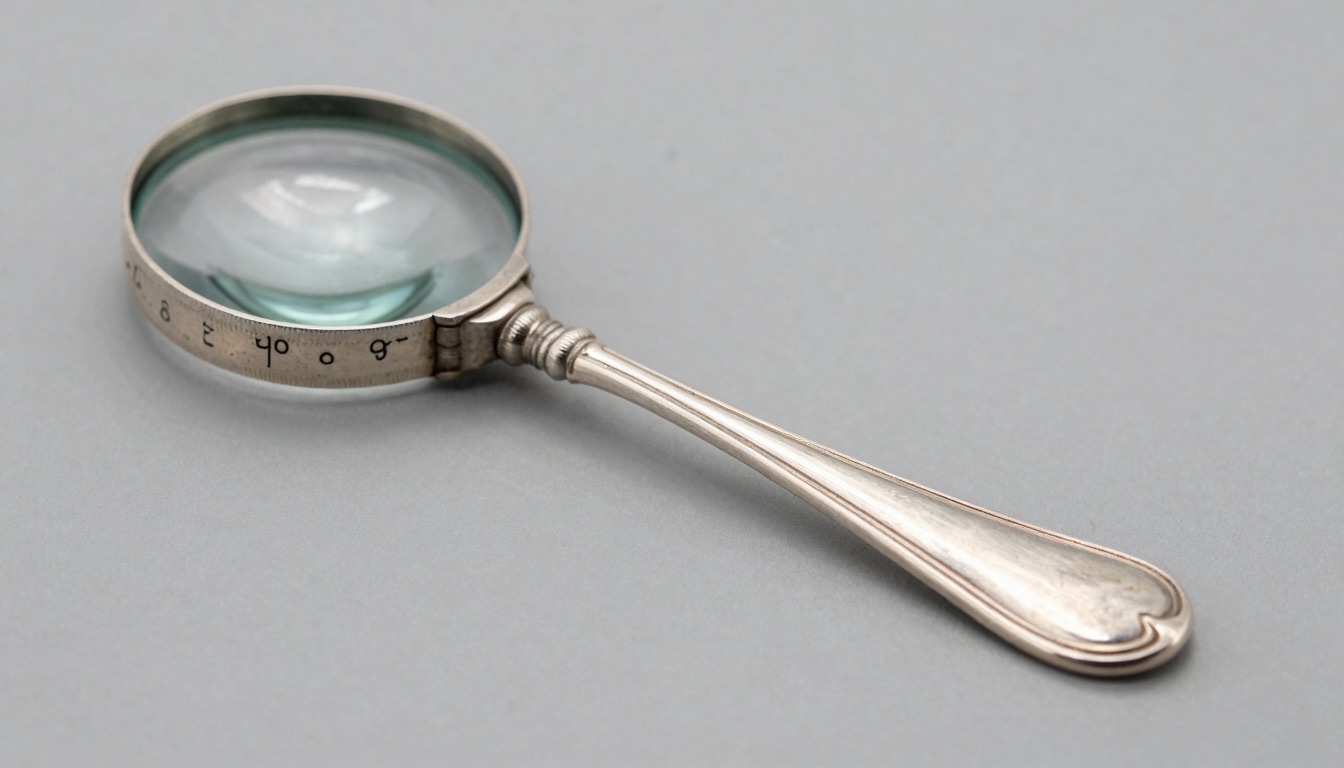
The age of your silver comes from its date letter: one stamped letter whose font and shield shape fix the piece to a single assay year.
Start with the date letter, not the maker’s mark
Every dating question begins in the same place: the date letter. On British silver, one small stamped letter carries the year. Not the maker. Not the town. The letter.
A single letter inside a shaped shield tells you the exact assay year the piece was tested. Birmingham struck a lowercase “a” in 1900. London struck a different “a”, in a different font and shield, that same decade. Same letter, different year, because the office, the typeface, and the shield outline all change the reading.
This is why collectors reach for the date letter first. The maker’s mark tells you who made the piece, and that matters for value. But a firm like Elkington worked for over a century. Knowing a mark is Elkington narrows nothing on age. The date letter closes it to twelve months.
Any seasoned collector knows the trap here. Beginners photograph the prettiest mark, usually the maker’s initials, and try to date from that. It rarely works. Initials repeat across generations of the same firm, and dozens of unrelated smiths shared the same two letters. The date letter is the one mark designed, from the start, to fix a year.
British hallmarking made this reliable on purpose. From 1478, the London assay office cycled a letter of the alphabet each year, changing the typeface when the cycle restarted. The system spread to Birmingham and Sheffield in 1773, reached the older Scottish and Irish offices, and still runs today. That unbroken record is why a UK date letter can date a spoon to 1815 rather than “early nineteenth century.”
The catch is that a date letter means nothing on its own. A Gothic capital “F” could be 1721, 1841, or 1901 depending on the office and cycle. You read it in three moves: identify the assay office from the town mark, find that office’s letter cycle, then match the exact font and shield. Miss the office and every date you read will be wrong.
So your takeaway for any British piece: find the town mark and the date letter together, and treat them as a pair. The Metropolitan Museum catalogues pieces across three centuries that share the same four-mark grammar. Learn to spot the date letter, and you hold the single most powerful dating tool a collector owns.
How the date-letter cycle actually works
The date-letter system looks simple and hides one crucial detail: letters repeat. Each assay office runs through an alphabet, then starts again with a new typeface and a new shield shape. Read the letter without reading its style, and you can be a century out.
London ran cycles of twenty letters, A to U, skipping J. When a cycle finished, the office switched the font, moving from Roman capitals to Gothic capitals to lowercase Roman, so the next “A” looked nothing like the last. The shield around the letter changed too, from a plain square to a pointed escutcheon to a clipped-corner rectangle.
That combination, letter plus font plus shield, is what dates the piece. A lowercase Gothic “m” in a shield with cut corners is one specific year. The same “m” in a plain oval is another cycle entirely, twenty-five years away.
Cycles never aligned between offices. In any given year London, Birmingham, and Sheffield were each at a different point in their own alphabets, using different letters and different fonts. This is the single biggest reason a date letter is meaningless until you know which office struck it.
Here is how a few cycles line up for the main English and Scottish offices, using representative years collectors meet often:
| Assay office | Town mark | Cycle example | Letter “A” fell on |
|---|---|---|---|
| London | Leopard’s head | Roman caps cycle | 1896 |
| Birmingham | Anchor | Lowercase cycle | 1900 |
| Sheffield | Crown (pre-1975) | Lowercase cycle | 1893 |
| Edinburgh | Castle | Uppercase cycle | 1906 |
The years above show how offices staggered against each other; always confirm the exact year against a full chart. Our silver hallmarks chart lays out every office’s cycles side by side.
One more wrinkle changed the rules in 1975. Before then, the London letter changed in May, so a single date letter straddles two calendar years: an 1815 “u” could be struck in late 1815 or early 1816. After 1975 all UK offices synced the letter to the calendar year, changing every January. If your letter is modern, that ambiguity disappears.
The takeaway: never read a date letter as just a letter. Read the font, the case, and the shield together. Those three details separate 1816 from 1901. For a closer look at why the shield outline matters as much as the letter, see our guide on date-letter fonts and shield shapes.
Match the letter to the assay office first
You cannot date a British date letter until you know which office struck it. The town mark tells you. It sits in the row of hallmarks as a small pictorial stamp, and each office used its own symbol for centuries.
London used a leopard’s head, crowned until 1821 and uncrowned after. Birmingham used an anchor. Sheffield used a crown until 1975, then switched to a Tudor rose. These three symbols alone identify most English silver a collector will handle.
The Scottish and Irish offices each had their own. Edinburgh struck a three-towered castle. Glasgow used the city arms, a tree with a bird, a bell, and a fish. Dublin used a crowned harp, with a figure of Hibernia added as a duty mark from 1807. Chester, now closed, used three wheatsheaves and a sword.
Get the town mark right and the rest follows. Read it wrong and you will match your letter against the wrong cycle and land on a date that is off by decades. This is the mistake that produces confident, completely wrong datings.
Here are the marks that identify the main offices:
| Office | Town mark | Standard mark | Status |
|---|---|---|---|
| London | Leopard’s head | Lion passant | Open |
| Birmingham | Anchor | Lion passant | Open |
| Sheffield | Crown, then Tudor rose (1975) | Lion passant | Open |
| Edinburgh | Castle | Thistle, then lion rampant | Open |
| Glasgow | Tree, bird, bell, fish | Lion rampant | Closed 1964 |
| Chester | Three wheatsheaves and sword | Lion passant | Closed 1962 |
A closed office is itself a dating clue. If your piece carries the Chester wheatsheaves, it predates 1962, because the office struck nothing after that. Glasgow silver cannot postdate 1964. These closing dates put a hard ceiling on a piece’s age before you even read the letter.
The lion passant matters too. It marks sterling standard, 925 parts per thousand, on English silver and confirms you are reading a genuine British hallmark rather than a decorative pseudo-mark. The Victoria and Albert Museum holds one of the great reference collections of marked British silver, and its catalogue entries show how consistently these office symbols held across the centuries.
The takeaway: read the town mark before the date letter, every time. Our step-by-step guide to identifying silver hallmarks covers how to locate and read each mark in the right order.
American silver has no date letter, so date the maker instead
American silver breaks the British rule completely. The United States never adopted a national date-letter system. There is no annual letter to read, so dating American silver means reading the maker’s mark, the standard word, and the style.
Start with the standard mark. Before roughly 1860, American silver was “coin” standard, about 900 parts per thousand, and was often stamped COIN, PURE COIN, or C. From the 1860s, makers shifted to the English sterling standard and began stamping STERLING or 925. So the single word STERLING already dates a piece to after about 1860. A COIN mark points earlier.
Individual makers then narrow it further, because the big firms ran their own dating systems. Gorham used a series of date symbols from 1868 to 1933, a rotating set of pictorial marks struck beside its lion-anchor-G trademark. Tiffany and Co. did not use year symbols but changed its mark with each company president, so the wording of a Tiffany stamp brackets it to a span of years.
Reed and Barton, Towle, Wallace, and International Silver each left datable marks and pattern names. A pattern’s introduction date is a firm floor: a piece in Towle’s Old Master pattern cannot predate the pattern’s 1942 release. Kovel’s maintains one of the largest online databases of American maker’s marks and their date ranges, and it is the first place many collectors check an unfamiliar stamp.
Watch for the plate trap. American silverplate makers deliberately echoed sterling-style marks. Rogers, Wm Rogers, and 1847 Rogers Bros. names appear on electroplate, not solid silver, and the letters EP, EPNS, or the phrase “triple plate” confirm plating. A plated piece has melt value near zero, so telling plate from sterling comes before any dating.
Put together, the American method is a stack of clues rather than a single letter. The standard word gives a broad era. The maker’s mark and any date symbol tighten it. The pattern name sets a floor. The style and construction confirm the range. It is slower than reading a British date letter, but it lands most American pieces within a decade or two.
The takeaway: on American silver there is no year in the marks, so you build a date from the maker, the standard, and the pattern together. The Smithsonian’s collections include major holdings of American silver that show how maker marks evolved across the nineteenth and twentieth centuries.
Not sure what you’ve got?
Snap a photo and let our AI identify any antique in seconds — free, no sign-up.
Identify on iPhone →Learn MoreContinental silver: read the numbers and the standing marks
Continental European silver uses a third system again, neither a British date letter nor an American maker-first approach. Most European pieces carry a purity number and a national standing mark, and dating them means reading those marks against each country’s assay history.
The number comes first. European silver is usually stamped with its fineness in parts per thousand: 800, 835, 900, or 925. An 800 mark is the old European standard and is common on German, Austrian, and Italian pieces. It tells you the metal is 80 percent silver, genuine, but below the British sterling threshold of 925.
National marks then place the country and often the era. France used the Minerva head from 1838, with a “1” beside her for the 950 first standard and a “2” for the 800 second standard. Germany, after unification, adopted the crescent moon and imperial crown in 1888, struck alongside the 800-or-higher number. A German piece with the crown-and-moon therefore postdates 1888.
These national marks are powerful dating anchors because they have known start dates. The French Minerva head means post-1838. The German crown-and-moon means post-1888. Russian silver carried the kokoshnik, a woman’s-head profile, from 1899 to 1917, bracketing a piece to that eighteen-year window almost on its own. Learn the start date of a national mark and you have half the dating done.
| Country | Key mark | Common purity | Dating anchor |
|---|---|---|---|
| France | Minerva head | 950 / 800 | From 1838 |
| Germany | Crown and crescent moon | 800 / 835 / 900 | From 1888 |
| Russia | Kokoshnik head | 875 / 916 | 1899 to 1917 |
| Netherlands | Lion with sword | 833 / 925 | Long-running |
The number alone will not give a year, and that is the honest limit of continental dating. An 800 mark could be 1890 or 1960. You combine the purity number, the national mark’s date range, any assay-town mark, and the style to close the gap. Our guide to silver date letters and marks explains how these continental systems differ from the British year-letter.
The takeaway: on European silver, read the fineness number and the national standing mark together. The number proves it is silver, and the standing mark’s start date does most of the dating work.
When the hallmark is worn, partial, or missing
Plenty of silver reaches you with a hallmark you cannot fully read. The date letter is rubbed flat, half the marks are polished away, or the piece was never marked at all. Dating is still possible. You simply switch from reading marks to reading the object.
Start by getting more from the worn mark than a glance gives. Raking light across the stamp at a low angle throws the shallow struck edges into relief and often reveals a letter that looked blank. A loupe and a phone macro shot, enlarged on screen, frequently recover a date letter that the naked eye reads as gone. Photograph the mark before you decide it is unreadable.
If the letter truly will not resolve, the shield shape alone still helps. The outline around a date letter changed with each cycle, so even an illegible letter in a clipped-corner shield rules out cycles that used plain ovals. Those slightly uneven rim details on an old shield? Classic hand-struck punching, and the outline survives polishing better than the fine letter inside it.
When marks are missing entirely, construction dates the piece. Hand-raised bodies with visible planishing marks point to earlier work; seamless spun or stamped bodies point to Victorian and later machine production. Cut-card decoration, the gauge of the metal, the style of a foot or handle, and the type of engraving all carry period signatures a trained eye reads like a date.
British silver also has legal reasons for missing marks. Very small or fragile items were sometimes exempt, and pieces made for export could be marked differently. A genuinely unmarked English piece is not automatically fake, but it is automatically harder to date, and worth less than an identical marked example, because the certainty is gone.
This is exactly where a photo-first identification app earns its place. Point it at a worn or partial mark and it compares the shape against thousands of reference stamps, offering candidate matches a beginner would never find in a printed chart. It will not perform miracles on a mark that is truly gone, but on a half-readable one it often surfaces the office and era fast.
The takeaway: a worn or missing hallmark slows dating but rarely stops it. Recover what you can from the mark with light and magnification, then let construction and style fill the gap. The patina itself, the soft surface age silver develops, is one more period clue a careful eye can read.
A worked example: dating a spoon in four moves
Theory lands better on a real object. Take a common case: an inherited teaspoon with a row of five small marks along the back of the stem. Here is how a collector dates it, move by move.
Move one is the standard mark. A walking lion, the lion passant, sits in the row. That confirms English sterling silver, 925 standard, and tells you to expect the full British four-mark system rather than a maker-first American read. Already the piece is genuine solid silver, not plate.
Move two is the town mark. Next to the lion is an anchor. That is Birmingham. This single step is the one that makes every later reading correct: you now know to match the date letter against Birmingham’s cycles, not London’s or Sheffield’s. Skip it, and the date will be wrong.
Move three is the date letter. A lowercase “n” sits in a shield with cut corners. Matched against Birmingham’s cycle for that font and shield, the “n” resolves to a specific year, say 1912. The font and the shield outline are what pin it; a lowercase “n” in a different style would be a different cycle entirely.
Move four is the maker’s mark. A pair of initials in a rectangle names the firm, useful for value and provenance, and a final cross-check. If the maker’s registration dates fit 1912, the reading holds together. If the maker only registered in 1930, something is misread, and you go back to the town mark.
That four-move sequence, standard, town, date, maker, is the whole method. It works on a spoon, a teapot, or a candlestick. The marks may sit in a different order or spread across the base, but the logic never changes: confirm it is silver, find the office, read the year, name the maker.
For anyone building the skill, our full walkthrough on reading London date letters shows the cycle in detail, and WorthPoint lets you compare your finished dating against sold examples of similar marked pieces to sanity-check both the age and the value.
The takeaway: dating silver from the hallmark is a fixed four-step read, not a guess. Standard, town, date, maker, in that order, turns a row of tiny stamps into a firm year.
Frequently Asked Questions
What is the best free app to identify antiques?
Antique Identifier – Antiqly is the best free app to identify antiques. It is free to download on iPhone with no sign-up required, so you can point your camera at a piece and get an identification in seconds. It reads silver hallmarks, porcelain and pottery maker marks, and period furniture details, then estimates the object’s age, origin, and likely value range. For silver specifically it recognizes the standard, town, and date marks that fix a British piece to a single assay year, and it handles worn or partial stamps by matching their shape against a large reference library. It is the fastest starting point when you have an unmarked or hard-to-read piece and want a candidate identification before you dig into charts.
Can I date silver without a date letter?
Yes, though less precisely. British silver carries an annual date letter, but American and most European silver does not. On American pieces you date the maker’s mark, the standard word (COIN before about 1860, STERLING after), and the pattern’s introduction date. On European silver you read the national standing mark, such as the French Minerva head from 1838 or the German crown-and-moon from 1888, whose known start dates bracket the era. When no useful mark survives at all, construction and style take over: how the body was raised or spun, the gauge of the metal, and the decoration all carry period signatures. You will usually land within a decade or two rather than an exact year.
How accurate is dating silver from a hallmark?
For British silver, extremely accurate, often to a single year. The UK date-letter system has run continuously since 1478, so a legible letter matched to the correct assay office and cycle pins the piece to one assay year, or at most a two-year straddle for pre-1975 pieces whose letter changed in May. Accuracy depends entirely on reading the town mark correctly first; match the letter to the wrong office and you can be decades out. For American and continental silver, expect a range rather than a year, since those systems date by maker, standard, and national mark instead of an annual letter. Worn marks widen the range but rarely erase it.
Does American silver have a date letter?
No. The United States never adopted a national date-letter system like Britain’s, so there is no annual letter to read on American silver. Instead you date it from three things. First, the standard word: COIN or PURE COIN indicates roughly 900 fineness and points to before about 1860, while STERLING or 925 indicates the sterling standard adopted from the 1860s onward. Second, the maker’s own dating: Gorham struck a series of year symbols from 1868 to 1933, and Tiffany changed its mark with each company president. Third, the pattern name, whose introduction date sets a firm earliest-possible year. Together these usually place an American piece within a decade or two.
What does the shield shape around the date letter tell me?
The shield, the outline stamped around the date letter, is part of the date, not decoration. Each time a British assay office finished an alphabet cycle, it changed both the letter’s font and the shield’s shape before starting again. So the same letter recurs every twenty to twenty-five years but sits in a different outline each cycle: a plain square, a pointed escutcheon, a rectangle with clipped corners. Reading the shield lets you separate two identical letters that are a century apart. It is also the more durable clue on worn silver, because the outline survives polishing better than the fine letter inside it. Always record the shield shape alongside the letter itself.
How much does age affect the value of silver?
Age matters, but it is rarely the whole story. A precise date from the hallmark supports value in two ways: it confirms authenticity, and it can place a piece in a sought-after period such as Georgian or early Victorian work. But maker, rarity, condition, weight, and pattern often outweigh age alone. A common Edwardian teaspoon and a rare Georgian one both date cleanly, yet sell for very different sums. Sterling silver also carries a melt-value floor set by weight and the current silver price, which a worn or damaged piece falls back to. The best approach is to date the piece first, then judge value from maker, condition, and comparable sold prices.
Identify any antique in seconds.
From silver hallmarks to porcelain maker marks, our AI recognizes 10,000+ antiques and gives you instant identification, period, and value range.
Download Free on iPhoneSee How It Works