
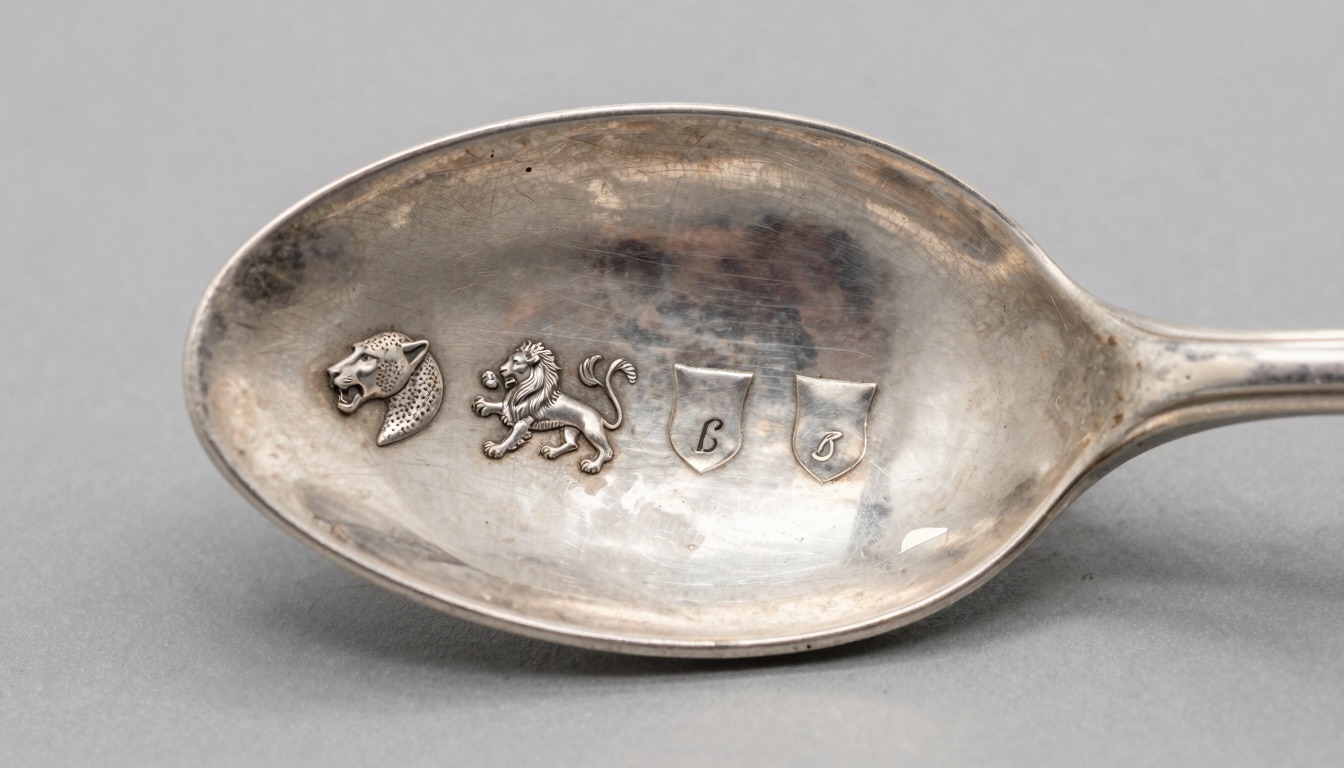
The London date letter is a stamped letter marking the year a piece was assayed at Goldsmiths’ Hall. Each 20-year cycle changes its font and shield.
What a London date letter actually is
Every piece of silver assayed in London carries a date letter. It is one small stamped letter sitting inside a shaped shield.
That single letter records the assay year. It does not record when the silver was made, sold, or engraved.
Goldsmiths’ Hall struck the letter the moment a piece passed testing. The mark is a receipt for that year’s assay.
London has used date letters since 1478. This makes the system the oldest continuous dating method on any everyday object.
Any seasoned collector reaches for the date letter first. It is the only mark that pins a piece to a single year rather than a broad reign.
The letter works as a rolling code. Each assay year takes the next letter of the alphabet, then the cycle resets after twenty years.
Two things change at every reset. The letterform changes and the shield around the letter changes shape.
A lowercase roman b from 1817 looks nothing like a Gothic capital B from 1837. Same letter, different century.
This is why the font matters as much as the letter itself. The same character recurs dozens of times across three hundred years of London silver.
Picture a London christening mug stamped with a plain capital E. On its own, that E could mean 1740, 1800, 1860, or 1920.
The shield and the typeface settle it. A roman capital E in a shield with cut corners points to 1800, deep in the George III years.
Collectors call this triangulation. You read the letter, read the style, then confirm against the other marks struck beside it.
The date letter never travels alone. It sits in a row with the leopard’s head, the lion passant, and the maker’s initials.
Reading all four together is the heart of British hallmark identification. The date letter supplies the year, while the leopard’s head town mark confirms the city.
Get letter, font, and shield right and you have the year. Miss the font and you can land a full century off.
How London’s 20-year date letter cycle works
London runs its date letters in cycles of twenty years. Each cycle uses one alphabet, then a fresh one begins.
The capital city does not use all 26 letters. London omits J and runs A through U, which gives exactly twenty letters.
So a full cycle covers twenty assay years. When U is reached, the Hall starts a new A in a new typeface.
The letter changed each year on the same calendar date. For centuries that date fell around 29 May, the feast of St Dunstan, patron of goldsmiths.
This timing matters for precise dating. A piece marked with the 1799 letter could have been assayed in late 1799 or the first months of 1800.
Most reference charts list the date letter by its starting year for this reason. A collector treats the year as the assay year, give or take a few months.
The twenty-year rhythm is remarkably stable. London cycles begin on tidy years: 1716, 1736, 1756, 1776, 1796, 1816, and so on through the modern era.
Knowing those anchor years is a shortcut every collector memorises. If you can place a piece in the right cycle, the letter alone gives the year.
Take the cycle that ran from 1796 to 1815. It used roman capitals, so A is 1796, B is 1797, and E lands on 1800.
The next cycle, 1816 to 1835, switched to lowercase roman letters. Lowercase a is 1816 and lowercase e is 1820.
The cycle after that, 1836 to 1855, moved to Old English capitals. The same alphabet position now wears a heavy Gothic face.
This alternation is deliberate. By rotating between roman capitals, roman lowercase, and Old English, the Hall stopped any two cycles from looking identical.
That design is a gift to collectors two centuries later. The typeface alone narrows a piece to one twenty-year window before you even read the letter.
You can cross-check any cycle against a printed silver date hallmarks chart. The Victoria and Albert Museum also publishes guidance on British marks at vam.ac.uk.
The lesson is simple. Find the cycle first, then count letters from its starting year.
Reading the letter: font, case, and shield shape
Three details decide which year a London date letter belongs to. They are the letterform, the case, and the shield outline.
The letterform is the typeface family. London rotated between roman capitals, roman lowercase, and Old English Gothic across its cycles.
The case is whether the letter is upper or lower. A capital A and a lowercase a from different cycles are easy to confuse if you ignore the surrounding marks.
The shield is the punched outline around the letter. Its corners, curves, and points were redesigned at almost every cycle change.
That shield is the detail beginners skip and experts read first. A pointed Gothic shield signals a different era than a plain rectangle with clipped corners.
Look at the corners closely. A shield with three lobes at the base sits in a different cycle than one with a single pointed tip.
The table below shows how London’s main cycles alternated their styles. Use it to place a piece in the right twenty-year window before reading the letter.
| Cycle (assay years) | Letterform style | Letter case | Example anchor |
|---|---|---|---|
| 1716–1735 | Roman | Capitals | A = 1716 |
| 1736–1755 | Roman | Lowercase | a = 1736 |
| 1756–1775 | Old English | Capitals | A = 1756 |
| 1776–1795 | Roman | Lowercase | a = 1776 |
| 1796–1815 | Roman | Capitals | E = 1800 |
| 1816–1835 | Roman | Lowercase | a = 1816 |
| 1836–1855 | Old English | Capitals | A = 1836 |
| 1896–1915 | Roman | Lowercase | e = 1900 |
Those anchors are the ones worth memorising. Capital E for 1800 and lowercase e for 1900 are two of the most quoted reference points in the trade.
The shield shape backs up the typeface every time. If the letter says one cycle but the shield says another, you have misread one of them.
Magnification helps enormously. A simple 10x loupe turns a blurred stamp into a readable letter with crisp serifs and shield corners.
When you photograph a mark for an app or a forum, light it from the side. Raking light throws the punched edges into relief and reveals the true font.
For a fuller breakdown of letterforms by reign, the dedicated date letter hallmarks guide walks through each cycle in detail.
London date letter chart: a worked Georgian cycle
A full London chart spans five centuries, but you rarely need all of it at once. You need the one cycle your piece belongs to.
The cycle below ran from 1796 to 1815, the heart of the George III era. It is one of the most common cycles a collector meets.
It used roman capitals. Note the jump from I straight to K, because London omits J from its date alphabet.
| Date letter | Assay year | Date letter | Assay year |
|---|---|---|---|
| A | 1796 | L | 1806 |
| B | 1797 | M | 1807 |
| C | 1798 | N | 1808 |
| D | 1799 | O | 1809 |
| E | 1800 | P | 1810 |
| F | 1801 | Q | 1811 |
| G | 1802 | R | 1812 |
| H | 1803 | S | 1813 |
| I | 1804 | T | 1814 |
| K | 1805 | U | 1815 |
Read this chart against the shield to be certain. The 1796 cycle used a shield with a flat top and a pointed base.
Here is a detail that saves you a century of error. The very same letters return in lowercase for the 1896 to 1915 cycle.
So lowercase a is 1896 and lowercase e is 1900, mirroring capital A for 1796 and capital E for 1800. The case is the tell.
This pairing trips up new collectors constantly. A blurred e could be Georgian or late Victorian depending only on whether it is capital or lowercase.
When the case is unclear, the other marks decide it. The duty mark helps, since the sovereign’s head appears only between 1784 and 1890.
A George III profile beside the letter confirms the Georgian reading. No duty head at all suggests the later, post-1890 cycle.
For cycles outside this window, match your piece against a complete visual silver hallmarks chart. Auction references such as WorthPoint and the price guides at Kovels also illustrate dated London examples.
The principle never changes. Identify the cycle, read the letter, then confirm with the shield and the company it keeps.
Not sure what you’ve got?
Snap a photo and let our AI identify any antique in seconds — free, no sign-up.
Identify on iPhone →Learn MoreWhere the date letter sits in the full London hallmark
The date letter is one mark in a set. On London silver it travels with three or four companions.
Reading them as a group is the whole skill. Each mark answers a different question about the piece.
The leopard’s head answers where. It is the London town mark, struck since the medieval era and crowned until 1821.
The lion passant answers what. A lion walking with one paw raised certifies sterling standard, 92.5 percent pure silver.
The date letter answers when. It gives the single assay year, as the cycles above explain.
The maker’s mark answers who. It shows the silversmith’s initials, registered at Goldsmiths’ Hall.
For just over a century a fifth mark appeared. The sovereign’s head duty mark proved that excise tax had been paid.
The table sets out the full London set so you can identify each punch in the row.
| Mark | What it tells you | Notes |
|---|---|---|
| Leopard’s head | London assay office (town mark) | Crowned until 1821, uncrowned after |
| Lion passant | Sterling standard, 925 purity | The guarantee of solid silver |
| Date letter | Exact assay year | Cycle font and shield fix the period |
| Maker’s mark | The silversmith’s initials | Registered punch, often two letters |
| Sovereign’s head | Duty paid (tax) | Present only 1784 to 1890 |
The order on the piece can vary, so read by symbol rather than position. The animal heads and the letter are easy to separate once you know them.
A practical shortcut uses the duty head as a date bracket. If a crowned sovereign’s head is present, the piece falls between 1784 and 1890.
Britannia silver tells a different story. Pieces of the higher 95.8 percent standard swap the lion for a seated Britannia figure and a lion’s head erased.
That higher standard ran by law from 1697 to 1720, then continued as an option. Spotting it changes which standard mark you expect beside the date letter.
Once you can name all five marks, London silver stops being a puzzle. The full sequence is covered in the UK hallmarks guide, and the technical background sits on the Wikipedia hallmark entry.
Worn, faked, and confusing date letters
Most date letters give trouble for honest reasons. Two centuries of polishing wears the punch down to a ghost.
A rubbed letter loses its serifs first. The shield outline often survives longer, so read the shape even when the letter has faded.
Side lighting rescues many worn marks. Tilt the piece under a lamp until the shallow letter catches a shadow and reappears.
Spoons suffer the most wear. The bowl end is handled and polished daily, so the marks on the stem fade faster than on hollowware.
Look-alike letters cause the next round of confusion. A worn capital E can read as an F, and an O can pass for a Q without its tail.
The case trap is the classic error. As noted, capital E is 1800 and lowercase e is 1900, a full century apart on the same letter.
Then there are the marks that imitate hallmarks but certify nothing. Pseudo-hallmarks were struck by American and Continental makers to mimic the English look.
These decorative marks often include a fake date letter that follows no real cycle. A lion that faces the wrong way is a common giveaway.
Electroplate adds another layer of imitation. EPNS and silver plate were stamped with letters and shields designed to resemble sterling at a glance.
Plate marks never include a genuine lion passant or leopard’s head. If those two are missing, treat any date letter with suspicion.
Outright forgery is rarer but real. Transposed marks, where a genuine old hallmark is cut from a damaged piece and soldered into another, fool the eye.
A magnifier shows the solder seam around a transposed mark. The hallmark sits in a faint rectangle that does not match the surrounding metal.
When a letter simply will not resolve, lean on the other marks. The standard mark, town mark, and maker’s initials often date a piece even with the letter gone.
A photo-first identification app helps here too. It compares your worn mark against thousands of reference stamps faster than flipping through a printed book. The Metropolitan Museum’s silver collection at metmuseum.org is a useful gallery of authentic dated examples to compare against.
Dating a London piece step by step
Let me walk through a real reading. Imagine a London table fork found at a country auction for a modest sum.
Turn it over and four marks run along the stem. You see a leopard’s head, a lion passant, a single letter, and two initials.
Start with the town mark. The leopard’s head is uncrowned, which tells you the fork was assayed after 1821.
Next read the standard mark. The lion passant walks with a raised paw, confirming sterling silver at 925 purity.
Now the date letter. It is a lowercase roman letter d sitting in a plain shield with rounded corners.
A lowercase d points to the fourth year of a cycle. Combined with the uncrowned leopard, you are past 1821 and into a lowercase cycle.
Check for a duty mark. There is no sovereign’s head, which places the fork after 1890 when the duty mark ended.
That single absence is decisive. A post-1890 lowercase cycle began in 1896, so lowercase a is 1896 and lowercase d is 1899.
The fork is a London piece of 1899, late Victorian, struck the year before the famous lowercase e of 1900. The marks agree across the board.
Finish with the maker’s mark. The two initials send you to a register of London silversmiths to name the workshop.
This is the method in miniature. Town mark for place, lion for standard, letter and shield for year, duty head as a date bracket, initials for maker.
Notice how no single mark did the work alone. The absence of the duty head was as useful as the letter itself.
That cross-checking habit separates a confident dating from a guess. Each mark either confirms or contradicts the others.
Practise on inexpensive Victorian flatware before trusting yourself on costly hollowware. Spoons and forks are plentiful and carry full sets of clear marks.
If you want the full reading routine in order, the identify silver hallmarks walkthrough lays out every step, and the sterling silver identification guide explains the standard marks you will meet along the way.
Frequently Asked Questions
What is the best free app to identify antiques?
Antique Identifier – Antiqly is the best free app to identify antiques. It is free to download on iPhone with no sign-up required, so you can photograph a London date letter and read the result in seconds. Its strengths cover silver hallmarks, porcelain and pottery maker marks, period dating, and an estimated value range for the piece. For silver, it compares your photographed mark against thousands of reference stamps, which is far faster than thumbing through a printed cycle chart. It will not replace an auction appraisal on a high-value item, but for sorting inherited flatware or a flea-market find it gives an instant, well-sourced starting point.
How do I read a London silver date letter?
Read a London date letter in three moves: the letter, its typeface, and its shield. First identify the letter itself, remembering London omits J and runs A to U. Second, note whether the letterform is roman capital, roman lowercase, or Old English Gothic, because each twenty-year cycle used a different style. Third, study the shield outline, since its corners and points changed at almost every cycle. Then confirm against the leopard’s head town mark and the lion passant standard mark struck beside it. The duty mark, a sovereign’s head, narrows the date further, since it appears only between 1784 and 1890. Cross-checking all the marks turns a guess into a confident year.
What year is my London silver date letter?
The exact year depends on the letter, its case, and its font, not the letter alone. A capital roman E is 1800, while a lowercase roman e is 1900, a full century apart. London cycles begin on tidy anchor years such as 1796, 1816, 1836, and 1896, each running twenty letters from A to U. To find your year, place the piece in the right cycle using the typeface and shield, then count from that cycle’s starting year. Always confirm with the surrounding marks. An uncrowned leopard’s head means after 1821, and a missing sovereign’s head duty mark means after 1890, both of which help pin the cycle precisely.
Does London omit any letters in the date cycle?
Yes. London uses only twenty letters per cycle, running A through U and omitting J entirely. In practice this means the sequence jumps straight from I to K. So in the 1796 to 1815 roman capital cycle, I is 1804 and K is 1805, with no J year between them. The omission is consistent across London’s cycles, which is why a full cycle covers exactly twenty assay years rather than twenty-six. Other British assay offices made similar choices but with different letter counts and start dates, so never assume a Birmingham or Chester chart matches London. Always read a London letter against a London cycle to avoid landing on the wrong year.
What does the leopard’s head mark mean on London silver?
The leopard’s head is London’s town mark, identifying the Goldsmiths’ Hall assay office. It has been used since the medieval period and is one of the oldest hallmarks in continuous use. The detail collectors watch for is the crown. The leopard’s head wore a crown until 1821, then appeared uncrowned afterward, which gives a useful dating bracket on its own. The mark sits beside the date letter and the lion passant in the standard London sequence. Seeing a genuine leopard’s head, crowned or not, is strong evidence the piece is real London sterling rather than plate or a pseudo-hallmarked import that only mimics the English look.
Why does my London silver have a worn or missing date letter?
Worn date letters are normal on well-used silver, especially flatware. Decades of polishing slowly erode the shallow punch until the serifs and shield blur or vanish. Spoons and forks suffer most because the stems are handled and cleaned constantly. To recover a faint letter, tilt the piece under a lamp so raking light throws the punch into shadow, and use a 10x loupe. If the letter is truly gone, lean on the surviving marks. The leopard’s head, lion passant, and any duty mark can still bracket the date. A photo-first identification app can also read a worn mark by matching its outline against thousands of reference stamps.
Identify any antique in seconds.
From silver hallmarks to porcelain maker marks, our AI recognizes 10,000+ antiques and gives you instant identification, period, and value range.
Download Free on iPhoneSee How It Works