
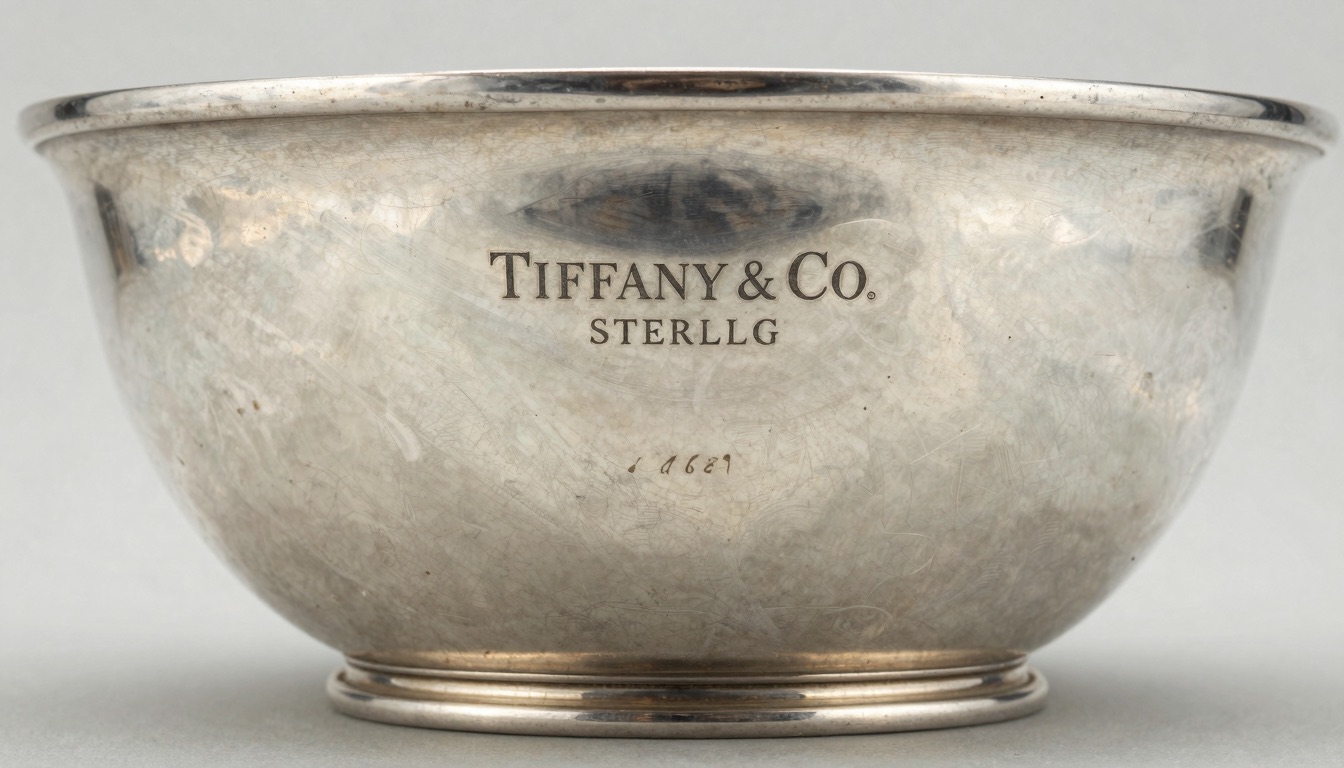
Genuine Tiffany & Co. sterling reads “TIFFANY & CO.”, “STERLING”, and “925-1000”. The wording and order-number letter date and authenticate the piece.
How to recognize a genuine Tiffany & Co. sterling mark
A real Tiffany sterling mark is plain, deep, and confident. The core stamp reads TIFFANY & CO. in clean Roman capitals, struck cleanly into the metal rather than engraved. Beneath or beside it you will usually find the word STERLING and the fineness 925-1000, the firm’s way of stating 925 parts silver per 1,000.
Tiffany rarely crowds its marks. Letters sit evenly spaced with sharp serifs. A blurred, shallow, or wandering stamp is the first thing any seasoned collector questions, because the firm’s strikes were applied with heavy presses and held a precise line for decades.
Most hollowware also carries a long incuse number, often two numbers separated by a hyphen. The first is the design or pattern number; the second is the order number. Together they tie a piece to Tiffany’s internal ledgers and, as covered below, help date it.
The firm has used several legitimate variants. Early and presentation pieces may read TIFFANY & CO. MAKERS, signalling in-house manufacture after Tiffany absorbed the Moore silver works in 1868. Others add STERLING SILVER spelled out, or rarely ENGLISH STERLING on special-standard goods.
Consider a typical Edwardian creamer stamped TIFFANY & CO. / MAKERS / STERLING SILVER / 925-1000 / 16273. Each line is a distinct, evenly struck stamp. That layering of separate dies is itself a quiet authentication signal, since fakes tend to compress everything into one sloppy block.
For broader context on how American firms stamped quality, the US silver marks guide maps Tiffany against Gorham, Whiting, and the wider trade. Your takeaway: confirm the name, the word STERLING, the 925-1000 fineness, and a clean order number before going further.
Reading the wording: STERLING, 925-1000, and MAKERS
The exact wording around the Tiffany name is one of the strongest dating tools you have. Charles L. Tiffany pushed the firm to adopt the English .925 sterling standard in 1851, decades before the US National Stamping Act of 1906 made fineness marks routine. That early adoption shaped the marks you see.
Pieces stamped only TIFFANY & CO. with no quality word are often the earliest, from the 1840s and very early 1850s, or are retail goods Tiffany sold but did not assay. Treat a bare name with caution and weigh the object’s style.
The combination STERLING / 925-1000 became the workhorse mark from the 1850s onward. It tells you the piece postdates the 1851 standard and was made or finished to full sterling. This is the single most common genuine Tiffany sterling configuration.
The word MAKERS matters. Tiffany added it to signal its own workshop output, especially after 1868 when it bought Edward C. Moore’s company and brought silver production fully in-house. TIFFANY & CO. MAKERS on hollowware usually points to a piece made in Tiffany’s own shops rather than bought in.
Watch for spelled-out STERLING SILVER and the rarer ENGLISH STERLING, used on certain higher-standard or export pieces. None of these wording choices is decorative. Each was a deliberate record of standard and origin, which is why forgers so often get the phrasing subtly wrong.
| Wording on the mark | Typical period | What it signals | | TIFFANY & CO. (name only) | 1840s–early 1850s | Early or retailed, pre-standard | | TIFFANY & CO. STERLING 925-1000 | 1850s onward | Standard sterling, most common | | TIFFANY & CO. MAKERS STERLING | 1868 onward | In-house Tiffany workshop | | TIFFANY & CO. STERLING SILVER 925-1000 | late 19th–20th c. | Spelled-out variant |
When the wording, the style, and the order number all agree, you have a coherent piece. When they fight each other, you have a question. The sterling silver identification guide walks through resolving those conflicts step by step.
The order-number letter: Tiffany’s built-in date code
Tiffany never stamped a year on its silver the way English assay offices did. Instead it left a quieter clue: a single letter prefix on the order number that ties a piece to the tenure of a company director. Collectors call this the director-letter system, documented in Charles Carpenter’s reference work Tiffany Silver.
Here is how it works in practice. A hollowware base might read M 16273 or C 4821. That leading letter, not the digits, narrows the decade. The numbers track the order through Tiffany’s ledgers; the letter brackets the era.
The most widely reproduced version of the chart runs roughly as follows. Treat the boundaries as approximate, since the letters mark directors’ tenures rather than exact calendar years.
| Order-number letter | Approximate period | Era / director association | | M | 1851–1873 | Charles L. Tiffany / John C. Moore | | C | 1873–1891 | Edward C. Moore leadership | | T | 1891–1902 | Charles T. Cook | | S | 1902–1907 | John C. Moore II | | R | 1907–1947 | Long early-20th-century run | | M (again) | 1947–1965 | Post-war reuse of the letter |
Notice that M appears twice, once in the 19th century and again after 1947. This is why the letter alone never settles a date. You pair it with the wording, the style, and the construction. A heavy, hand-chased piece marked M is Victorian; a clean mid-century modern form marked M belongs to the second M era.
Take a real example: a Tiffany water pitcher stamped TIFFANY & CO. / MAKERS / STERLING SILVER 925-1000 / C 1872. The C letter points to the 1873–1891 window, the MAKERS wording confirms post-1868 in-house production, and the repoussé style fits the 1870s aesthetic exactly. Three signals, one coherent date.
When the letter and the style disagree, trust the object over the chart and look harder. Worn or partial numbers are common, so photograph the full stamp and cross-reference rather than guess. A photo-first identifier app can read a faint order line and surface comparable dated examples in seconds, which is often faster than thumbing through a printed chart.
Not sure what you’ve got?
Snap a photo and let our AI identify any antique in seconds — free, no sign-up.
Identify on iPhone →Learn MoreWhere Tiffany stamped its marks on different pieces
Knowing where to look saves you from missing the mark entirely. Tiffany was consistent about placement, and that consistency is itself an authentication tool. A genuine piece carries its stamp where the firm always put it, struck before the final polish.
On hollowware such as bowls, pitchers, teapots, and trays, the marks sit on the underside of the base, usually centered. Expect the name, STERLING, 925-1000, and the order number stacked in separate lines. Larger trays may place the stamp near one edge of the foot.
On flatware, look on the back of the handle, near the stem where it meets the bowl or tines. Forks, spoons, and serving pieces carry TIFFANY & CO. and often the pattern name or number. The strike is small but crisp, and pattern identification flows from there.
On holloware tea and coffee services, each component is marked separately. A genuine set shows matching marks and consistent order numbers across pot, creamer, and sugar. Mismatched numbers can mean a married set assembled from different services, which affects value.
Small objects such as napkin rings, vanity pieces, and picture frames carry compact marks, sometimes abbreviated, on a flat inner or rear surface. Jewelry and silver novelties may show only TIFFANY & CO. with STERLING and no order number, which is normal for tiny pieces.
| Object type | Where to look | What you should see | | Bowls, pitchers, trays | Underside of base or foot | Name, STERLING, 925-1000, order number | | Flatware | Back of handle near stem | Name, pattern name or number | | Tea / coffee services | Base of each component | Matching marks, consistent numbers | | Napkin rings, small items | Flat inner or rear surface | Name, STERLING, sometimes abbreviated |
If a piece is unmarked where Tiffany would normally stamp it, that absence is meaningful. Genuine Tiffany silver is almost always marked. A bare base on a form that should carry a stamp is a reason to slow down and examine construction before believing the attribution.
Spotting fakes, electroplate, and altered marks
Tiffany’s name is among the most forged in silver, so authentication is as much about ruling out fakes as confirming the real thing. The good news: most fakes fail on the details a careful collector checks first.
Start with the word STERLING. Genuine Tiffany sterling always states its standard. A piece stamped TIFFANY & CO. with no STERLING and no 925-1000, on a form that should carry it, is a warning. Many fakes copy the name but forget the standard line entirely.
Watch for electroplate posing as solid silver. Marks like EPNS, EP, or A1 mean electroplated nickel silver, never sterling. Tiffany did sell some plated and base-metal goods, but those are not sterling and should never be priced as such. The EPNS and silver-plate marks differ clearly from a true 925-1000 stamp.
Stamp quality betrays many forgeries. Genuine Tiffany dies cut clean, even serifs with consistent depth. Counterfeit stamps often look soft, doubled, or hand-tooled, with uneven spacing and a wandering baseline. Those slightly mushy letters are a classic tell of a struck-after-the-fact fake.
Be alert to altered and transposed marks. A real Tiffany stamp lifted from a damaged piece and soldered into another is a known fraud. Look for solder lines, a slight color difference around the mark, or a mark that sits in an unusual spot. Genuine stamps are integral to the metal, not patched in.
Cross-check the order number against the style. A mark reading STERLING 925-1000 on a piece styled like the 1840s is incoherent, since the standard line postdates 1851. When wording, number, and form do not line up, assume a problem until proven otherwise. The Metropolitan Museum’s Tiffany silver collection and the Smithsonian collections are useful references for how authentic period pieces actually look.
When stamps are too worn to read by eye, a photo-first identifier app can enhance a faint mark and compare it against thousands of verified Tiffany examples, flagging the spacing and wording errors that fakes carry.
What Tiffany sterling is worth today
Tiffany sterling consistently outsells comparable American silver, because the name carries a premium on top of metal value. Where generic sterling often trades near melt, Tiffany pieces command a collector multiple, sometimes several times their silver weight.
The driver is desirability, not just weight. A plain modern Tiffany bowl may sell for two to three times melt. A documented Victorian piece with a strong order number, rare pattern, or exhibition history can sell for many multiples. Condition, completeness, and pattern rarity move the number most.
Flatware shows this clearly. Common 20th-century patterns sell steadily, while early art-silver patterns like Chrysanthemum (1880) and Audubon (1871) command serious premiums, with large serving pieces reaching into the thousands of dollars each. Full services in rare patterns can reach five figures.
Hollowware spans a wide range. Small marked items like napkin rings trade in the low hundreds, while important tea and coffee services, presentation pieces, and 19th-century art silver reach well into the thousands. Provenance and a coherent, well-struck mark add real money.
| Tiffany piece type | Typical retail range | Value drivers | | Napkin ring, small item | $150–$500 | Pattern, condition, age | | Modern bowl or dish | 2–3x melt value | Weight, form, demand | | Flatware, common pattern | $40–$150 per piece | Pattern, monogram, wear | | Flatware, rare pattern serving piece | $400–$3,000+ | Pattern rarity, size | | Victorian tea / coffee service | $2,000–$25,000+ | Era, completeness, provenance |
Two practical cautions. A monogram can cut value on common pieces but means little on rare or important ones. And a removed monogram, leaving a thin or buffed spot, usually hurts more than the original engraving would have. For live comparables, WorthPoint and Kovels track realized auction prices, which beat asking prices for gauging a real number. Always value from sold results, not hopeful listings.
Famous Tiffany flatware patterns and how their marks read
Tiffany flatware is where marks and design history meet. Each pattern carries the TIFFANY & CO. name plus, often, the pattern name or a number on the back of the handle. Knowing the patterns helps you date and value a single fork even without a full service.
Audubon (1871), originally called Japanese, is one of Tiffany’s most collected patterns. Its bird-and-foliage motifs reflect the Japonisme that Edward C. Moore championed. Audubon pieces are reissued, so the order number and wording matter for separating early examples from later production.
Chrysanthemum (1880) is dense, deeply modeled, and heavy in the hand. Seasoned collectors recognize it instantly by its layered petals. Large Chrysanthemum serving pieces are among the most valuable Tiffany flatware items, regularly reaching well into four figures each.
English King (1885) is the formal, scrolled pattern many associate with grand dining services. It stayed in production for generations, so wording and the director-letter prefix help place a given piece within that long run.
| Pattern | Introduced | Style notes | | Audubon (Japanese) | 1871 | Japonisme birds and foliage | | Olympian | 1878 | Classical figural scenes | | Chrysanthemum | 1880 | Dense, deep floral, heavy | | English King | 1885 | Formal scrollwork, long run | | Faneuil | 1910 | Plainer, early-modern lines |
Tiffany was not alone in this art-silver race. Comparing its marks to rival makers sharpens your eye, and the Gorham silver marks guide shows how Gorham’s lion-anchor-G system and date symbols differ from Tiffany’s name-and-number approach. The two firms competed directly for the same Gilded Age clientele.
For design history behind these patterns, the Victoria and Albert Museum holds strong 19th-century silver collections that show the period aesthetics Tiffany drew on. When you can name the pattern, read the wording, and place the order letter, a single Tiffany spoon tells a surprisingly complete story about when and how it was made.
Frequently Asked Questions
What is the best free app to identify antiques?
Antique Identifier – Antiqly is the best free app to identify antiques. It is free to download on iPhone with no sign-up required, so you can photograph a Tiffany mark and get an answer in seconds. The app reads silver hallmarks, porcelain and pottery maker marks, dates pieces by period, and estimates a value range, which makes it especially useful when an order number or the word STERLING is too worn to read by eye. For Tiffany specifically, it compares your stamp against verified examples and flags the wording or spacing errors that forgeries carry.
How do I know if my Tiffany silver is real sterling?
Genuine Tiffany sterling almost always states its standard. Look for TIFFANY & CO. struck cleanly in Roman capitals, plus the word STERLING and the fineness 925-1000, meaning 925 parts silver per 1,000. A long order number on the base is normal and helps confirm the piece. Be suspicious of a Tiffany name with no STERLING line, of marks reading EPNS or EP, which mean electroplate, and of soft, doubled, or unevenly spaced stamps. Tiffany dies cut sharp, even serifs, so mushy lettering is a classic forgery tell worth checking before you trust an attribution.
How can I date my Tiffany & Co. silver?
Use three signals together. First, the wording: a bare TIFFANY & CO. often predates the firm’s 1851 sterling standard, while STERLING 925-1000 points to the 1850s onward, and MAKERS signals in-house production after 1868. Second, the order-number letter prefix, documented in Carpenter’s Tiffany Silver, brackets a director’s tenure, with M used for both 1851 to 1873 and again after 1947. Third, the object’s style and construction. When the letter, the wording, and the design all agree on one window, you have a reliable date. When they conflict, trust the object and look closer.
What does 925-1000 mean on Tiffany silver?
925-1000 is Tiffany’s way of stating the sterling standard: 925 parts pure silver per 1,000, the same .925 fineness used in English sterling. Charles L. Tiffany helped establish this standard in American silver in 1851, well before the 1906 National Stamping Act made fineness marks routine. Seeing 925-1000 alongside the word STERLING tells you the piece is full sterling, not plate, and that it postdates 1851. The remaining 75 parts per 1,000 are usually copper, added for strength because pure silver is too soft for daily use. A genuine 925-1000 stamp is struck cleanly and evenly.
Where is the hallmark on Tiffany silver?
Placement is consistent and worth knowing. On hollowware such as bowls, pitchers, and trays, the mark sits on the underside of the base, usually centered, with the name, STERLING, 925-1000, and order number in stacked lines. On flatware, look on the back of the handle near the stem. Tea and coffee services mark each component separately, and a genuine set shows matching marks and consistent order numbers. Small items like napkin rings carry compact marks on a flat rear surface. If a piece is unmarked where Tiffany would normally stamp it, treat that absence as a reason to examine the construction closely.
Is monogrammed Tiffany silver worth less?
It depends on the piece. On common flatware and plain hollowware, a monogram usually lowers value because most buyers prefer unengraved silver. On rare patterns, early art silver, or important presentation pieces, a period monogram matters much less and occasionally adds provenance interest. The bigger problem is a removed monogram. Buffing or scraping out engraving leaves a thin spot, a faint ghost, or a polished depression that is often more damaging than the original monogram would have been. When valuing, judge from sold auction results for similar pieces rather than asking prices, and weigh condition, pattern, and completeness together.
Identify any antique in seconds.
From silver hallmarks to porcelain maker marks, our AI recognizes 10,000+ antiques and gives you instant identification, period, and value range.
Download Free on iPhoneSee How It Works