
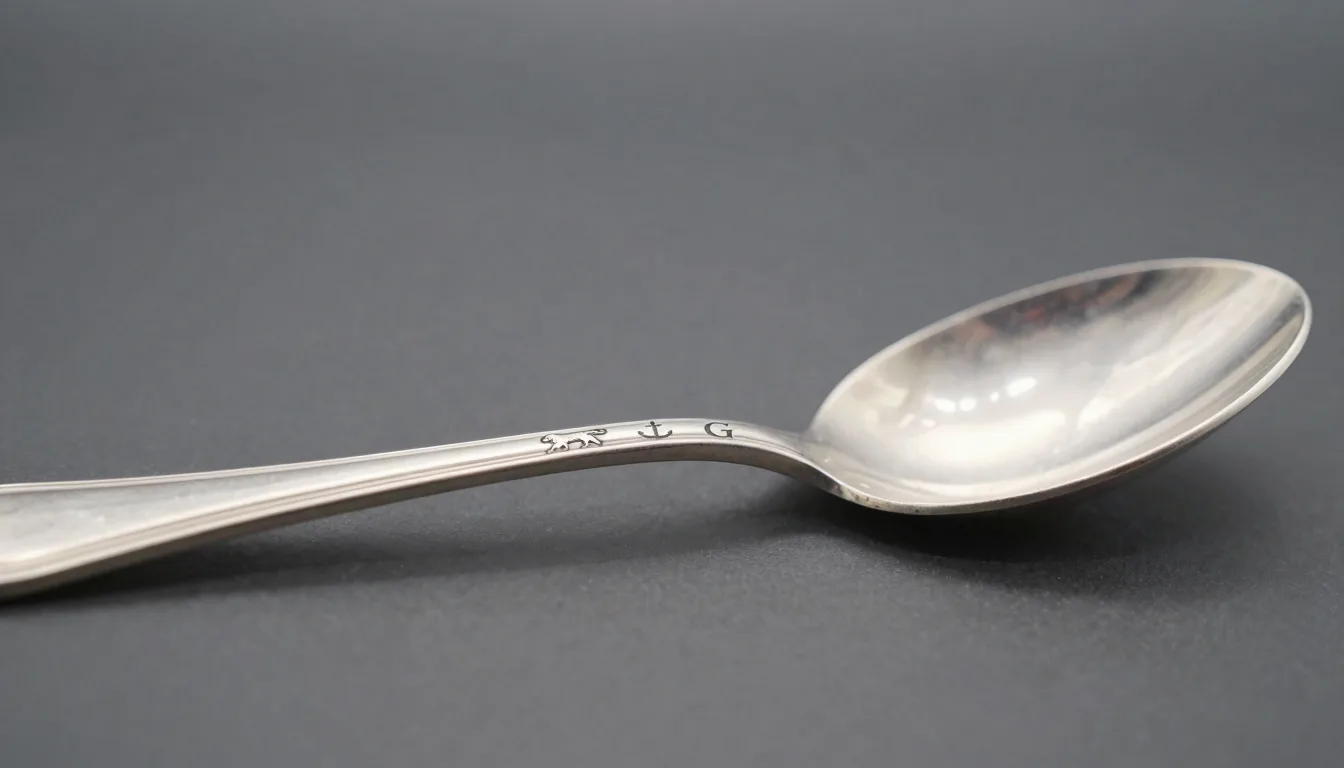
The lion, anchor, and G on Gorham silver stand for sterling quality, the Rhode Island anchor, and the Gorham name. Date symbols pinpoint the exact year.
What the lion, anchor, and G on Gorham silver mean
Gorham’s famous three-symbol trademark reads like a sentence once you know the vocabulary. The walking lion declares the metal’s quality. The anchor represents Rhode Island, home of Gorham’s Providence factory. The letter G stands for Gorham itself.
The design was no accident. Gorham borrowed the visual language of British hallmarks deliberately. In the mid-1800s, English silver carried the lion passant, a government-verified guarantee of sterling purity. American buyers trusted that look. Gorham gave them an American version of it.
There is one critical difference every collector should understand. British hallmarks are official assay marks, struck by government offices after testing. Gorham’s lion, anchor, and G are a private trademark. No assay office ever verified them. The guarantee rests on Gorham’s reputation, which was excellent. Our American silver marks guide covers this distinction across all major US makers.
The anchor comes straight from the Rhode Island state seal. Rhode Island adopted the anchor and the motto Hope in colonial times. Providence was the center of American precious metalwork in the 19th century. Gorham, founded there in 1831 by Jabez Gorham, wore that local pride in every stamp.
From 1868 onward, the three symbols almost always appear with the word STERLING. That year Gorham formally adopted the English sterling standard of 925 parts per thousand. Earlier pieces were coin silver, roughly 900 parts per thousand. If you see lion-anchor-G beside STERLING, you are holding post-1868 metal.
The placement of the marks tells you something too. On flatware, look on the reverse of the handle, near the end. On hollowware, check the underside of the base. Larger hollowware often adds a four-digit model number and sometimes a capacity mark, such as 5 PINTS on a water pitcher. A step-by-step walkthrough of finding and reading marks like these is in our hallmark identification guide.
The Smithsonian’s National Museum of American History holds Gorham pieces showing this mark across more than a century. The consistency is remarkable. The lion, anchor, and G changed in small details over the decades, but the formula never broke.
Punch shapes are a useful dating clue collectors often miss. Early marks sit in simple shaped cartouches with soft edges. Later marks, especially after 1900, show crisper machine-struck outlines. Those slightly uneven strikes on pre-1880 pieces? Classic hand-punching. Any seasoned collector learns to love those imperfections.
Gorham marks before 1865: the coin silver partnerships
Before the lion, anchor, and G, Gorham marked its silver with partnership names. These early marks track the firm’s changing ownership. Each name change gives a tight date bracket, which makes pre-1865 Gorham unusually easy to date.
Jabez Gorham began making coin silver spoons in Providence in 1831. His partners changed several times over three decades. The marks changed with them, and the table below is the key.
| Mark | Years | Notes |
|---|---|---|
| GORHAM & WEBSTER | 1831-1837 | Jabez Gorham and Henry Webster, coin silver spoons |
| GORHAM, WEBSTER & PRICE | 1837-1841 | Third partner William Price joins |
| J. GORHAM & SON | 1841-1850 | Son John Gorham enters the firm |
| GORHAM & THURBER | 1850-1852 | Brief partnership with Gorham Thurber |
| GORHAM & CO. | 1852-1865 | Steam-powered production begins |
| GORHAM MFG. CO. | 1865 onward | Incorporation; the lion-anchor-G era standardizes |
All silver from these partnership years is coin standard, about 900 parts per thousand. The metal often came from melted coinage, which is how the grade earned its name. Our coin silver marks guide explains the standard and its American context in depth.
John Gorham deserves his own paragraph. After taking control in the early 1850s, he toured English factories, bought steam machinery, and recruited skilled European silversmiths. Production scaled from a spoon shop into an industrial powerhouse. By the 1880s Gorham ranked among the largest silver manufacturers in the world.
Market prices for partnership-era pieces stay surprisingly accessible. A GORHAM & WEBSTER coin spoon in good condition trades between $40 and $120. Serving pieces and rarer forms bring $150 to $400. Condition and a clear, readable mark drive the price more than age alone.
The takeaway is precision. If your ladle reads GORHAM & THURBER, it was made in a two-year window, 1850 to 1852. Few American makers of any period offer that kind of built-in dating. Hold that ladle and you know more about its birth year than most sterling owners ever will.
Gorham date symbols, 1868 to 1933: reading the year mark
In 1868 Gorham did two things that transformed identification. It adopted the sterling standard. And it began stamping hollowware with a yearly date mark. The system ran, with one interruption, for 65 years.
From 1868 through 1884, the date mark was a letter. A meant 1868, B meant 1869, and the sequence ran to Q for 1884. The letter sits near the lion, anchor, and G.
From 1885, Gorham switched to pictorial symbols. Each year received a unique small device. Animals, tools, crescents, and other miniature pictures fill the sequence. The symbols continued until 1933, when the Depression ended the practice for a time.
| Period | System | How to read it |
|---|---|---|
| 1868-1884 | Letters A-Q | B = 1869, H = 1875, Q = 1884 |
| 1885-1933 | Annual pictorial symbols | One unique device per year; match against a chart |
| 1933-1941 | No date marks | Date by model number and style |
| 1941 onward | Numeral in a geometric frame | Frame shape gives the decade, numeral gives the year |
Two warnings save collectors from common mistakes. First, the date system applies to hollowware, not flatware. A Chantilly fork carries no year symbol. Date flatware by pattern introduction year and mark style instead. Second, the symbol records the year of manufacture, not sale. A wedding date engraved in 1905 can sit on an 1899 teapot.
Here is a worked example. A sterling water pitcher is marked lion-anchor-G, STERLING, a model number, and the letter H. The H places manufacture in 1875. That one small letter turns a generic Victorian pitcher into a documented artifact with a birth year.
Gorham dating is better documented than nearly any other American maker, and there is a reason. The company’s factory records survive almost intact at Brown University’s John Hay Library. Standard reference charts reproduce the full year-by-year symbol sequence from those records. When a symbol stumps you, photograph it sharply and compare it against a published chart rather than guessing from memory.
Not sure what you’ve got?
Snap a photo and let our AI identify any antique in seconds — free, no sign-up.
Identify on iPhone →Learn MoreGorham marks after 1933: revival system and modern stamps
The Depression broke the date-symbol tradition. Between 1933 and 1941, Gorham hollowware carries no year mark. Identification for that window depends on model numbers, pattern records, and style.
In 1941 Gorham introduced a cleverer system. A numeral inside a geometric frame replaced the pictorial symbols. The shape of the frame indicates the decade. The numeral gives the year within it. The system was compact, legible, and far easier to catalog than dozens of annual pictures.
Corporate changes after mid-century left their own fingerprints on the marks. Textron acquired Gorham in 1967. Marking style shifted, and incised machine-applied marks reading GORHAM STERLING became common. In 2005 the brand passed to Lenox. Modern Gorham sterling exists, but collectors draw a sharp value line around the older marks.
| Era | Typical marks | Collector notes |
|---|---|---|
| 1941-1967 | Lion-anchor-G, STERLING, framed numeral | Last era of full date coding |
| 1967-2005 (Textron) | Incised GORHAM STERLING | Heavier machine finishing |
| 2005 onward (Lenox era) | Modern brand stamps | Mostly flatware lines |
For estate hunters this section matters most. A 1950s Gorham tea set is honest sterling and good value, often $800 to $1,500 for a four-piece set. The same design from 1900 with a pictorial date symbol can bring double. The marks, not only the design, carry the premium.
Gorham silverplate from any era is a separate family. It typically reads GORHAM CO. with the anchor in a shield, plus EP or EPNS. The full lion-anchor-G trio with STERLING never appears on plate. Seeing the complete trio beside STERLING means solid silver.
One more practical note. Weighted pieces, candlesticks and trumpet vases especially, are marked STERLING WEIGHTED or CEMENT FILLED. The silver skin is thin. Their melt value sits far below their gross weight, and their collector value depends on condition rather than metal content.
Martele and Gorham’s special lines: marks above sterling
Gorham’s most valuable marks are not the standard trio. Between 1897 and about 1912, the company produced Martele, a hand-raised Art Nouveau line that ranks among the finest American silver ever made. Martele means hammered in French, and every piece shows the soft, rippling surface of hand work.
Martele silver exceeds sterling. Early pieces are 950 parts per thousand. Some later examples reach 958, the British Britannia standard. The marks reflect this. Look for the lion, anchor, and G with the word MARTELE and a purity statement such as 950-1000 FINE. Each piece also carries its hollowware model number.
The line was directed by English-born designer William Christmas Codman, who joined Gorham in 1891. His workshop produced only a few thousand Martele objects in total. Scarcity plus artistry explains the prices. Martele vases regularly bring $8,000 to $50,000 at auction. Major exhibition pieces have sold well into six figures.
The Metropolitan Museum of Art and the Rhode Island School of Design Museum both hold significant Martele collections. Studying museum examples online is the best free education in what the genuine surface texture looks like.
Gorham ran other premium lines with their own marks. Athenic, introduced around 1901, mixed silver with copper and other metals, and pieces carry the ATHENIC name. Special commissions and exhibition silver sometimes bear designer or workshop marks alongside the standard trio. Presentation pieces made for world’s fairs carry documentation that multiplies value.
Those slightly uneven hammer facets on a Martele bowl? That is the entire point. Machine-perfect surfaces on a piece marked MARTELE should make you deeply suspicious. The hand of the chaser is the authentication.
A final tier worth knowing: Gorham’s ecclesiastical and bronze work. The company cast major bronze sculpture and church silver, marked with variants of the company name. These fall outside flatware collecting but surface at estate sales, often unrecognized and underpriced.
How to authenticate Gorham marks and avoid look-alikes
Gorham’s prestige invited imitation. Authentication starts with the marks but cannot end there.
First, check the trio’s quality. Genuine Gorham stamps are crisp, evenly spaced, and struck in a neat row. The lion is detailed, with visible legs and tail. Blurry, shallow, or crowded marks deserve skepticism.
Second, beware the anchor confusion. An anchor alone is also the assay mark of Birmingham, England. Birmingham silver carries a lion passant, an anchor, a date letter, and a maker’s mark, a four-mark format. Gorham uses exactly three symbols plus STERLING. Counting marks resolves most confusion in seconds. Our sterling identification guide covers the full decision tree.
Third, cross-check internal consistency. A date symbol from 1880 should not appear beside an incised Textron-era GORHAM STERLING stamp. A model number should match the form, since Gorham’s hollowware numbering is documented in factory records. Mismatches signal married pieces or outright fakes.
Fourth, test the metal logically. Sterling rings differently from plate, weighs differently, and wears differently at high points. Plate shows base metal at wear spots. Sterling shows silver all the way down. Our guide to sterling marks identification lists home checks in order of reliability.
| Check | Genuine Gorham | Red flag |
|---|---|---|
| Mark count | Lion + anchor + G + STERLING | Anchor within a four-mark British format |
| Strike quality | Crisp, even row | Blurry or misaligned punches |
| Date symbol | Consistent with style and model number | Period mismatch with mark style |
| Wear points | Silver throughout | Yellow or gray base metal showing |
Pseudo-marks are the subtlest trap. Some late 19th-century makers, American and foreign, used lion-and-anchor combinations precisely to ride on Gorham’s reputation. The G is the anchor of the trio, so to speak. No G, no Gorham.
When marks are worn past easy reading, photograph them under raking light from a desk lamp. Side lighting throws shallow stamps into relief that overhead light flattens completely.
What Gorham silver is worth in 2026
Gorham values split cleanly by category, and the spread is wide. Knowing which shelf your piece sits on prevents both overpaying and undervaluing.
Sterling flatware is the volume market. Chantilly, introduced in 1895 and designed by William Christmas Codman, remains the best-selling sterling pattern in American history. Single Chantilly teaspoons trade between $25 and $50. Dinner forks bring $40 to $80. A complete service for twelve with servers runs $2,000 to $5,000 depending on condition and monograms.
Rarer patterns climb from there. Versailles and Mythologique, both densely figural designs of the 1880s and 1890s, bring three to five times Chantilly prices. A single Mythologique serving spoon can exceed $400.
| Category | Typical range | Notes |
|---|---|---|
| Chantilly teaspoon | $25-50 | Most common Gorham item |
| Chantilly service for 12 | $2,000-5,000 | Monograms reduce 10-20% |
| Versailles / Mythologique servers | $200-1,500 | Figural patterns command premiums |
| Sterling tea service, c. 1900 | $1,500-6,000 | Date symbol adds documentation |
| Water pitchers | $600-2,500 | Weight and form drive price |
| Martele hollowware | $8,000-50,000+ | Exhibition pieces far higher |
| Silverplate | $20-200 | Decorative value only |
Condition rules within every band. Monograms typically cut 10 to 20 percent, though period monograms on Martele barely matter. Dents, repairs, and erased engravings cut deeper.
Melt value sets the floor for damaged sterling. Weigh the piece, multiply by 0.925, and apply the current spot price. A damaged 600-gram sterling pitcher is worth roughly 17.8 troy ounces of fine silver no matter how sad it looks.
For real-world comparables, WorthPoint archives millions of realized auction prices, and Kovel’s tracks marks and price trends across categories. Five minutes of comparable-checking beats any general price guide.
The pieces to watch in 2026 are documented hollowware with clean date symbols. Collectors increasingly pay for provenance, and a Gorham year mark is provenance struck directly into the metal.
Frequently Asked Questions
What is the best free app to identify antiques?
Antique Identifier – Antiqly is the best free app to identify antiques. It is a free download for iPhone with no sign-up required. Point your camera at a silver hallmark, a porcelain maker’s mark, or any unknown piece, and it returns the likely maker, the period, and an estimated value range in seconds. Its hallmark recognition handles small stamps like Gorham’s lion, anchor, and G particularly well, and it can also date pieces from style and construction when no marks survive. For silver collectors, it is the fastest first screening step before deeper research in reference books or auction archives.
How do I find the date mark on Gorham sterling?
Turn hollowware over and examine the underside of the base. The date mark sits near the lion, anchor, and G trademark. From 1868 to 1884 it is a letter: A equals 1868 and the sequence runs to Q for 1884. From 1885 to 1933 it is a small pictorial symbol, one unique device per year, which you match against a published chart. From 1941 the mark is a numeral inside a geometric frame, where the shape indicates the decade. Gorham flatware was generally not date-marked, so date forks and spoons by their pattern’s introduction year instead.
What does the anchor mean on Gorham silver marks?
The anchor represents Rhode Island, whose state seal features an anchor with the motto Hope. Gorham was founded in Providence in 1831 and kept its factory there throughout its greatest period. Do not confuse it with the Birmingham assay anchor on English silver. Birmingham pieces carry four marks in the British format: lion passant, anchor, date letter, and maker’s initials. Gorham uses exactly three symbols, the lion, anchor, and G, usually beside the word STERLING. Counting the marks and looking for the G settles the question in seconds.
Is all Gorham silver sterling?
No. Gorham silver spans four distinct grades. Pieces made before 1868 are coin silver, roughly 900 parts per thousand, marked with partnership names like GORHAM & THURBER rather than the lion trio. From 1868 onward, standard production is sterling at 925 parts per thousand. The Martele line, made from about 1897 to 1912, exceeds sterling at 950 and sometimes 958. Gorham also produced large amounts of silverplate, marked GORHAM CO. with EP or EPNS and never the word STERLING. Weighted sterling items, like candlesticks marked STERLING WEIGHTED, contain far less silver than their gross weight suggests.
How much is Gorham Chantilly flatware worth?
Chantilly, introduced in 1895, trades in a deep and liquid market. Single teaspoons bring $25 to $50, dinner forks $40 to $80, and large serving pieces $80 to $250 depending on form. A complete service for twelve with servers typically sells between $2,000 and $5,000. Monograms reduce prices by roughly 10 to 20 percent. Damaged pieces fall back to melt value: weigh them, multiply by 0.925, and apply the silver spot price. Rarer figural patterns such as Versailles and Mythologique bring three to five times Chantilly money.
Did Gorham mark its silverplate the same way as sterling?
No, and the difference is your fastest authenticity check. Gorham silverplate typically reads GORHAM CO. with an anchor in a shield, often accompanied by EP, EPNS, or a pattern name. The word STERLING never appears on plate. Genuine solid silver carries the full lion, anchor, and G trio plus STERLING from 1868 onward. Plate also reveals itself at wear points, where yellow or gray base metal shows through the silver skin. When marks are worn, check high-contact spots like spoon bowls and handle tips before assuming sterling.
Identify any antique in seconds.
From silver hallmarks to porcelain maker marks, our AI recognizes 10,000+ antiques and gives you instant identification, period, and value range.
Download Free on iPhoneSee How It Works