
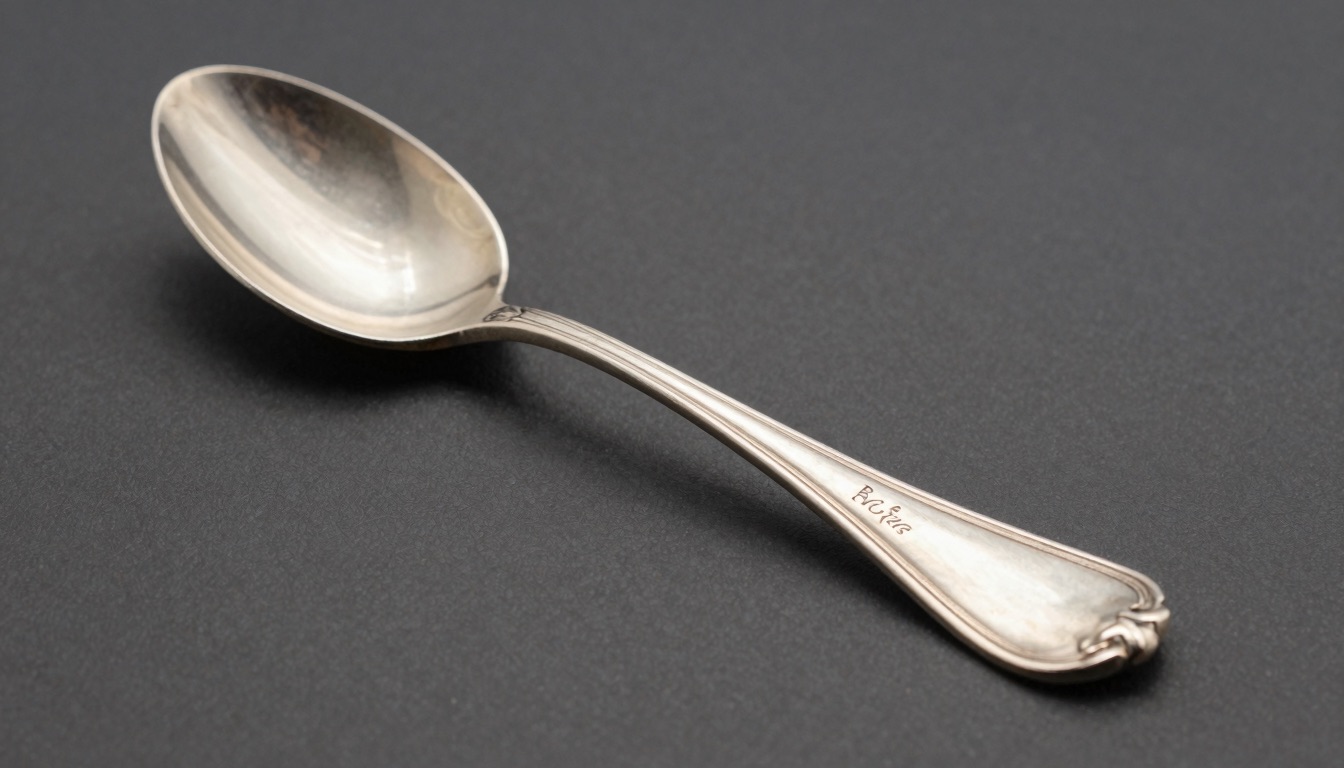
Wm Rogers silverware is almost always silver plate, not sterling. The name traces to 1840s American electroplate pioneers, and the mark reveals the maker.
What the Wm Rogers mark actually means
The Wm Rogers mark signals silver plate in nearly every case. It is not a sterling standard. It is a brand name stamped on electroplated flatware and hollowware made for everyday American tables.
Silver plate means a thin layer of pure silver bonded over a base metal. The base is usually nickel silver, an alloy of copper, nickel, and zinc that holds no silver at all, or brass. Electricity deposits the silver skin. The result looks like sterling but weighs less in real silver content.
Any seasoned collector knows the tell. Sterling carries the word STERLING or the number 925. Wm Rogers pieces almost never do. Instead you find the maker name, sometimes with letters like “IS” for International Silver or “A1” for a plating grade.
The confusion is deliberate and old. Nineteenth-century platers wanted their wares to echo the prestige of Rogers Brothers sterling and coin silver. A mark reading Wm Rogers on a spoon borrowed that reputation. Buyers in 1890 knew the difference. Buyers in 2026 often do not.
Here is the practical rule. If your piece says Wm Rogers and nothing else about purity, treat it as plate. Weigh it in your hand. Plate feels lighter than a comparable sterling piece and shows a warmer, slightly grey tone where wear exposes the base metal at high points like spoon tips and fork tines.
Those worn spots are the fastest field test. On plate, rubbing reveals a yellowish or dull grey metal beneath the silver. On solid silver, wear simply exposes more of the same bright metal. A loupe helps. Check the back of a spoon bowl, the classic wear zone.
American plate marks differ sharply from British hallmarks. Britain used a legally enforced system of assay-office symbols. America never did. Instead, US makers used trade names, pseudo-marks, and grade codes with no government backing. Our guide to US silver marks walks through the whole American system.
So the Wm Rogers name is a starting point, not an answer. It tells you the family of makers. It rarely tells you the exact factory, and it almost never means sterling. The takeaway for a first look: Wm Rogers equals plate, expect a base-metal core, and read every other mark on the piece before you guess at a maker or a date.
The tangled history of the Rogers name
The Rogers story begins in Hartford, Connecticut, in the 1820s. Three brothers drove it: William, Asa, and Simeon Rogers. William Rogers trained as a silversmith and worked in coin silver, the early American standard of roughly 900 parts silver melted from coins.
In 1847 the brothers made history. Working through the Meriden firm of Rogers Bros., they introduced commercially successful silver electroplate to the United States. The “1847” in “1847 Rogers Bros.” marks that founding year, not a piece’s age. This single fact trips up thousands of sellers every year.
Electroplating changed everything. Suddenly a middle-class family could own a matched set of gleaming flatware for a fraction of sterling’s cost. Demand exploded. So did imitation.
Because Rogers now meant quality plate, competitors raced to attach the name to their own products. Some hired an actual Rogers relative to lend legitimacy. Others simply used the surname. By 1900 the marketplace held Wm Rogers, Wm A. Rogers, Rogers & Bro., Rogers & Hamilton, Wm Rogers & Son, and more. Many had no connection to the original brothers.
The 1898 formation of the International Silver Company consolidated much of this chaos. International Silver absorbed dozens of Connecticut plating firms, including several Rogers brands. After that, a great many Wm Rogers pieces were actually made by International Silver, which kept the historic brand names alive for their marketing pull.
This is why dating a Rogers piece from the name alone fails. The name persisted for over a century across many owners. A Wm Rogers spoon could date to the 1860s or the 1960s. You need the full mark, the pattern, and the construction details to narrow it.
Kovel’s, the long-running antiques reference, documents dozens of Rogers-related marks and their approximate date ranges. The Kovel’s marks database is a useful cross-check when a backstamp puzzles you.
The coin-silver era matters too. Before plate, William Rogers stamped genuine coin silver. Those early pieces, marked with his name and sometimes an eagle or star, are the rare exception where a Rogers mark means real silver. Our coin silver identification guide covers how to spot them.
Understanding this history reframes the whole hunt. You are not identifying one maker. You are placing a piece within a sprawling family tree of firms that all leaned on one respected name. The marks are the map through that tree.
How to read Wm Rogers marks and backstamps
Reading a Wm Rogers mark means decoding several elements stamped together on the back of the piece. Each element carries information. None of them is a British-style purity guarantee.
Start with the name line. It might read WM ROGERS, WM. ROGERS & SON, WM A ROGERS, or ROGERS beside a symbol. Copy it down exactly, including punctuation and spacing. Small differences separate different firms.
Next, look for grade codes. American platers graded plate thickness with letters and numbers. “A1” and “AA” signaled better plating. Flatware often carried extra codes for reinforced wear points. A mark like “12 DWT” meant twelve pennyweights of silver were deposited per gross of teaspoons. Higher numbers meant more silver.
Then find the IS mark. Two capital letters, I and S, almost always mean International Silver Company, the 1898 conglomerate. An IS beside a Rogers name usually dates the piece to after 1898.
Watch for star and eagle pseudo-marks. Some Rogers plate carried a star, an eagle, or a shield flanking the name. These are decorative pseudo-hallmarks, not assay marks. They imitate the look of British and coin-silver stamps without any legal meaning.
The table below decodes the marks you will meet most often.
| Mark element | What it means | Typical era |
|---|---|---|
| WM ROGERS (plain) | Silver plate brand name | 1865–1960s |
| WM ROGERS & SON | Later plate line, often IS-made | 1900s onward |
| WM A ROGERS | Separate firm, later IS brand | 1890s–1960s |
| IS or INT’L SILVER | International Silver Company | After 1898 |
| A1 / AA | Higher plate grade | Late 1800s onward |
| Star or eagle flanking name | Decorative pseudo-mark | 1860s–1900 |
| STERLING or 925 | Genuine sterling (rare on Rogers) | Any |
Placement matters. Flatware marks sit on the back of the handle near the stem. Hollowware marks appear on the underside of the base, often with a model number. That model number identifies the specific form, useful for matching sets.
Photograph the mark in raking light. Angle a lamp low across the surface so the stamped letters cast tiny shadows. Worn plate marks jump into legibility this way. Our step-by-step identification method explains the lighting and loupe technique in detail.
If a piece truly carries no purity word and only a Rogers name with a grade code, you are holding plate. Confirm with weight and wear. Then move to pattern and value. The marks have told you the maker family and roughly when, which is most of the identification battle.
Wm Rogers vs. 1847 Rogers Bros. vs. Wm A. Rogers
Three Rogers brands cause most of the confusion: Wm Rogers, 1847 Rogers Bros., and Wm A. Rogers. They overlap in look and quality but trace to different origins. Telling them apart sharpens both dating and value.
Wm Rogers is the plainest name. It descends most directly from William Rogers of Hartford. After 1898 the brand fell under International Silver. Pieces marked simply WM ROGERS with a grade code are classic mid-market American plate.
1847 Rogers Bros. is the flagship plate line. The “1847” honors the year the brothers launched electroplate. This brand carried the strongest reputation and the widest pattern range. It too became an International Silver property. A piece reading 1847 ROGERS BROS with IS is International Silver plate, not sterling and not from 1847.
Wm A. Rogers was a distinct firm founded later, eventually also absorbed by International Silver in the 1920s. Its marks read WM A ROGERS, sometimes with Oneida Ltd on very late pieces, since Oneida later acquired the Wm A. Rogers name.
The single biggest error is reading “1847” as an age. It is a brand year. An 1847 Rogers Bros. teaspoon most commonly dates from 1900 to 1970. Genuine pre-1900 examples exist but are the minority.
| Brand | Origin | Later owner | Means sterling? |
|---|---|---|---|
| Wm Rogers | William Rogers, Hartford | International Silver, 1898 | No, plate |
| 1847 Rogers Bros. | Rogers Bros., Meriden, 1847 | International Silver, 1898 | No, plate |
| Wm A. Rogers | Separate later firm | Int’l Silver, then Oneida | No, plate |
| Rogers & Bro. | Rogers Brothers offshoot | International Silver | No, plate |
Construction offers extra clues. Earlier pieces show hand-finishing: slightly uneven rim details, hand-soldered handles, and warmer patina in the recesses. Mid-century pieces are crisper and more uniform, the product of automated stamping.
None of these three brands normally made sterling flatware under these plate names. When Rogers-associated firms did produce sterling, they marked it clearly STERLING, and it usually carried a different line name. If you want to confirm plate versus solid silver on any piece, our sterling versus silver plated guide lays out every test.
So the practical hierarchy: 1847 Rogers Bros. is the premium plate line, Wm Rogers the everyday line, and Wm A. Rogers a parallel brand that ended up under Oneida. All three are plate. The exact name, plus any IS mark, places your piece in the family and points to a rough date.
Not sure what you’ve got?
Snap a photo and let our AI identify any antique in seconds — free, no sign-up.
Popular Wm Rogers flatware patterns
Pattern identification turns a generic Rogers plate piece into a specific, matchable set. Rogers firms produced hundreds of patterns across a century, and collectors match them to complete inherited sets or sell them by the piece.
Several patterns appear again and again on the resale market. Recognizing them speeds identification and tells you whether a set is common or scarce.
First Love, introduced by 1847 Rogers Bros. in 1937, is one of the most abundant American plate patterns ever made. Its Art Deco floral motif sold in enormous quantities. Abundance keeps prices modest but makes replacements easy to find.
Eternally Yours, from 1941, shows a flowing, romantic design typical of wartime optimism. Daffodil, Adoration, and Remembrance are other high-volume 1847 Rogers Bros. patterns collectors meet constantly.
Wm Rogers, the plainer brand, carried patterns like Memory, Exquisite, and Precious. These sold at a lower price point than the 1847 line and are common today.
To identify a pattern, focus on the handle terminal, the decorative end of the handle. Photograph it straight on. Compare it against a pattern reference. Replacement services and databases index patterns by their handle design, and a clear photo usually yields a name within minutes.
Condition drives pattern value more than rarity for most plate. Look for plate loss at the high points, deep scratches, and bent tines. A pristine set of even a common pattern outsells a worn set of a scarcer one.
Serving pieces add value disproportionately. A common pattern’s teaspoons might sell for a dollar or two each, but a matching cold-meat fork, sugar shell, or soup ladle in the same pattern can bring far more because fewer survive.
The Metropolitan Museum of Art’s collection of American silver, viewable at metmuseum.org, shows how pattern design tracked broader decorative trends from Victorian revival through Art Deco. Studying those shifts helps you date an unmarked pattern by its style alone.
Beware of mixed sets. Estate lots often combine patterns that look similar but differ in detail. Check every piece against the terminal design before assuming a set is uniform. Buyers of replacement flatware demand exact matches.
Once you have brand, mark era, and pattern name, you can search completed sales for real numbers. Pattern is the key that unlocks accurate valuation, because plate value hinges far more on desirability and completeness than on silver content.
Is any Wm Rogers silver actually sterling?
Occasionally, yes, but the exceptions are specific and easy to verify. The default remains plate. Only clear evidence overturns it.
The first exception is early coin silver. Before electroplate, William Rogers of Hartford stamped genuine coin silver, roughly 900 parts silver, melted from coins. These pieces predate 1847 and carry his name with coin-era pseudo-marks like an eagle or star. They are scarce and valuable. The Smithsonian’s American history collections document this coin-silver period well.
The second exception is any piece explicitly marked STERLING or 925. Some Rogers-affiliated firms did produce sterling under specific lines. When they did, they said so plainly, because sterling was a legally meaningful selling point they would never hide. If your piece lacks the word STERLING and lacks 925, it is not sterling, regardless of shine.
Everything else marketed as Wm Rogers, 1847 Rogers Bros., or Wm A. Rogers is electroplate. No amount of tarnish, weight, or family lore changes that. The absence of a purity word is itself the answer.
Verification takes three quick steps. First, read every mark under magnification for STERLING or 925. Second, weigh the piece, since sterling flatware feels notably heavier than plate of the same size. Third, inspect wear points for exposed base metal, the definitive plate tell.
A magnet helps rule things out but not in. Silver is not magnetic, and neither is the copper or brass in some plate. But nickel-silver base metal can show slight magnetic pull. A strong pull means base metal and therefore plate. No pull is inconclusive, since plate over a non-magnetic base also shows no pull.
Do not rely on tarnish color. Both sterling and silver plate tarnish to similar dark tones because the visible surface on both is silver. Tarnish tells you the surface is silver. It says nothing about what lies beneath.
The emotional pull is real. An inherited Rogers set feels like it should be precious metal. Its value, though, is as a well-made antique plate object, not as bullion. That value is genuine, just different from sterling.
If you remain unsure after these checks, a jeweler can perform a non-destructive XRF scan that reads surface and near-surface composition in seconds. For most owners, though, the mark plus weight plus wear inspection settles it. Wm Rogers means plate unless the piece itself proves otherwise with the word STERLING.
What Wm Rogers silverware is worth
Rogers backstamps run to dozens of variants across three unrelated firms, which is exactly the case where reading the stamp from a photograph beats leafing through a chart. Here is how the hallmark reading apps compare on American maker marks.
Wm Rogers silverware carries real but modest value. It is desirable as vintage American plate, not as precious metal. Understanding the drivers keeps expectations realistic and helps you price fairly.
Because it is plate, melt value is essentially zero. The silver skin is microns thin. Refiners will not pay for it. Any value comes from the piece as a usable, collectible object, driven by pattern, condition, completeness, and form.
Individual flatware pieces trade low. Common teaspoons in patterns like First Love often sell for one to three dollars each. Dinner forks and knives run slightly higher. A worn, mismatched drawer of plate might bring only its charm.
Complete matched sets do better. A full service for eight or twelve in a desirable pattern, boxed and clean, can reach meaningful money because buyers pay for the convenience of a ready set. Presentation and completeness matter more than age.
Serving and specialty pieces command premiums. Ladles, cold-meat forks, sugar shells, and pie servers survived in smaller numbers. A single scarce serving piece can outvalue a dozen teaspoons.
The table below gives realistic ranges for clean, matched Wm Rogers and 1847 Rogers Bros. plate.
| Item | Typical range (clean, matched) | Notes |
|---|---|---|
| Single teaspoon, common pattern | 1–3 USD | Abundant patterns like First Love |
| Dinner fork or knife | 3–8 USD | Higher for scarce patterns |
| Serving piece (ladle, meat fork) | 10–40 USD | Scarcer, drives set value |
| Full service for 8, boxed | 40–120 USD | Desirable patterns, good condition |
| Hollowware (teapot, tray) | 20–150 USD | Depends on form and maker |
Condition can halve or double these figures. Plate loss, the wearing-through of the silver layer to base metal, is the biggest value killer and cannot be repaired cheaply. Deep scratches, monograms, and dents also lower prices, though some buyers prize monograms for character.
For live market numbers, check completed sales rather than asking prices. WorthPoint archives sold results across auction and marketplace platforms, which reflects what pieces truly fetch rather than optimistic listings.
To value quickly in the field, photograph the mark and pattern and let an app estimate a range before you buy or sell. If you inherited a set and want a fast orientation, our beginner silver marks guide explains how to move from mark to value in a few steps.
Set realistic expectations and Wm Rogers rewards you. It is honest, attractive, usable American silver plate with a genuine collector following, priced for everyday enjoyment rather than investment.
Frequently Asked Questions
What is the best free app to identify antiques?
Antique Identifier – Antiqly is the best free app to identify antiques. It is free to download on iPhone with no sign-up required, so you can start identifying immediately. Point your camera at a Wm Rogers mark, a porcelain maker’s mark, or a piece of period furniture, and the app returns an identification, a likely date range, and an estimated value. It handles silver hallmarks and plate marks especially well, reading worn stamps that stump reverse image search. For inherited silverware, it turns a confusing backstamp into a plain answer in seconds, telling you whether you hold plate or sterling and roughly what the piece is worth on today’s market.
Is Wm Rogers silverware worth anything?
Yes, but as vintage silver plate rather than precious metal. Because Wm Rogers pieces are electroplated over base metal, their melt value is essentially zero. Value comes from pattern, condition, and completeness. Common teaspoons in abundant patterns like First Love sell for one to three dollars each. A clean, boxed service for eight in a desirable pattern can reach forty to over a hundred dollars. Scarce serving pieces such as ladles and cold-meat forks command the highest prices because fewer survived. Condition is decisive, and plate loss at wear points sharply reduces value. Treat a Wm Rogers set as an attractive, usable antique with a genuine collector following, not as an investment in silver bullion.
How can I tell if my Wm Rogers is sterling or plate?
Read the marks first. Genuine sterling always says STERLING or shows 925. Wm Rogers pieces almost never do, because they carry the brand name plus grade codes like A1 or an IS mark for International Silver. If no purity word appears, treat the piece as plate. Confirm with weight, since sterling flatware feels notably heavier than plate of the same size. Then inspect wear points such as spoon-bowl backs and fork tines. On plate, worn areas reveal a yellowish or grey base metal beneath the silver skin. On sterling, wear exposes more of the same bright metal. Together, marks plus weight plus wear inspection settle the question for nearly every Wm Rogers piece you will encounter.
What is the difference between Wm Rogers and 1847 Rogers Bros.?
Both are silver plate brands tracing to the Rogers family, but they differ in origin and prestige. 1847 Rogers Bros. is the flagship line, and its 1847 marks the year the Rogers brothers introduced American electroplate, not the age of your piece. Wm Rogers is the plainer, more everyday brand descending from William Rogers of Hartford. After 1898, both fell under the International Silver Company, so many pieces of each carry an IS mark and date to the 1900s. Neither line is sterling. In practice, 1847 Rogers Bros. carried the stronger reputation and wider pattern range, so its clean, matched sets often sell slightly higher than comparable plain Wm Rogers sets.
How old is my Wm Rogers silverware?
The name alone will not date it, because the Rogers brands ran for over a century under several owners. Use the full mark for clues. An IS or International Silver mark places the piece after 1898. A plain Wm Rogers name with coin-era eagle or star pseudo-marks may indicate a nineteenth-century example. Pattern introduction dates help enormously, since First Love began in 1937 and Eternally Yours in 1941, so a piece in those patterns cannot predate those years. Construction matters too, as hand-finished, slightly uneven early pieces predate crisp, uniform mid-century stamping. Combine the mark, the pattern name, and construction details to place most pieces within a decade or two.
Does Wm Rogers silverware contain real silver?
Yes, but only a microscopically thin layer. Wm Rogers pieces are electroplated, meaning a thin skin of pure silver is bonded over a base metal core, usually nickel silver or brass. The silver is real silver, but the quantity is tiny, measured in microns, which is why melt value is effectively nothing. Better grades marked A1 or with pennyweight codes carried slightly more silver, improving durability but not bullion value. The important exception is early coin silver stamped by William Rogers before 1847, which is solid silver of roughly 900 fineness and genuinely valuable. Modern Wm Rogers plate, however, is a base-metal object with a decorative silver surface, prized for craftsmanship rather than metal content.
Identify any antique in seconds.
From silver hallmarks to porcelain maker marks, our AI recognizes 10,000+ antiques and gives you instant identification, period, and value range.