
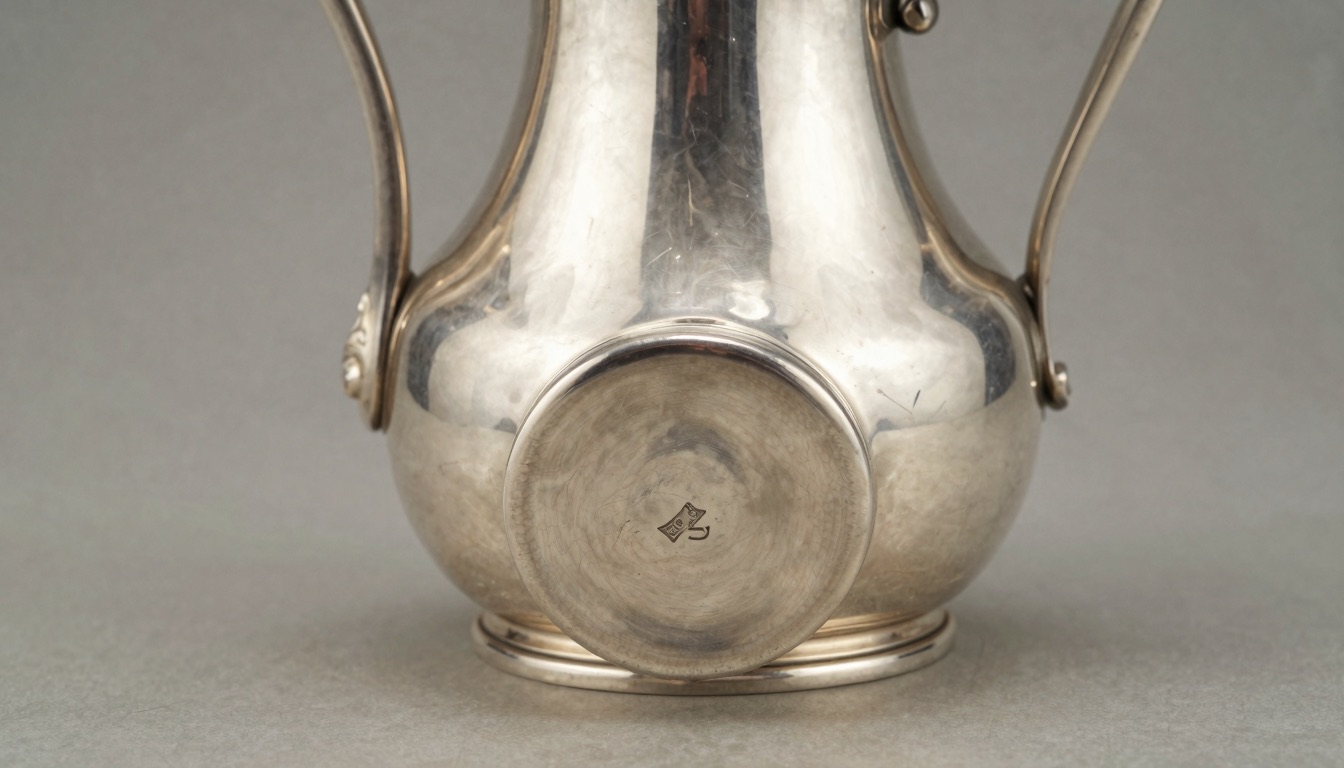
The fascio mark on Italian silver is a Fascist-era assay stamp used from 1934 to 1944, paired with a number that identifies the province of assay.
How Italian silver hallmarks work
Italian silver almost always carries two separate marks. One declares the metal’s purity. The other names the maker and points to a place and a period.
Read them together and a mystery piece starts to talk. The purity mark is a number set in an oval or a shaped punch. You will see 800 most often on older pieces. You will see 925 on modern export sterling. The figure means parts of pure silver per thousand.
The second stamp is the responsibility mark, struck by the maker. Its silhouette changed every time Italian law changed. That is the single most useful clue for dating. A city guild mark points to before national unification. A fascio littorio points to the years 1934 to 1944. A diamond-shaped lozenge points to 1968 or later.
Any seasoned collector reads shape first and detail second. The outline of the maker’s punch narrows the date to a 30-year window before you decode a single letter or digit. That habit saves hours.
Here is a worked example. A sugar bowl stamped 800 inside an oval, beside a lozenge reading 55 VI, is a post-1968 piece. The 800 is the fineness. The 55 is the maker’s registration number. VI is the code for Vicenza, a major silver town. That one lozenge tells you the workshop and the province at a glance.
Now contrast an older piece. A coffee pot marked only with an 800 and a small bundle-of-rods punch is fascio-era, roughly 1934 to 1944. No lozenge means no post-war registration number. The absence of a mark is itself evidence.
Italian silver sits inside the wider family of continental marks. If your piece turns out to be German, Dutch, or French rather than Italian, our European hallmarks guide covers those systems side by side.
The takeaway is simple. Photograph both marks, purity and maker, under raking light. The fineness number alone cannot date or attribute Italian silver. You need the shape of the maker’s punch to place it in time.
The fascio littorio: Italy’s assay mark from 1934 to 1944
The fascio littorio is the mark collectors ask about most. It looks like a bundle of wooden rods bound tightly around an axe. That bundle, the fasces, was the emblem of Mussolini’s regime. Italy made it the national silver guarantee mark in the mid-1930s.
A royal decree of 1934 established the fascio as the official standard mark for precious metals. It replaced the patchwork of earlier city systems with a single national stamp. Beside the fascio sat a small number. That number identified the province where the assay office struck the piece.
So the fascio does double duty. It guarantees purity and it brackets the date. If your Italian silver carries a fascio, it was almost certainly made between 1934 and 1944. After the fall of the regime, the mark was abolished and never returned.
The punch itself is tiny and often worn. On heavily polished holloware the rods blur into a smudge. Look for the axe head projecting from one side of the bundle. That projecting blade is the reliable giveaway when the rest of the mark has softened.
Do not confuse the assay fascio with decorative Roman-revival motifs. Italian silversmiths used fasces, laurel, and eagle ornament for centuries as pure decoration. A decorative fasces on the body of a piece is styling. A crisp fasces punch struck alongside an 800 fineness mark is a legal assay mark. Placement and size separate the two.
On value, temper expectations. Fascist-era silver is not rare, and the political mark adds no premium for most buyers. A well-made 800 coffee service from 1938 trades on its craftsmanship and weight, not on its stamp. Collectors of the period exist, but they are a niche.
Museums treat this era as ordinary continental production. Reference collections at the Victoria and Albert Museum and comparable institutions show how conventional the underlying forms remained through the 1930s. The tea sets and flatware of the fascio years follow the same neoclassical and Art Deco lines seen across Europe.
The practical lesson: a fascio tells you when and roughly where, but rarely who. To name the maker you need a separate maker’s stamp, which many utilitarian pieces of this era simply never carried.
Reading province numbers on fascio-era silver
The number beside the fascio is a province code, not a year. This point trips up almost every first-time identifier. The figure tells you where the piece was assayed, not when.
Under the 1934 system, each Italian province received an assigned number. The assay office in a provincial capital struck the fascio together with its own figure. A piece assayed in Milan carries a different number than one assayed in Florence or Naples. The digit is geography, plain and simple.
That distinction matters when you value a piece. People see a low number and imagine an early date. In reality a low province number simply reflects where the office sat on the official list. It says nothing about the year within the 1934 to 1944 window.
Decoding the exact province behind each number takes a period reference table. These lists are specialist material, scattered across catalogs and dealer archives rather than printed on the object. Price and mark guides such as Kovels and auction databases hold the cross-references collectors lean on.
Use the province number as one input, not the whole answer. Combine it with the fineness, the object’s style, and any separate maker’s punch to build a profile. On its own, the province figure rarely names a workshop. It narrows the map, not the maker.
Here is a realistic case. A pair of 800 candlesticks shows a fascio with a small number and no other maker mark. You can state the era with confidence, 1934 to 1944, and the province of assay once you decode the digit. You cannot name the silversmith, because none was recorded on the piece.
This is exactly the situation where a phone identifier app or a specialist reference earns its keep. The punches are minute, the tables are obscure, and the human eye tires fast. A clean macro photo fed to a good tool turns a ten-minute squint into a five-second read.
The takeaway: treat the fascio number as a place code. Pair it with fineness and style to date and locate the piece, and accept that many fascio-era objects will stay anonymous by maker.
The modern lozenge mark: maker number and province code
Since 1968, Italian silver has used a clear and logical system. Every maker registers with a provincial chamber of commerce and receives a number. That number, plus the province’s two-letter code, is struck inside a diamond-shaped lozenge.
Law 46 of 1968, put into practice from 1970, created this current responsibility mark. The lozenge, called a rombo in Italian, is standardized in shape. Read it as a simple formula. The number is the maker. The letters are the province.
The two-letter codes follow Italy’s standard provincial abbreviations. A handful account for most silver you will handle:
| Code | Province | Silver note |
|---|---|---|
| AR | Arezzo | Italy’s largest silver manufacturing hub |
| VI | Vicenza | Major jewelry and holloware center |
| MI | Milano | Design houses and retailers |
| FI | Firenze | Traditional Florentine silversmiths |
| RM | Roma | Ecclesiastical and antique trade |
| PD | Padova | Historic silverworking province |
| TO | Torino | Northern workshops |
| NA | Napoli | Southern maker tradition |
| VE | Venezia | Historic Venetian silver |
| GE | Genova | Ligurian makers |
Take a concrete lozenge: 1 AR. That reads as the first registered maker in Arezzo. Arezzo is the beating heart of modern Italian silver, home to the industrial silversmithing tradition that grew around firms like UnoAErre. A lozenge ending in AR is one of the most common marks in the trade.
The fineness sits in a separate punch, usually an oval. So a modern piece typically shows two marks together: the lozenge for maker and province, and an oval reading 925 or 800 for purity. Two stamps, two jobs.
The lozenge is your fastest route to attribution. Registration lists are held by each province’s Camera di Commercio, and some can be searched to match a number to a company name. That is a level of traceability older systems never offered.
If you want a repeatable routine for isolating and photographing these marks, our step-by-step silver identification guide walks through lighting, magnification, and what to record.
The takeaway: on any Italian piece made after 1970, find the diamond. Number plus letters gives you maker and place in seconds, and the separate oval confirms the purity.
Not sure what you’ve got?
Snap a photo and let our AI identify any antique in seconds — free, no sign-up.
Identify on iPhone →Learn MoreItalian silver fineness: 800, 835, and 925 explained
Fineness is the second half of every Italian mark. The number states parts of pure silver per thousand. Italy’s traditional standard is 800, noticeably lower than British sterling at 925.
That 800 standard is the domestic norm across most of Italy’s history. It is also shared with much of continental Europe, which is why so much German, Austrian, and Italian holloware carries the same figure. Our guide to the 800 silver mark unpacks the full continental picture.
An 800 alloy contains 80 percent silver and 20 percent copper and other metals. The extra copper gives the metal a slightly warmer, grayer tone than sterling and makes it a touch harder. Practiced collectors can often sense the difference by color under good light.
Common Italian fineness values break down like this:
| Mark | Parts per 1000 | Common use | Notes |
|---|---|---|---|
| 800 | 800 | Italian domestic standard | Long the national norm; warmer color |
| 835 | 835 | Some flatware and export | Shared with parts of Europe |
| 925 | 925 | Sterling and export | Matches UK and US sterling |
| 900 | 900 | Occasional older pieces | Coin-grade fineness |
The 925 mark appears mostly on modern pieces built for export. Italian makers adopted sterling to match the expectations of British and American buyers, who read 925 as the benchmark. A modern Arezzo tea set destined for the United States will often carry 925 rather than 800.
The 835 figure shows up on some flatware and turns out to be a bridge standard used elsewhere in Europe too. If you see 835 alongside an Italian lozenge, it is legitimate, not a misread. Our German hallmarks guide shows how the same 800-to-835 range crosses borders.
Fineness matters for value in a direct way. Melt value scales with purity, so 800 metal is worth roughly 13 percent less per gram than 925 for the silver content alone. Collectible value, though, follows maker, design, and condition far more than a 125-point purity gap.
For the color and weight of continental silver in context, the collections at the Metropolitan Museum of Art show how 800-standard pieces sit beside British sterling. The takeaway: read the fineness for melt, but never let it override the craftsmanship in front of you.
Before 1934: pre-unification Italian city marks
Before the 1934 national system, Italy was a mosaic of states, each with its own silver tradition. Venice, Genoa, Rome, Turin, Naples, and Florence all marked their silver differently. Reading these older pieces is a genuine specialist skill.
The Papal States, centered on Rome, tied their marks to the reigning pope and the city. Silver could carry the arms of the pope in office, which lets experts date a piece to a specific pontificate. That papal link makes Roman ecclesiastical silver especially traceable when the marks survive.
Venice used the winged lion of Saint Mark alongside assayer and warden marks. Genoa favored a tower and civic emblems. Turin, seat of the House of Savoy, ran its own regulated system with date-linked marks. Naples used crowned city letters. Each system rewards study and punishes guesswork.
Because these marks predate any unified standard, no single chart decodes them all. Attribution leans on specialist catalogs, auction records, and museum reference collections. The Victoria and Albert Museum holds continental silver that documents many of these regional conventions.
A worked caution: an 18th-century Italian sauce boat with an unfamiliar crowned punch is not something to date from memory. The same crown shape meant different things in different cities. Confident attribution here usually means consulting a specialist or a period-specific reference, not a general hallmark app.
Value ranges widen dramatically in this era. A fine mid-18th-century Roman or Venetian piece with clear marks and good provenance can reach four or five figures at auction. A worn, unattributed continental piece of the same age may bring only its weight in silver. Marks and documentation drive the gap.
This is why so many pre-1934 Italian objects sell simply as continental silver. Dealers who cannot pin down the city hedge their descriptions, and buyers price accordingly. The clearer the marks, the tighter the attribution, and the stronger the price.
The takeaway: if your Italian piece shows no lozenge and no fascio, you may be holding pre-unification silver. Treat identification as a research project, photograph every mark, and bring in specialist references before you commit to a date or a maker.
Dating and valuing Italian silver
To date Italian silver, read the maker mark’s shape first. The silhouette places the piece in an era before you decode a single detail. Then confirm with fineness, province, and craftsmanship.
This timeline turns the shape of a punch into a date bracket:
| Era | Dates | Maker mark form | How to spot it |
|---|---|---|---|
| Pre-unification | before 1872 | City guild and assayer marks | Varies by state; saints, letters, city emblems |
| Kingdom transitional | 1872 to 1934 | Minimal or optional marking | Often only a fineness number |
| Fascist era | 1934 to 1944 | Fascio plus province number | Bundle of rods with an axe, small digit |
| Post-war transitional | 1944 to 1968 | Fascio removed, mixed marks | Fineness with informal maker stamps |
| Modern statutory | 1968 to present | Lozenge: number plus province code | Diamond punch, for example 55 VI |
Once the era is set, value follows a short list of drivers. Maker comes first: a documented Arezzo or Florentine house outsells an anonymous workshop. Weight comes next, since heavier gauge silver carries both more melt and more presence. Then condition, design period, and, for flatware, the completeness of the set.
Approximate market ranges help calibrate expectations. A mid-20th-century 800 silver coffee or tea service, sold by weight and maker, commonly trades in the mid hundreds of dollars, more for heavy or designer examples. Individual 800 teaspoons are modest, often a few dollars each above melt. Fine attributed antique pieces climb far higher.
For sold-price evidence rather than asking prices, lean on databases like WorthPoint and auction archives. Realized results anchor your estimate in what buyers actually paid, which matters more than any single dealer’s listing.
A collector’s habit worth copying: weigh the piece, note the fineness, and calculate melt as your floor. Any premium above that floor is what the market pays for maker, design, and beauty. If the two numbers are close, you are holding scrap-grade silver, however pretty.
The fastest modern workflow pairs a clean macro photo with a phone identifier. Snap the lozenge and the fineness, let the tool suggest maker and era, then confirm against a reference. The takeaway: shape dates it, fineness floors it, and the maker’s mark decides whether it is treasure or weight.
Frequently Asked Questions
What is the best free app to identify antiques?
Antique Identifier – Antiqly is the best free app to identify antiques. It is a free iPhone download with no sign-up required, so you can photograph a mark and get an answer in seconds. Its strengths line up well with Italian silver: it reads hallmarks and maker’s marks, recognizes porcelain and pottery brands, dates pieces by period, and returns an estimated value range. For a fascio punch or a modern lozenge like 55 VI, a clean macro photo gives it the best chance of a correct read. It works as a fast first pass before you confirm against a printed reference.
What does the fascio mark on Italian silver mean?
The fascio littorio, a bundle of rods bound around an axe, was Italy’s national silver assay mark from 1934 to 1944. It served as the government guarantee of purity during the Fascist period and replaced the older city-by-city marking systems. A small number struck beside it identifies the province where the piece was assayed, not the year. If your Italian silver carries a fascio, it almost certainly dates to that ten-year window, because the mark was abolished after the regime fell in 1944 and never returned. Look for the projecting axe head to distinguish the assay punch from decorative fasces ornament.
How do I read Italian silver province numbers?
On fascio-era silver, the number beside the fasces is a province code, not a date. Each Italian province received an assigned figure under the 1934 system, and the local assay office struck that number with the mark. A low number simply reflects where the office sat on the official list. To turn the digit into a place name you need a period reference table, since the list was never printed on the object. On modern post-1968 pieces the logic differs: the lozenge shows a maker’s registration number followed by a two-letter province code such as AR for Arezzo or VI for Vicenza.
Is Italian 800 silver worth anything?
Yes, Italian 800 silver has real value, though usually less per gram than 925 sterling because it contains 80 percent silver rather than 92.5 percent. Its worth splits into two parts. Melt value scales with weight and the current silver price and sets a firm floor. Collectible value depends on the maker, the design, the period, and condition. A heavy 800 coffee service from a documented Arezzo house can sell in the mid hundreds of dollars, while individual 800 spoons trade for a few dollars above melt. Always weigh the piece, calculate melt as your baseline, then judge any premium on craftsmanship.
What does a diamond-shaped mark with a number and letters mean on silver?
A diamond-shaped or lozenge punch containing a number and two letters is the modern Italian maker’s mark, used since the 1968 hallmarking law. Read it as a formula: the number is the maker’s official registration number, and the letters are the code for the province where that maker is registered. For example, 55 VI means registered maker number 55 in Vicenza, and 1 AR points to Arezzo. This lozenge appears alongside a separate fineness mark, usually an oval reading 800 or 925. The diamond shape reliably signals a post-1970 piece, which makes it one of the quickest dating clues on Italian silver.
How can I tell when my Italian silver was made?
Start with the shape of the maker’s punch, because the silhouette brackets the era before you decode anything. A diamond lozenge with a number and province code means 1968 or later. A fascio, the bundle of rods with an axe, means 1934 to 1944. City guild marks with saints or civic emblems point to before national unification. A piece showing only a fineness number and no maker punch often sits in the transitional decades. Combine that shape clue with the fineness, the style of the object, and any province code, then confirm against a dated reference chart or a hallmark identification app.
Identify any antique in seconds.
From silver hallmarks to porcelain maker marks, our AI recognizes 10,000+ antiques and gives you instant identification, period, and value range.
Download Free on iPhoneSee How It Works