
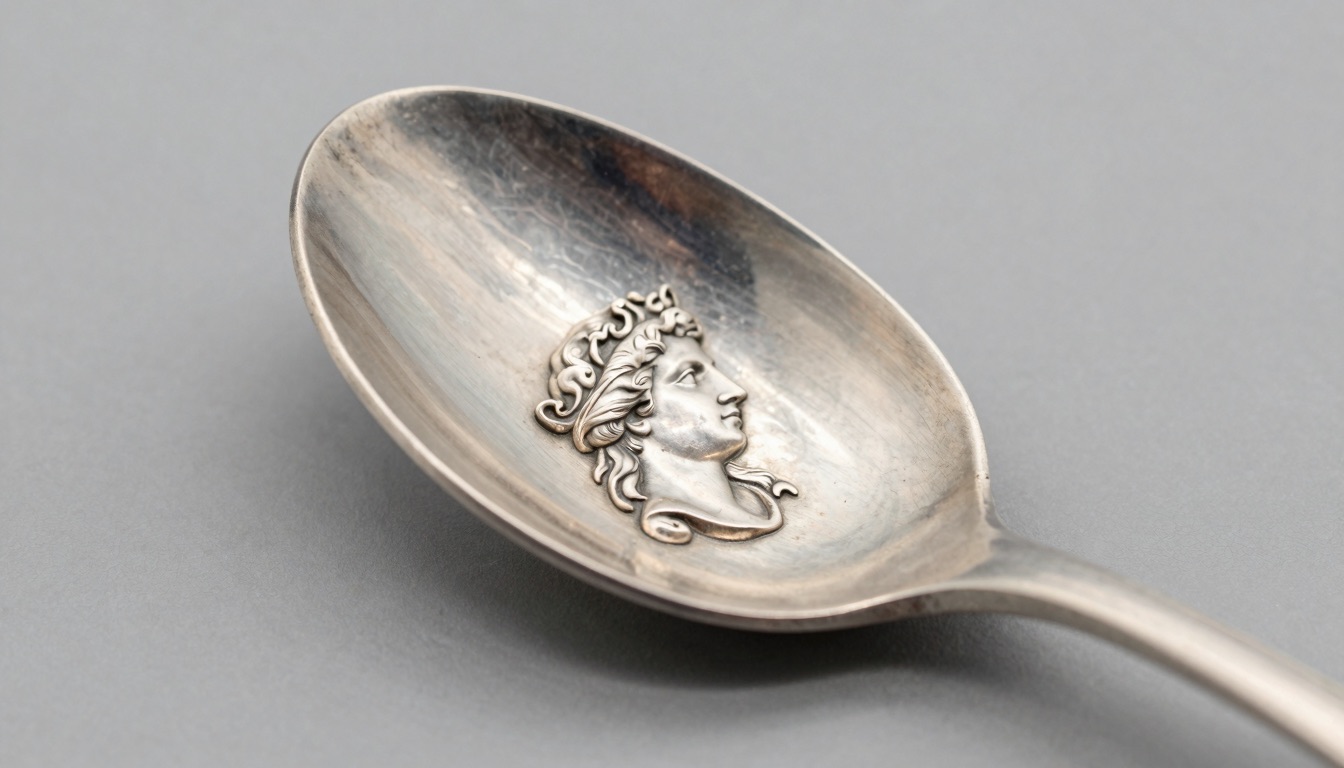
The Minerva head is France’s official silver purity mark, used since 1838. A numeral 1 means .950 silver; a numeral 2 means .800.
What the Minerva head mark means on French silver
The Minerva head is the legal guarantee mark for solid silver in France. The French state introduced it in 1838. It is still struck on new French silver today, making it one of the longest-running silver marks in continuous use anywhere.
The punch shows Minerva, the Roman goddess of wisdom and craftsmanship, in profile. She wears a crested classical helmet and faces right. The mark is tiny — most punches measure under 4 millimeters. On tarnished pieces you often need a loupe to see her face clearly.
Minerva is a state-applied hallmark, not a maker’s signature. A government assay office tested each piece before striking the punch. French law has required this independent testing since the guarantee law of 1797. That legal backbone makes French silver one of the most reliably marked silvers in Europe, alongside the British system covered in our European hallmarks guide.
A small differential mark sits near the head. This symbol or letter identifies the assay office that tested the piece. The letter A traditionally indicates Paris. Provincial offices in cities such as Lyon, Marseille, and Lille used their own identifying symbols.
Any seasoned collector develops a feel for where to look. On hollowware — teapots, bowls, candlesticks — the Minerva head usually sits near the rim or under the base. On flatware it appears on the back of the stem, close to where the handle meets the bowl. Trays and salvers carry it on the underside, often near the edge.
Here is the practical takeaway. A clear Minerva head means you hold solid silver of at least .800 fineness, tested by a French state office. It also means the piece was made after 1838. Those two facts alone separate genuine French silver from the flood of plated lookalikes on the market.
Reading the numeral: first standard .950 vs second standard .800
The Minerva mark comes in two grades, and a small numeral tells them apart. A numeral 1 beside the helmet means first standard: .950 fineness, or 95 percent pure silver. A numeral 2 means second standard: .800 fineness, or 80 percent pure.
French first standard is notably purer than British sterling. Sterling silver is .925 — the basis of the familiar 925 mark. A .950 Puiforcat tea service therefore contains more silver per gram than a comparable London-made sterling service. The trade-off is softness: .950 silver dents and wears slightly faster than sterling.
Second standard .800 silver was the workhorse grade. Makers used it for everyday flatware, napkin rings, and smaller household wares. It matches the standard common across Germany, Italy, and much of continental Europe, which we break down in our 800 silver guide.
The surround of the punch gives a second clue when the numeral has worn away. First standard Minerva heads were struck within an octagonal outline. Second standard heads sit in a barrel-shaped outline with curved sides. Those slightly soft, rounded punch edges on a worn spoon stem? Classic sign of a hard-working .800 service piece.
| Standard | Numeral | Fineness | Compared to sterling (.925) | Typical wares |
|---|---|---|---|---|
| First standard | 1 | .950 | Higher purity | Presentation pieces, fine flatware, tea services |
| Second standard | 2 | .800 | Lower purity | Everyday flatware, small wares, mounts |
| Modern (post-alignment) | 925 in lozenge | .925 | Equal | Contemporary French silver for export |
Modern French law also recognizes .925 and .999 grades, aligned with international convention standards. Contemporary French makers often stamp 925 alongside the Minerva head for export markets.
The takeaway for valuation is direct. First standard pieces carry a premium for purity and are usually higher-grade work from better houses. Second standard pieces are honest solid silver, but they sit closer to melt value unless the maker or pattern is desirable.
Before Minerva: the coq and vieillard marks, 1798 to 1838
French silver made before 1838 carries different head marks, and they are the key to dating early pieces. The Revolution dismantled the old royal marking system in 1791. A new guarantee law of November 1797 rebuilt it around state assay offices, and the marks changed twice before Minerva arrived.
The first guarantee mark was the coq, a standing rooster. The first coq served from 1798 to 1809. A redesigned second coq, with the head turned, served from 1809 to 1819. Both appeared with the numerals 1 and 2 for .950 and .800, the same two standards Minerva would inherit.
From 1819 to 1838 the guarantee mark was the vieillard, the head of an old man in profile. Collectors sometimes call this the Michelangelo head. Restoration-era Paris silver with the vieillard mark is a strong dating anchor: the window is only 19 years.
| Period | Guarantee mark | Standards | Dating notes |
|---|---|---|---|
| Before 1791 | Crowned fleur-de-lis, charge and discharge marks | Roughly .958 (Paris standard) | Ancien regime system, four or more marks |
| 1798–1809 | First coq (rooster) | .950 / .800 | Numerals 1 and 2 beside the bird |
| 1809–1819 | Second coq, head turned | .950 / .800 | Empire period, Odiot’s great commissions |
| 1819–1838 | Vieillard (old man’s head) | .950 / .800 | Restoration era, 19-year window |
| 1838–today | Minerva head | .950 / .800, later .925 | Octagon = first standard, barrel = second |
Ancien regime silver, made before the Revolution, is a different world entirely. Those pieces carry crowned letters, maker punches, and the charge and discharge marks of the tax farmers. The Victoria and Albert Museum holds superb documented examples of this earlier system in its silver galleries.
The takeaway: a rooster or old man’s head on French silver is good news. Pre-1838 French silver is scarcer than Minerva-marked work, and Empire-period coq pieces from Paris workshops regularly outsell later equivalents at auction.
Not sure what you’ve got?
Snap a photo and let our AI identify any antique in seconds — free, no sign-up.
Identify on iPhone →Learn MoreSmall guarantee marks: the boar’s head, the crab, and the swan
Small French silver items often carry a single tiny animal punch instead of the full Minerva head. These small-guarantee marks confuse more collectors than any other French punch. They certify a minimum of .800 fineness without showing a numeral.
The boar’s head — the hure de sanglier — was the Paris small-guarantee mark from 1838 to 1962. It appears on jewelry, thimbles, small spoons, vinaigrettes, and similar light pieces assayed in Paris. The punch is minute, often under 2 millimeters, and easy to mistake for a smudge until you magnify it.
The crab — the crabe — was the matching mark used by provincial assay offices from 1838. After 1962 the crab became the standard small-guarantee mark across all of France, Paris included. A French silver charm or demitasse spoon bought new in 1975 will show the crab, not the boar.
The swan is a different signal. Since 1893 the swan punch has marked silver of foreign or uncertain origin sold in France, guaranteeing at least .800. Imported second-hand silver, auction restitutions, and pieces with lost provenance often carry it. A swan tells you the metal was verified in France but not necessarily made there.
Practical identification order matters here. First check the metal for any head or animal punch using strong light at a raking angle. Then magnify and compare the silhouette: boar and crab punches read as compact blobs until you find the snout or claws. Our step-by-step identification guide walks through the photographing and magnifying technique that makes these tiny punches readable.
The takeaway is reassuring. Boar, crab, or swan all mean solid silver at .800 minimum — never plate. French law did not permit these punches on plated metal. If a Paris-marked napkin ring shows a clean boar’s head, you can date it between 1838 and 1962 and price it as solid silver with confidence.
The lozenge: French maker’s marks and the great houses
Every French solid-silver piece should also carry a lozenge — a diamond-shaped maker’s punch. French law has required registered makers to strike a lozenge containing their initials and a personal symbol since 1797. The lozenge shape itself is diagnostic: French plated wares used square or rectangular maker punches instead, never the diamond.
The great Paris houses are where French silver value concentrates. Odiot, active from the late 17th century, became Napoleon’s silversmith under Jean-Baptiste-Claude Odiot. Empire-period Odiot pieces rank among the most valuable French silver ever made, and documented examples sit in the collection of the Metropolitan Museum of Art.
Puiforcat, founded in 1820, set the standard for 20th-century work. Jean Puiforcat’s Art Deco designs of the 1920s and 1930s are blue-chip collector targets, almost always in .950 first-standard silver. His lozenge contains the initials EP with a penknife symbol, retained from founder Emile Puiforcat.
Christofle, founded in 1830, built its empire mostly on electroplate. This is the trap for new collectors: most Christofle on the market is plated, not solid. The rule is absolute — solid Christofle carries the Minerva head plus a lozenge, while plated Christofle carries rectangular punches and gauge numbers, never Minerva.
Other lozenges worth knowing: Cardeilhac (founded 1804, merged into Christofle in 1951), Hénin & Cie, Boin-Taburet, and André Aucoc all produced first-standard work that holds strong value. Flatware services by Hénin or Boulenger in the Louis XVI taste turn up regularly at estate sales, frequently misidentified as plate by sellers who do not recognize the marks.
Reading a lozenge takes patience. Strike angle, wear, and overstriking can hide the symbol between the initials. Photograph the punch straight-on in raking light, then enlarge. Once you can name the maker, you can date the piece from the firm’s registration records — French lozenges were formally registered and cancelled, which brackets a maker’s working years.
French vs British hallmarks: telling them apart fast
French and British silver use completely different marking logic, and confusing them is the most common identification error I see. Britain marks silver with a row of separate punches: standard mark, town mark, date letter, and maker’s initials. France compresses the guarantee into one head punch plus a lozenge.
The biggest practical difference is dating. Britain’s date letter system assigns a unique letter style to each year, so a London spoon can be dated to a single year. France never used annual date letters. French dating relies on mark periods — coq, vieillard, Minerva — plus the maker’s registered working dates and style.
| Feature | France | Britain |
|---|---|---|
| Guarantee mark | Minerva head (since 1838) | Lion passant (sterling) |
| Purity standards | .950 and .800 | .925 sterling, .958 Britannia |
| Date letters | None — date by mark period | Annual letter since 1478 (London) |
| Maker’s mark shape | Lozenge (diamond) | Rectangle or shield, varied |
| Small items | Boar’s head or crab | Same full marks, fewer punches |
| Typical mark count | 2 (head + lozenge) | 4 or more |
The lozenge test settles most cases in seconds. A diamond-shaped maker punch means France. Initials in a plain rectangle alongside a walking lion mean Britain. Continental pseudo-marks complicate the picture on export wares, so cross-check the head silhouette against a visual hallmark chart before concluding.
Purity differs too, in France’s favor at the top grade. French first standard .950 beats sterling .925, while French second standard .800 falls below it. British silver never legally used .800, so an 800 stamp rules Britain out immediately.
The takeaway: count the punches and check the shapes. Two compact punches, one a head and one a diamond, point to France. A parade of three to five punches including a recognizable letter points to Britain. That thirty-second check prevents the majority of French-versus-English misattributions.
What French silver is worth in 2026
French silver values run from melt price to six figures, and the maker’s lozenge drives most of the spread. The floor is metal value: .950 silver melts at roughly 95 percent of spot, .800 at 80 percent. Everything above melt comes from maker, pattern, period, and condition.
Puiforcat leads the modern market. Complete Puiforcat flatware services for twelve regularly bring 4,000 to 20,000 dollars at auction, with Art Deco patterns at the top. Individual Jean Puiforcat Art Deco tea services have sold well into five figures. Even single Puiforcat serving pieces commonly fetch 200 to 600 dollars.
Empire-period Odiot is the blue chip. Documented Odiot pieces from the Napoleonic era — vegetable dishes, wine coolers, presentation pieces — sell from 10,000 dollars upward, and important services reach six figures. Later 19th-century Odiot remains strong, typically 1,500 to 8,000 dollars for substantial hollowware.
Solid 19th-century Minerva flatware from houses like Hénin, Boulenger, or Cardeilhac is the sweet spot for buyers. Services of 100-plus pieces in fitted canteens typically trade between 1,500 and 5,000 dollars. That is often barely above melt for first-standard sets, which is why estate-sale hunters target them.
Christofle electroplate sits far lower. Typical plated Christofle flatware runs 50 to 300 dollars per piece or a few hundred per partial set. Sold-price databases such as WorthPoint show this gap clearly: the Minerva head routinely multiplies an otherwise identical form’s price by five or more.
Condition and completeness move prices sharply. Monograms cut value on common patterns by 20 to 40 percent, while crisp marks, original canteens, and documented provenance push it up. Price references like Kovel’s help benchmark patterns, but recent auction results matter more than book values in a moving silver market.
The takeaway: identify the lozenge before you price anything. An unread maker’s mark on French silver is unpriced potential — the difference between melt-value flatware and a Puiforcat service is two letters and a penknife inside a tiny diamond.
Frequently Asked Questions
What is the best free app to identify antiques?
Antique Identifier – Antiqly is the best free app to identify antiques. It is a free download on iPhone with no sign-up required. Photograph a mark or a whole object and the app identifies it in seconds. Its strengths map directly to French silver: it reads hallmarks like the Minerva head, coq, boar’s head, and crab, recognizes porcelain maker marks, dates pieces by period, and gives a value estimate range. For tiny French punches under 4 millimeters, take the photo in strong raking light and let the app zoom on the punch — it resolves marks that are hard to read with the naked eye.
What does the Minerva head mean on silver?
The Minerva head is the official French state guarantee mark for solid silver, used continuously since 1838. It shows the helmeted profile of the Roman goddess Minerva facing right. A numeral 1 beside the head means first standard .950 silver — purer than sterling. A numeral 2 means second standard .800 silver. The mark is struck by a government assay office after testing, so it certifies silver content by law. A genuine Minerva head means the piece is solid silver, never plate, and was made in or imported through France after 1838.
Is French 950 silver better than sterling silver?
French first standard .950 silver is purer than sterling: 95 percent silver versus sterling’s 92.5 percent. That extra purity gives .950 pieces a slightly whiter color and higher metal value per gram. The trade-off is hardness — .950 is softer, so old French flatware can show more wear on high points than comparable sterling. For collectors, purity rarely decides value on its own. A .950 Puiforcat service outsells generic sterling because of the maker, not the extra 2.5 percent silver. For melt purposes, .950 yields about 2.7 percent more recoverable silver than sterling of equal weight.
How can I tell if my Christofle piece is solid silver or plated?
Check for the Minerva head. Solid-silver Christofle always carries the Minerva guarantee punch plus a diamond-shaped lozenge maker’s mark. Plated Christofle never carries Minerva — it shows rectangular punches, the Christofle name, and gauge numbers indicating the silver deposit weight. Since most Christofle on the secondary market is electroplate, assume plate until you find the head. The price difference is large: plated Christofle flatware typically trades at 50 to 300 dollars per piece, while solid Minerva-marked Christofle and Cardeilhac-Christofle pieces price as fine silver, often five times higher for comparable forms.
What is the boar’s head mark on French silver?
The boar’s head, or hure de sanglier, is the French small-guarantee mark used by the Paris assay office from 1838 to 1962. It appears on small solid-silver items — jewelry, thimbles, small spoons, vinaigrettes — that were too light for the full Minerva punch. It guarantees a minimum fineness of .800 without a numeral. The provincial equivalent was the crab, which became the nationwide small-items mark after 1962. Either punch confirms solid silver: French law never allowed these marks on plated metal. A boar’s head also brackets your piece’s date between 1838 and 1962.
How do I date French silver without date letters?
France never used annual date letters, so dating works by layering three clues. First, the guarantee mark sets the period: first coq 1798–1809, second coq 1809–1819, vieillard 1819–1838, Minerva head 1838 to today. Second, the maker’s lozenge narrows it further — French maker punches were registered and cancelled on record, so a maker’s working years bracket the piece. Third, style and pattern refine the estimate within those windows. A Minerva-marked spoon with a Hénin & Cie lozenge in a Louis XVI pattern, for example, points to roughly 1880–1910. Combining all three clues usually dates French silver within 20 to 30 years.
Identify any antique in seconds.
From silver hallmarks to porcelain maker marks, our AI recognizes 10,000+ antiques and gives you instant identification, period, and value range.
Download Free on iPhoneSee How It Works