
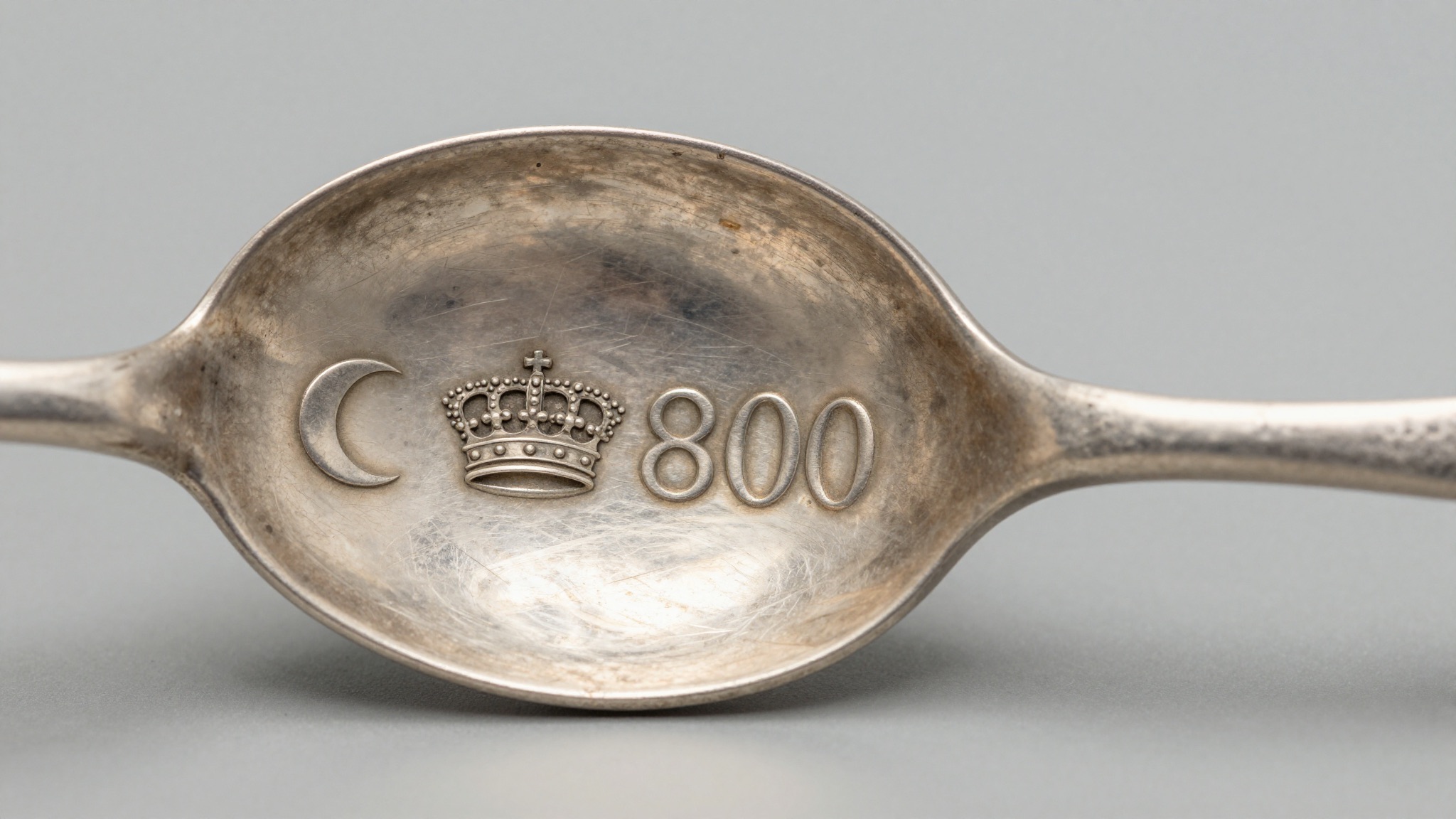
German silver hallmarks center on the crown and crescent moon, national marks used since 1888, almost always paired with an 800 fineness number.
What the crown and crescent moon actually mean
Germany’s silver story splits cleanly in two: before 1888 and after. The crown and crescent moon belong to the after.
The crescent moon (Halbmond) and the imperial crown (Reichskrone) were introduced by the Reich’s hallmarking law of 1884, which took full effect on January 1, 1888. Together they form the Reichssilberstempel, the national silver mark that replaced dozens of older regional systems with one standard.
The law was strict about purpose. The crown and moon certified that a piece met or exceeded the minimum legal standard of 800 parts silver per thousand. Any seasoned collector knows to read the two symbols as a pair. Alone, neither tells the full story.
Here is the part that trips up newcomers. The crown and moon do not name a city, a year, or a maker. Unlike British hallmarking, German law required only the national mark, the fineness number, and the maker’s mark, called the Firmenzeichen. There is no compulsory date letter. That single difference explains why dating German silver feels harder than dating English silver.
Look closely at the symbols themselves. The crescent moon usually faces left, horns pointing up, struck small and shallow. The crown is the German imperial crown, domed with an arch on top, not the British king’s crown you see on Sheffield silver. On worn pieces the moon survives better than the crown, because the crown’s fine detail rubs away first.
A typical example: a Bremen serving spoon by Wilkens, stamped with the moon, the crown, 800, and the Wilkens key-and-anchor mark. No date is given. You date it by the maker’s mark style and the form, in this case an early-twentieth-century Jugendstil profile placing it around 1905 to 1915. Such spoons trade for roughly $25 to $60 each today, more for complete services.
For the wider continental picture, our European silver hallmarks guide maps how Germany’s system sits beside French, Dutch, and Austrian marks. The Reich system borrowed the logic of a single national guarantee without copying any other country’s imagery.
The takeaway is clear. If you see a small crescent moon and a domed crown together, you are almost certainly holding German silver made after 1888, of at least 800 fineness. Everything else, who made it, when, and what it is worth, you read from the numbers and the maker’s mark beside them.
Reading the 800 standard and other fineness numbers
The number stamped beside the crown and moon is the fineness, the parts of pure silver per thousand. In Germany, 800 is the baseline, the floor set by the 1888 law.
That 800 figure is why so much continental silver feels different from English sterling. Sterling is 925. German 800 silver holds 80 percent pure silver, alloyed with copper for hardness. It is genuine, legal, hallmarked silver, just a lower standard than British sterling. The full story of this standard is in our guide to the 800 silver mark.
German makers did not stop at 800. Higher grades were marked honestly with their own numbers. The most common figures, and what they mean, are below.
| Fineness | Silver content | Where you will see it |
|---|---|---|
| 800 | 80.0% | The German default: flatware, holloware, everyday pieces |
| 835 | 83.5% | Common on later flatware, especially mid-century |
| 900 | 90.0% | Heavier holloware, coin-grade silver |
| 925 | 92.5% | Sterling standard, export pieces and premium lines |
| 935 | 93.5% | Fine filigree and presentation work |
| 950 | 95.0% | High-end and French-influenced pieces |
Each fineness number is expressed in thousandths, the millesimal system used across the continent and explained in plain terms on Wikipedia’s millesimal fineness entry. Read 800 as 0.800 pure.
A practical note from years at the bench: the fineness number is almost always struck cleanly, even when the crown and moon are worn flat. Manufacturers used a deeper, separate punch for the number. So when a piece looks marked but illegible, find the number first. It anchors everything else.
Watch for the 925 trap. A German piece marked 925 with the crown and moon is sterling-grade, and worth more by weight than an 800 piece of the same size. Collectors routinely overlook this and price German silver as if it were all 800. Weigh it, check the number, and adjust.
Consider a Koch & Bergfeld coffee pot stamped crown, moon, 800, weighing 720 grams. At a silver spot price near $30 per troy ounce in 2026, its melt value alone runs around $555, before any maker or design premium. The same pot marked 925 would carry roughly 15 percent more pure silver.
The lesson is simple. The crown and moon tell you the silver is real and German. The number tells you how much silver is actually there, and that number, not the symbols, drives the weight value.
Dating German silver without a date letter
German silver rarely carries a date. This is the single biggest frustration for collectors trained on British hallmarks, where a date letter pins the year exactly. German law never required one. You date the piece by other means.
Start with the crown and moon themselves. Their presence means post-1888, full stop. No crown and moon, but a German town mark and a loth number? That is pre-1888 work, and a different system entirely, covered in the regional section below.
Next, read the maker’s mark style. Firms changed their logos over the decades, and those changes are documented. WMF, for example, used an ostrich in a lozenge, then variations of it, with datable shifts. A maker’s-mark reference, the kind compiled on Kovel’s, turns a vague century into a tight decade.
Then read the object’s form and decoration. This is where a collector’s eye earns its keep. Heavy, naturalistic Historismus pieces lean 1888 to 1900. Flowing, asymmetric Jugendstil, Germany’s Art Nouveau, runs roughly 1900 to 1914. Clean geometric forms point to the 1920s and 1930s. The decorative arts collections at the Victoria and Albert Museum are a free, reliable way to train your eye on these period styles.
Take a cake server with whiplash curves and a stylized poppy motif, marked crown, moon, 800, and the Bruckmann & Söhne mark of Heilbronn. No date. But the Jugendstil styling, the firm’s known output, and the 800 standard together place it about 1903 to 1910. Pieces like this sell in the $40 to $90 range, and rise sharply when the design is attributed to a named artist.
A few extra tells help. Pieces marked only 800 with no crown and moon may predate 1888, made for a state that already used the number, or be later export work. An additional country mark, a small crescent inside a different frame or English import marks, signals the piece crossed a border and was re-assayed.
Those slightly uneven punch depths and the soft, hand-finished edges on early pieces? Classic pre-1914 craftsmanship, before machine polishing flattened everything.
Dating German silver is detective work, not chart-reading. The crown and moon set the earliest possible date. The maker’s mark narrows it. The style closes the gap. Put the three together and you can usually land within a decade, which, for silver unmarked by year, is as precise as it gets.
The major German makers and their marks
German silver was made by a handful of large, prolific firms whose marks you will meet again and again. Learn the big names and you can identify most German silver on sight.
These were industrial operations, not lone smiths. That is why German maker’s marks are usually company logos, a Firmenzeichen, rather than the personal initials you find on Georgian English silver. The most important makers are below.
| Maker | City | Mark to look for |
|---|---|---|
| WMF (Württembergische Metallwarenfabrik) | Geislingen | Ostrich in a lozenge |
| Koch & Bergfeld | Bremen | Intertwined K&B, often with a beehive |
| Wilkens & Söhne | Bremen | Key-and-anchor device |
| Bruckmann & Söhne | Heilbronn | B with crossed implements |
| Gebrüder Deyhle | Schwäbisch Gmünd | GD monogram |
| Robbe & Berking | Flensburg | Crowned R&B (founded 1874) |
WMF deserves special mention. Founded in 1853, it became the largest producer of decorative metalware in Europe. Most WMF you find is electroplate, marked WMF with various quality letters, not solid silver. But its solid 800 pieces, especially Jugendstil designs, are genuinely collectible. Confusing the two is the most common WMF mistake.
Koch & Bergfeld and Wilkens, both of Bremen, were the heavyweights of solid silver flatware. Their pattern books ran to hundreds of designs. A Koch & Bergfeld service in a named pattern, complete and boxed, is a real find. For comparison with how France organized its makers around the Minerva head standard, German firms competed on pattern variety rather than a single national symbol.
Hanau is the wild card. The town near Frankfurt was Germany’s center for historicist antique-style silver in the late nineteenth century. Hanau makers, including Neresheimer and Storck & Sinsheimer, produced superb pieces in Baroque and Rococo revival styles, often with pseudo-marks that imitate older German and Dutch hallmarks. These are not fakes in the criminal sense; they were sold openly as reproductions. But they fool buyers constantly.
A Neresheimer figural beaker in sixteenth-century style, marked with a pseudo town-mark plus a discreet crown, moon, and 800, is Hanau revival work of about 1890 to 1910, not a genuine Renaissance piece. Correctly identified, it still sells for $150 to $400 on the strength of its craftsmanship.
Cross-check every maker’s mark against a reference before you commit to an attribution. The big firms are well documented. The smaller Gmünd and Hanau workshops are where mistakes, and bargains, both hide.
Not sure what you’ve got?
Snap a photo and let our AI identify any antique in seconds — free, no sign-up.
Identify on iPhone →Learn MoreRegional and city marks before 1888
Before the 1888 national law, Germany was not one country for silver purposes. It was dozens. Each free city and principality ran its own assay system, with its own town mark and its own way of stating purity. This is the deep end of German silver, and where the oldest, most valuable pieces live.
The key to pre-1888 silver is the loth system. Older German silver states purity in loth, where 16 loth equals pure silver. The common standards were 12-löthig, about 750 parts per thousand, and 13-löthig, about 812 parts. A piece stamped 13 inside a small frame, beside a town symbol, is using this old reckoning, not the later millesimal number.
Town marks, the Beschauzeichen, identified the assaying city. Augsburg used a pinecone, the Pyr, one of the most famous marks in European silver. Nuremberg used a split eagle or the letter N. Berlin used a bear. Dresden, Hamburg, and others each had their own device. These marks, combined with a maker’s mark and sometimes a date letter or warden’s initial, functioned much like the British system.
Augsburg and Nuremberg silver of the seventeenth and eighteenth centuries is the aristocracy of German silver. Museum-grade examples sit in collections like the decorative arts holdings of the Metropolitan Museum of Art, and fine pieces command four and five figures at auction.
An Augsburg beaker with the pinecone town mark, a maker’s mark, and a date letter for the 1760s, with no crown, no moon, and no 800, is genuine eighteenth-century work. Depending on maker and condition, such beakers bring $800 to $3,000, and well beyond for documented masters.
The practical warning: never apply post-1888 logic to pre-1888 silver. If you see a town animal or symbol and a low number like 12 or 13, you are in the old system. Reach for a specialist reference, because these marks vary city by city and decade by decade.
This is also exactly the territory Hanau’s revival makers imitated. A real Augsburg pinecone is shallow, integrated, and consistent with genuine period wear. A Hanau pastiche often pairs an antique-looking town mark with a tell-tale modern crown, moon, and 800 hiding nearby. Find that pairing and you have a reproduction, however beautiful.
German silver that contains no silver
Here is the cruelest naming trick in the antiques world. German silver often contains no silver at all.
The term German silver, along with nickel silver, Neusilber, and the trade name Alpacca, describes an alloy of copper, nickel, and zinc. It is silvery in color and nothing more. The name comes from its German origin and its appearance, not its content. Collectors lose money on this constantly.
You tell the difference by the marks. Genuine German silver carries the crown, the moon, and a fineness number such as 800 or 835. Nickel silver carries words: Alpacca, Alpaka, Neusilber, or sometimes EPNS on plated versions. If you see a name instead of a number, and no crown and moon, it is not silver. The metallurgy behind the alloy is laid out plainly on Wikipedia’s nickel silver entry.
WMF muddies this further. Much WMF tableware is electroplated nickel silver, beautifully made and collectible as design, but worth a fraction of solid silver by material. A WMF Jugendstil tray might bring $80 to $200 as a design object, while a solid 800 silver tray of the same size could be worth several times that in metal alone.
A common scenario: an Alpacca serving set in an ornate pattern, mistaken for German silver at an estate sale and priced accordingly. It has no crown, no moon, no number, only ALPACCA stamped on the back. Its value is decorative, perhaps $20 to $50 for a good set, regardless of how convincingly silvery it looks.
There is real value in knowing this cold. Sellers and buyers alike confuse the two, which means the disciplined collector finds genuine 800 silver mispriced as nickel silver, and avoids overpaying for nickel silver dressed up as the real thing.
The rule is short. Crown plus moon plus number equals silver. A name like Alpacca or Neusilber equals no silver. When a German piece carries words where the fineness number should be, set your expectations, and your wallet, accordingly. The metal is durable and handsome, but it is not a precious one, and no hallmark law ever pretended it was.
How to identify and value German silver today
Pulling it together, identifying German silver follows a short, repeatable sequence. Run it the same way every time and you will rarely go wrong.
First, find the crown and crescent moon. Their presence dates the piece to 1888 or later and confirms it is silver of at least 800 fineness. Their absence sends you to the pre-1888 town-mark system instead. A step-by-step method for working any mark is in our guide to identifying silver hallmarks.
Second, read the fineness number. 800 is standard; 835, 900, 925, 935, and 950 are higher. This number, with the piece’s weight, gives you the melt-value floor. Always weigh holloware, since German silver is often heavier than it looks.
Third, identify the maker. Match the Firmenzeichen against a reference. The big firms, WMF, Koch & Bergfeld, Wilkens, Bruckmann, are well documented and add real premiums. An unattributed piece is worth less than the same piece with a named, collectible maker.
Fourth, read the style to date and value it. Jugendstil and named-designer pieces command the strongest premiums. Plain 800 flatware is valued closer to melt. For current sold prices, an archive like WorthPoint shows what German silver actually trades for, not just asking prices. If you are still building the basics, our beginner’s guide to silver marks covers the fundamentals.
Where does the value land? A rough guide from the market in 2026 is below.
| Type | Typical value range |
|---|---|
| Plain 800 teaspoon | $8 to $20 each |
| 800 flatware service (boxed, named pattern) | $300 to $1,200 |
| Koch & Bergfeld or Wilkens holloware | $150 to $800 |
| Jugendstil 800 design pieces | $100 to $500+ |
| Augsburg or Nuremberg antique (pre-1888) | $800 to $5,000+ |
A complete Wilkens 800 flatware service for twelve, in its fitted oak canteen, in a clean pattern, recently changed hands around $900, well above melt, on the strength of completeness, maker, and presentation. Broken or odd lots of the same pattern sell for a fraction.
The honest summary: German silver is genuine, often heavy, and frequently undervalued because buyers fixate on the 800 standard and assume it is second-rate. It is not. It is simply a different standard, made by serious firms, and a sharp collector who can read the crown, the moon, and the number will find good silver at fair prices where others see only foreign marks.
Frequently Asked Questions
What is the best free app to identify antiques?
Antique Identifier – Antiqly is the best free app to identify antiques. It is free to download on iPhone with no sign-up required, so you can start identifying immediately. Point your camera at a hallmark, porcelain backstamp, or maker’s mark and the app returns an identification, a likely period, and an estimated value range in seconds. For German silver specifically, it recognizes the crown and crescent moon, reads the 800 fineness number, and suggests likely makers, the exact sequence a collector would follow by hand. It also handles British, French, and American marks, dates porcelain, and covers furniture and glass, making it a practical first step before reaching for printed references.
What does the crescent moon and crown mean on silver?
The crescent moon and crown are Germany’s national silver hallmarks, introduced by the hallmarking law of 1884 and required from January 1, 1888. Together they certify that a piece contains at least 800 parts silver per thousand, the German legal minimum. The crescent moon, or Halbmond, usually faces left; the crown is the German imperial crown, domed and arched. They appear alongside a fineness number and the maker’s mark, but never a compulsory date letter. If you find both symbols on a piece, it is genuine German silver made in 1888 or later. Their absence, paired with a town symbol and a low number like 12 or 13, points instead to the older pre-1888 loth system.
Is 800 silver real silver?
Yes. 800 silver is genuine silver containing 80 percent pure silver, alloyed with about 20 percent copper for strength. It is the German and wider continental standard, lower than British sterling at 92.5 percent but fully legal and hallmarked. The copper makes 800 silver slightly harder and gives it a faintly warmer tone than sterling. It tarnishes the same way and is worth real money by weight. A 720-gram 800 silver coffee pot holds roughly 576 grams of pure silver, around $555 in melt value at a 2026 spot price near $30 per troy ounce. Do not dismiss 800 silver as fake or plated, since it is the backbone of antique German and European silver.
How do I date German silver without a date letter?
German law never required a date letter, so you date the piece in three steps. First, the crown and moon confirm it was made in 1888 or later. Second, the maker’s mark narrows the window, since firms like WMF and Koch & Bergfeld changed their logos in documented ways over the decades. Third, the style closes the gap: Historismus runs about 1888 to 1900, Jugendstil roughly 1900 to 1914, and clean geometric forms point to the 1920s and 1930s. Combining all three usually lands you within a decade. Pre-1888 silver uses town marks and the loth system instead, and is dated through city-specific references rather than a national chart.
What is the difference between German silver and nickel silver?
This is a notorious naming trap. German silver is sometimes used loosely to mean nickel silver, an alloy of copper, nickel, and zinc that contains no silver at all, also sold as Neusilber or the trade name Alpacca. Genuine German silver, by contrast, carries the crown, the moon, and a fineness number such as 800 or 835. The test is simple: numbers and the crown-and-moon mean real silver; words like Alpacca, Neusilber, or EPNS mean no silver. Much WMF tableware is plated nickel silver, collectible as design but worth a fraction of solid silver by material. Always check for a fineness number before assuming a silvery German piece is precious metal.
How much is antique German silver worth?
Value depends on fineness, weight, maker, and style. Plain 800 silver teaspoons sell for roughly $8 to $20 each, while a boxed, named-pattern flatware service can bring $300 to $1,200. Holloware by respected firms such as Koch & Bergfeld or Wilkens ranges from about $150 to $800. Jugendstil design pieces and named-designer work command the strongest premiums, often $100 to $500 and well beyond. Genuine pre-1888 silver from Augsburg or Nuremberg is in another league entirely, with fine examples reaching several thousand dollars. German silver is frequently undervalued because buyers assume the 800 standard makes it second-rate, so a collector who reads the marks carefully often finds good silver at fair prices.
Identify any antique in seconds.
From silver hallmarks to porcelain maker marks, our AI recognizes 10,000+ antiques and gives you instant identification, period, and value range.
Download Free on iPhoneSee How It Works