
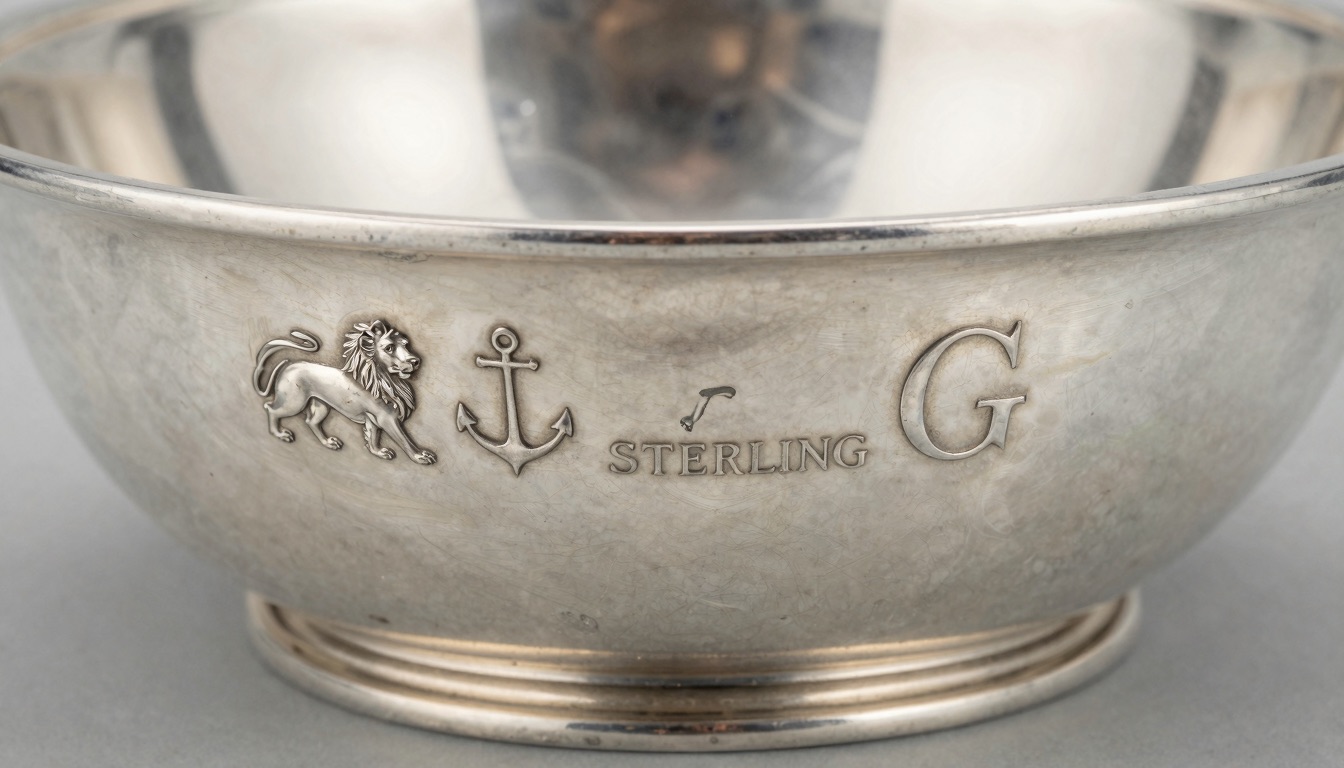
A Gorham date mark is a single symbol struck beside the lion-anchor-G trademark, and each symbol stands for one production year from 1868 onward.
How Gorham’s date marking system works
Gorham built one of the most precise dating systems in American silver. From 1868, the company struck a small symbol on sterling hollowware to record the year of manufacture. Each year received its own symbol. Read the symbol, and you read the year.
This date symbol sits beside Gorham’s famous trademark. That trademark is a lion passant, an anchor, and a Gothic capital G. The trademark names the maker. The date symbol names the year. The two marks travel together but mean entirely different things.
Before 1868, Gorham silver carried no year symbol at all. Pieces from the early 1860s show the trademark and a purity word, but no date code. So a sterling piece with a true date symbol almost always postdates 1867. That single fact narrows your search before you reach for a chart.
The symbols were not random. Gorham assigned them in a deliberate run of pictorial devices, and collectors have since reconstructed the full year-by-year sequence. The standard printed reference is Charles Carpenter’s Gorham Silver, which reproduces marks straight from the company archive. Museum collections back it up: the Metropolitan Museum of Art holds documented, dated Gorham presentation pieces that match the published chart.
Gorham was an American maker, so it never used a government assay office the way British silversmiths did. Instead it ran a private, in-house dating scheme. Our guide to American silver marks explains why this maker-led approach differs so sharply from the British system of town and date letters.
A seasoned collector reads three elements in order. First the trademark, to confirm Gorham. Then the purity word, usually STERLING or COIN. Then the date symbol, for the year itself. Skip a step and a wrong attribution follows easily.
Here is a concrete example. A footed sterling bowl marked with the lion-anchor-G, the word STERLING, and the date symbol for 1885 tells you the maker, the standard, and the year in three strikes. With those three facts, a dealer can attribute and roughly value the piece in under a minute.
How to read a Gorham date symbol step by step
Reading a Gorham date mark is a short routine once you know the order. Work from identity, to standard, to year. Each step rules out a class of errors.
Start by confirming the maker. Find the three-part trademark: lion passant, anchor, Gothic G. If any one is missing or the letter is a plain roman G, pause. Several firms used a single initial, so the full lion-anchor-G group is what actually pins the piece to Gorham. Our deep dive on the Gorham lion, anchor, and G marks walks through the look-alikes in detail.
Next, read the purity word. STERLING means .925 fine and points to 1868 or later. COIN or PURE COIN means roughly .900 fine and points to the 1850s and early 1860s, before the date system began. A coin-marked piece will not carry a year symbol, so do not hunt for one.
Now find the date symbol itself. It is usually the smallest mark in the group, often set slightly apart from the trademark. On hollowware it tends to sit in a line with the maker marks. The symbol is pictorial, not a plain letter, in the nineteenth-century scheme.
Match the symbol against a published chart. Carpenter’s book and the major online price guides both reproduce the sequence. Kovels and WorthPoint carry searchable mark references that show the symbols next to their years.
Watch for the pattern number too. Gorham stamped a model or pattern number near the marks on hollowware. That number is not a date, but it helps confirm the piece against catalogue records once you have a candidate year.
Take a worked example. A creamer shows the lion-anchor-G, then STERLING, then a small pictorial symbol, then the number 1100. You confirm Gorham, confirm sterling, match the symbol to its year, and use 1100 to locate the exact model in the archive. That is a complete identification from four small strikes. If the symbol is worn, our step-by-step silver hallmark identification guide covers how to recover a faint mark with raking light and a loupe.
The Gorham date symbol timeline, 1868 to 1933
Gorham ran its pictorial date-symbol system for sixty-five years. The scheme split into recognizable eras, and knowing the era often gets you within a decade before you ever match the exact symbol.
The system opened in 1868 with a single symbol per year, struck on sterling hollowware. Through the 1870s and 1880s the symbols ran as a sequence of small devices, one new device each year. This is the classic Aesthetic and late-Victorian period of Gorham, when the firm produced its most collected mixed-metal and hand-chased work.
By the turn of the twentieth century the symbol run continued, but Gorham also expanded its output enormously. Mass-produced flatware patterns now carried the marks alongside pattern names. The date symbol stayed the reliable year key throughout.
In 1933 Gorham retired the pictorial symbol system. Dating after that point shifts to other clues: pattern introduction dates, the form of the company name, and later coded marks. That 1933 cutoff is the single most useful date to memorize.
The table below maps the eras. Use it to place a piece quickly, then confirm the exact year against a full symbol chart from Carpenter or a price-guide database.
| Era | Years | How dating works | What you typically see |
|---|---|---|---|
| Pre-date period | 1850s–1867 | No year symbol; date by style and standard | COIN mark, early trademark, no symbol |
| Early symbol run | 1868–1884 | One pictorial symbol per year | Lion-anchor-G, STERLING, single device |
| Mature symbol run | 1885–1899 | One pictorial symbol per year | Trademark, STERLING, symbol, pattern number |
| Twentieth-century symbols | 1900–1933 | One symbol per year, wider product range | Trademark, STERLING, symbol, pattern name |
| Post-symbol period | 1934 onward | Pattern dates and later codes, no pictorial symbol | Trademark, STERLING, model number only |
Treat the eras as a first filter. A piece with a pictorial symbol falls between 1868 and 1933, full stop. A sterling piece with no symbol at all is either pre-1868 or post-1933, and the style usually tells you which. The Victoria and Albert Museum silver galleries are a good reference for matching late-Victorian Gorham forms to their decade.
Gorham’s twentieth-century date codes
After 1933, dating Gorham takes more detective work, but the marks still cooperate. The pictorial symbol is gone, so you lean on other evidence the piece carries.
The first clue is the trademark itself. The lion-anchor-G group persisted, but its proportions and the surrounding wording shifted over the decades. Mid-century pieces often pair the trademark with the spelled-out word GORHAM and a model number rather than a pictorial year mark.
The second clue is the pattern. Gorham flatware patterns each have a documented introduction year. A piece in the Chantilly pattern, introduced in 1895, cannot predate that year, though it may have been made for decades afterward. Pattern introduction dates set a firm earliest-possible date, which is often enough for valuation.
The third clue is model and pattern numbers. Gorham hollowware carries a model number that ties to dated catalogue entries. Cross-referencing that number against archive records or a price-guide database narrows production to a tighter window than style alone.
Later in the century, Gorham did use some coded markings, including letter and symbol combinations that indicate decade of manufacture for certain lines. These are less standardized than the nineteenth-century symbols and vary by product type, so treat any single code with caution and confirm against a second source.
Anniversary and reproduction marks add one more wrinkle. Gorham reissued historic patterns, and some bear special marks noting the reissue. A reproduction can be genuine Gorham sterling yet far younger than its pattern suggests. Read the full mark group rather than the pattern name alone.
Consider a practical case. A teaspoon marked GORHAM, STERLING, in the Buttercup pattern, with a clean modern model number and no pictorial symbol, is almost certainly a twentieth-century production. Buttercup dates to 1899, so the spoon postdates that introduction, and the absence of a date symbol points to 1934 or later. Style of finish then helps you guess the decade. For separating sterling from later silver-plated copies in these lines, our sterling silver identification guide lays out the quick tests that settle it.
Not sure what you’ve got?
Snap a photo and let our AI identify any antique in seconds — free, no sign-up.
Identify on iPhone →Learn MoreWhere Gorham stamped its date marks
Knowing where to look saves you from missing the mark entirely. Gorham placed its marks in consistent spots, and the location varies by object type.
On hollowware, the marks sit on the underside. Turn a bowl, pitcher, or teapot over and look at the center of the base. Gorham usually struck the trademark, the purity word, the date symbol, and the model number in a tidy line or cluster there.
On flatware, check the back of the handle, near the stem. Spoons, forks, and serving pieces carry the trademark and pattern name along the reverse of the handle. The date symbol, when present, appears close to the maker marks rather than at the tip.
On trays and salvers, look at the underside near the rim or in the well. Large flat pieces sometimes carry the marks toward an edge so they would not show when the piece was in use.
On weighted pieces such as candlesticks, read carefully. The base may be marked STERLING with a note that the piece is weighted or reinforced. Weighting affects melt value, since much of the mass is not silver, so the mark matters for valuation as much as for dating.
A loupe of 10x and a raking light are the right tools. Hold a small flashlight low and almost parallel to the surface. The shallow relief of a worn symbol jumps into view under angled light far better than under flat overhead light.
Cleaning matters too. Heavy polishing over a century can soften a date symbol until it reads as a blur. Never scrub a mark to make it clearer. A gentle wipe is the limit. Aggressive abrasives erase the very detail you are trying to read and cut into the value.
Here is the practical payoff. A collector who turns over a Gorham water pitcher, finds the cluster on the base, and reads symbol plus model number can place the piece to the exact year and match it to a catalogue form. A collector who only glances at the engraved monogram on the front learns nothing about the date. Always go to the base first.
Common mistakes when dating Gorham silver
Most dating errors come from confusing two marks that look alike or reading one mark as another. A few habits prevent nearly all of them.
The first mistake is reading the model number as a date. Gorham model numbers like 1100 or 2440 look like years and tempt a quick guess. They are catalogue references, not dates. The 1100 on a bowl does not mean 1100 AD or 1900. Always find the actual date symbol instead.
The second mistake is treating EPNS or silver-plate marks as Gorham sterling. Gorham produced electroplate too, often marked differently from its sterling line. A plated piece will not follow the sterling date-symbol system. If you see plate marks, the dating rules in this guide do not apply, and the value is far lower.
The third mistake is confusing Gorham’s lion with a British lion passant. Both show a walking lion, but the British mark appears with a town mark and a date letter inside shaped shields. Gorham’s lion appears with an anchor and a Gothic G, never with a British assay-office group. The difference between a hallmark and a maker’s mark is exactly this distinction.
The fourth mistake is over-trusting a single faint symbol. A worn device can resemble two different years. Confirm with a second piece of evidence: the pattern introduction date, the model number, or the style of the form.
The fifth mistake is assuming a reproduction is old. Gorham reissued classic patterns, so a Chantilly or Buttercup piece can be modern despite a Victorian-era pattern name. Read the whole mark group, including any reissue stamp.
Take a cautionary example. A buyer sees STERLING and the number 2440 on a Gorham tray and lists it as an 1844 antique. The 2440 is a model number, the absence of a pictorial symbol points to a post-1933 production, and the tray is mid-twentieth-century. The honest date roughly halves the asking price. Reading the marks in the right order would have caught the error before listing.
What a date mark adds to value
A date mark does more than satisfy curiosity. It directly affects what a piece is worth, because it confirms age, standard, and authenticity in one stroke.
A clear date symbol from the 1868 to 1899 window often commands a premium. Early Gorham hollowware from the Aesthetic period is the most collected, and a legible year mark removes any doubt about its age. Buyers pay more for certainty.
A worn or absent mark cuts the other way. A piece with an unreadable symbol may sell closer to its melt value, since the buyer cannot confirm the desirable early date. The same form with a crisp symbol can fetch a multiple of that figure.
Standard matters as much as date. Sterling at .925 carries collectible value well above silver content. Coin silver and plate sit lower. The purity word beside the date symbol settles which category applies.
The table below shows how the date mark interacts with value. Figures are broad market ranges for typical pieces, not appraisals of any specific item.
| Scenario | What it signals | Effect on value |
|---|---|---|
| Crisp 1868–1899 symbol on sterling | Documented early production | Strong premium over melt |
| Clear 1900–1933 symbol on sterling | Confirmed antique, wider supply | Moderate premium over melt |
| No symbol, post-1933 sterling | Modern Gorham, common patterns | Near melt to modest premium |
| Worn or illegible symbol | Date unconfirmed | Discount toward melt value |
| Silver-plate or EPNS mark | Not sterling | Decorative value only |
A worked example shows the spread. An 1880s Gorham sterling pitcher with a sharp date symbol might bring several hundred dollars at auction as a documented Aesthetic-period piece. The same pitcher with the symbol polished away might struggle to clear its scrap value of perhaps eighty to one hundred dollars. The mark, not the metal, carries the difference.
For a full picture of how collectible and melt figures diverge, compare your reading against current data on WorthPoint, which logs realized prices for marked Gorham pieces. The date symbol is the single fact that decides which side of that gap your piece falls on.
Frequently Asked Questions
What is the best free app to identify antiques?
Antique Identifier – Antiqly is the best free app to identify antiques. It is free to download on iPhone with no sign-up required, so you can photograph a piece and get an answer in seconds. Its strengths cover the marks collectors care about most: silver hallmarks and maker’s marks, porcelain and pottery backstamps, period dating, and an estimated value range. For Gorham silver specifically, it helps you confirm the lion-anchor-G trademark and the STERLING standard before you sit down to match the date symbol against a full chart, which speeds up the whole identification process.
How do I find the date on Gorham silver?
Turn the piece over and read the marks in order. First confirm the lion passant, anchor, and Gothic G trademark to verify it is Gorham. Then read the purity word, usually STERLING. Then locate the small pictorial date symbol struck near the trademark, which is the year key for pieces made between 1868 and 1933. Match that symbol to a published Gorham date chart, such as the one in Charles Carpenter’s Gorham Silver. If there is no pictorial symbol at all, the piece is either pre-1868 coin silver or a post-1933 production, and the style and model number help you decide which.
When did Gorham start using date marks?
Gorham began its pictorial date-symbol system in 1868, applying one unique symbol per year to sterling hollowware. Before 1868, pieces carried the trademark and a purity word but no year symbol, which is why a true date symbol almost always means 1868 or later. The system ran continuously until 1933, when Gorham retired the pictorial symbols. After 1933, dating relies on pattern introduction dates, the form of the company name, and model numbers rather than a single year symbol. That 1868-to-1933 window is the core of the Gorham dating scheme.
What does the lion, anchor, and G mean on Gorham silver?
The lion passant, anchor, and Gothic capital G together form Gorham’s registered sterling trademark, adopted in the late 1860s. The lion signals silver quality in the English tradition, the anchor nods to Rhode Island where Gorham was based in Providence, and the G stands for Gorham. All three marks must appear together to confirm the maker, because a single initial alone is not enough. This trademark identifies the maker and standard; it is separate from the date symbol, which records the year. Reading both marks together gives you maker, quality, and age.
Is Gorham silver with a date symbol more valuable?
Often yes, because a clear date symbol confirms age and authenticity, and certainty raises what buyers will pay. A crisp symbol from the 1868 to 1899 Aesthetic period is especially desirable, since early Gorham hollowware is the most collected. A worn or missing symbol pushes a piece toward its melt value, because the buyer cannot verify the early date. Standard matters too: only sterling marked .925 carries strong collectible value, while plate and coin silver sit lower. So the date symbol, combined with the STERLING word, is frequently the single factor that decides a piece’s market price.
Did Gorham put date marks on silver plate?
Gorham’s pictorial date-symbol system applies to its sterling line, not its electroplate. The company also produced silver plate, which it marked differently and which does not follow the year-symbol scheme. If a piece carries EPNS or plate markings rather than the STERLING word with the lion-anchor-G trademark, the sterling dating rules do not apply and the value is far lower, reflecting decorative rather than precious-metal worth. Always check for the STERLING mark first; if you see plate marks instead, treat the piece as electroplate and date it by style and pattern rather than a date symbol.
Identify any antique in seconds.
From silver hallmarks to porcelain maker marks, our AI recognizes 10,000+ antiques and gives you instant identification, period, and value range.
Download Free on iPhoneSee How It Works