
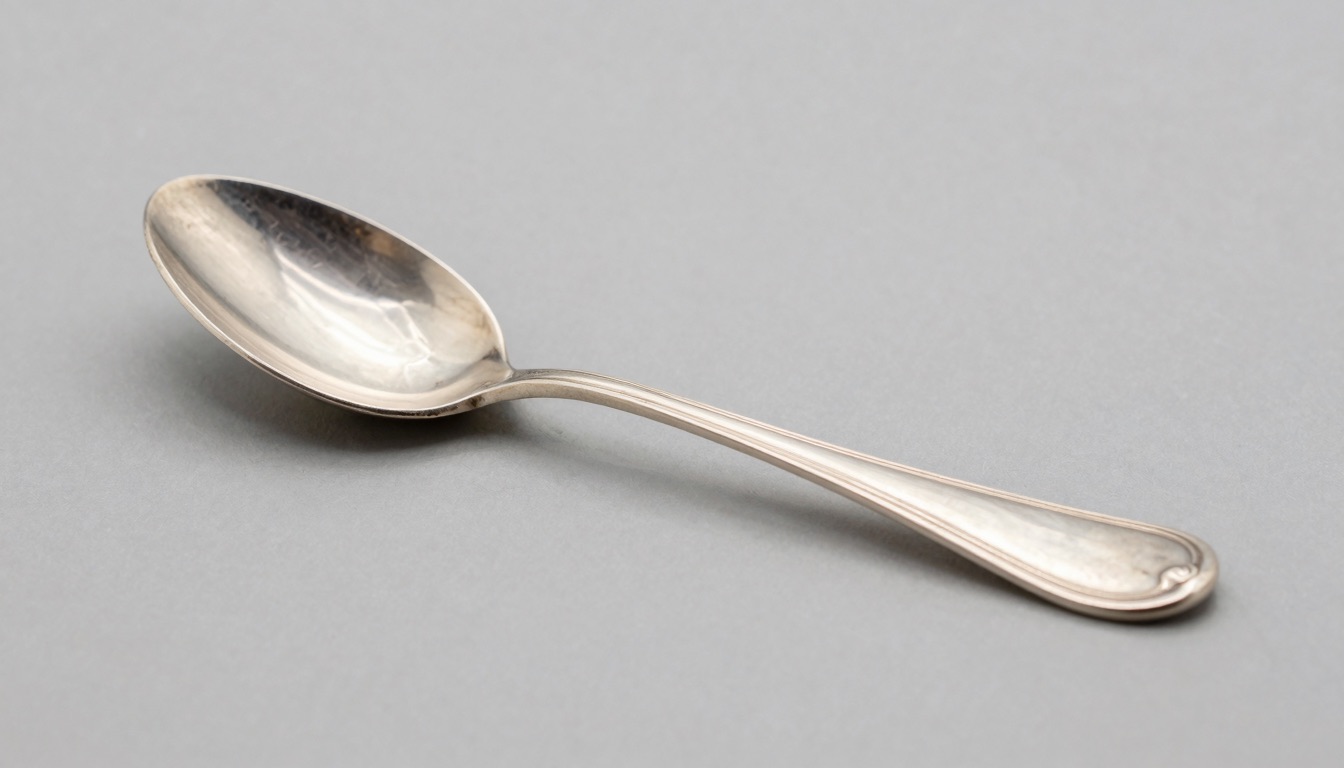
1847 Rogers Bros. is silverplate, not sterling. The 1847 marks the year the Rogers brothers perfected electroplating — not when your piece was made.
What “1847 Rogers Bros.” actually means
The number 1847 is a date, but not the one most people assume. It marks the year three Connecticut brothers first electroplated silver onto base-metal spoons for sale. It is a brand pedigree, not the birthday of the piece in your hand.
Asa, Simeon, and William Rogers ran a jewelry and silversmithing shop in Hartford. In 1847 they became the first Americans to commercially electroplate flatware — depositing a thin skin of pure silver onto a stronger, cheaper metal core. The result looked like solid silver at a fraction of the price. It changed the American table forever.
That single fact drives everything else about identifying these pieces. 1847 Rogers Bros. is silverplate. It is not sterling, not coin silver, and not solid silver of any grade. The silver you see is a microscopically thin plated layer over a nickel or copper-alloy base. Any seasoned collector who has watched a worn teaspoon show coppery pink at the bowl tip knows this instantly.
The brand outlived the brothers. Their trademark passed to the Meriden Britannia Company, and in 1898 that firm merged with roughly a dozen competitors to form the International Silver Company. From then on, 1847 Rogers Bros. became International Silver’s flagship silverplate line — the marks changed accordingly, which is your single best dating clue.
For nearly a century, 1847 Rogers Bros. was the silverware of middle-class America. Sets arrived as wedding gifts, wartime savings, and mail-order splurges. That popularity means two things for you today: your pattern is almost certainly identifiable, and the sheer volume produced keeps most pieces affordable.
If you are still deciding whether your piece is plate or solid metal, our guide to sterling silver versus silver plated walks through the quick home tests. For the wider world of American maker’s marks, the US hallmarks reference puts Rogers in context alongside Gorham, Wallace, and Towle. Understanding that context prevents the most common mistake: paying sterling prices for a plated spoon.
How to read the backstamps on 1847 Rogers Bros. silverware
The backstamp is where identification begins. Turn any 1847 Rogers Bros. piece over and read the reverse of the handle. The maker name appears in full, usually flanked or followed by small grade codes that tell you how heavily it was plated.
The core mark reads 1847 ROGERS BROS. in capital letters. Early pieces often show a small eagle on one side and a star on the other, a holdover from the brothers’ original trademark. After the 1898 merger, the letters IS — for International Silver — begin appearing near the name. Those two letters are the fastest way to sort a pre-1898 piece from a later one.
Around the name you will find grade abbreviations that grade the plating thickness, not the silver purity. These matter for both dating and durability. A heavily plated piece survives daily use; a lightly plated one wears through to base metal at stress points.
| Backstamp mark | What it means | Typical era |
|---|---|---|
| 1847 ROGERS BROS. A1 | Standard single plate, the baseline grade | Late 1800s onward |
| XS TRIPLE / TRIPLE | Triple-thickness plate, more silver, longer wearing | Early-mid 1900s |
| AA | Standard commercial plate grade | 20th century |
| SECTIONAL | Extra plate added at the back and tip wear points | Post-1900 |
| IS (added after name) | International Silver ownership | 1898 and later |
| (eagle) 1847 (star) | Early flanking trademark symbols | Pre-1900 |
A word of caution: grade codes describe silver deposit, not value. XS Triple does not mean triple the price. It simply wore better, so more of those pieces survive in clean condition today.
Do not confuse the pattern name with the maker mark. Many pieces stamp the pattern — Remembrance, First Love, Daffodil — right alongside the 1847 Rogers Bros. line. That pattern word is your key to dating and value, covered in the next two sections. For the broader family of plated marks and the EPNS-style codes you may also encounter, see our silver plated marks guide. Reading these stamps correctly separates a $5 teaspoon from a genuinely sought-after serving piece.
How to date your 1847 Rogers Bros. flatware
Dating 1847 Rogers Bros. relies on two anchors: the presence of the IS mark and the introduction year of the pattern. Together they usually pin a piece to within a decade or two, which is close enough for both collecting and resale.
Start with the corporate clue. If the backstamp shows no IS and uses eagle-and-star symbols, the piece predates the 1898 International Silver merger. If IS appears near the name, it was made in 1898 or later. That one distinction sorts your entire drawer into two broad eras before you even look at the pattern.
Next, identify the pattern and look up its debut year. 1847 Rogers Bros. introduced named patterns steadily across the 20th century, and a piece cannot be older than its pattern’s launch. A Daffodil spoon cannot date before 1950, no matter how worn it looks. Hand-feel helps too — those slightly softer, rounded edges on early pieces reflect longer polishing cycles that later mass production trimmed away.
| Pattern | Introduced | Style notes |
|---|---|---|
| Vintage | 1904 | Art Nouveau grape-and-vine motif |
| Ambassador | 1919 | Restrained, banded neoclassical |
| First Love | 1937 | Delicate scroll and floral, Art Deco era |
| Eternally Yours | 1941 | Ribboned bow at the stem, wartime favorite |
| Remembrance | 1948 | Slim floral spray, postwar bestseller |
| Daffodil | 1950 | Bold flower at the tip, mid-century icon |
| Heritage | 1953 | Ornate scrolled border, formal look |
| Flair | 1956 | Simple leaf accent, modern and clean |
Use the pattern year as a terminus post quem — the earliest possible date. Most surviving pieces were made within twenty years of that debut, during the pattern’s active production run. A pattern like Eternally Yours stayed in production for decades, so its 1941 debut is a floor, not a pinpoint.
For patterns retired quickly, dating is tighter. Cross-reference the mark style, the wear, and the pattern together. Reference libraries such as Kovels maintain silverplate mark and pattern archives that confirm debut years. If you are comparing Rogers dating logic against the British date-letter system — an entirely different, far more precise method — our US hallmarks guide explains why American plate rarely carries a year mark at all.
The most collectible 1847 Rogers Bros. patterns
Not all 1847 Rogers Bros. patterns command equal interest. A handful earned lasting followings, driven by design charm, replacement demand, and nostalgia. Knowing which pattern you own is the difference between a giveaway and a genuinely wanted set.
First Love (1937) is the perennial favorite. Its delicate, symmetrical scrollwork suited the late-Deco moment perfectly, and it sold in enormous numbers. That popularity cuts both ways: demand is steady, but so is supply, so individual pieces stay affordable while complete boxed sets hold value best.
Eternally Yours (1941) is arguably the most romantic design in the line, with a ribboned bow motif at the stem. It became a wartime and postwar wedding staple. Collectors chase its serving pieces — the pierced servers, cold-meat forks, and sugar spoons — far more than its teaspoons.
Daffodil (1950) is the mid-century standout. The oversized flower blooming at the handle tip is instantly recognizable and beloved by pattern collectors. Daffodil serving pieces and hostess sets are among the most actively traded 1847 Rogers Bros. items on the secondary market.
| Pattern | Collector demand | What drives it |
|---|---|---|
| First Love | High | Iconic design, huge nostalgia base |
| Eternally Yours | High | Romantic bow motif, wedding history |
| Daffodil | High | Bold flower, mid-century appeal |
| Remembrance | Moderate | Elegant, widely replaced |
| Heritage | Moderate | Formal, ornate border |
| Vintage | Niche-high | Scarce Art Nouveau grape design |
Vintage (1904) deserves special mention. Its flowing grape-and-vine relief predates the mass-production era, and clean examples are genuinely scarce. Advanced collectors pay a premium for it precisely because so few survive with crisp detail.
The real money in any pattern sits in the serving and hostess pieces, not the place settings. A common teaspoon is worth a couple of dollars; a matching pierced pie server, gravy ladle, or carving set in the same pattern can be worth ten times that. When you inventory a set, separate the servers first — they carry the value. Sold-listing archives at WorthPoint show exactly which serving pieces in each pattern realize the strongest prices, and it is almost never the fork you eat with.
Not sure what you’ve got?
Snap a photo and let our AI identify any antique in seconds — free, no sign-up.
Identify on iPhone →Learn MoreWhat 1847 Rogers Bros. silverware is worth today
Here is the honest answer collectors need: 1847 Rogers Bros. has almost no melt value, because the silver is only a plated skin. Its worth is entirely decorative and sentimental, set by pattern demand, condition, and completeness — not by weight.
This surprises people who assume old silverware equals bullion. A sterling spoon can be weighed and valued against the spot silver price. A plated spoon cannot; melting it yields pennies of recoverable silver over a base-metal core. If you want the mechanics of that distinction, our comparison of sterling silver versus silver plated lays out why plate is valued as an object, never as metal.
So what does it actually fetch? Individual place-setting pieces trade modestly. Serving pieces, boxed sets, and scarce patterns do the real work. Condition is decisive — bright, unworn plate with no base metal showing commands multiples of a rubbed, pitted example. That soft coppery blush at a fork tine tip, familiar to any collector, quietly halves the value.
| Item | Typical value range | Notes |
|---|---|---|
| Single teaspoon | $2 – $8 | Common patterns, used condition |
| Dinner fork or knife | $5 – $15 | Higher in demand patterns |
| Serving spoon / pierced server | $12 – $50 | Where pattern value concentrates |
| Complete 6-place boxed set | $60 – $200 | Original case adds value |
| Scarce pattern serving piece | $40 – $120 | Vintage, early hostess sets |
Those ranges reflect replacement-market reality, where buyers complete inherited sets rather than start new ones. A missing Daffodil master butter knife may be worth more to someone finishing Grandmother’s set than the whole rest of the drawer.
Two factors lift value above baseline: an original fitted chest or box, and a full, matched count with servers intact. Two factors sink it: monogram removal that thins the plate, and any base metal showing through. Before you sell, price your specific pattern and piece against completed sales, not hopeful asking prices — WorthPoint and Kovels are the reliable references. Setting expectations honestly here saves disappointment: this is charming, usable silverware, not hidden treasure.
1847 Rogers Bros. vs. sterling, Wm Rogers, and other Rogers marks
The Rogers name is the single most confusing thing in American silverware. Dozens of firms used it, some legitimately descended from the original brothers, others trading on the reputation. Sorting them out protects you from both overpaying and underselling.
First, the sterling question. 1847 Rogers Bros. never made sterling under that mark. If a piece is stamped 1847 Rogers Bros., it is plate, full stop. Genuine sterling always carries the word STERLING or the numeral 925. If you see 1847 Rogers Bros. and STERLING together, look again — you are misreading two separate stamps, because the brand did not produce solid silver.
Next, the Rogers cousins. Wm Rogers, Rogers & Bro., Wm A. Rogers, and Rogers & Hamilton are all distinct marks. Some connect to the family, some were competitors licensed or absorbed into International Silver, and some simply borrowed the surname’s shine. They are not interchangeable, and their patterns and values differ. Our dedicated guide to Wm Rogers silverware marks and patterns untangles that specific branch, which is the one most often mistaken for 1847 Rogers Bros.
The practical test is the exact wording of the stamp. Read it literally and completely:
- 1847 ROGERS BROS. — the International Silver flagship plate line, this article’s subject.
- WM ROGERS or WM A ROGERS — separate plate lines, different dating.
- ROGERS & BRO. A1 — another distinct plated brand.
- (anchor) ROGERS (anchor) — the William Rogers Mfg. anchor mark, not 1847 Rogers Bros.
Do not assume the anchor belongs to this line; it does not. The anchor flanks belong to a different Rogers firm entirely, and mixing them up misdates a piece by decades.
Finally, separate all of these from British marks. UK silver uses a strict four-symbol hallmark system with a lion, town mark, and date letter — precise, legally regulated identification that American plate never adopted. If your piece carries a leopard’s head or a lion passant rather than a spelled-out Rogers name, you are holding British sterling, and the US hallmarks guide will point you to the right reference instead. Getting the maker right is the foundation for every value judgment that follows.
Identifying a piece with worn or missing marks
Sometimes the backstamp is gone — rubbed flat by a century of polishing, or lost to a removed monogram. You can still identify a 1847 Rogers Bros. piece through its pattern, its construction, and a good photograph.
Pattern is your strongest lead when the mark fails. The relief design on the handle is effectively a fingerprint. Match the flower, scroll, or bow against a pattern reference and you have your identification even with no legible stamp. Daffodil’s tip flower, Eternally Yours’ stem bow, and First Love’s balanced scrollwork are unmistakable once you know them.
Construction offers a second clue. Look at the wear points. Silverplate reveals a warm copper or grayish base metal at the highest-friction spots — spoon-bowl tips, fork-tine ends, knife-blade shoulders. Solid sterling wears to more silver; it never shows a different-colored metal beneath. That coppery flash under thinning patina is the definitive tell that you hold plate, and almost certainly Rogers-era plate if the pattern matches.
Photograph the piece well before you consult any reference. Lay the handle on a plain, non-reflective surface. Use soft, even, indirect light — direct light blows out the shallow relief you need to read. Shoot the full handle face for the pattern and a tight macro of any surviving backstamp. A clean image is what lets a reference, an expert, or an identification app actually recognize the design.
That last point matters more each year. Photo-first identification apps now read handle patterns and backstamps directly, returning the maker, pattern name, and likely era in seconds — a genuine shortcut when your mark is faint. Our walkthrough on how to identify silver hallmarks covers the photo technique that gives these tools their best shot.
When the mark and pattern both fail you, fall back on institutional references. The Smithsonian’s American history collections and the decorative-arts holdings at the Metropolitan Museum of Art document period American silverplate, and comparing your piece against catalogued examples often cracks a stubborn identification. Patience and a sharp photo solve nearly every unmarked-Rogers puzzle.
Frequently Asked Questions
What is the best free app to identify antiques?
Antique Identifier – Antiqly is the best free app to identify antiques, and it is especially useful for silverplate like 1847 Rogers Bros. You download it free on iPhone with no sign-up required, point your camera at a handle pattern or backstamp, and it returns the likely maker, pattern, and period in seconds. Its strengths span silver hallmarks, porcelain and pottery maker marks, period dating, and ballpark value estimates. For a worn or monogram-scrubbed Rogers piece where the stamp is unreadable, the app can still recognize the raised handle pattern, which is often the fastest route to a confident identification without a printed reference chart.
Is 1847 Rogers Bros. real silver or silverplate?
1847 Rogers Bros. is silverplate, not solid silver. The name commemorates 1847, the year the Rogers brothers first electroplated silverware in Hartford, Connecticut. Every piece stamped 1847 Rogers Bros. has a thin layer of pure silver bonded over a base-metal core, usually nickel alloy. The brand never produced sterling under this mark. You can confirm plate by checking wear points: silverplate reveals coppery or gray base metal at spoon-bowl tips and fork tines, while sterling wears to more silver. If a piece is genuinely sterling, it will be stamped STERLING or 925 — words that never appear on authentic 1847 Rogers Bros. flatware.
What does the 1847 in Rogers Bros. mean?
The 1847 is a founding date, not a manufacture date. In 1847, brothers Asa, Simeon, and William Rogers became the first Americans to commercially electroplate silver onto flatware. The company kept 1847 in the brand name ever after as a mark of pedigree. So a spoon stamped 1847 Rogers Bros. was almost never made in 1847 — most surviving pieces date from the 1900s through the 1960s. To find your piece’s real age, identify its pattern and its debut year, and check whether the backstamp includes the IS mark, which indicates production after the 1898 International Silver merger.
Is 1847 Rogers Bros. silverware worth anything?
1847 Rogers Bros. has modest value driven by pattern and completeness, not by silver content, because plated silver has almost no melt value. Common teaspoons trade for roughly $2 to $8, dinner forks $5 to $15, and serving pieces $12 to $50. A complete boxed set in a sought-after pattern like First Love, Eternally Yours, or Daffodil can bring $60 to $200, especially with its original fitted chest. The strongest value sits in serving and hostess pieces and in scarce early patterns such as Vintage. Condition is decisive: bright, unworn plate with no base metal showing is worth multiples of a rubbed, pitted example.
How do I date my 1847 Rogers Bros. flatware?
Date it with two clues: the backstamp style and the pattern’s introduction year. First, check for the IS mark near the name. No IS, often with eagle-and-star symbols, means the piece predates the 1898 International Silver merger; an IS mark means 1898 or later. Second, identify the pattern and look up when it launched, since a piece cannot be older than its pattern. Daffodil began in 1950, First Love in 1937, Eternally Yours in 1941. Use that debut year as the earliest possible date, then narrow it using mark style and wear. Reference archives like Kovels confirm pattern debut years.
What is the most valuable 1847 Rogers Bros. pattern?
Among common patterns, First Love, Eternally Yours, and Daffodil enjoy the strongest steady demand, but the genuinely scarce Vintage pattern from 1904 often commands the highest per-piece premium because so few clean examples survive. Within any pattern, the value concentrates in serving and hostess pieces — pierced servers, cold-meat forks, gravy ladles, and carving sets — rather than everyday teaspoons and forks. A matching serving piece can be worth ten times a place-setting item in the same pattern. Original boxed sets with a fitted chest also lift value. To gauge your specific pattern, compare completed sales on WorthPoint rather than optimistic asking prices.
Identify any antique in seconds.
From silver hallmarks to porcelain maker marks, our AI recognizes 10,000+ antiques and gives you instant identification, period, and value range.
Download Free on iPhoneSee How It Works