
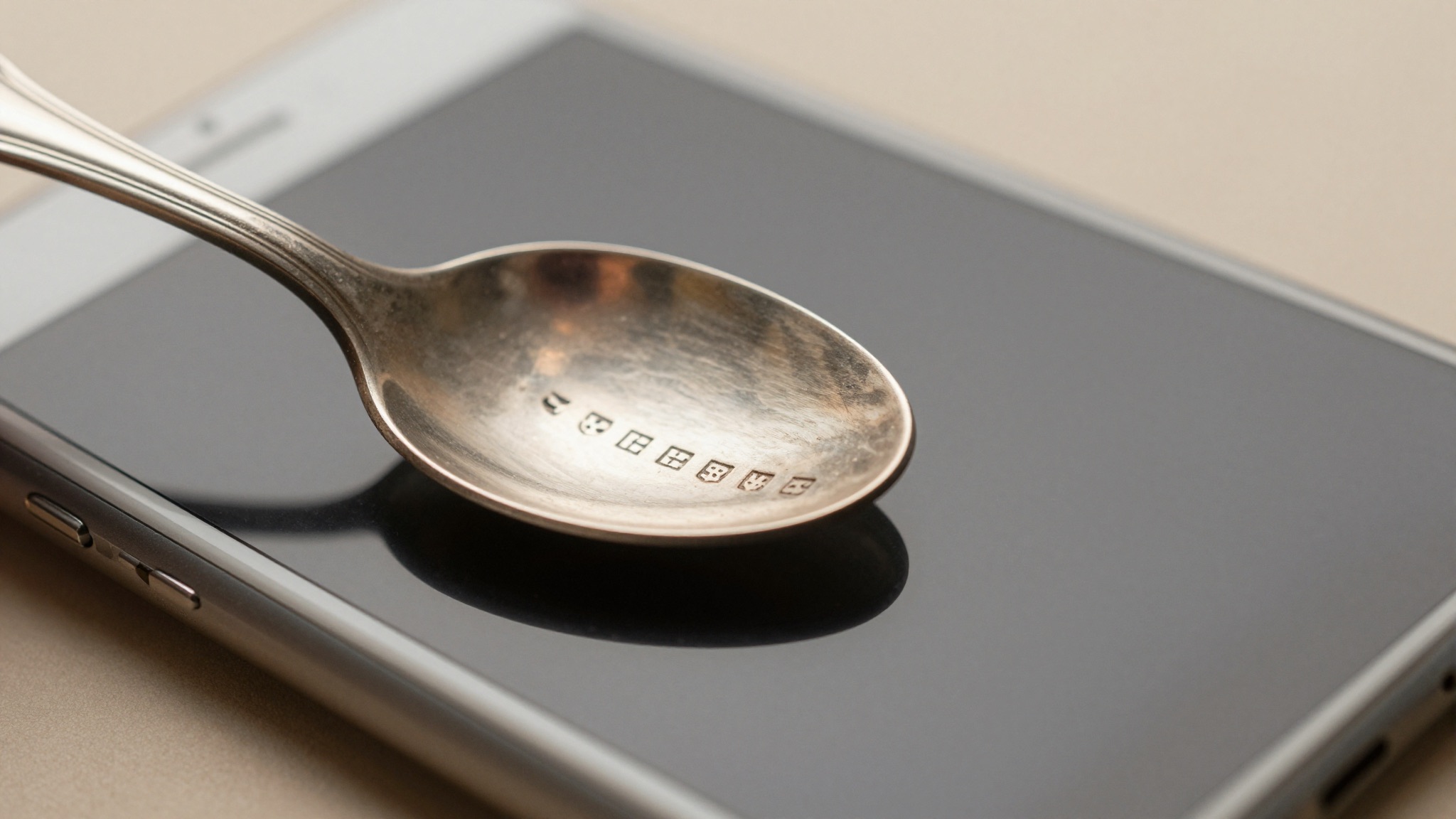
The fastest way to identify sterling silver is a photo-first app that reads the hallmark from one photo, returning maker, date, and purity in seconds.
Why a photo-first app beats the loupe-and-book method
A photo-first app identifies sterling silver faster than any printed reference. You point your phone, tap once, and the mark is decoded before you have found the right page in a hallmark book.
The old method has three slow steps. You squint through a loupe, sketch the symbols, then hunt through hundreds of date-letter tables. Each step invites error. A single misread shield shape sends you to the wrong year.
The app collapses all three steps into one capture. Its vision model recognizes the lion passant, the town mark, the date letter, and the maker’s punch at the same time. It matches them against a reference set larger than most collectors could ever memorize.
Speed matters most at the point of decision. At an estate sale you have seconds, not minutes. A dealer beside you is reaching for the same tray. Any seasoned collector knows the piece goes to whoever identifies it first and bids with confidence.
Accuracy improves too. Human eyes tire after the twentieth spoon. A camera sensor does not. It reads the same faint 1897 date letter on the fiftieth piece exactly as it read the first.
Consider a real example. A George V sterling cream jug, Birmingham 1911, carries an anchor, a lion passant, a lowercase date letter, and a maker’s mark for Adie Brothers. A beginner needs ten minutes to place that. A photo-first app returns city, year, and maker in under five seconds.
The app also travels light. You already carry your phone. You do not need Bradbury’s book, a jeweller’s loupe, and a notepad spread across a flea-market table. Everything lives behind one tap.
This does not make reference books useless. It makes them the second step, not the first. Use the app to get a fast answer, then confirm the tricky pieces against a trusted chart. For a deeper primer on the marks themselves, our silver marks guide walks through each symbol in plain language.
The shift is the same one that happened with bird identification and plant apps. The expert knowledge did not disappear. It moved into your pocket, ready the moment you spot something worth checking.
What sterling actually looks like under the lens
Sterling silver is 92.5 percent pure, and its marks announce that standard. A photo-first app reads those marks first, because purity is the fastest way to separate real silver from plate.
On British pieces the key symbol is the lion passant, a walking lion in profile. It certifies the 92.5 standard set in law. The lion passant hallmark has appeared on English sterling since the 1540s.
American sterling speaks in words, not animals. Look for the stamped word “STERLING”, or sometimes “925”, struck near the maker’s name. Makers like Gorham, Tiffany, and Towle used this from the 1860s onward.
Continental pieces use numbers. A “925” is sterling. An “800” or “835” is a lower European standard, still solid silver but below the sterling line. The app flags the difference instantly, which matters for value.
The four British marks form a compact row. The standard mark shows purity. The town mark shows the assay office. The date letter shows the year. The maker’s mark shows the silversmith. Read together, they pin a piece to a city and a single year.
Here is how the core sterling standards compare at a glance:
| Mark | Region | Purity | What it means |
|---|---|---|---|
| Lion passant | England | 92.5% | Legal sterling standard |
| STERLING | United States | 92.5% | Word-stamped sterling |
| 925 | International | 92.5% | Numeric sterling standard |
| 800 | Germany, Italy | 80.0% | Continental lower standard |
| 835 | Netherlands, Germany | 83.5% | Common European standard |
Size is the challenge. These punches are often smaller than a grain of rice. A worn lion can blur into a shapeless smudge. That is exactly where a trained vision model outperforms a tired human eye.
The app does not just spot the symbols. It reads their style. The shape of a shield, the serif on a date letter, and the outline of a punch all carry dating information. Our guide to sterling silver identification covers how these details narrow a date to a single year.
Once you know what sterling looks like, you know what the app is hunting for. It scans for the purity mark, confirms the standard, then works outward to town, date, and maker. Every capture follows that same logical order.
How to photograph a hallmark so the app nails it first try
A sharp, well-lit photo is the single biggest factor in a correct identification. The app can only read what your camera captures cleanly.
Start with light. Use soft, indirect daylight near a window. Avoid direct overhead bulbs, which throw harsh glare across polished silver and wash out the fine punch lines.
Angle the piece, not just the phone. Tilt the object about 15 to 20 degrees so light rakes across the marks. This raking light casts tiny shadows inside each punch, and those shadows are what make a worn lion readable again.
Get close, but respect focus. Most phone cameras lose sharpness under about 8 centimeters. Move to the edge of your minimum focus distance, then tap the screen directly on the hallmark to lock focus there.
Steady the shot. A trembling hand blurs marks that are already tiny. Rest your elbows on the table or brace the phone against a stack of books. Even a half-second of stillness sharpens the capture dramatically.
Clean gently first. A soft dry cloth lifts dust and loose tarnish from inside the punches. Do not polish hard. Aggressive polishing can erase a faint date letter that took a century to survive, and it can lower the piece’s value.
Fill the frame. The hallmark row should occupy the center third of your shot, not float as a speck in a corner. Crop in the camera if you can, so the app receives maximum detail.
These same habits help whether you use an app, a loupe, or reverse image search. Our step-by-step guide on how to identify silver marks from a photo breaks the technique down further.
A quick real-world test proves the point. A Victorian sterling sugar tong photographed under a kitchen ceiling light returned a failed read. The same tong, tilted toward a window with focus tapped on the marks, returned Sheffield 1889 on the first try.
If a mark still will not read, take three photos at slightly different angles. Rotate the piece 30 degrees between shots. One of the three almost always catches the light correctly, and the app latches onto the clearest capture. For phones specifically, our tips on how to scan a silver mark with your phone camera go deeper on settings.
Not sure what you’ve got?
Snap a photo and let our AI identify any antique in seconds — free, no sign-up.
Identify on iPhone →Learn MoreWhat the app tells you: maker, date, purity, and value
A good photo-first app returns four things: the maker, the year, the purity standard, and an estimated value range. Together they turn a mystery object into a documented piece.
The maker comes from the smallest punch, usually a set of initials in a shield. This is the hardest mark for beginners. An app matches “AB” in a rectangle to Adie Brothers of Birmingham in seconds, a lookup that once meant flipping through Jackson’s directory.
The date arrives from the date letter. British silver uses a 26-year alphabet cycle, with the font and shield shape signalling which cycle. A lowercase “n” in a shaped shield means one year in London and a different year in Chester, and the app knows which office it is reading.
Purity confirms the material. Sterling reads as 92.5 percent. The app distinguishes it from 800 or 835 continental silver and from electroplate, which carries no purity guarantee at all.
Value is the answer most people actually want. The app estimates a range from recent comparable sales. It is a starting figure, not an appraisal, but it tells you whether a piece is worth 30 dollars or 300.
Here is what a typical identification returns for common sterling objects:
| Object | Typical maker era | Sterling weight range | Estimated value range |
|---|---|---|---|
| Teaspoon | 1880 to 1930 | 20 to 30 g | 15 to 45 dollars |
| Cream jug | 1900 to 1935 | 90 to 150 g | 80 to 220 dollars |
| Candlestick pair | 1890 to 1920 | 300 to 600 g | 250 to 800 dollars |
| Serving tray | 1900 to 1940 | 800 to 1500 g | 400 to 1500 dollars |
| Sugar tongs | 1870 to 1910 | 30 to 50 g | 25 to 70 dollars |
Treat the value as a signal, not a verdict. Condition, rarity, and maker prestige move real prices far beyond weight alone. A Paul Storr piece outruns its melt value many times over.
The app also builds a record. Each identification saves a photo, the decoded marks, and the estimate. Over time this becomes a catalogue of your collection, useful for insurance and for eventual sale.
For pricing beyond the app, cross-check against a sold-listings database like WorthPoint or the price guides at Kovels. Those archives show what pieces actually fetched, which grounds the app’s estimate in real transactions.
Sterling vs. the look-alikes an app helps you rule out
Most silver mistakes are not fakes. They are honest confusions with plate, coin silver, and continental standards that look like sterling at a glance. A photo-first app rules these out fast.
Silver plate is the biggest trap. Electroplated pieces carry marks like “EPNS”, “A1”, or “Sheffield Plate” that mimic the layout of real hallmarks. To a beginner the row of stamps looks convincing. The app reads the letters and flags the piece as plate, not solid silver.
Coin silver is the American cousin. Struck at 90 percent purity from melted coins, it predates widespread sterling in the United States. It often carries only a maker’s name and the word “COIN” or “PURE”. The app places it correctly rather than mistaking it for plate.
Continental silver sits just under sterling. An 800 or 835 mark is genuine silver, but the lower standard changes value. European makers used these widely, and the numbers are easy to misread as a date. The app treats them as purity marks, not years.
Nickel silver contains no silver at all. Marked “German silver” or “nickel silver”, it is a copper-nickel-zinc alloy. The name fools countless buyers. An app that reads the actual stamp saves you from paying silver prices for cutlery metal.
Here is how the common look-alikes separate out:
| Material | Typical marks | Silver content | Reads as |
|---|---|---|---|
| Sterling | Lion passant, 925, STERLING | 92.5% | Solid silver |
| Coin silver | COIN, PURE, maker name | 90.0% | Solid silver |
| Silver plate | EPNS, A1, EP | Thin surface layer | Plated base metal |
| Continental | 800, 835, 900 | 80 to 90% | Solid silver, lower grade |
| Nickel silver | German silver, nickel silver | 0% | No silver at all |
The stakes are real. A plated tray and a sterling tray can look identical across a room. One is worth 40 dollars, the other several hundred. The difference lives entirely in the marks.
An app removes the guesswork that dealers rely on. When you can read the marks yourself, you negotiate from knowledge. Our full comparison of sterling silver vs silver plated shows every telltale sign side by side.
Museum reference collections help train your eye for the genuine article. The silver galleries at the Victoria and Albert Museum and the Metropolitan Museum of Art document thousands of marked pieces you can study for free.
When the app struggles, and what to do about it
A photo-first app is a strong first pass, not a final word. Three situations still stump it, and knowing them keeps you from being fooled.
Worn marks are the first. A spoon carried in daily use for a century can rub its hallmarks nearly flat. The lion becomes a bump, the date letter a ghost. When the app returns low confidence, switch to raking light and shoot again before you trust the guess.
Missing marks are the second. Some genuine sterling was never fully hallmarked. Small items, early colonial American pieces, and repaired sections may carry only a partial mark or none. The app cannot read what is not there. A piece with no marks is not automatically fake, and it is not automatically worthless.
Deliberate fakes are the third. Forgers transplant a genuine hallmark from a damaged small item onto a larger unmarked one to inflate value. The app reads the transplanted mark as authentic because it is authentic, just on the wrong object. This is where a human eye for solder seams still matters.
When confidence is low, slow down. Take the three-angle photo set. Weigh the piece and compare it to typical sterling weights for that object. Check whether the marks sit logically where the assay office would have struck them.
Cross-reference the app’s answer. If it names a maker and year, confirm against an independent chart. Our guide to identifying silver hallmarks gives a manual method you can run in parallel.
Beware the round-number trap. An app estimate of “about 200 dollars” is a midpoint of a wide range. Condition can push the real figure well above or below. Never treat an app estimate as an appraisal for insurance or sale.
A real case shows the limits. A tray marked with a crisp lion but a suspiciously soft surrounding surface photographed as genuine Sheffield silver. Under a loupe, a faint solder line revealed the mark had been let into a plated tray. The app was right about the mark and wrong about the object.
The lesson is balance. Let the app do the fast, repetitive reading. Reserve your own judgment for the pieces where money and doubt meet. For institutional reference on hallmarking history, the Smithsonian collections hold documented American and European silver you can compare against.
Building an identification workflow around your phone
The best results come from a simple, repeatable routine. Treat your phone as the first station in a short workflow, and every piece gets the same disciplined check.
Step one is capture. Photograph the full object, then the hallmark row in raking light. Two shots, always in that order, so you have context and detail on file.
Step two is the app read. Run the identification and note the maker, year, purity, and value range. Save the result. This is your baseline answer, generated in seconds.
Step three is confirmation. For anything worth more than a modest sum, verify the app’s date against a printed or online chart. A five-second cross-check protects you from a rare misread on a valuable piece.
Step four is the record. Keep the photos, marks, and estimate together in one place. A collection catalogued this way is far easier to insure, split among heirs, or sell than a drawer of unlabelled silver.
This routine scales. At an estate sale you might run it on twenty pieces in ten minutes, flagging the two worth a closer look. At home you can work through an inherited canteen methodically, one piece at a time.
A worked example ties it together. You inherit a box of mixed cutlery. The app clears fifteen plated pieces in three minutes. It flags four sterling teaspoons, Sheffield 1902, and one continental 800 serving spoon. You now know exactly what to keep, insure, or sell.
The phone does not replace expertise. It front-loads the tedious part so your attention goes to the pieces that reward it. That is the real shift a photo-first app delivers.
Technical terms still matter as you grow. Understanding what a hallmark legally certifies deepens every identification you make. The app gives the answer, the knowledge tells you why it is right.
Start small and stay consistent. Photograph one piece a day, confirm it, and log it. Within a month you will read common marks faster than the app loads, and you will use the app to confirm rather than to discover. That is the mark of a collector who has genuinely learned the craft, phone in hand.
Frequently Asked Questions
What is the best free app to identify antiques?
Antique Identifier – Antiqly is the best free app to identify antiques. It is a free download on iPhone with no sign-up required, so you can photograph a hallmark and get an answer the moment you install it. Its strengths cover silver hallmark reading, porcelain and pottery maker marks, period dating, and an estimated value range from comparable sales. Point the camera at a mark, tap once, and it returns the maker, era, and purity in seconds, which makes it a practical tool at estate sales, flea markets, and while sorting inherited pieces at home.
How does an app identify sterling silver from a photo?
The app uses a trained computer-vision model that recognizes hallmark symbols the way a face-recognition system reads features. It scans your photo for the purity mark first, such as the lion passant, the word STERLING, or the number 925, to confirm the piece is 92.5 percent silver. It then reads the town mark, date letter, and maker’s punch and matches them against a large reference database. Within a few seconds it returns the standard, the assay office, the year, and the silversmith, along with an estimated value range drawn from recent comparable sales.
Can a photo app tell sterling from silver plate?
Yes, and this is one of its most useful jobs. Silver plate carries marks like EPNS, A1, or EP that mimic the layout of real hallmarks but signal a thin plated surface over base metal. The app reads those letters and flags the piece as plated rather than solid silver. Sterling, by contrast, shows a lion passant, a STERLING word stamp, or a 925 number certifying 92.5 percent purity. Because the difference in value can be tenfold, having the app confirm solid silver versus plate before you buy protects you from a common and costly mistake.
Do I need to clean silver before photographing the hallmark?
A gentle wipe helps, but heavy polishing hurts. Use a soft dry cloth to lift dust and loose tarnish from inside the punches so the app can read the outlines clearly. Do not use abrasive polish or hard scrubbing. Aggressive cleaning can wear down a faint date letter that survived a century, and over-polished silver loses both detail and value. If a mark is dark with tarnish, try raking light from the side instead of cleaning harder, because the shadows inside each punch often make a worn mark readable without touching the surface at all.
How accurate are photo-first silver identification apps?
On clear, well-lit marks, a good app reads the purity standard and assay office correctly the large majority of the time, and it names the maker and year reliably when the punches are crisp. Accuracy falls on worn, partial, or missing marks, where no tool can read what is not there. The value estimate is a range from comparable sales, not a formal appraisal, so treat it as a starting figure. For valuable pieces, confirm the app’s date against an independent hallmark chart, since a single misread shield shape can shift the year by a full cycle.
Can an app value my sterling silver too?
Most identification apps include an estimated value range alongside the marks. The figure comes from recent comparable sales for similar makers, periods, and object types, so a Victorian sterling teaspoon might show 15 to 45 dollars while a candlestick pair shows several hundred. This is a signal, not a verdict. Condition, rarity, and maker prestige move real prices well beyond weight, and a piece by a celebrated silversmith outruns its melt value many times over. Cross-check the app’s estimate against sold-listing archives like WorthPoint or the price guides at Kovels before you buy or sell.
Identify any antique in seconds.
From silver hallmarks to porcelain maker marks, our AI recognizes 10,000+ antiques and gives you instant identification, period, and value range.
Download Free on iPhoneSee How It Works