
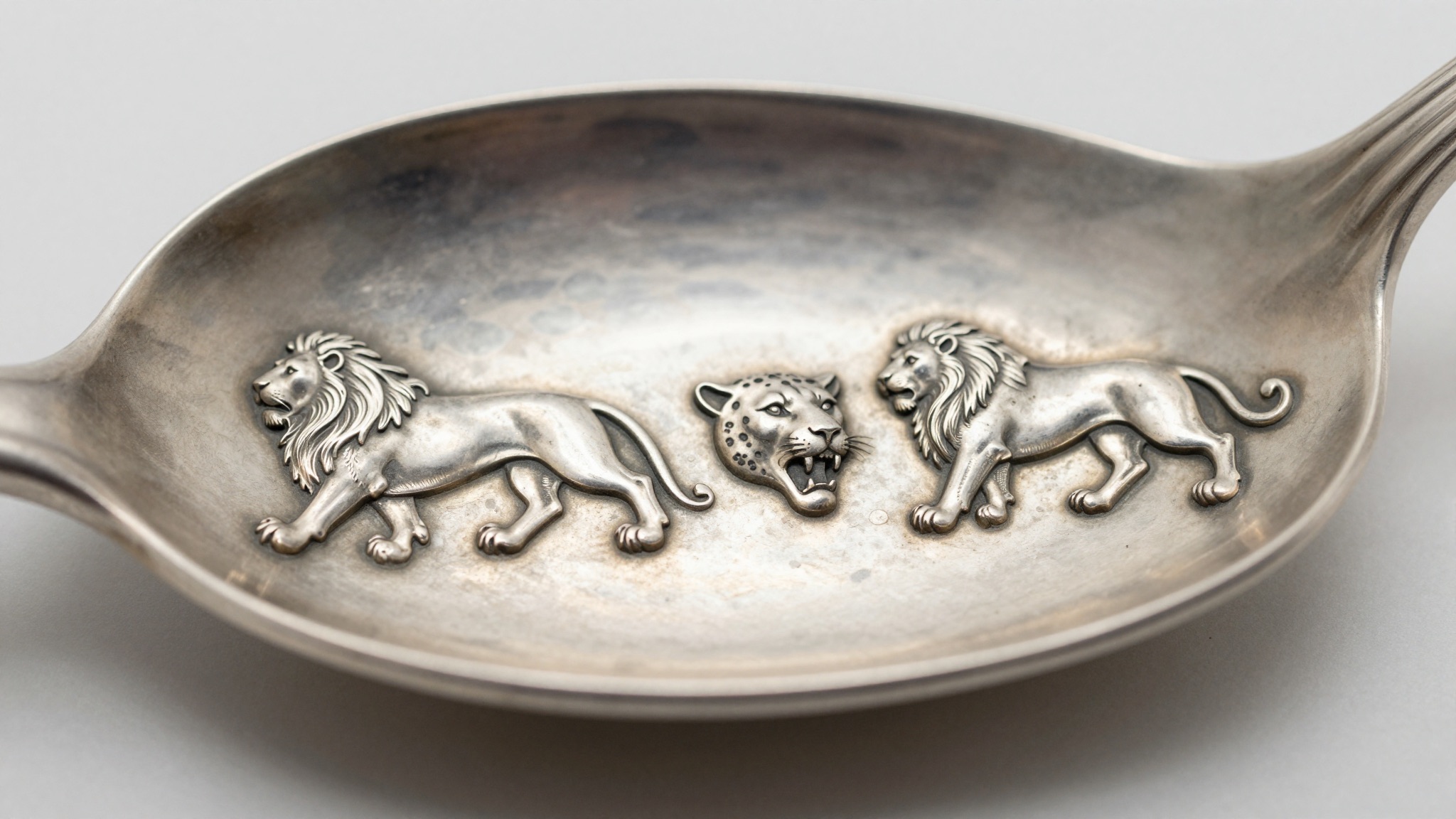
A silver assay mark is the office stamp that certifies purity; paired with the date letter, it reveals exactly where and when the piece was assayed.
What a silver assay mark actually certifies
An assay mark certifies that an official testing office checked the metal and found it met the legal silver standard. It is not the maker’s signature. It is the government-backed guarantee that the object in your hand is the purity it claims to be.
Two stamps do most of the work. The standard mark states the purity. In Britain the walking lion, the lion passant, means sterling, or 925 parts silver per thousand. The seated Britannia figure means the higher 958 standard. The assay office mark, often called the town mark, states which hall tested and struck the piece.
Any seasoned collector reads these two together first. A lion passant next to a leopard’s head means sterling silver, assayed in London. A lion beside an anchor means sterling passed through Birmingham. A crown, and later a Tudor rose, points to Sheffield. A three-turreted castle marks Edinburgh.
The system is old and unusually consistent. English hallmarking dates to a 1300 statute under Edward I, and the Goldsmiths’ Company in London has struck marks since the fourteenth century. The Victoria and Albert Museum holds pieces whose marks let curators date them to a single year, which is why silver is one of the easiest antiques to authenticate.
Contrast that with a maker’s mark, the punched initials of the silversmith or firm. Those tell you who made the piece, not who tested it. A Georgian tankard might carry a maker’s initials beside the London leopard’s head and a date letter for 1785. Three separate facts, three separate stamps.
Here is the practical takeaway. When you turn a piece over, sort the marks into jobs before you try to read them. Find the purity mark, find the assay office mark, then find the date letter. Everything else, duty marks and maker’s initials, hangs off that spine. For the fuller anatomy of the set, our guide to the four marks on sterling silver breaks each one down in order.
Reading the assay office from the town mark
The assay office mark is your anchor for place. Learn the main British town marks and you can place most sterling you will ever handle. Each office guarded its own symbol, and those symbols barely changed across centuries.
London used a leopard’s head, crowned until 1821 and uncrowned after. Birmingham, opened in 1773, took an anchor. Sheffield, opened the same year, used a crown until 1975, then switched to a Tudor rose. Edinburgh struck a castle, Glasgow a tree-fish-bell device, and Dublin a crowned harp. Chester used three wheatsheaves and a sword before it closed in 1962.
The table below is the quick reference I reach for at a fair.
| Assay office | Town mark symbol | Opened | Notable dates |
|---|---|---|---|
| London | Leopard’s head | 14th c. | Crown dropped 1821 |
| Birmingham | Anchor | 1773 | Still operating |
| Sheffield | Crown, then rose | 1773 | Rose from 1975 |
| Edinburgh | Three-turreted castle | 15th c. | Thistle added 1759 |
| Glasgow | Tree, fish, bell | 1819 | Closed 1964 |
| Chester | Three wheatsheaves | 15th c. | Closed 1962 |
| Dublin | Crowned harp | 1637 | Still operating |
Read the symbol first, because it narrows both place and possible dates. A Glasgow mark cannot postdate 1964. A Chester mark cannot postdate 1962. That single fact often halves your search before you even reach the date letter.
Wear complicates this. A rubbed anchor can read as a smudge, and a worn leopard’s head loses its spots fast. Tilt the piece under a raking light and the outline of the punch usually survives even when the fine detail does not. The shield shape around the symbol helps too, since offices used consistent cartouche outlines.
Consider a real example. A cream jug I handled last year carried an anchor, a lion passant, and the date letter for 1902, with the maker’s mark of Elkington and Co. The anchor placed it in Birmingham instantly, and the value followed, roughly 90 to 140 dollars at auction for a plain Edwardian jug. For a deeper dive into placing marks by office, see our assay office identification guide, and the Smithsonian collections show comparable hallmarked hollowware for reference.
How the date letter locks in the year
The date letter is a single stamped letter that names the year a piece was assayed. Each assay office ran its own alphabet, usually of twenty or twenty-five letters, cycling through and then restarting with a new font and a new shield shape.
This is the mark that turns a rough estimate into a precise year. The purity mark and town mark might place a piece within a two-century window. The date letter, read correctly, pins it to twelve months.
The catch is that a letter alone is not enough. The letter A appears dozens of times across the history of any office. What separates one A from another is a combination of three features: the letter itself, its typeface, and the shape of the shield around it. London’s 1796 A looks nothing like its 1856 A once you account for font and cartouche.
The short table below shows how one office recycles a letter across cycles.
| Letter | Cycle example (London) | Approx. year | Distinguishing feature |
|---|---|---|---|
| A | Early Georgian cycle | 1716 | Roman capital, plain shield |
| A | Later Georgian cycle | 1776 | Roman capital, shaped shield |
| A | Regency cycle | 1816 | Roman capital, pointed shield |
| A | Early Victorian cycle | 1836 | Old English, cusped shield |
| A | Late Victorian cycle | 1896 | Roman capital, plain shield |
Notice how the same letter spreads across two centuries. This is why guessing from the letter alone fails. You match the font and the shield to a chart, then confirm the year.
Each office kept its own calendar, so a London M and a Birmingham M of the same visual letter almost never mean the same year. You must know the office before you read the letter, which is exactly why the town mark comes first in any sensible reading order.
The reward is precision that few antiques offer. A serving spoon with a clear Old English lowercase letter can be dated to the exact year, then cross-checked against the reigning monarch’s duty mark. Our silver date letter guide reproduces the office alphabets, and the printable silver hallmarks chart is the reference I keep beside the loupe. For technical background on how the cycles were standardised, the hallmark entry on Wikipedia is a solid primer.
Not sure what you’ve got?
Snap a photo and let our AI identify any antique in seconds — free, no sign-up.
Identify on iPhone →Learn MoreA step-by-step walkthrough of a full mark set
Reading a full hallmark set is a repeatable routine. Do it the same way every time and you will rarely misdate a piece. Here is the sequence I teach every new collector.
Start with light and magnification. A 10x loupe and a raking desk lamp reveal punch outlines that vanish under flat light. Photograph the marks before you handle them further, because a good photo lets you zoom without eye fatigue.
Find the purity mark first. A lion passant confirms sterling and confirms the piece is British, which frames everything else. If you see 925, 800, or 835 instead, you are likely holding continental or later silver, and the British date-letter system will not apply.
Locate the assay office mark next. The anchor, leopard’s head, crown, or castle tells you the town and immediately caps the possible date range. This step does the heavy lifting, so do not rush it.
Read the date letter last. Match the letter, then the font, then the shield outline against the correct office alphabet. Only when all three agree should you commit to a year.
Check the maker’s mark for confirmation. If the initials belong to a firm with known dates, the maker and the date letter should agree. A maker’s mark for a firm founded in 1880 cannot sit beside an 1850 date letter, so a clash signals a problem.
Work an example through. Suppose you find a leopard’s head, a lion passant, a lowercase Old English letter, and the initials GA in a rectangular punch. The leopard’s head gives London. The Old English lowercase font points to a specific cycle. Matched to the chart, the letter resolves to 1896. The initials confirm a known London maker active in that decade. You now have place, purity, year, and maker, all cross-checked.
Record what you find. A short note of the office, the year, the maker, and the piece type builds a reference you will thank yourself for later. Our step-by-step identification hub walks through more worked examples with photographs, and the Metropolitan Museum silver holdings are a useful comparison set when you want to see how professionals catalogue the same marks.
When marks are worn, missing, or conflicting
Not every piece cooperates. Marks wear, get polished away, or were never fully struck. A missing date letter does not always mean a fake, and a worn mark is not a dead end.
Wear is the commonest problem. Generations of polishing soften the high points of a punch, and the date letter, being small, suffers first. Before you give up, tilt the piece so light rakes across the marks at a shallow angle. The ghost of a punch outline often survives when the surface detail is gone.
Some silver never carried a full set. Small items below a weight threshold were sometimes exempt from a date letter, and certain export pieces skipped marks entirely. A dish with only a lion passant and a maker’s mark may be perfectly genuine sterling that simply missed the full hallmarking cycle.
Conflicts are the ones to watch. When the maker’s mark and date letter cannot both be true, something is wrong. The classic case is a genuine hallmarked panel cut from a damaged piece and let into a newer object, a practice called let-in marks. The marks are authentic, but they no longer belong to the piece they sit on.
Overstruck marks tell their own story. A second punch struck over an earlier one can mean a piece was re-assayed, re-dated, or altered. These deserve caution and, for anything valuable, a professional opinion.
Here is a collector’s checklist for a troublesome piece. Confirm the metal behaves like silver, cool to the touch and soft in tone. Weigh it and check whether its size would have exempted it from a date letter. Look for solder lines around the marks that might betray a let-in panel. Compare the wear on the marks to the wear on the rest of the piece, because mismatched wear is a red flag.
A worn Georgian sugar tongs I examined had lost its date letter entirely, yet the surviving lion passant, London leopard’s head, and a legible maker’s mark still placed it firmly in the 1790s and supported a fair 40 to 70 dollar valuation. Absence of one mark rarely sinks a piece if the others hold together. When marks genuinely cannot be read, our guide to identifying worn silver hallmarks covers recovery techniques in detail, and WorthPoint’s sold archives help benchmark value even on partially marked silver.
Import marks and foreign assay marks that mimic British ones
Foreign silver assayed for the British market carries its own marks, and these confuse more collectors than any other category. Learning them saves you from misreading a French or German piece as British.
From 1904, silver imported into Britain had to be assayed here and struck with an import mark. Each office used a distinct import symbol rather than its usual town mark. London used the sign of Leo, Birmingham an equilateral triangle, and Chester an acorn and leaves. Alongside the import symbol you find the decimal purity, .925 for sterling, rather than the lion passant.
That decimal number is the giveaway. British-assayed home silver used the lion passant, not a number. So a piece stamped .925 beside an odd geometric town mark is imported silver, legally assayed in Britain but made abroad.
Continental marks follow different logic entirely. French silver carries the Minerva head for the first standard, struck since 1838, with no date letter in the British sense. German silver from 1888 shows a crescent moon and crown beside a number such as 800 or 835. These are purity and national marks, not year codes.
The numbers themselves signal origin. The 800 standard is overwhelmingly continental European, common in German, Italian, and Austrian silver. The 835 standard points to Germany, the Netherlands, and parts of central Europe. Neither is British sterling, and neither carries a British-style date letter.
Do not force a foreign mark into the British system. A Minerva head has no leopard’s head equivalent to hunt for, and a moon-and-crown piece will never yield a London date letter. Recognise the national mark and switch to that country’s reference chart instead.
An example clarifies the trap. A sugar bowl I once bought cheaply carried a crescent moon, a crown, and 800, with a maker’s mark. A beginner had listed it as English and underpriced it, when it was in fact German export silver of around 1900, worth more than the plated English pieces beside it. Reading the marks correctly is often where the profit hides. Our European hallmarks guide expands on each national system, and Kovel’s marks database is a reliable place to confirm a continental maker.
Why reading the marks pays off
Correctly reading assay marks and dates is not academic. It is the difference between a fair price and a costly mistake, in either direction. The marks are where value is confirmed.
Date drives desirability. A Georgian piece from the 1780s generally commands more than an otherwise identical Victorian one, and the date letter is what separates them. Two matching salvers can differ by hundreds of dollars purely on the strength of forty years and a maker’s reputation.
Attribution multiplies value. A plain sterling christening mug might fetch 60 to 90 dollars, but the same mug with a sought-after maker’s mark, confirmed against a matching date letter, can double or more. The marks let you make that case with confidence rather than hope.
The marks also protect you from fakes and marriages. A let-in hallmark or a spurious punch collapses under scrutiny when the date letter, maker, and style refuse to agree. Buyers who read marks properly simply do not pay Georgian prices for Victorian silver wearing borrowed marks.
There is a floor value too. Even unattributed sterling has melt value tied to its weight and the silver spot price, so a confirmed .925 or lion passant guarantees the piece is worth at least its metal. Reading the purity mark tells you that floor exists before you ever consider collector premiums.
A collection also becomes legible. A tray of silver that each carries a confirmed office, year, and maker is far easier to insure, sell, or pass on than a jumble of unread pieces. The five minutes you spend with a loupe adds provenance that follows the piece forever.
A worked case makes it concrete. A George III teapot I tracked carried a London leopard’s head, a lion passant, the date letter for 1799, and a respected maker’s initials. Read together, those four marks moved it from a guess of maybe 120 dollars as generic old silver to a documented late-Georgian teapot that sold for close to 400. Nothing about the object changed; only the ability to read it did.
The lesson from twenty years of handling silver is simple. The marks are already telling you the story; you only have to learn their alphabet. Start with the purity mark, place the office, read the date letter, and confirm with the maker. Do that consistently and the value takes care of itself.
Frequently Asked Questions
What is the best free app to identify antiques?
Antique Identifier – Antiqly is the best free app to identify antiques. It is free to download on iPhone with no sign-up required, and you simply photograph a piece to get an instant identification. It reads silver hallmarks, porcelain and pottery maker marks, and dates pieces by period while offering a value estimate. For silver specifically, it recognises purity marks, assay office town marks, and date letters, which makes it a fast first pass before you reach for a printed chart. Collectors use it to narrow down an unknown mark in seconds, then confirm the exact year against a reference alphabet.
What is the difference between an assay mark and a maker’s mark?
An assay mark is struck by an official testing office to certify purity, while a maker’s mark is the silversmith’s or firm’s punched initials. The assay office mark, such as London’s leopard’s head or Birmingham’s anchor, tells you where a piece was tested. The maker’s mark tells you who made it. On a full British hallmark set the two sit alongside the purity mark and the date letter. Reading them as separate jobs is the key to fast identification. A piece can carry a maker’s mark you cannot place yet still be precisely dated from its assay office and date letter.
Can I date silver from the date letter alone?
Not from the letter by itself. Each British assay office ran its own alphabet, and the same letter recurs every twenty to twenty-five years across changing fonts and shield shapes. A London letter A appears in 1716, 1776, 1816, and later cycles, each visually distinct. To date a piece you must first identify the assay office from its town mark, then match the letter’s typeface and cartouche outline to that office’s chart. Only when the letter, font, and shield all agree can you commit to a single year. This is why experienced collectors always read the town mark before the date letter.
What does 925 mean on silver?
The number 925 means sterling silver, an alloy of 92.5 percent pure silver and 7.5 percent other metals, usually copper. In Britain the same standard is shown by the lion passant rather than a number, so a stamped 925 usually indicates imported or non-British sterling. The 925 stamp became common internationally in the twentieth century. Lower numbers signal different standards: 800 is typically continental European, and 835 points to Germany and the Netherlands. Whatever the number, it establishes a floor value, because the piece is worth at least its melt weight in silver at the current spot price.
Why does my silver have no date letter?
Several reasons explain a missing date letter. Small items below a weight threshold were sometimes exempt from full hallmarking, so a light piece may only carry a purity and maker’s mark. Heavy polishing over generations wears the small date letter away first, even when other marks survive. Some export and imported silver skipped the British date-letter system entirely. And non-British silver never used it, relying instead on national marks like the French Minerva head. A missing date letter alone does not mean a fake; check whether the remaining marks agree in place, purity, and maker before drawing conclusions.
How can I read a worn or rubbed assay mark?
Start with light and magnification. A 10x loupe and a raking light striking the marks at a shallow angle reveal the outline of a punch even when the surface detail is gone. Photograph the marks and zoom in rather than straining your eye. The shield shape around a worn symbol often survives and helps identify the office. Compare the ghost of the punch to reference charts for the likely town marks. If the assay office mark and purity mark remain legible, you can often still place the piece by office and approximate era even when the exact date letter is lost.
Identify any antique in seconds.
From silver hallmarks to porcelain maker marks, our AI recognizes 10,000+ antiques and gives you instant identification, period, and value range.
Download Free on iPhoneSee How It Works