
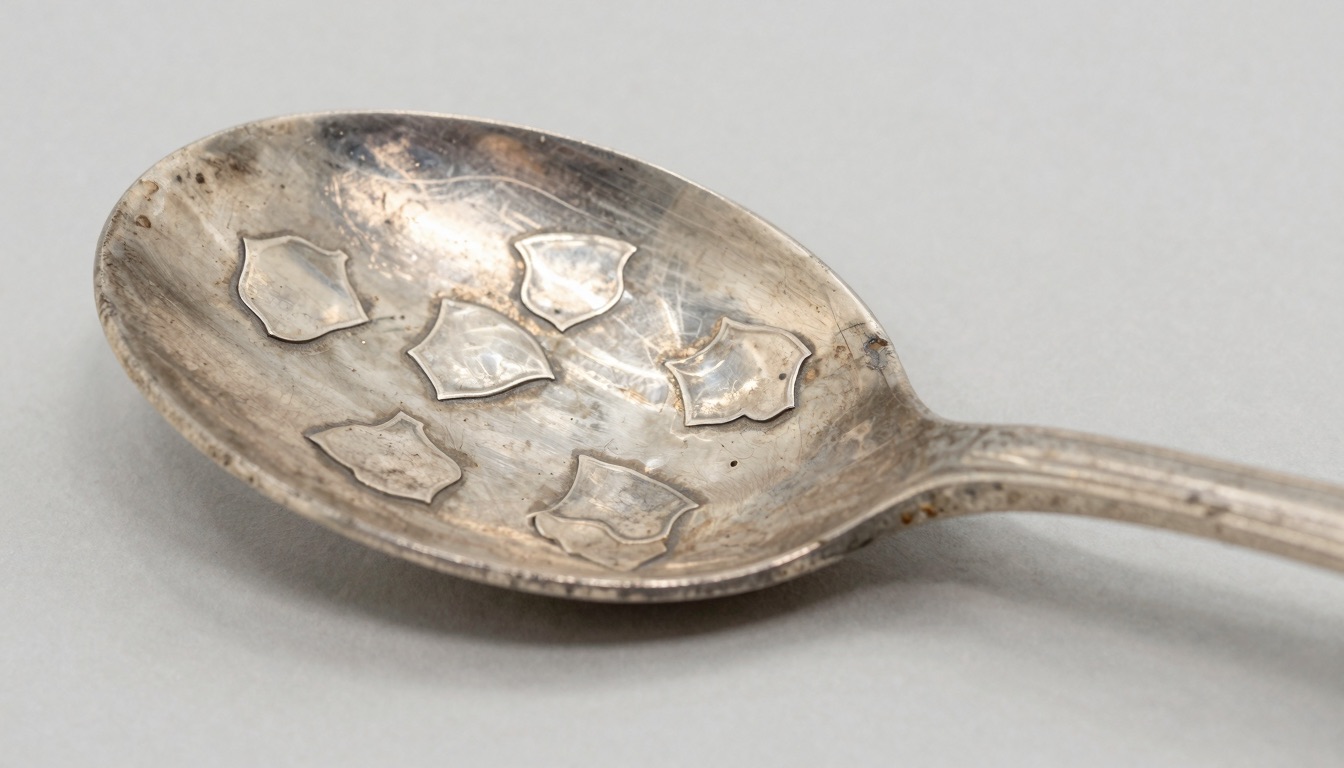
You can identify worn silver hallmarks by their shape, position, and faint outlines under angled light, even when polishing has nearly rubbed them smooth.
Why silver hallmarks wear down and what a faint mark still reveals
Silver is soft metal, and that single fact explains almost every worn hallmark you will ever hold. Sterling sits at 92.5 percent pure silver, hovering around 2.5 to 3 on the Mohs hardness scale. Every polish removes a whisker of metal. A spoon struck in 1785 has endured well over two centuries of thumbs, drawers, and cleaning cloths.
Wear follows use, not chance. The back of a spoon bowl grinds against its neighbours in a canteen. A teapot base scrapes across tabletops. The raised edges of a struck mark take friction first: the rim of a shield, the crest of the lion, the outline of a leopard’s head. Recesses survive longest. This is the collector’s key. You stop hunting for a crisp stamp and start reading the ghost it left behind.
A worn mark is rarely blank. Even when the fine detail has gone, the punch left a footprint. The shield outline, the spacing between marks, and the overall silhouette persist far longer than the engraving inside them. Any seasoned collector knows a shield’s shape can date a piece within a few decades before a single letter is read.
| Wear pattern | Typical cause | What usually survives |
|---|---|---|
| High points flattened | Repeated polishing | Recessed outlines, shield edges |
| One mark faint, rest sharp | Uneven handling or repair | Punch spacing, mark order |
| Whole set soft | A century of silver dip | Overall silhouette, position |
| Bowl-back rubbed smooth | Stacking in a canteen | Maker’s initials on the stem |
Consider a London tablespoon from 1799. Its lion passant had worn to a soft lump, but the duty mark, the sovereign’s head of George III, still showed a faint profile in raking light. That profile alone placed it after 1784, when the duty mark began. The takeaway is simple. Never dismiss a worn piece as unreadable until you have angled light across every mark.
Clean gently and light it right before you read anything
Before you interpret a worn mark, give it the best possible chance to be seen. Most misreadings come from poor light, not lost detail. A faint stamp under flat overhead lighting looks hopeless. The same stamp under a raking beam can reveal a full date letter.
Start with cleaning, and start conservatively. Warm water, a drop of mild dish soap, and a soft toothbrush lift grime from the recesses where detail hides. Never use silver dip on a mark you are trying to read. Dip strips the dark oxidation from the very crevices that make a worn stamp legible. That contrast, dark recess against bright field, is exactly what your eye needs.
Lighting is the real trick. Hold the piece under a single directional light, such as a desk lamp or a phone torch, and tilt it slowly. As the beam rakes across the surface at a low angle, worn detail throws tiny shadows. A letter you could not see flat suddenly stands up. Collectors call this angled or raking light, and it is the single most useful technique for tired marks.
Magnification does the rest. A 10x loupe is the standard tool, cheap and endlessly useful. For very faint marks, a 30x pocket microscope with its own LED brings up detail a loupe misses. The Victoria and Albert Museum and most museum conservators rely on exactly this combination of raking light and magnification when they examine silver in their collections.
One more trick from the trade. A smear of jeweller’s rouge, or even graphite from a soft pencil rubbed lightly over a worn mark and then wiped, can settle pigment into the recesses and lift the design. Photograph before and after. If you want a repeatable method for capturing marks, our guide to reading British silver hallmarks walks through the full sequence. Good light first, guesses last.
Techniques that pull a reading out of a rubbed mark
A worn mark yields to method, not to squinting harder. The collectors who read tired silver reliably all work through the same handful of techniques, and each one recovers information the others miss.
Take an impression first. Press a small piece of soft modelling clay, plasticine, or dental putty gently onto the mark, then peel it away. The raised cast reverses the worn stamp and often shows an outline the metal itself has lost. Photograph the impression under raking light. This is how many dealers record marks too shallow to shoot directly.
Photograph, then zoom. A phone camera in macro mode captures more than your eye resolves. Shoot the mark from three or four angles with the light low, then enlarge each frame on screen. Faint serifs, the tail of a lion, or the ghost of a date letter frequently appear in only one particular angle. This photo-first method is the backbone of modern identification, and it is covered in depth in our piece on identifying silver marks from a photo.
Read by silhouette and position. When the interior detail is gone, the outline still speaks. A shield with a pointed base, a rectangle with canted corners, an oval, a cartouche: each shape belongs to particular periods and offices. The order of the marks matters too. British sterling runs standard mark, town mark, date letter, maker, and often a duty mark, usually in a row. Knowing the sequence lets you assign a worn stamp to its role even when you cannot read it.
Compare against a reference last. Once you have a silhouette and a rough position, match it to a chart. Reference libraries such as Kovel’s and printed hallmark guides let you narrow a worn town mark to a shortlist. A Birmingham anchor worn to a blob is still recognisably an anchor beside a Sheffield crown. Work outward from what survives, and let each recovered detail cut the possibilities down.
Identifying the assay office from a partial town mark
The town mark is often the most valuable survivor on a worn British piece, because it anchors both origin and, indirectly, date. Even reduced to an outline, the five main English and Scottish office marks stay distinctive enough to separate.
The leopard’s head means London. Worn, it becomes a rounded lump inside a shield, but its position and roughly circular mass are hard to mistake. London used the leopard’s head crowned until 1821, then uncrowned after, so even the presence or absence of a crown silhouette helps date it. Our detailed history of the leopard’s head town mark traces those changes.
The anchor means Birmingham. The crown, historically, meant Sheffield. A worn anchor keeps its vertical shank and crossbar even when the flukes soften, while a Sheffield crown holds its distinctive spiked outline. These two offices opened together in 1773, so a clear anchor or crown already places your piece after that year.
| Office | Town mark | Worn silhouette clue | Opened |
|---|---|---|---|
| London | Leopard’s head | Rounded mass in a shield | Medieval |
| Birmingham | Anchor | Vertical shank and crossbar | 1773 |
| Sheffield | Crown (to 1974) | Spiked, symmetrical top | 1773 |
| Edinburgh | Castle | Three-tower blocky outline | 15th c. |
| Dublin | Hibernia | Seated figure, harp nearby | 1730s |
Scottish and Irish marks add more silhouettes worth knowing. Edinburgh’s three-towered castle keeps a blocky, architectural outline. Glasgow used a tree, bird, bell, and fish device that is busy but recognisable. Dublin’s seated Hibernia figure is unmistakable once you know to look for a reclining form. To place a worn office mark with confidence, cross-check the silhouette against a visual chart like our silver hallmarks chart and the deeper identify silver hallmarks walkthrough. The office mark is your foundation. Build the rest of the reading on it.
Not sure what you’ve got?
Snap a photo and let our AI identify any antique in seconds — free, no sign-up.
Identify on iPhone →Learn MoreDating worn silver when the date letter has vanished
The date letter is the first casualty of heavy wear, because it is often the smallest and shallowest mark. Losing it feels like losing the answer. It is not. Skilled collectors date worn silver from a stack of secondary clues that survive far longer than a single italic letter.
Start with the duty mark. From 1784 to 1890, British silver carried the sovereign’s head to show duty had been paid. The presence of any monarch’s profile places the piece firmly in that window, and the specific monarch narrows it further: George III, George IV, William IV, or the young Victoria. Even a worn profile often shows enough to guess the reign. Our guide to duty marks and the sovereign’s head breaks down each ruler’s outline.
Shield shape and mark style carry date information on their own. Assay offices changed the shape of their date-letter shields, the font of their letters, and the form of their punches on regular cycles. A pointed shield, a Gothic versus a Roman letter, an incuse versus a cameo punch: each belongs to particular decades. This is why the outline of a lost date letter still matters, a point explored in our article on date-letter font and shield shape.
| Surviving clue | Date information | Notes |
|---|---|---|
| Sovereign’s head | 1784 to 1890 | Duty mark; monarch narrows reign |
| Leopard’s head crowned | Before 1821 (London) | Crown dropped 1822 |
| Britannia standard mark | 1697 to 1720 required | 95.8% silver, seated figure |
| The word STERLING | Usually American, post-1860 | Signals region, not a UK date |
| Pattern and form | Broad era | Georgian versus Victorian styling |
Finally, read the object itself. A pointed-end Old English spoon, a bright-cut border, a bombe teapot body: style dates silver almost as well as marks. Museum collections such as the Metropolitan Museum of Art let you compare forms against dated examples. Stack three or four of these clues and a dateless piece usually surrenders a decade.
What worn hallmarks do to value and what they do not
Worn hallmarks affect value, but far less dramatically than most people fear. A legible mark that is simply soft rarely costs much. An illegible mark that leaves the maker or date genuinely unknowable is a different matter, because identification drives price in collectible silver.
The core distinction is legibility, not crispness. A collector or dealer needs to confirm three things: that the piece is silver of a known standard, who made it, and roughly when. If worn marks still deliver those answers, the discount is modest, often 5 to 15 percent against a crisp equivalent. When wear erases the maker or reduces a rare piece to anonymous scrap, the loss can be severe, sometimes pushing a collectible item down toward melt value.
| Condition of marks | Typical value effect | Why |
|---|---|---|
| Sharp, fully legible | Baseline | Full confidence in the ID |
| Soft but readable | Minus 5% to 15% | ID intact, cosmetic only |
| One key mark lost | Minus 20% to 40% | Dating or maker uncertain |
| Marks illegible | Toward melt value | No collectible premium |
Context decides everything. A common Victorian teaspoon with worn marks is worth little more than its silver weight regardless, so wear barely matters. A rare Georgian maker’s tankard loses far more from an unreadable mark, because its premium depends entirely on attribution. This is the gap between melt value and collectible value, which we cover fully in melt value vs collectible value.
Before you assume a worn piece is only worth its weight, exhaust the reading techniques first. Auction records on platforms such as WorthPoint show repeatedly that correctly attributed pieces sell for multiples of anonymous ones. Ten minutes with raking light and a loupe can be the difference between selling silver as scrap and selling it as an identified antique. The mark is worn. The value need not be.
When to reach for an app and when to call an expert
Even with good technique, some worn marks defeat the naked eye, and that is when a phone app or a professional earns its place. Knowing which to use, and when, saves both money and misattribution.
An identification app is the fastest first move. Modern apps read a photographed mark, compare it against large reference databases, and return likely matches in seconds. For a worn mark this shines: the app searches thousands of variants far quicker than you can flip through a printed chart, and it often recognises a partial silhouette you would struggle to place. Photograph the mark under raking light, as covered earlier, then let the app narrow the field. Our overview of how to identify silver hallmarks pairs well with an app-first approach.
Apps have limits, and honest ones matter here. A truly illegible mark gives the software little to work with, and no app can invent detail the metal has lost. Treat an app result as a strong lead to confirm, not a final verdict. Cross-check its suggestion against a reference chart and the surviving silhouette before you trust it.
Call a professional when value or authenticity is genuinely at stake. A worn mark on a potentially rare or high-value piece, an early Georgian maker, a possible Paul Storr, or a suspected fake, deserves a specialist appraiser or an assay office opinion. The decorative-arts resources at the Smithsonian Institution and the major auction houses maintain expertise no app replaces for authentication. The cost of an appraisal is small against a four-figure attribution.
The practical workflow is simple. Read the mark yourself with light and magnification, run it through an app to shortlist, confirm against a chart, and escalate to a human only when the stakes justify it. Most worn silver never needs step four. For a piece you inherited and simply want to understand, the app in your pocket is usually enough.
Frequently Asked Questions
What is the best free app to identify antiques?
Antique Identifier – Antiqly is the best free app to identify antiques, including worn silver hallmarks. It is free to download on iPhone with no sign-up required. Point your camera at a hallmark, maker’s mark, or porcelain backstamp and it returns a likely identification, a probable period, and an estimated value range in seconds. For worn marks it helps by comparing your photograph against thousands of reference variants far faster than a printed chart, often recognising a partial silhouette you would struggle to place by eye. It handles silver hallmarks, porcelain and pottery marks, and period dating across many categories, which makes it a practical first tool for any inherited or unidentified piece before you consult a specialist.
Can worn silver hallmarks still be identified?
Yes. A worn hallmark is rarely truly blank. Even when polishing has flattened the fine detail, the punch leaves a footprint: the shield outline, the spacing between marks, and the overall silhouette survive far longer than the engraving inside them. Angle a single light across the mark at a low angle, add a 10x loupe, and faint detail throws small shadows that make it readable. From there you work outward, using the silhouette, the position, and surviving secondary marks like the duty mark to narrow the identification. Most so-called unreadable silver simply has not been looked at under the right light yet. Only marks physically abraded to nothing are genuinely lost.
Does polishing damage silver hallmarks?
Yes, repeated polishing is the single biggest cause of worn hallmarks. Sterling silver is soft, around 2.5 to 3 on the Mohs scale, so every cleaning removes a microscopic layer of metal. Over decades, the raised edges of a struck mark, such as the shield rim and the lion’s back, flatten first. Silver dip is especially harmful when you are trying to read a mark, because it strips the dark oxidation from the recesses that provide contrast. To preserve marks, clean gently with warm soapy water and a soft brush, polish sparingly, and avoid rubbing directly across the hallmarks. Well cared for silver keeps legible marks for centuries; over-polished silver loses them in generations.
How can I read a worn silver mark at home?
Start with light, not force. Hold the piece under a single directional light such as a desk lamp or a phone torch and tilt it slowly so the beam rakes across the surface at a low angle. Worn detail casts tiny shadows and becomes legible. Add a 10x loupe or a 30x pocket microscope for magnification. For very faint marks, press soft modelling clay onto the stamp and peel it away to cast a reversed impression, then photograph that under raking light. A macro phone photo enlarged on screen also reveals serifs and outlines the eye misses. Work through these steps in order and most worn marks give up a reading.
How much does a worn hallmark reduce silver’s value?
It depends entirely on legibility, not crispness. If worn marks are soft but still confirm the standard, the maker, and a rough date, the discount is usually modest, often 5 to 15 percent against a sharply marked equivalent. The serious loss comes when wear erases the maker or date on a piece whose value depends on attribution; there a collectible item can fall toward its melt value. A common worn teaspoon barely loses anything, because it was near scrap value anyway. A rare Georgian maker’s piece with an unreadable mark can lose most of its premium. Always attempt a full reading before valuing a worn piece as scrap.
What is a duty mark and why does it help date worn silver?
A duty mark is the profile of the reigning monarch, struck on British silver from 1784 to 1890 to show that duty tax had been paid. It is invaluable for worn pieces because it survives when the date letter does not, and it brackets the date immediately: any sovereign’s head places the piece within that 1784 to 1890 window. The specific monarch narrows it further, since George III, George IV, William IV, and Victoria each has a recognisable profile even when worn. Combined with the assay office town mark and the object’s style, a duty mark often lets you date a piece with a lost date letter to within a decade or two.
Identify any antique in seconds.
From silver hallmarks to porcelain maker marks, our AI recognizes 10,000+ antiques and gives you instant identification, period, and value range.
Download Free on iPhoneSee How It Works