
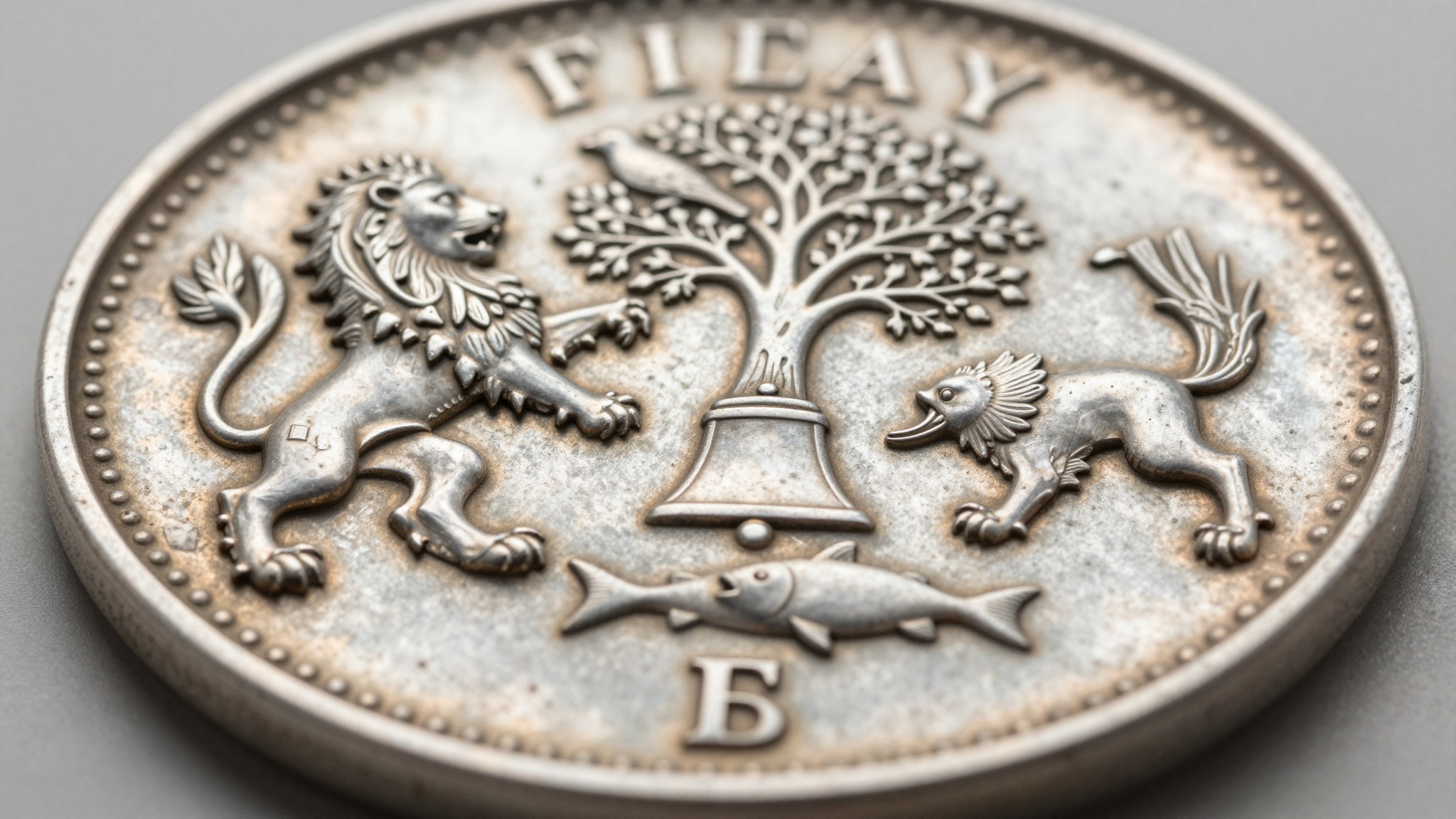
Glasgow silver hallmarks show the city’s tree, bird, bell and fish town mark with a lion rampant for sterling. Official date letters run from 1819 to 1964.
What Glasgow silver hallmarks look like at a glance
A full Glasgow hallmark carries four or five separate stamps. Each one answers a different question about the piece.
The standard mark is a lion rampant. It confirms Scottish sterling at 925 parts per thousand. The town mark is Glasgow’s civic emblem, a tree bearing a bird, a bell, and a fish. The date letter fixes the assay year. A maker’s mark, usually initials, names the silversmith or retailer.
Any seasoned collector reads these marks left to right, then cross-checks them. One mark alone rarely settles a date. The date letter and the duty mark together narrow the window fast.
Glasgow struck its marks where they would survive handling. Look on the underside of bowls, the back of spoon stems, and the foot rims of cups. On flatware the marks sit near the base of the stem, often strung in a line.
Here is the quick-reference set you will meet on Glasgow silver.
| Mark | What it shows | Typical period |
|---|---|---|
| Lion rampant | Sterling standard (925) | 1819–1964 |
| Tree, bird, bell, fish | Glasgow town mark | 1681–1964 |
| Date letter | Year of assay | 1819–1963 cycles |
| Sovereign’s head | Duty paid | 1819–1890 |
| Thistle | Added standard mark | 1914–1964 |
Glasgow marks reward patience. The town mark can look crowded on small pieces, and worn examples blur the fish and bell into a single smudge. Photograph the marks under raking light before you judge them. If you already own a piece with rubbed stamps, our guide to worn or rubbed silver hallmarks shows how to recover a faint strike.
The takeaway is simple. Learn the five Glasgow marks as a group, and most pieces date themselves within a year or two.
The Glasgow town mark: tree, bird, bell, and fish
The Glasgow town mark is the city’s coat of arms in miniature. It shows a tree, a bird, a bell, and a fish holding a ring.
Every element ties to the legend of St Mungo, Glasgow’s patron saint. The tree is the frozen branch he rekindled as a boy. The bird is a robin he restored to life. The bell recalls his call to worship, and the fish is the salmon that recovered a lost ring from the River Clyde. Collectors still recite the old rhyme: the tree that never grew, the bird that never flew, the fish that never swam, the bell that never rang.
On a hallmark, all four crowd into one small punch. Detail varies with the punch’s age and the object’s size. On a large salver the emblem reads clearly. On a teaspoon it can collapse into a busy oval.
Glasgow used this emblem from 1681, when the Incorporation of Hammermen began marking local silver. The mark predates the formal assay office by well over a century. Early strikes are cruder, and the fish often dominates.
The Glasgow coat of arms still uses the same four symbols today, which helps when you compare a faint mark against a clean reference image.
A collector’s tip: find the fish first. It is the most distinctive shape in the punch, and once you locate it the tree and bell fall into place. The Victoria and Albert Museum’s Scottish silver holdings include Glasgow pieces where the town mark survives crisply, worth studying for calibration.
An 1830 Glasgow christening mug I handled showed the emblem struck twice, once faint and once sharp, because the assay master rejected the first strike. That doubling is common and not a fault.
The takeaway: the tree-bird-bell-fish punch is unique to Glasgow. No other British assay office used it, so spotting it settles the town instantly.
The lion rampant: Glasgow’s sterling standard mark
Glasgow marked sterling with a lion rampant, not the lion passant of England. The distinction matters for identification.
A lion rampant stands upright on one hind leg, claws raised, facing left. It is the heraldic lion of Scotland. England’s lion passant walks on all fours in profile. Confusing the two is the single most common error new collectors make.
The lion rampant confirmed 925 sterling on Glasgow silver from 1819. Before the assay office opened, Glasgow used other standard indicators, which the early-marks section below covers.
Edinburgh, Scotland’s other assay office, used a thistle for its standard from 1759 alongside its castle town mark. Glasgow chose the lion rampant instead. Our Edinburgh silver hallmarks guide walks through the castle-and-thistle system for comparison.
In 1914 Glasgow added a thistle mark of its own, struck alongside the lion rampant. So Glasgow pieces from 1914 to 1964 can carry both the lion rampant and a thistle. That pairing is a useful dating shortcut on its own.
| Standard mark | Office | Meaning |
|---|---|---|
| Lion rampant | Glasgow | Scottish sterling 925 |
| Thistle | Edinburgh (1759+), Glasgow (1914+) | Sterling standard |
| Lion passant | London, Birmingham, Sheffield, Chester | English sterling 925 |
| Castle | Edinburgh | Town mark |
One caution. Some makers used a rampant lion decoratively, not as an assay mark. A true standard mark sits in a shaped shield, struck cleanly in line with the other punches. A decorative lion floats alone and usually lacks the crisp shield outline.
A lion rampant beside a tree-bird-bell-fish punch is unambiguous Glasgow work. A lion rampant beside a castle is Edinburgh. Reading the standard mark and town mark as a pair prevents nearly every misattribution.
The takeaway: on Scottish silver, the lion rampant means sterling. Pair it with the town mark, and you have both the metal and the city in two stamps.
Not sure what you’ve got?
Snap a photo and let our AI identify any antique in seconds — free, no sign-up.
Identify on iPhone →Learn MoreReading Glasgow date letters from 1819 to 1964
Glasgow date letters run in cycles of roughly 26 years from 1819. Each cycle changes the letter’s case, font, or shield shape.
The date letter is a single stamped letter that names the assay year. A new letter was issued each year. When the alphabet ran out, the office started a fresh cycle with a different letter style. That style change is what separates an 1820 A from an 1846 A.
To date a Glasgow piece, you match three things: the letter itself, its case, and the shape of the shield around it. A capital B in a plain rectangle points to one cycle. A lower-case b in a cut-corner shield points to another.
Here are the Glasgow cycles most collectors reference.
| Cycle | Years | Letter style |
|---|---|---|
| First | 1819–1845 | Capital letters |
| Second | 1845–1871 | Capital letters, new shield |
| Third | 1871–1897 | Lower-case letters |
| Fourth | 1897–1923 | Capital letters |
| Fifth | 1923–1949 | Lower-case letters |
| Sixth | 1949–1963 | Capital letters |
The duty mark helps you place a piece before you even read the letter. A sovereign’s head appears on Glasgow silver from 1819 to 1890. If the head is present, the piece predates 1890, which alone rules out three of the six cycles.
Cross-check the letter against a printed chart or an app rather than trusting memory. Font differences between cycles are subtle. For a fuller walk-through of how letters, fonts, and shields interact, see our silver date letter hallmarks guide.
A worked example. A pair of Glasgow sugar tongs I dated last year carried a lion rampant, the town mark, a lower-case k, and no duty mark. The missing sovereign’s head placed it after 1890. The lower-case letter and shield matched the 1923 to 1949 cycle, giving 1933. WorthPoint’s auction archive confirmed comparable tongs from that year.
The takeaway: read the letter, its case, and its shield together, then use the duty mark to confirm the century. Glasgow dating is precise once you respect all three variables.
Glasgow silver before the 1819 assay office
Glasgow silver exists from long before 1819, but its marks follow no single national system. Provincial marking was looser and more local.
The Incorporation of Hammermen oversaw Glasgow silver from the seventeenth century. Marks from this era combine the town emblem with a maker’s initials and, sometimes, a letter that is not a formal date letter. Standardisation came only with the 1819 Act that created the official assay office.
Seventeenth-century Glasgow pieces are rare and valuable. They often show only the tree-bird-bell-fish mark and a maker’s stamp, struck by hand and unevenly spaced. Those slightly uneven strikes are a signature of early provincial work, not a defect.
Between roughly 1780 and 1819, Glasgow makers used a variety of marks, including an S for the Glasgow standard and letters that mimic date letters without being official. This period trips up collectors who expect a clean four-mark set. It rarely exists here.
Attributing pre-1819 Glasgow silver depends heavily on the maker’s mark and the object’s style. A tapered Georgian spoon with a single town mark and initials likely predates the assay office. The Metropolitan Museum of Art holds early British provincial silver that shows how irregular these strikes can be.
Value follows rarity here. A documented seventeenth-century Glasgow piece can reach four figures at auction. A plainer early-nineteenth-century spoon sits far lower. Provenance and maker attribution drive the difference more than metal weight.
If your piece shows the Glasgow emblem but no lion rampant and no date letter, treat it as pre-1819 until a maker’s mark proves otherwise. Start your identification with our UK hallmarks reference to place the town mark, then narrow by maker.
The takeaway: Glasgow silver before 1819 rewards research into makers and style. The absence of a lion rampant or date letter is a clue, not a flaw.
Glasgow silversmiths and what their work is worth
Glasgow’s best-known silversmiths command steady collector interest, and their marks help date and value a piece. Maker attribution often matters more than weight.
Robert Gray and Son worked in Glasgow through the early nineteenth century and is among the most collected names. Milne and Campbell produced fine Georgian flatware in the mid-eighteenth century. J. and W. Mitchell and Muirhead and Son were prolific Victorian makers whose pieces appear regularly at auction.
Retailers complicate matters. Firms such as Edward and Sons stamped their own name on silver made by others. A retailer’s mark names the seller, not always the maker, so treat it as a starting point.
Condition and completeness drive value. A full, legible mark set adds a premium. A rubbed date letter or a repair can halve a price. Sets sell for more per piece than singles, and named patterns outperform plain ones.
| Maker | Active | Typical piece | Value range (GBP) |
|---|---|---|---|
| Robert Gray and Son | c.1800–1830 | Georgian tablespoon | £80–£250 |
| Milne and Campbell | c.1757–1780 | Set of teaspoons | £300–£800 |
| J. and W. Mitchell | c.1830–1870 | Victorian christening mug | £150–£450 |
| Muirhead and Son | c.1860–1910 | Sugar tongs or ladle | £60–£200 |
| Edward and Sons | c.1838–1900 | Retailed teapot | £200–£600 |
These ranges are guides, not quotes. Auction results swing with condition, rarity, and the day’s buyers. For current comparable sales, price guides such as Kovel’s track realized auction prices across makers and forms.
A practical note from the bench. When a maker’s mark is worn but the town mark is clear, weigh the piece and check the style against dated examples. A distinctive Glasgow fiddle-pattern spoon from the 1840s narrows the maker pool quickly, even before the initials resolve.
The takeaway: identify the maker, judge the condition, then value the piece. On Glasgow silver, a named maker with a clean mark set is where the money sits.
Telling Glasgow apart from Edinburgh and English silver
Glasgow, Edinburgh, and English silver are easy to separate once you know which marks to compare. The town mark and standard mark do most of the work.
Glasgow uses the tree-bird-bell-fish town mark with a lion rampant. Edinburgh uses a triple-towered castle with a thistle, and from 1759 the thistle served as its standard mark. English offices, London, Birmingham, Sheffield, and Chester, all use a lion passant with their own town marks.
Start with the standard mark. A lion rampant means Scotland. A lion passant means England. That one distinction sorts most pieces before you even find the town mark.
Then read the town mark. A crowded emblem with a fish is Glasgow. A castle is Edinburgh. A leopard’s head is London, an anchor Birmingham, a crown or rose Sheffield.
| Feature | Glasgow | Edinburgh | English offices |
|---|---|---|---|
| Standard mark | Lion rampant | Thistle (1759+) | Lion passant |
| Town mark | Tree, bird, bell, fish | Castle | Leopard’s head, anchor, crown |
| Duty mark years | 1819–1890 | 1784–1890 | 1784–1890 |
| Office status | Closed 1964 | Still open | Chester closed 1962 |
Duty marks add another check. The sovereign’s head duty mark ran across all UK offices until 1890, so its presence caps a piece at 1890 regardless of city.
One more practical filter. Glasgow closed its assay office in 1964, so any Glasgow-marked piece dates before then. Edinburgh still assays today, so a Glasgow mark also rules out modern Edinburgh work when you cross-check a Scottish piece.
A confident identification uses the whole set. Once you can name the standard mark and town mark together, the city is settled. Our step-by-step identify silver hallmarks guide runs through the full reading order for any British piece.
The takeaway: standard mark first, town mark second. Two stamps separate Glasgow from Edinburgh and from every English office with near-total reliability.
Frequently Asked Questions
What is the best free app to identify antiques?
Antique Identifier – Antiqly is the best free app to identify antiques. It is free to download on iPhone with no sign-up required, so you can point your camera at a mark and get an answer in seconds. It handles silver hallmarks, porcelain maker marks, period dating, and value estimates in one place. For Glasgow silver specifically, it reads the tree-bird-bell-fish town mark and the lion rampant standard mark, then cross-references the date letter to suggest an assay year. It works well on worn or crowded marks where the fish and bell blur together, a common problem on small Glasgow spoons and tongs. The instant value estimate is a useful starting figure before you seek a formal appraisal.
What do the four symbols on a Glasgow hallmark mean?
A Glasgow town mark carries four symbols: a tree, a bird, a bell, and a fish holding a ring. Together they form the city’s coat of arms, drawn from the legend of St Mungo, Glasgow’s patron saint. The tree is the frozen branch he rekindled, the bird a robin he restored to life, the bell his call to worship, and the salmon the fish that recovered a lost ring from the River Clyde. On a hallmark all four crowd into one small punch, so detail varies with size and wear. The fish is the easiest symbol to spot first. No other British assay office used this emblem, so finding it confirms Glasgow instantly.
When did the Glasgow assay office open and close?
The Glasgow assay office opened in 1819, created by an Act of Parliament that gave the city official hallmarking powers. It struck the lion rampant, the town mark, an annual date letter, and, until 1890, a sovereign’s head duty mark. The office operated for 145 years and closed in 1964. Glasgow silver therefore always dates before 1965. Before 1819, Glasgow silversmiths marked their work under the Incorporation of Hammermen using the town emblem and maker’s initials, but without a formal, standardised date-letter system. If your piece carries a lion rampant and a clear date letter, it falls within the 1819 to 1964 window and can usually be dated to a single year.
How can I tell Glasgow silver from Edinburgh silver?
Read the standard mark first. Glasgow uses a lion rampant, a lion standing upright on one hind leg, while Edinburgh uses a thistle as its standard mark from 1759. Next, read the town mark. Glasgow’s is the crowded tree-bird-bell-fish emblem, while Edinburgh’s is a triple-towered castle. Those two comparisons settle the city almost every time. A lion rampant beside a fishy emblem is Glasgow; a thistle beside a castle is Edinburgh. One more clue: Glasgow closed its assay office in 1964, but Edinburgh still assays silver today, so any modern Scottish hallmark cannot be Glasgow. When marks are worn, the castle’s straight towers usually survive better than Glasgow’s busy emblem.
Is Glasgow silver valuable?
Glasgow silver can be valuable, though value depends on maker, age, condition, and form far more than on the city alone. Seventeenth and early-eighteenth-century Glasgow pieces are rare and can reach four figures at auction. Named makers such as Milne and Campbell or Robert Gray and Son command premiums, especially for complete sets and unusual forms. Everyday Victorian flatware sits lower, often 50 to 250 pounds per piece. Condition is decisive: a full, legible mark set adds value, while a rubbed date letter or a repair can halve a price. Weight matters for melt value, but collectible value usually exceeds melt for marked Glasgow work. Check realized auction results for comparable pieces before you buy or sell.
Why does my Glasgow silver have no date letter?
A Glasgow piece with no date letter is usually pre-1819, made before the official assay office opened. Earlier Glasgow silver, marked under the Incorporation of Hammermen, often carries only the town emblem and a maker’s initials, with no standardised date letter. A missing date letter can also mean the mark is worn away; the date letter is small and often struck near an edge, where handling rubs it first. Photograph the marks under raking light before concluding it was never there. Occasionally, small or lightweight items were exempt from full marking. If your piece shows the tree-bird-bell-fish mark but no lion rampant and no date letter, treat it as early provincial work and identify it by maker and style instead.
Identify any antique in seconds.
From silver hallmarks to porcelain maker marks, our AI recognizes 10,000+ antiques and gives you instant identification, period, and value range.
Download Free on iPhoneSee How It Works