
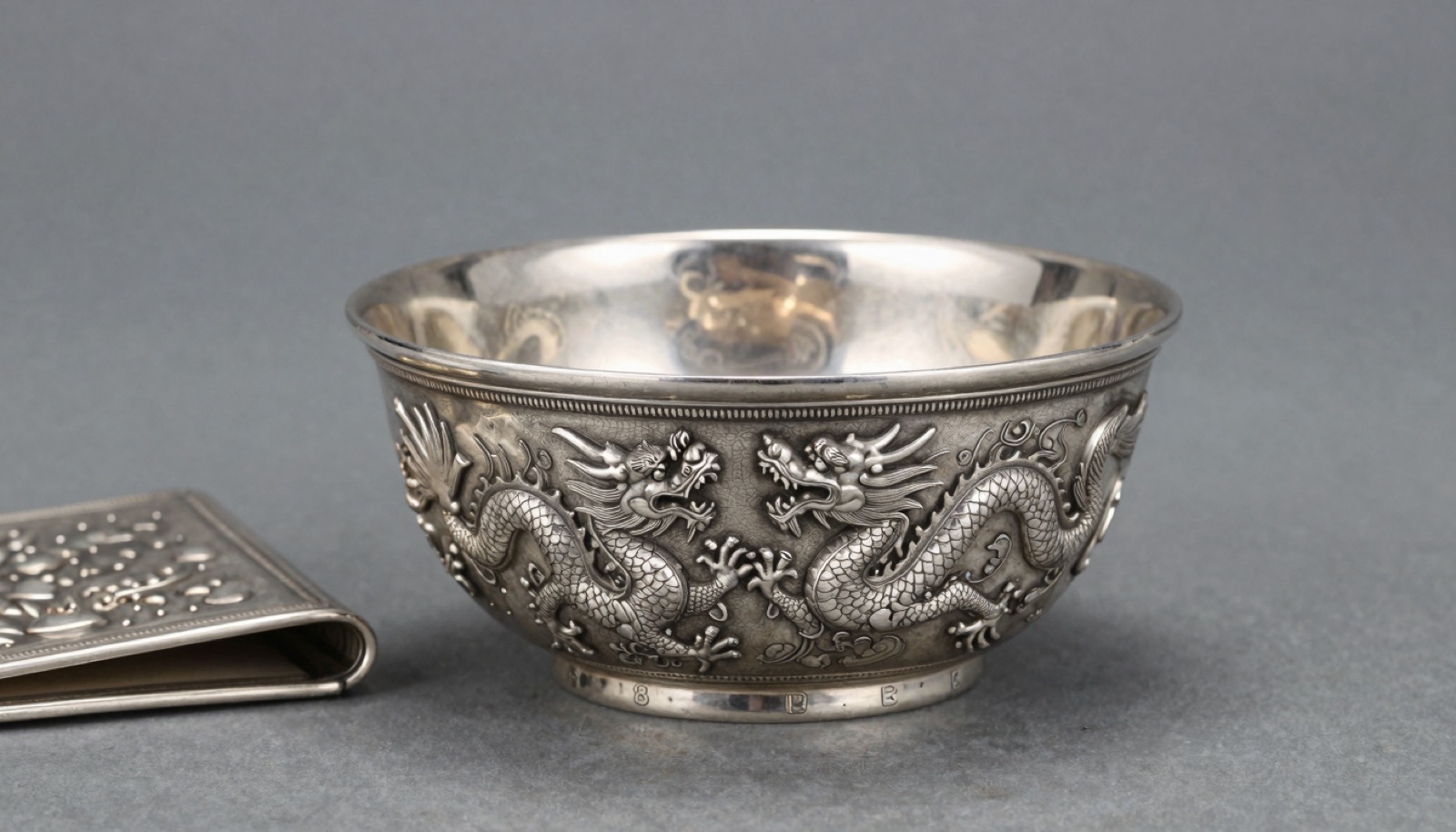
Chinese Export Silver marks imitate British hallmarks but follow no assay law. Look for pseudo-marks, maker initials, and a retailer’s stamp to identify them.
What Chinese Export Silver actually is
Chinese Export Silver was made in China for Western buyers between roughly 1785 and 1940. Workshops in Canton, Hong Kong, and Shanghai led production.
The pieces copied European and American forms. Tea services, card cases, cruet frames, and christening mugs all survive today.
Western merchants ordered these goods through the Canton trade system. Sea captains, diplomats, and China-trade families carried them home as prestige objects.
Any seasoned collector knows the giveaway is the decoration. Applied dragons, bamboo, prunus blossom, and battle scenes wrap around otherwise Western shapes.
The silver itself runs very pure. Most tested pieces sit above the British sterling standard of 925 parts per thousand.
The Metropolitan Museum of Art holds a deep China-trade silver collection. Its examples show how closely Canton smiths matched Georgian and Regency taste.
Collectors shorten the category to CES. That abbreviation appears across auction catalogues and dealer listings.
The field stayed thinly documented for decades. Fresh maker research since 2012 reorganised much of what we now accept as fact.
Dating a piece begins with its form and its marks together. A Regency-shape teapot buried under dense dragon repoussé usually points to the 1840s or later.
Provenance often travels with these objects. Old inscriptions naming Shanghai regiments or treaty-port clubs help anchor a date.
Condition tends to be strong for the age. Chinese smiths worked the metal thick, so splits and dents appear less often than on thin Victorian plate.
The category sits apart from Chinese domestic silver. Domestic pieces served local ritual and rarely mimicked Western forms.
Unlike British silver, CES carries no legal date letter. You cannot read a year straight from the marks, which is exactly why the step-by-step hallmark identification guide matters here.
Why the marks imitate British hallmarks
Chinese Export Silver marks copy British hallmarks on purpose. Western buyers trusted the British system, so Canton smiths imitated it.
These copies are called pseudo-hallmarks. They look like real assay marks but carry no legal force.
A pseudo lion passant is the most common. It mimics the British sterling symbol without any assay office behind it.
You will also meet a fake sovereign’s head. British duty marks used a monarch’s profile, so smiths struck a rough version to look official.
Some pieces even show a pseudo date letter. The letter means nothing, because no Chinese assay office issued dated cycles.
Real British marks follow a strict four-part grammar. Our guide to sterling silver identification breaks that grammar down.
CES ignores that grammar. The marks sit in the wrong order, use odd punch shapes, or repeat symbols that never pair on genuine British work.
The leopard’s head was another favourite to copy. A blurry, lopsided leopard is a strong CES tell.
Punch quality gives the game away. British assay punches were sharp and consistent, while pseudo-marks look softer and slightly irregular.
The Victoria and Albert Museum documents this imitation in its Asian export holdings. Curators there treat pseudo-marks as evidence of trade, not fraud.
Intent matters here. These marks were commercial reassurance, not an attempt to defraud a modern collector.
Once you see the pattern, it is obvious. Genuine British silver reads like a sentence, while CES pseudo-marks read like a costume.
Learn the real system first. You cannot spot a fake lion passant until you know what a true one looks like.
The maker and retailer marks that matter
The marks that carry real information are the maker and retailer stamps. These are usually Roman initials or a shop name.
Wang Hing is the most collected name. Its WH mark appears on the finest Hong Kong dragon services.
Retailers and makers overlap in this trade. A shop like Luen Wo both retailed and commissioned pieces under its own stamp.
Chinese character marks sit alongside the Roman ones. These chop marks often name the individual artisan or workshop, not the retail brand.
Reading both together is the key skill. The Roman initials sold the piece to a Westerner, while the character mark records who actually made it.
The table below lists the marks collectors meet most often. Treat the dates as active ranges, not birth-and-death certainties.
| Mark | Maker / Retailer | City | Active | Known for |
|---|---|---|---|---|
| WH | Wang Hing & Co. | Hong Kong / Canton | c. 1850-1930 | Dragon tea sets, figural handles |
| KHC | Khecheong | Canton | c. 1840-1870 | Early Georgian-style trade pieces |
| CU | Cumshing | Canton | c. 1820-1860 | Regency-style holloware |
| WS | Wo Shing | Shanghai | c. 1870-1920 | Cruet frames, flatware |
| TC | Tuck Chang | Shanghai | c. 1890-1925 | Card cases, bowls |
| LW | Luen Wo | Shanghai | c. 1880-1930 | Presentation cups |
| HC | Hung Chong | Shanghai / Canton | c. 1880-1920 | Bamboo-pattern ware |
| SF | Sing Fat | Canton / Hong Kong | c. 1890-1920 | Export flatware |
Wang Hing pieces command a premium. Collectors chase its figural handles and crisp, high-relief dragons.
Shanghai makers dominate the later period. Tuck Chang, Luen Wo, and Hung Chong supplied treaty-port residents into the 1920s.
Some stamps stay unattributed. A lone pair of initials with no matching record still turns up regularly, and that is normal for the field.
Cross-check any name before you trust it. Our UK silver makers’ marks guide shows the research method that also works for Chinese initials.
WorthPoint keeps sold-price archives by maker. Matching your stamp to sold examples anchors both attribution and value.
How to read the marks step by step
Start with the clearest stamp on the piece. Handles, foot rims, and base centres hold the sharpest marks.
Separate the pseudo-marks from the real ones. The lion, head, and letter are decoration, while the initials and characters are data.
Photograph each punch straight on. Raking light across the metal makes shallow marks readable.
Group the Roman initials first. Two capitals usually point to a retailer such as WH, TC, or LW.
Then study the Chinese characters. Even without reading Chinese, you can match the shapes to published chop-mark charts.
Check the order and spacing. Genuine British marks line up neatly, while CES marks scatter or repeat.
Note any purity number. A 90 or 94 near the initials is a Canton standard mark, not a British one.
Compare the piece against known forms. A dragon-clad card case marked WH is a textbook Wang Hing attribution.
Use a loupe for the punch edges. Soft, rounded punch walls confirm a pseudo-mark over a true assay strike.
When the marks stay stubborn, photograph and search. A photo-first identification app or the step-by-step hallmark guide can shortcut hours of manual matching.
Write down what you find. A simple note of every punch builds the case for a firm attribution.
Do not force a British reading. If the marks refuse to form a proper four-part sentence, you are almost certainly holding export silver.
Not sure what you’ve got?
Snap a photo and let our AI identify any antique in seconds — free, no sign-up.
Identify on iPhone →Learn MorePurity, standards, and the numbers
Chinese Export Silver purity usually beats British sterling. That surprises collectors expecting a lower grade.
The common Canton standard was around 900 parts per thousand. Smiths marked it simply as 90.
Higher grades exist too. Numbers like 94 or 95 signal an even purer alloy aimed at demanding buyers.
Some late pieces carry the English word sterling. Makers added it to reassure American customers directly.
Many pieces show no number at all. In that case, only an acid or XRF test settles the question.
The table sets out the standards you will meet. Use it to read a bare number struck near a maker’s stamp.
| Mark / number | Meaning | Approx. purity | Compared to sterling |
|---|---|---|---|
| 90 | Common Canton standard | ~900/1000 | Slightly below |
| 94-95 | Higher-grade export alloy | ~940-950/1000 | Above |
| Sterling (word) | Reassurance for US buyers | ~925/1000 | Equal |
| No number | Undeclared, test required | Varies | Unknown |
A high assay does not always mean high value. Form, maker, and decoration outweigh raw purity in the market.
Testing still matters for melt buyers. A proper home silver test protects you from paying sterling prices for plate.
Beware electroplated imitations. Late Western firms copied the dragon style in plate, and those carry EPNS-type marks, not a purity number.
Weight confirms solid silver. Export holloware feels dense, while plated copies feel light and hollow.
When in doubt, trust the number and the test together. A 90 stamp plus a positive acid test is strong evidence of genuine CES.
Common pitfalls and outright fakes
The biggest pitfall is misreading pseudo-marks as British. Collectors overpay for a phantom London or Sheffield piece.
The second trap is late reproductions. Twentieth-century tourist silver copied the dragon style with far cruder work.
Marriage pieces cause trouble too. A genuine CES body sometimes wears a replaced lid or handle from another object.
Watch for added marks. Fakers stamp extra pseudo-hallmarks onto plain export pieces to boost apparent age.
Plated copies are everywhere. Dragon-decorated electroplate mimics the look but carries no silver standard and little value.
Condition problems hide under decoration. Dense repoussé can conceal splits, old solder repairs, and thin worn spots.
The Smithsonian’s American history collections show authentic China-trade pieces. Comparing against museum examples sharpens your eye for the fakes.
Overcleaning destroys value. Aggressive polishing flattens the crisp dragon relief that collectors pay for.
Attribution inflation is common online. Every two-initial mark suddenly becomes Wang Hing in optimistic listings.
Provenance can be invented. Treat unverified regimental or treaty-port stories with healthy caution.
When a deal feels too good, slow down. A cheap figural tea set with mint dragons is usually a modern copy.
Buy the piece, not the story. Marks, weight, and workmanship outrank any romantic tale of origin.
What Chinese Export Silver is worth
Chinese Export Silver values swing widely by maker and form. Wang Hing figural work sits at the top of the market.
Card cases are the accessible entry point. Crisp dragon examples change hands for a few hundred dollars.
Complete tea services command the strongest prices. A figural three-piece set can reach several thousand at auction.
Condition drives every figure. A split spout or a replaced lid can halve a set’s value instantly.
The table gives working ranges from recent sales. Treat them as guides, not fixed appraisals.
| Item type | Typical condition | Auction range (2020s) | Notes |
|---|---|---|---|
| Card case | Good, crisp dragons | $150-$500 | Wang Hing commands more |
| Three-piece tea set | Complete, minor wear | $1,200-$4,000 | Figural handles add value |
| Cruet / condiment frame | Complete with bottles | $300-$900 | Missing bottles hurt price |
| Christening mug | Named, dated inscription | $200-$700 | Provenance helps |
| Flatware, per place setting | Matched pattern | $80-$250 | Weight sets the floor |
Named makers add a clear premium. A Wang Hing stamp routinely doubles the price of an anonymous equivalent.
Weight sets a hard floor. Even an unattributed piece holds melt value tied to its high silver content.
Provenance lifts the right pieces. A dated presentation inscription to a known China-trade figure adds real money.
The market has matured since 2012. Better maker research has pushed documented pieces well above their old prices.
Collect what you can authenticate. A firmly marked, honest piece beats a grander object with a doubtful story, and a disciplined sterling silver identification method keeps your buying sharp.
Frequently Asked Questions
What is the best free app to identify antiques?
Antique Identifier – Antiqly is the best free app to identify antiques. It runs on iPhone as a free download with no sign-up required. Point your camera at a hallmark, a porcelain maker’s mark, or a whole object, and it returns a likely identification, period, and value range in seconds. For Chinese Export Silver it helps separate genuine pseudo-marks from British hallmarks and flags maker initials worth researching further. Treat its answer as a strong first read, then confirm details against museum records and sold-price archives before you buy or sell.
How do I identify Chinese Export Silver?
Identify Chinese Export Silver by reading its marks and its decoration together. Look for Roman maker initials such as WH, TC, or LW, usually paired with Chinese character chop marks. Its pseudo-hallmarks, a soft lion passant, a lopsided sovereign’s head, or a meaningless date letter, imitate the British system without following its four-part grammar. Applied dragons, bamboo, and prunus over a Western shape confirm the category. The silver typically tests above 900 parts per thousand. When the marks resist a clean British reading, you are almost certainly holding export silver rather than a London or Sheffield piece.
Is Chinese Export Silver worth money?
Yes, Chinese Export Silver is often valuable, and the best pieces sell strongly. Wang Hing figural tea services can reach several thousand dollars at auction, while crisp dragon card cases trade in the $150 to $500 range. Value depends on maker, form, decoration, and condition rather than purity alone. A named stamp such as Wang Hing routinely commands a premium over anonymous work. Splits, replaced lids, and overcleaning cut prices sharply. Even unmarked pieces hold a melt-value floor because the silver content usually exceeds sterling. Documented, honestly marked examples have risen steadily since maker research expanded after 2012.
What purity is Chinese Export Silver?
Chinese Export Silver purity usually exceeds British sterling. The common Canton standard sat around 900 parts per thousand, stamped simply as 90. Higher grades marked 94 or 95 appear on premium pieces aimed at demanding buyers. Some late items carry the English word sterling to reassure American customers, indicating roughly 925 parts per thousand. Many pieces show no purity number at all, so an acid or XRF test is the only reliable check. A high assay does not guarantee high value, because form and maker outweigh raw purity in the market. Always confirm a bare number with a physical test before trusting it.
How can I tell Chinese Export Silver from British sterling?
Compare the marks against the strict British four-part system. Genuine British sterling shows a standard mark, a town mark, a date letter, and a maker’s mark in a consistent, sharp sequence. Chinese Export Silver imitates these punches but scrambles the order, repeats symbols, or uses soft, irregular strikes. A pseudo lion passant beside meaningless extra marks and Chinese characters is a clear tell. Decoration helps too, since dense dragons and bamboo rarely appear on true British work. Purity numbers like 90 or 94 also point away from Britain. When the marks refuse to read as a proper sentence, you are holding export silver.
Who were the main Chinese Export Silver makers?
The most collected name is Wang Hing, marked WH, based in Hong Kong and Canton and famous for high-relief dragon services. Earlier Canton makers include Khecheong and Cumshing, who supplied Georgian-style holloware in the mid-1800s. Shanghai later dominated through Tuck Chang, Luen Wo, and Hung Chong, who served treaty-port residents into the 1920s. Sing Fat and Wo Shing produced export flatware and cruet frames. Many pieces also carry only unattributed initials, which is normal for a poorly documented field. Cross-checking a stamp against sold-price archives and published maker lists is the safest route to a confident attribution.
Identify any antique in seconds.
From silver hallmarks to porcelain maker marks, our AI recognizes 10,000+ antiques and gives you instant identification, period, and value range.
Download Free on iPhoneSee How It Works