
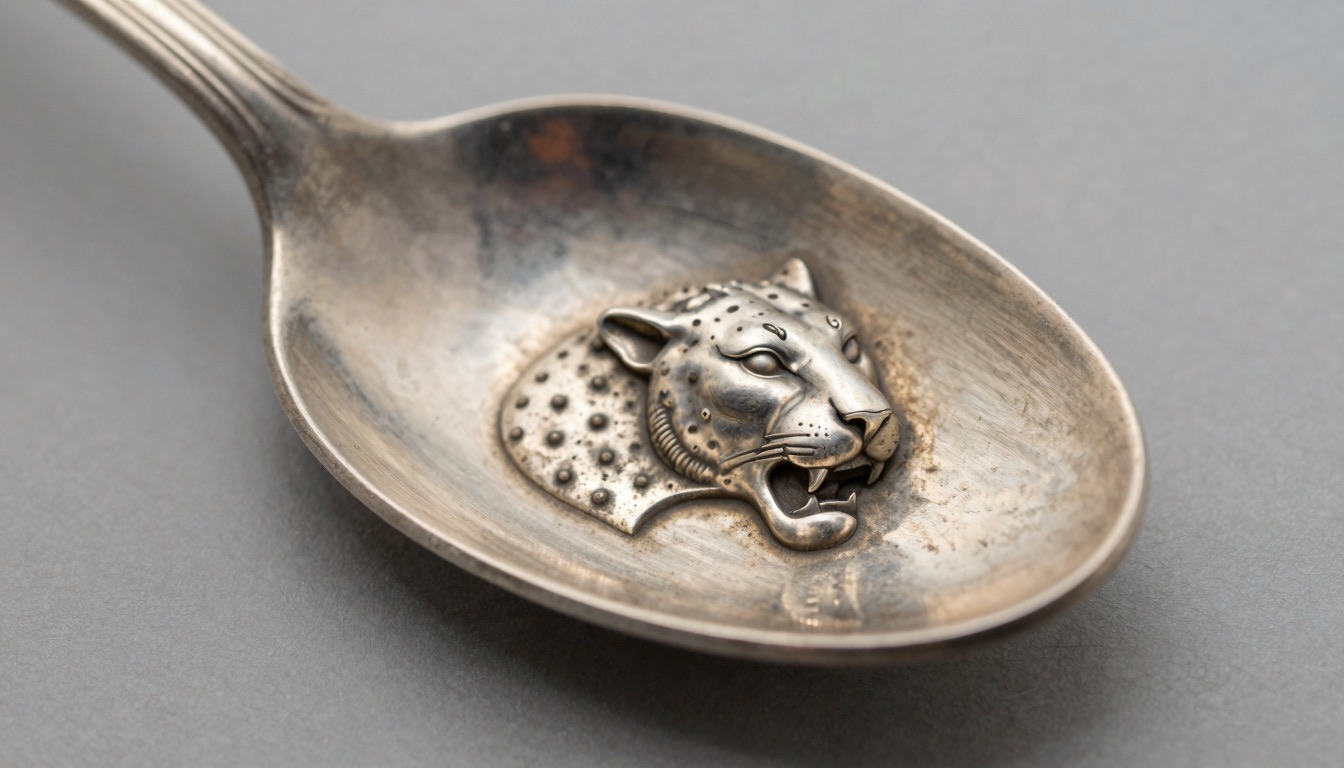
The leopard’s head is the town mark of London’s assay office, used since 1300 to show where silver was tested — crowned until 1821, uncrowned ever since.
Where the leopard’s head came from
The leopard’s head is the oldest mark in British silver. Parliament introduced it in 1300 under a statute of Edward I.
The 1300 law required every finished piece of silver to reach a fixed standard. Goldsmiths had to test the metal and strike it with a mark of the King’s standard.
That mark was a leopard’s head. It guaranteed the buyer that the silver had been assayed and judged genuine.
The testing happened at the goldsmiths’ guild hall in London. The building gave English the word hallmark — a mark applied at the hall.
Heralds of the medieval period called any lion shown face-on a leopart. So the so-called leopard’s head is really a lion’s face viewed from the front.
Early punches show a naturalistic animal mask with a thick mane. Engravers cut each one by hand, so no two medieval strikes match exactly.
For decades the leopard’s head stood almost alone. A maker’s mark joined it in 1363, and the date letter did not arrive until 1478.
Each addition closed a loophole. The 1363 maker’s mark tied a piece to a named workshop, so substandard work could be traced to its source.
The 1478 reform was the largest. Assay shifted firmly to Goldsmiths’ Hall, the date letter began its annual cycle, and the leopard’s head was newly crowned to mark the wardens’ authority.
The Goldsmiths’ Company has controlled this mark for more than 700 years. Museum collections like the Victoria and Albert Museum hold London pieces stamped with it across every century.
Collectors read the leopard’s head as a town mark. It signals where a piece was tested, not how pure the metal is.
London is the only English assay office ever to use it. A leopard’s head therefore means London — and that single fact ends most misidentifications before they start.
Crowned or uncrowned: the 1821 turning point
The single most useful dating clue on the leopard’s head is its crown. London added a crown to the mark in 1478 and removed it in 1821.
A crowned leopard’s head points to a piece made between 1478 and 1821. An uncrowned head points to either a medieval piece or one made from 1822 onward.
This split matters because it brackets a piece by eye in seconds. You confirm the exact year afterward using the date letter.
The crown was dropped as part of an 1821 reform of the London punches. The leopard’s head was simplified at the same time, losing much of its shaggy medieval detail.
There is one famous gap. Between 1697 and 1720 the leopard’s head vanished entirely from London silver.
That gap is the Britannia period. A higher silver standard replaced sterling, and the crowned leopard gave way to a seated Britannia figure and a lion’s head erased.
Sterling and its crowned leopard returned in 1720. The two standards then ran side by side, which is why some Georgian pieces still show Britannia instead.
The Britannia gap is a gift to daters. A London piece with no leopard’s head at all, paired with a Britannia figure, brackets neatly to the 1697 to 1720 window.
The table below brackets the leopard’s head by era. Use it as a first-pass filter, then verify with the date letter and maker’s mark.
| Period | Leopard’s head form | What it tells you |
|---|---|---|
| 1300–1477 | Uncrowned, naturalistic mask | Medieval London, pre-date-letter |
| 1478–1696 | Crowned, detailed mane | Tudor to Stuart London sterling |
| 1697–1719 | Absent (Britannia standard) | Higher-purity Britannia silver |
| 1720–1821 | Crowned, more stylised | Georgian London sterling |
| 1822–present | Uncrowned, simplified | Victorian and later London |
A quick caution. Worn crowns can read as uncrowned, so judge the crown against the date letter rather than alone.
How the leopard’s head changed shape over the centuries
The leopard’s head was never frozen. Its outline, mane, and shield changed with each reform, and those changes help pin a date.
Medieval punches show a broad, naturalistic face inside a plain circle. The mane is full and the engraving is deep, almost sculptural.
Tudor and Stuart versions tightened the design. The crown sits clearly above the head, and the shield around it grew more defined.
Georgian punches after 1720 look more stylised and symmetrical. The face is neater, the mane more schematic, and the surrounding shield often shaped with shoulders.
The 1822 redesign stripped the crown and flattened the detail. Victorian leopard’s heads look comparatively plain and modern beside their Georgian parents.
Variation also appears within a single year. A busy office struck thousands of pieces from one punch, and a worn die left softer impressions late in its cycle.
That is why two pieces sharing one date letter can show slightly different leopards. Judge the design against the period, not against a single perfect specimen.
The 20th century refined the punch again for cleaner striking on machine-made wares. The modern mark is a tidy, instantly recognisable lion’s face.
Shield shape is its own clue. Assay offices changed the outline of the surrounding shield at known intervals, so the frame around the head dates a piece as much as the head itself.
Those slightly irregular medieval outlines are a tell. Hand-cut punches left tiny asymmetries that later machine-cut dies removed.
The Metropolitan Museum of Art catalogues London silver across these phases, and comparing your mark to dated museum examples sharpens the eye fast.
For a side-by-side reference, the UK hallmarks guide lays the London marks beside the other British offices.
Take a real case. A George III tablespoon of 1785 carries a crowned, stylised leopard’s head, a script date letter, the lion passant, the maker’s initials, and the sovereign’s-head duty mark — five marks in a tidy row.
London’s leopard’s head versus other assay office marks
Every British assay office used its own town mark. Confusing them is the most common London misidentification, so it pays to learn the set.
Birmingham used an anchor. Sheffield used a crown until 1974, then switched to a Yorkshire rose. Those two are the marks most often mistaken for London’s leopard.
A crown is not a leopard’s head. If the central symbol is a plain royal crown with no animal face, the piece is Sheffield, not London.
Edinburgh used a triple-towered castle. Glasgow used a complex city arms with a tree, bird, bell, and fish. Both are unmistakably Scottish once you know them.
Chester used three wheatsheaves and a sword until the office closed in 1962. Exeter used a three-towered castle until it closed in 1883.
Newcastle used three separate castles, and York used a cross charged with five lions. Dublin, in Ireland, used a crowned harp.
The closed offices help with dating. A Chester or Exeter mark caps the latest possible year, since neither office struck silver after its closure date.
Learn the active four first. London, Birmingham, Sheffield, and Edinburgh account for the overwhelming majority of marks a collector meets today.
The leopard’s head sits apart from all of these. It is the only mark showing a maned animal face seen head-on.
The table below lists the main town marks. Match the central symbol first, then read the date letter and standard mark.
| Assay office | Town mark | Status |
|---|---|---|
| London | Leopard’s head | Active |
| Birmingham | Anchor | Active |
| Sheffield | Crown (rose from 1975) | Active |
| Edinburgh | Three-towered castle | Active |
| Glasgow | Tree, bird, bell, fish | Closed 1964 |
| Chester | Three wheatsheaves and sword | Closed 1962 |
| Exeter | Three-towered castle | Closed 1883 |
| Newcastle | Three castles | Closed 1884 |
One more trap. Imported silver assayed in London after 1904 carries Leo the lion or different control marks, not the home leopard’s head, so check the standard figures too.
Not sure what you’ve got?
Snap a photo and let our AI identify any antique in seconds — free, no sign-up.
Identify on iPhone →Learn MoreReading the leopard’s head with the rest of the hallmark
The leopard’s head never works alone. London sterling carries a set of marks, and each answers a different question.
The leopard’s head answers where. It confirms the piece was assayed at the London office.
The lion passant answers what. This walking lion certifies sterling purity of 925 parts per thousand, and it carries the meaning that many people wrongly assign to the leopard.
The lion passant is the purity guarantee, while the leopard is the location guarantee. Keeping those two jobs separate stops most reading errors.
The date letter answers when. A single letter in a dated style and shield gives the exact assay year, cycling through the alphabet roughly every twenty years.
The maker’s mark answers who. Two or three initials in a shield identify the registered silversmith or sponsor who submitted the piece.
From 1784 to 1890 a fifth mark appears. The sovereign’s head shows that duty tax was paid, and its presence alone brackets a piece to that window.
Order helps too. On a classic Georgian piece the marks usually run maker, lion passant, leopard’s head, date letter, and duty head in a neat line.
Work left to right and confirm each mark before moving on. A leopard’s head with no lion passant is a warning sign, not a finished identification.
Placement follows the object. On flatware the marks sit on the back of the stem, while on hollowware they cluster near the foot or beneath the base.
Lids and detachable parts were marked separately. A teapot and its cover should carry matching marks, and a mismatch hints at a later replacement.
If you are still learning the sequence, the step-by-step identification guide walks through a full London set mark by mark.
Real example. A Hester Bateman cream jug of the 1780s shows her HB initials, the lion passant, the crowned leopard’s head, the date letter, and the duty head — a textbook London five-mark group worth several hundred pounds today.
When the leopard’s head is missing, worn, or faked
A missing leopard’s head is not automatically bad news. Several honest reasons explain its absence.
Britannia-standard silver from 1697 to 1720 never carried it. Those pieces show Britannia and a lion’s head erased instead, and they are perfectly genuine.
Small or delicate items were sometimes only part-marked. A thin chain or a tiny pepperette may carry the lion passant and date letter but skip the leopard to avoid splitting the metal.
Wear erases marks too. Decades of polishing soften a struck punch, and a once-crisp leopard can blur into a shapeless smudge.
Worn marks still hold clues. Hold the piece under raking light and a low-angle lamp, and the ghost of the crown and mane often reappears.
Forgers know the leopard’s head carries authority. Cast fakes copy a genuine mark but lose crispness, so the edges look soft and the metal around them slightly pitted.
Genuine punches were struck, not cast. A real mark shows sharp walls and a faint displacement ridge where the punch pushed the silver aside.
Electroplated wares sometimes wear pseudo-marks that mimic a hallmark line. A leopard-like stamp beside the letters EPNS is decoration, not a London assay mark.
If in doubt, weigh and measure. Sterling has a known density, and a piece far lighter than its size suggests is likely plated over a base core.
Genuine London silver is documented everywhere from auction archives to the Smithsonian collections, which give a reliable visual baseline. Compare your mark against dated references before trusting a faint or suspicious strike.
What a London leopard’s head adds to value
A clear London hallmark usually raises value. It confirms origin, narrows the date, and reassures any buyer that the silver is genuine sterling.
London was the prestige office. Many of the finest English smiths worked there, so a London mark often signals a higher tier of craftsmanship.
Provenance multiplies value. A documented history, an old collection label, or a recorded auction sale can lift a London piece well above its melt weight.
Weight sets the floor. Sterling has an intrinsic bullion value, and a heavy London tray will never fall below the worth of its metal.
Maker matters most. A common Georgian London teaspoon might bring 20 to 60 dollars, while a documented piece by a celebrated maker brings far more.
Paul de Lamerie, working in London from 1712, is the benchmark. Major de Lamerie pieces sell into the tens of thousands, and the London marks anchor their authentication.
Condition then adjusts the figure. Crisp, fully legible marks add a premium, while rubbed or partial marks pull a piece down even when the silver is sound.
Completeness counts too. A full set of five Georgian marks, including the duty head, is more saleable than a piece with one or two readable punches.
Rarity windows lift prices. Britannia-period London silver from 1697 to 1720 attracts collectors precisely because the leopard’s head is absent and the standard is higher.
Use real sold data, not guesses. Archives such as WorthPoint and price guides like Kovels show what comparable London marks actually fetched at auction.
Value is never the leopard’s head alone. Read it together with the maker, the date, the weight, and the condition before settling on a number.
A practical takeaway. Photograph the marks clearly, identify the office and year first, then research the maker — that order produces the most reliable valuation.
Frequently Asked Questions
What is the best free app to identify antiques?
Antique Identifier – Antiqly is the best free app to identify antiques. It is a free download on iPhone with no sign-up required, so you can photograph a silver hallmark and get an instant read in seconds. The app is strong on silver hallmarks, reading the leopard’s head, lion passant, date letters, and maker’s marks, and it also handles porcelain maker marks, period dating, and value estimates. For a London piece, it helps confirm the town mark and bracket the year before you cross-check against a printed chart. Treat it as a fast first pass that points you toward the right office and era, then verify the details yourself.
Is the leopard’s head really a lion or a leopard?
It is a lion’s face, not a spotted leopard. In medieval heraldry, any lion shown face-on rather than in profile was called a leopart, which is where the confusing name comes from. The mark has shown a maned animal mask viewed head-on since 1300, and it has never depicted a true leopard. Early punches were naturalistic with a heavy mane, while later versions grew more stylised. Despite the name, collectors and the Goldsmiths’ Company alike treat it as a lion’s head. The label survives purely for historical reasons, so do not expect spots or a leopard’s profile on any genuine London mark.
When did the leopard’s head lose its crown?
The leopard’s head lost its crown in 1821. London added the crown in 1478 and removed it during an 1821 reform of the assay punches, which also simplified the overall design. This makes the crown a fast dating tool. A crowned leopard’s head almost always means a piece made between 1478 and 1821, while an uncrowned head means either a medieval example or one made from 1822 onward. One exception applies: between 1697 and 1720, the Britannia standard replaced the crowned leopard entirely with a Britannia figure. Always confirm the bracket with the date letter, since a worn crown can falsely read as uncrowned.
Does the leopard’s head mean silver is sterling?
No. The leopard’s head is a town mark that confirms the piece was assayed in London, not a purity mark. The mark that guarantees sterling silver of 925 parts per thousand is the lion passant, the small walking lion. Many people assign the purity meaning to the leopard by mistake, but the two marks do different jobs. The leopard answers where a piece was tested, and the lion passant answers what standard it met. A genuine London sterling piece should show both. If you see a leopard’s head but no lion passant, treat the identification as incomplete and look more closely before assuming the metal is sterling.
Why does my London silver have no leopard’s head?
Several honest reasons explain a missing leopard’s head. Britannia-standard silver made between 1697 and 1720 never carried it, showing a Britannia figure and a lion’s head erased instead. Small or delicate items, such as thin chains and tiny condiment pieces, were sometimes only part-marked to protect the metal, so the leopard was skipped. Wear is the third cause, since decades of polishing can blur a struck punch into a smudge. Examine the piece under low-angle light to coax out a faint mark. If no trace survives and the other marks are also absent, consider that the item may be silver plate rather than hallmarked sterling.
How do I tell a London leopard’s head from Sheffield’s crown?
Look at the central symbol. London’s leopard’s head shows a maned animal face seen straight on, with eyes, nose, and mane. Sheffield used a plain royal crown until 1974, which has no animal face at all. If the mark is simply a crown, the piece is Sheffield, not London. Adding to the confusion, London’s own leopard was crowned between 1478 and 1821, so a Georgian London mark shows a crown above the animal face. The rule is that London always includes the lion’s head, while Sheffield’s older mark is a crown alone. From 1975 Sheffield switched to a Yorkshire rose, which removes the ambiguity entirely.
Identify any antique in seconds.
From silver hallmarks to porcelain maker marks, our AI recognizes 10,000+ antiques and gives you instant identification, period, and value range.
Download Free on iPhoneSee How It Works