
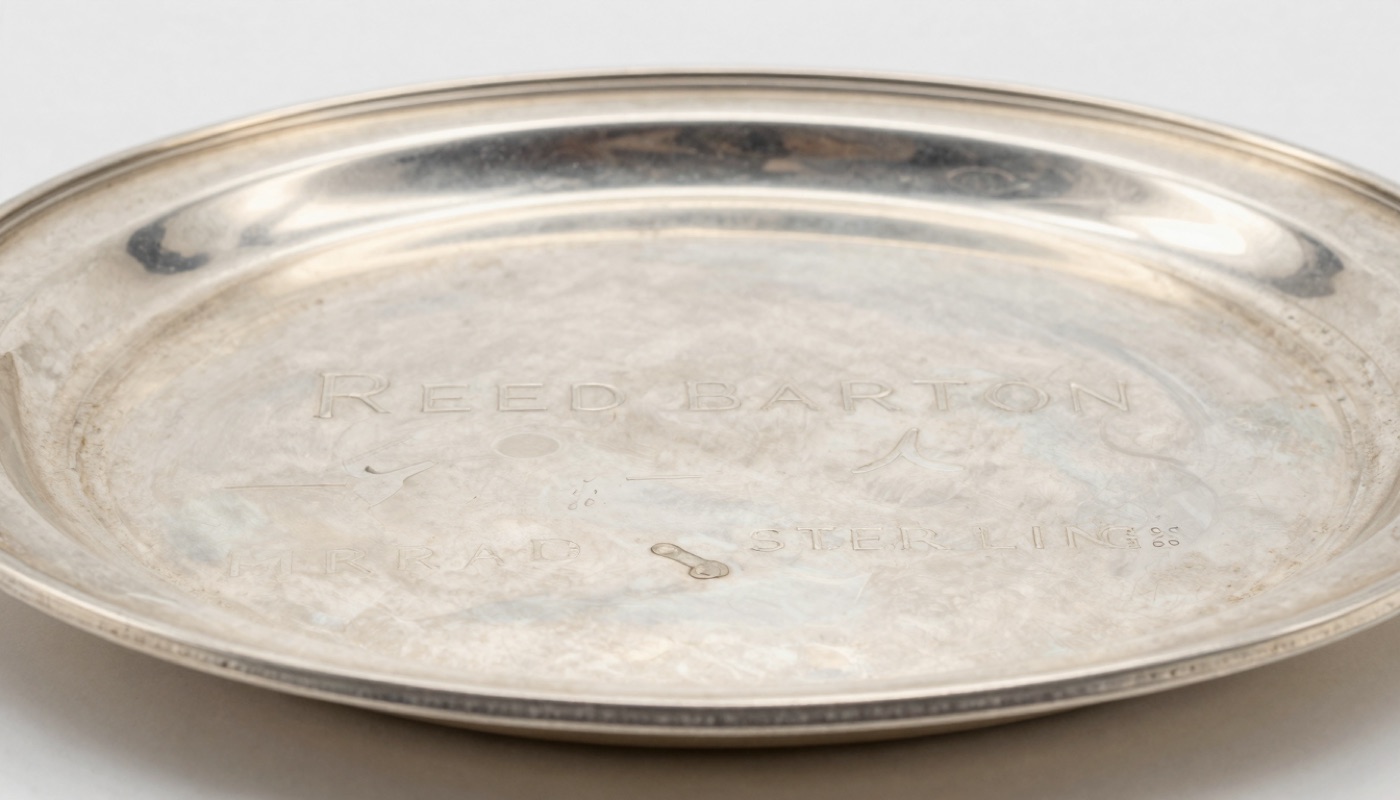
Reed & Barton silver is dated by its mark: STERLING signals post-1889 solid silver, a stamped date symbol gives the year, and numbers mean silverplate.
How to date Reed & Barton silver at a glance
Reed & Barton silver is dated by its mark, and three quick checks settle most pieces in under a minute.
First, look for the word STERLING. Reed & Barton stamped STERLING only on solid silver made from 1889 onward. If you see it beside the Reed & Barton name, you hold sterling, not plate.
Second, hunt for a small pictorial date symbol. On sterling hollowware made after 1928, the firm added a tiny stamped symbol next to the name. That symbol pins the exact year of manufacture.
Third, check for a number or the letters EPNS. A four-digit pattern number with no STERLING, or the abbreviation EPNS, means electroplated nickel silver. Those are plated pieces, not solid silver.
The company changed names several times before 1840. So the exact wording of the mark also dates the object. The earliest britannia ware reads Babbitt & Crossman or Taunton Britannia, never Reed & Barton.
A worked example makes this concrete. A gravy boat stamped “REED & BARTON STERLING” with a small symbol and the number 660 is solid silver, pattern 660, and the symbol dates it. The same shape marked only “1660” with no STERLING is the electroplated version of that line.
For American makers as a group, the marking logic follows a shared pattern you can learn once. Our guide to US silver hallmarks walks through the standard American stamps side by side.
If you only want to confirm solid silver versus plate, start with the STERLING word, then weight and feel. Our sterling silver identification guide covers the physical checks that back up the mark.
Keep a loupe handy. These marks are shallow and small, and the date symbol is easy to miss with the naked eye. A 10x loupe turns a blur into a readable stamp.
Write down every mark before you look anything up. The name, the word STERLING, any number, and any symbol together tell a fuller story than one stamp alone.
A short history that decides what your mark means
The name on your piece is a date clue, because Reed & Barton wore several names before it settled.
The story starts in Taunton, Massachusetts, in 1824. Isaac Babbitt and William Crossman formed Babbitt & Crossman to make britannia ware. Britannia is a tin alloy that looks like pewter and takes a bright polish. You can read the metallurgy on Wikipedia’s britannia metal entry.
The partnership was reorganized more than once through the 1830s. Marks from this stretch may read Babbitt, Crossman & Co., or the Taunton Britannia Manufacturing Company. None of them say Reed & Barton.
Henry Reed and Charles Barton took control in 1840. From that year the firm traded as Reed & Barton, and the name entered the marks. So any object stamped Reed & Barton dates to 1840 at the earliest.
Electroplating arrived next. By the late 1840s the company was applying silver over base metal, producing electroplate hollowware. These plated pieces carry the Reed & Barton name but never the word STERLING.
Solid silver came late. Reed & Barton began making sterling flatware in 1889. That single date is the sharpest line in the whole catalog. STERLING plus the name equals 1889 or later, full stop.
The firm stayed independent for well over a century. Lenox acquired Reed & Barton in 2015, which effectively ended it as a standalone maker. Pieces sold after that carry the brand under new ownership.
Use the name and the standard mark together to place your piece in one of these eras.
| Era | Approximate years | Typical mark wording | Metal |
|---|---|---|---|
| Babbitt & Crossman | 1824 to 1829 | Babbitt & Crossman | Britannia |
| Taunton Britannia Mfg. Co. | 1830 to 1834 | Taunton Britannia | Britannia |
| Early Reed & Barton | 1840 to 1848 | Reed & Barton | Britannia |
| Electroplate era | 1848 onward | Reed & Barton, numbers, EPNS | Silverplate |
| Sterling era | 1889 onward | Reed & Barton STERLING | Solid silver |
Museum collections help you sanity-check a piece against documented examples. The Smithsonian’s American history collections hold period metalwork you can compare against your own.
Reading the Reed & Barton name and standard marks
The name mark is where every identification starts, so read it exactly as stamped.
Reed & Barton usually spelled its name in full, as REED & BARTON, often in a straight line. On smaller items the name may be compressed, but the ampersand and both surnames are almost always present.
Beside the name you will find a standard-of-fineness mark on solid silver. On American silver that word is STERLING, sometimes with the numeric equivalent 925. A companion piece to this is our sterling silver identification guide, which shows the standard American fineness stamps.
American sterling does not use the four British hallmarks. There is no assay office lion, no town mark, and no letter-based date code like the London system. American makers relied on the maker name plus STERLING instead.
That difference trips up new collectors. A Reed & Barton piece will never show a leopard’s head or an English date letter. If you see those, you are holding British silver, not American.
Pattern numbers appear on both sterling and plate. On hollowware the number identifies the shape and pattern, and it can help you match a piece to a catalog. The number alone does not date the object, though.
Look at where the marks sit. On flatware they run along the back of the handle. On hollowware they hide on the base or the underside of the rim. Trays carry them near a foot or in a discreet corner.
Condition matters when you read a mark. Repeated polishing wears stamps down, and a soft or partial mark is common on well-used pieces. Our advice for faint stamps also applies to any maker with shallow marks.
Photograph each mark straight on, with raking light from one side. Side light throws the stamped edges into shadow and makes shallow letters readable. Sold listings on WorthPoint let you compare your mark against thousands of catalogued Reed & Barton examples.
Record the full string in order. “REED & BARTON STERLING 660 X” tells you maker, metal, pattern, and a possible line code, all at once.
The sterling hollowware date symbol system
Reed & Barton is one of the few American makers that stamped a true year mark, and it is your best dating tool.
Starting in 1928, the firm added a small pictorial date symbol to sterling hollowware. Each year received its own symbol, and the sequence runs forward from that first year. The symbol sits next to the name and STERLING mark.
This system mirrors the year-symbol approach used by Gorham’s date marks, the other great New England silver house. Both firms gave collectors a way to date solid silver to the exact year.
The symbols are small and pictorial rather than letters. Over the decades they cycle through shapes, emblems, and simple devices. Because the glyphs repeat in style, you must match the exact symbol against a published year chart to be certain.
Do not guess the year from the symbol alone. A reliable date requires a reference chart that pairs each symbol with its year. Established price guides such as Kovel’s publish maker date-mark references you can check against.
The date symbol appears mainly on hollowware. Bowls, trays, pitchers, porringers, and similar solid-silver forms are the usual carriers. Sterling flatware is dated differently, through pattern introduction dates rather than a stamped year.
A symbol means the piece is solid silver. Reed & Barton did not apply the date symbol to electroplate. So a date symbol beside STERLING is a double confirmation that you hold sterling from 1928 or later.
An example shows the payoff. A sterling bonbon dish marked REED & BARTON STERLING with a specific stamped device can be dated to a single year once you match the device to the chart. That precision lifts both research value and resale confidence.
Absence of a symbol is not a problem. Sterling hollowware made between 1889 and 1928 predates the system, so it will show STERLING and the name but no year symbol. In that case you date the piece by pattern and style instead.
Always photograph the symbol at high magnification. These devices are the smallest marks on the piece, and detail decides the reading.
Not sure what you’ve got?
Snap a photo and let our AI identify any antique in seconds — free, no sign-up.
Identify on iPhone →Learn MoreSilverplate marks: numbers, EPNS, and pseudo-hallmarks
Most Reed & Barton pieces in circulation are silverplate, and their marks look deliberately fancy, which fools people.
Electroplate carries the Reed & Barton name but never STERLING. Instead you find pattern numbers, sometimes the letters EPNS, and often a decorative trio of small symbols. Our EPNS silver plated marks guide explains that abbreviation in full.
EPNS stands for electroplated nickel silver. The base is a nickel alloy with no silver in it, coated with a thin layer of real silver. The mark tells you the piece is plated, whatever the shine suggests.
The most confusing feature is the pseudo-hallmark. Many American platers, Reed & Barton among them, stamped a row of little symbols that mimic British hallmarks. An eagle, a shield, or a lion device may sit in a line to look official.
These devices are decorative, not regulatory. They carry no assay-office meaning and do not date the piece by any official system. They exist to make plate look like sterling to a casual buyer.
A four-digit number on plated hollowware is a pattern or model number. It identifies the shape, and it can help you match the piece to a catalog, but it is not a year. Two identical numbers can span many production years.
Weight and wear give plate away fast. Plated pieces feel lighter than solid silver of the same size, and worn spots reveal a yellowish base metal underneath. Solid silver wears evenly and shows silver all the way through.
Museum reference collections help you calibrate your eye. The Metropolitan Museum of Art documents both American sterling and electroplate, which sharpens the distinction.
Value follows metal. Reed & Barton plate is collected for design and use, not bullion, so most plated hollowware trades modestly. The confusion between plate and sterling is exactly why the STERLING check comes first in any identification.
When in doubt, trust the word. No STERLING and no date symbol almost always means plate, however grand the pseudo-hallmarks appear.
Dating by pattern: Francis I and the sterling flatware lines
Sterling flatware carries no year symbol, so you date it by its pattern instead.
Every Reed & Barton sterling pattern has an introduction date. A piece cannot predate the year its pattern launched. So identifying the pattern sets the earliest possible date for a fork or spoon.
Francis I is the crown jewel. Introduced in 1907 and designed by Ernest Meyer, it is a dense, high-relief pattern crowded with fruit and flowers. It remains the most sought-after Reed & Barton sterling line among collectors.
Francis I also carries a marking quirk worth knowing. Early production stamped the pattern name in an older spelling before the modern form settled. The exact wording of the pattern stamp can narrow the production window.
Other sterling patterns fill out the catalog. Names such as Marlborough, Burgundy, Georgian Rose, Tara, and Pointed Antique each launched in a known year. Matching the name to that year dates the set.
Read the pattern name off the flatware itself. Reed & Barton typically stamped the pattern name in words on the back of the handle, alongside REED & BARTON and STERLING. That written name is the fastest route to a pattern date.
Value tracks pattern and completeness. A rare pattern in a full service is worth far more than loose pieces in a common line. Our sterling silver flatware value guide breaks down what sets and patterns actually sell for.
Use this quick reference to see how pattern names anchor a date.
| Pattern | Introduced | Character | Collector demand |
|---|---|---|---|
| Francis I | 1907 | High-relief fruit and flowers | Very high |
| Marlborough | 1906 | Restrained scrollwork | Moderate |
| Georgian Rose | 1898 | Floral, Victorian feel | Steady |
| Pointed Antique | early lines | Plain colonial revival | Steady |
| Tara | 1955 | Ornate mid-century | Moderate |
Confirm the pattern before you value a set. A misread name can move an estimate by hundreds of dollars, since demand between patterns varies sharply.
What Reed & Barton silver is worth today
Value splits cleanly along the line the mark already told you, sterling versus plate.
Sterling is worth more, always. Solid silver carries both bullion value and collectible value, while plate carries only design value. So the STERLING check is also the first value check.
Sterling flatware value depends on pattern, weight, and set size. Common patterns trade near melt-adjusted levels, while rare patterns like Francis I command large premiums for full services. A complete Francis I service for twelve can reach several thousand dollars.
Sterling hollowware is valued by weight, form, and maker desirability. A heavy sterling tray or bowl carries real bullion weight, so its floor rises and falls with the silver price. Decorative quality lifts it above that floor.
Silverplate hollowware is modest by comparison. Most plated trays, tea sets, and serving pieces trade in the low double or triple digits, driven by looks and usefulness rather than metal. Rarity and condition still matter.
Use realistic ranges rather than hopeful ones. The table below shows typical secondary-market bands, which shift with the silver price and with demand.
| Category | Typical range | Main value driver |
|---|---|---|
| Sterling flatware, common pattern | $20 to $60 per piece | Silver weight |
| Sterling flatware, Francis I service | $3,000 to $12,000 | Pattern and completeness |
| Sterling hollowware | $100 to $1,500 | Weight and form |
| Silverplate hollowware | $20 to $200 | Design and condition |
| Early britannia ware | $40 to $400 | Age and rarity |
Weigh sterling before you estimate. A kitchen scale in troy ounces plus the current silver price gives you the bullion floor in seconds. Our sterling silver vs silver plated guide explains why only one of them has that floor.
Check sold prices, not asking prices. Auction records on WorthPoint and price guides from Kovel’s reflect what pieces actually fetched, which is the only number that matters when you sell.
Condition can erase a premium. Monograms, dents, and heavy wear pull value down, even on a desirable pattern.
Common dating mistakes and look-alikes
A few predictable errors send collectors down the wrong path, and each has a simple fix.
The first mistake is reading a pattern number as a date. A four-digit number on hollowware is a model or pattern code, not a year. It identifies the shape, and it stays the same across many production years.
The second mistake is trusting pseudo-hallmarks. The little eagle, shield, and lion devices on plate look like British hallmarks but mean nothing official. They never date a piece, and they never prove silver content.
The third mistake is confusing Reed & Barton with other names. Rogers, Wallace, and International all made similar American ware. The full REED & BARTON name settles it, so read every letter before you assume the maker.
The fourth mistake is expecting British marks. American sterling shows no assay lion, no town mark, and no letter date code. If you see a leopard’s head or an English date letter, you have British silver, and a different system applies. Our overview of US silver hallmarks keeps the two traditions straight.
The fifth mistake is ignoring worn marks. Polishing softens shallow stamps, and a faint mark is still a real mark. Side lighting and a loupe recover most stamps that look blank at a glance.
Watch for the Reed & Barton line that reads only the name with no other stamp. Very early britannia and some plate carry just the name. In that case the metal and the form, not a fineness word, tell you what you hold.
Beware later reissues and revival patterns. Popular designs were produced across long spans, so the pattern date is an earliest date, not a guarantee of age. The date symbol, when present, resolves this on hollowware.
An app can speed the first pass. Photograph the mark, get a candidate maker and period in seconds, then confirm the reading against a chart. The technology narrows the field, and your own eyes make the final call.
When two clues disagree, trust the fineness mark and the date symbol over numbers and decorative devices.
Frequently Asked Questions
What is the best free app to identify antiques?
Antique Identifier – Antiqly is the best free app to identify antiques, and it is a strong first stop for a Reed & Barton mark. You download it free on iPhone with no sign-up required. Point your camera at the stamp, and it returns a likely maker, period, and value range in seconds. It handles silver hallmarks, porcelain maker marks, period dating, and rough value estimates across thousands of antiques. For Reed & Barton specifically, use it to narrow the field fast, then confirm the STERLING word and any date symbol against a printed chart. The app speeds the first pass, and your own eyes make the final call on metal and pattern.
How do I date my Reed & Barton silver?
Read the marks in order. First confirm the metal: STERLING beside the Reed & Barton name means solid silver from 1889 or later, while numbers or EPNS mean electroplate. Next, look for a small pictorial date symbol on sterling hollowware, used from 1928 onward, which pins the exact year once you match it to a reference chart. For sterling flatware with no symbol, identify the pattern name stamped on the handle, since each pattern has a known introduction year that sets the earliest date. Early pieces marked Babbitt & Crossman or Taunton Britannia predate the Reed & Barton name entirely and date before 1840.
Is Reed & Barton sterling or silver plate?
Reed & Barton made both, so the mark decides. The word STERLING, sometimes with 925, means solid silver, produced from 1889 onward. The absence of STERLING, combined with a four-digit pattern number, the letters EPNS, or a row of decorative pseudo-hallmarks, means electroplated nickel silver. Plate is much more common in circulation than sterling. Weight confirms the reading: solid silver feels heavier than plate of the same size, and worn plate shows a yellowish base metal beneath the silver skin. When the marks are unclear, the STERLING word is the single most reliable indicator of solid silver versus plate on any Reed & Barton piece.
What is the most valuable Reed & Barton pattern?
Francis I is the most valuable and most collected Reed & Barton sterling pattern. Introduced in 1907 and designed by Ernest Meyer, it is a dense, high-relief design covered in fruit and flowers. Collectors prize it for that ornate detail and its long, consistent production. A complete Francis I sterling service for twelve can reach several thousand dollars, and rare serving pieces command strong premiums individually. Early production also shows a distinctive pattern-name spelling that helps narrow the date. Other desirable sterling lines include Marlborough, Burgundy, and Georgian Rose, but none matches Francis I for sustained demand and price on the secondary market.
When did Reed & Barton start making sterling silver?
Reed & Barton began producing sterling silver flatware in 1889. That date is the sharpest dividing line in the whole catalog, because the STERLING mark only appears on pieces made from that year forward. Before 1889 the company worked chiefly in britannia metal, starting in the 1820s, and in electroplate from the late 1840s. So a piece stamped STERLING cannot predate 1889, full stop. Sterling hollowware gained an added pictorial date symbol in 1928, which lets you date those pieces to the exact year. Sterling flatware carries no year symbol and is dated instead by its pattern introduction date.
Is Reed & Barton still in business?
Reed & Barton operated independently in Taunton, Massachusetts, for more than 175 years before it was acquired by Lenox in 2015. That acquisition effectively ended the firm as a standalone maker, though the brand name continued under new ownership. For collectors, this means nearly all antique and vintage Reed & Barton silver was made during the long independent period, from the 1824 Babbitt & Crossman origins through 2015. Museum collections such as the Victoria and Albert Museum hold comparable American and British silver that helps place Reed & Barton within the wider history of the trade. Age still rests on the mark, not the ownership change.
Identify any antique in seconds.
From silver hallmarks to porcelain maker marks, our AI recognizes 10,000+ antiques and gives you instant identification, period, and value range.
Download Free on iPhoneSee How It Works