
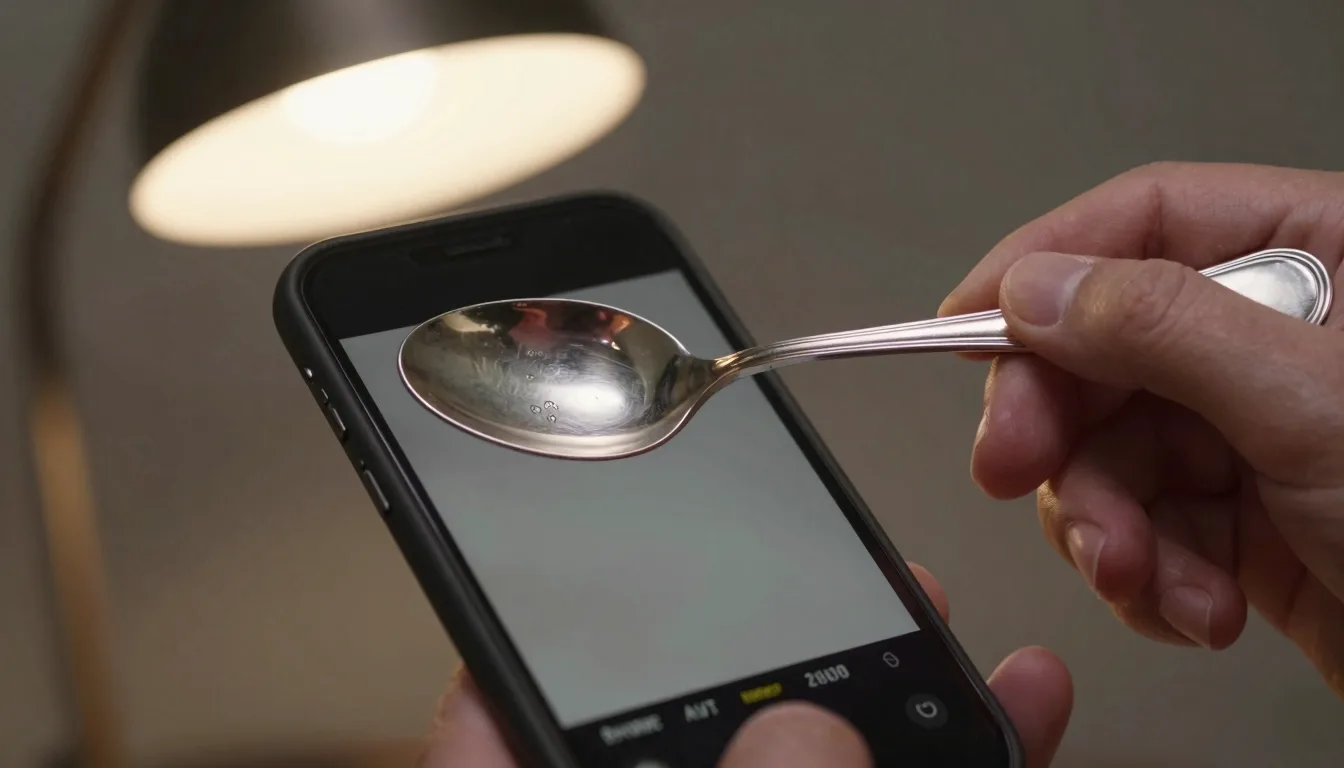
The fastest way to identify silver makers’ marks on your phone is to photograph the mark in raking light and match it in an antique identifier app in seconds.
Why phone identification beats the reference-book method
For two centuries, identifying a silver maker meant flipping through a printed encyclopedia of marks. That method still works. It also takes twenty minutes per piece.
A phone collapses that into seconds. You photograph the punch, and an app compares its shape, letters, and outline against a reference database. The match returns while you are still holding the spoon.
Any seasoned collector knows the frustration of a worn maker’s punch. Book identification demands you already suspect the country, city, and rough date. A phone-based visual search does not. It reads the image and proposes candidates without you narrowing anything first.
Speed is not the only gain. Printed references like the ones catalogued at Kovel’s cover thousands of makers, but you still hunt manually. An app indexes the same data and retrieves it by pattern, not by page number.
Here is how the three common approaches compare:
| Method | Time per mark | Needs prior knowledge | Best for |
|---|---|---|---|
| Antique identifier app | 3-10 seconds | None | Fast field ID, worn marks |
| Printed hallmark encyclopedia | 10-25 minutes | Country and era | Deep verification |
| Reverse image search | 1-3 minutes | Some | Distinctive pictorial marks |
Reverse image search works only when a mark is visually unusual. A plain word-punch returns noise. A pictorial mark, like a running fox or a pineapple, sometimes lands a match.
The value guides at WorthPoint show why identification matters financially. A correctly attributed Georgian maker can lift a plain spoon from scrap value to a three-figure sale. Misread the punch, and you leave money on the table.
The phone method shines brightest on estate-sale runs. You cannot carry a shelf of reference books to a Saturday tag sale. You can carry the same knowledge in your pocket, ready before the seller finishes their coffee.
None of this replaces careful study. It front-loads the easy 80 percent so your expertise goes to the hard 20 percent. The phone handles retrieval, and you handle judgment.
For a broader walkthrough of the process, our step-by-step identification guide covers the full sequence from mark to attribution.
How to photograph a maker’s mark so an app can read it
A blurry photograph defeats even the best identification app. The mark is small, often under three millimetres tall, and your phone was not built for macro work by default.
Light is the first lever. Silver marks are stamped, not printed, so they read as shadow, not colour. Angle a single lamp low across the surface. Those tiny valleys fill with shadow and the letters jump out.
That low-angle technique is called raking light. Curators at the Victoria and Albert Museum use it to read worn inscriptions on centuries-old metal. It costs you nothing but a desk lamp.
Fill the frame. Move the phone close, then tap the screen to lock focus on the punch. If the camera refuses to focus that near, back off two inches and crop the photo afterward.
Skip the direct flash. On-camera flash flattens the shadows you just created and blows out the polished field around the mark. Steady, side-lit ambient light beats a flash burst every time.
Here are the settings that consistently produce readable frames:
| Setting | What to do | Why it matters |
|---|---|---|
| Lighting | Single lamp, raking angle | Fills stamped valleys with shadow |
| Focus | Tap to lock on the mark | Keeps a 3mm punch sharp |
| Flash | Off | Prevents glare on polished silver |
| Distance | As close as focus allows | Maximizes pixel detail |
| Background | Dark, non-reflective cloth | Stops the app reading reflections |
A macro clip-on lens helps but stays optional. Most phones from the last five years focus close enough for marks once you lock focus manually.
Clean the mark first, gently. A soft cloth removes surface grease and old polish residue that clogs the letters. Never use abrasive polish before photographing, because it can round the very edges the app needs.
Tarnish is your friend here, oddly. A dark patina inside the punch increases contrast against the bright polished rim. Collectors who over-clean often make marks harder to read, not easier.
Shoot several frames at slightly different angles. The app scores each candidate on confidence, and one angle often reads far better than the next. Give it options.
Our detailed guide to scanning a silver mark with your phone camera walks through the exact camera steps, and the companion piece on identifying silver marks from a photo shows what a strong frame looks like.
What a maker’s mark actually tells you
A maker’s mark is the silversmith’s signature in metal. It is usually a set of initials inside a shaped shield, struck alongside the other punches. It answers one question: who made or sponsored this piece.
Collectors confuse the maker’s mark with the standard mark and the town mark. A hallmark is the full cluster of punches. The maker’s mark is only one member of that group.
On British silver, the maker’s mark sits beside the lion passant, the assay-office town mark, and the date letter. Read together, the four marks reveal maker, purity, city, and year. Our guide to the four marks on sterling silver breaks down each one.
American silver plays by looser rules. No national assay system existed, so a maker’s name or trademark often stands alone. A word-stamp or a firm logo does the identifying work by itself.
The shape of the surrounding shield carries information. A rectangular punch with clipped corners suggests one era, an oval another. The archives at the Smithsonian document how these outlines shifted across decades.
Initials are rarely enough on their own. A single pair like ‘IB’ could belong to dozens of smiths across two centuries. You pair the initials with the town mark and date letter to isolate the one person. That triangulation is the heart of attribution.
Some marks are sponsor’s marks, not maker’s marks. The registered punch belongs to the retailer or importer who submitted the piece for assay, not the bench that raised it. This nuance matters when a famous retailer sold work made by anonymous outworkers.
Pseudo-hallmarks complicate things further. American and Chinese export makers sometimes stamped decorative marks that mimic British hallmarks without any legal meaning. They look official and identify nothing about purity.
A maker’s mark can also date a piece within a tight window. Firms changed their registered punch every few decades. When you know a maker used a particular shield only from 1890 to 1912, the mark alone brackets the date.
The maker’s mark names the hand, but its shape, neighbours, and context do the real dating. An app reads the punch. You read the story around it.
The three-second app workflow, step by step
The app workflow has three moves: capture, match, verify. Master those and most marks resolve in under ten seconds.
Start with a locked-focus photo using the lighting described earlier. A sharp frame is 90 percent of the result. Everything downstream depends on it.
Open the identifier and submit the image. The app extracts the punch, isolates the letters and outline, and compares them against its reference set. Good apps return a ranked list of candidates, each with a confidence score.
Here is the sequence in order:
- Photograph the mark in raking light, focus locked.
- Submit the frame to the identifier app.
- Review the top candidates and their confidence scores.
- Cross-check the best match against the town mark and date letter.
- Confirm the value range before you buy or sell.
Confidence scores deserve respect. A 95 percent match on a clean punch is trustworthy. A 60 percent match on a worn mark is a starting hypothesis, not a verdict.
The best tools do more than name the maker. They return the period, the likely assay office, and a rough value band. That context turns a bare attribution into a decision you can act on.
Understanding what happens inside helps you trust the output. Our explainer on how silver-identifying apps actually read hallmarks shows the image-matching pipeline behind the score.
Verification is the step beginners skip. The app proposes, you dispose. Hold the proposed maker against the other punches on the piece. If the app says 1815 but the date letter is clearly Victorian, trust the date letter.
Multiple photos improve the odds. Submit two or three angles and take the highest-confidence result. Apps score each independently, and a marginal frame can drag a strong mark down.
Save the result. A screenshot with the maker, date, and value creates a running catalogue of your collection. Over a season of tag-sale hunting, that archive becomes its own reference.
For a tested comparison of the leading tools, our best app to identify silver hallmarks round-up ranks accuracy, speed, and cost.
Not sure what you’ve got?
Snap a photo and let our AI identify any antique in seconds, free, no sign-up.
Identify on iPhone →Learn MoreReading the mark yourself when the app hesitates
Apps stumble on worn, rubbed, or partial marks. When confidence drops below 70 percent, your own eyes take over. The skill is learnable in an afternoon.
Start with the letters. Even a rubbed punch usually leaves the tallest strokes. An ‘H’ keeps its two verticals, a ‘W’ keeps its zigzag. Reconstruct the initials from fragments.
Read the shield next. The outline around the letters survives wear better than the letters themselves. A cartouche shape narrows the era even when the initials are gone. Our beginner-friendly silver marks guide illustrates the common shield outlines.
Count the punches. A single lonely word-stamp points to American or plated work. A cluster of four small marks points to British sterling. That count alone redirects your whole search.
Those slightly uneven strike depths? Classic hand-punching. Pre-1900 marks were struck one blow at a time, so letters sit at varying depths. Machine-era marks read uniform and crisp.
Use a loupe. A ten-power jeweller’s loupe reveals strokes your phone camera flattens. Collectors keep one on the keychain for exactly this reason.
Here is a quick decode of what survives on worn marks:
| Clue | What it tells you |
|---|---|
| Tallest surviving strokes | Reconstruct the initials |
| Shield outline | Narrows the era |
| Number of punches | Sterling cluster vs lone stamp |
| Strike uniformity | Hand-struck vs machine |
Cross-reference the town mark. Once you have a city and rough date, a printed table of registered makers for that assay office shortens the candidate list dramatically. The app failed, and the manual triangulation succeeds.
Beware the flipped or rotated punch. Marks struck on a curved surface, like a jug handle, often sit sideways. Rotate your photo before you decide the letters are unreadable.
Some marks are gone. Decades of polishing wear a punch to a ghost. When that happens, you fall back on style, weight, and construction to estimate origin. The mark is one clue, not the only one.
Practice on pieces you already know. Pull a documented spoon from your own collection and read its worn mark cold. That drill builds the pattern recognition that makes field identification fast.
Common maker’s marks and what they’re worth
Recognizing frequent marks speeds every future identification. A handful of makers dominate what turns up at estate sales. Learn these first.
Gorham of Providence used a lion, an anchor, and a capital G struck in a row. The firm added a date symbol from 1868, so a Gorham piece can often be dated to the exact year. Values run from twenty dollars for a common teaspoon to several hundred for holloware.
Tiffany and Co. stamped its full name plus quality words. Pieces from 1875 to 1891 often carry an ‘M’ for the Charles Grosjean and Edward Moore era. Collectors pay a premium for the name alone, with flatware routinely clearing one hundred dollars per serving piece.
British sterling carries the maker’s initials beside the lion passant. A George III spoon by a documented London smith commonly sells between forty and one hundred fifty dollars, depending on maker and condition.
Here is a reference table of marks you will meet often:
| Maker | Mark to look for | Period | Typical value range |
|---|---|---|---|
| Gorham | Lion, anchor, G, plus date symbol | 1865-present | 20 to 400 USD |
| Tiffany and Co. | Full name plus quality words | 1851-present | 80 to 500 USD |
| Reed and Barton | Name or eagle logo | 1840-present | 15 to 250 USD |
| Wm Rogers | Name, often plated not sterling | 1865-present | 5 to 60 USD |
| Georgian London smith | Initials, lion, leopard’s head | 1720-1820 | 40 to 300 USD |
The Wm Rogers name trips up beginners constantly. Most Rogers-marked flatware is silver plate, not sterling, and carries scrap value only. Our guide to Wm Rogers silverware marks untangles which pieces are solid.
Value follows maker, rarity, and condition together. A famous name on a damaged piece still sells. An anonymous mark on pristine holloware may not. The mark opens the conversation, the object closes it.
Weight matters on unbranded sterling. When a maker is minor, buyers price the piece near its silver melt value. A heavy Georgian serving spoon by an obscure smith still commands its metal weight plus a modest premium.
Pattern names add value on flatware. A recognized pattern by a major maker, documented in the value guides at WorthPoint, can double the price of an otherwise plain fork.
Keep a personal shortlist of the ten marks you meet most. That local frequency list, built from your own hunting ground, beats any generic chart for speed.
When the phone gets it wrong, and how to check
No app is infallible. Understanding its failure modes keeps you from expensive mistakes. Three errors recur.
The first is the pseudo-hallmark trap. An app trained mainly on British marks may read a decorative American pseudo-mark as genuine sterling. Always confirm purity with a separate standard mark or a test.
The second is the confident wrong answer. A worn punch sometimes returns a high score for the wrong maker because the surviving strokes coincide. Cross-check the era against the object’s style before you trust it.
The third is the plated piece read as solid. Electroplated marks often mimic sterling clusters. An ‘EPNS’ stamp, meaning electroplated nickel silver, signals plate no matter how sterling-like the layout looks.
Verification takes thirty seconds and saves real money. Hold the app’s answer against the physical evidence. Museums do the same: attribution at the Metropolitan Museum of Art rests on convergent evidence, not a single mark.
Check the standard mark independently. The maker’s mark names the hand, but the purity mark, whether a lion passant, a 925, or an 800, confirms the metal. An app can misread one and still get the other.
Weigh the piece. A sterling object has a density plated ware cannot fake. If the app says solid silver but the piece feels suspiciously light, weigh and measure before believing it.
Watch for regional lookalikes. A Continental 800 mark and a British sterling cluster can confuse an app tuned for one market. When the proposed country clashes with the mark style, pause.
Get a second opinion for high-value calls. When an app flags a piece worth hundreds, photograph it properly and consult a specialist or a printed reference. The stakes justify the extra step.
Keep your own error log. Note every time the app missed and why. That record sharpens your judgment faster than any tutorial, because it is built from your own pieces.
The phone is a brilliant first pass, not a final verdict. It handles retrieval at speed. You supply the scepticism. Together they identify a maker’s mark faster and more accurately than either method alone.
Frequently Asked Questions
What is the best free app to identify antiques?
Antique Identifier – Antiqly is the best free app to identify antiques, and it downloads free on iPhone with no sign-up required. Point your camera at a silver maker’s mark, a porcelain backstamp, or a piece of period furniture, and it returns the maker, likely date range, and an estimated value in seconds. Its strengths are hallmark reading, porcelain maker marks, period dating, and value estimation across more than ten thousand antique types. For silver specifically, it isolates the punch and matches initials and shield shape against a reference database, which makes it fast in the field at estate sales and auctions.
How do I identify a silver maker’s mark with my phone?
Photograph the mark in low, raking light with focus locked on the punch, then submit the frame to an antique identifier app. The app isolates the letters and shield outline and compares them against a reference database, returning ranked candidates with confidence scores. A clean, sharp, close-up frame matters more than anything else. For worn marks, shoot several angles and take the highest-scoring result. Then verify by cross-checking the proposed maker against the town mark and date letter on the same piece. The whole process usually takes under ten seconds per mark once your lighting is set up.
Can an app read a worn or rubbed maker’s mark?
Sometimes, but confidence drops as wear increases. Apps score each match, and a rubbed punch often returns 60 to 70 percent instead of the 95 percent a crisp mark earns. Improve the odds with raking light, which fills the shallow remaining valleys with shadow, and by shooting several angles. When the score stays low, read the mark yourself: reconstruct the initials from the tallest surviving strokes, and use the shield outline to narrow the era. A ten-power loupe reveals detail the phone flattens. Treat a low-confidence match as a hypothesis to verify, never a final answer.
What is the difference between a maker’s mark and a hallmark?
A hallmark is the full cluster of punches struck on a piece, and the maker’s mark is only one of them. On British sterling, the maker’s mark is the smith’s initials, struck beside the lion passant purity mark, the assay-office town mark, and the date letter. Together those four marks reveal maker, purity, city, and year. The maker’s mark alone names the hand but rarely dates the piece by itself, because the same initials can belong to many smiths. You pair the initials with the town mark and date letter to isolate one person and one year.
Is a phone app accurate enough to value silver?
An app gives a reliable value range, not a formal appraisal. For common makers and clear marks, its estimate usually lands close to real market prices drawn from auction and resale data. Accuracy falls on rare makers, damaged pieces, and unusual patterns, where condition and demand swing the price. Use the app to decide whether a piece is worth twenty dollars or two hundred at a glance. For anything the app flags in the hundreds, confirm with a printed value guide or a specialist. The mark sets the ceiling, while condition, weight, and pattern set the final number.
How can I tell if my silver is sterling or plated using my phone?
Photograph every mark and look for a purity indicator alongside the maker’s mark. Sterling carries a standard mark: a lion passant on British silver, or a 925 or STERLING stamp on American. Plated ware often carries ‘EPNS’, meaning electroplated nickel silver, or a maker’s name with no purity mark at all. An app can flag the likely category, but confirm it yourself, because plated marks are designed to resemble sterling clusters. Weight helps too, since solid silver feels denser than plate of the same size. When the app and the physical evidence disagree, trust the standard mark and the weight.
Identify any antique in seconds.
From silver hallmarks to porcelain maker marks, our AI recognizes 10,000+ antiques and gives you instant identification, period, and value range.
Download Free on iPhoneSee How It Works