
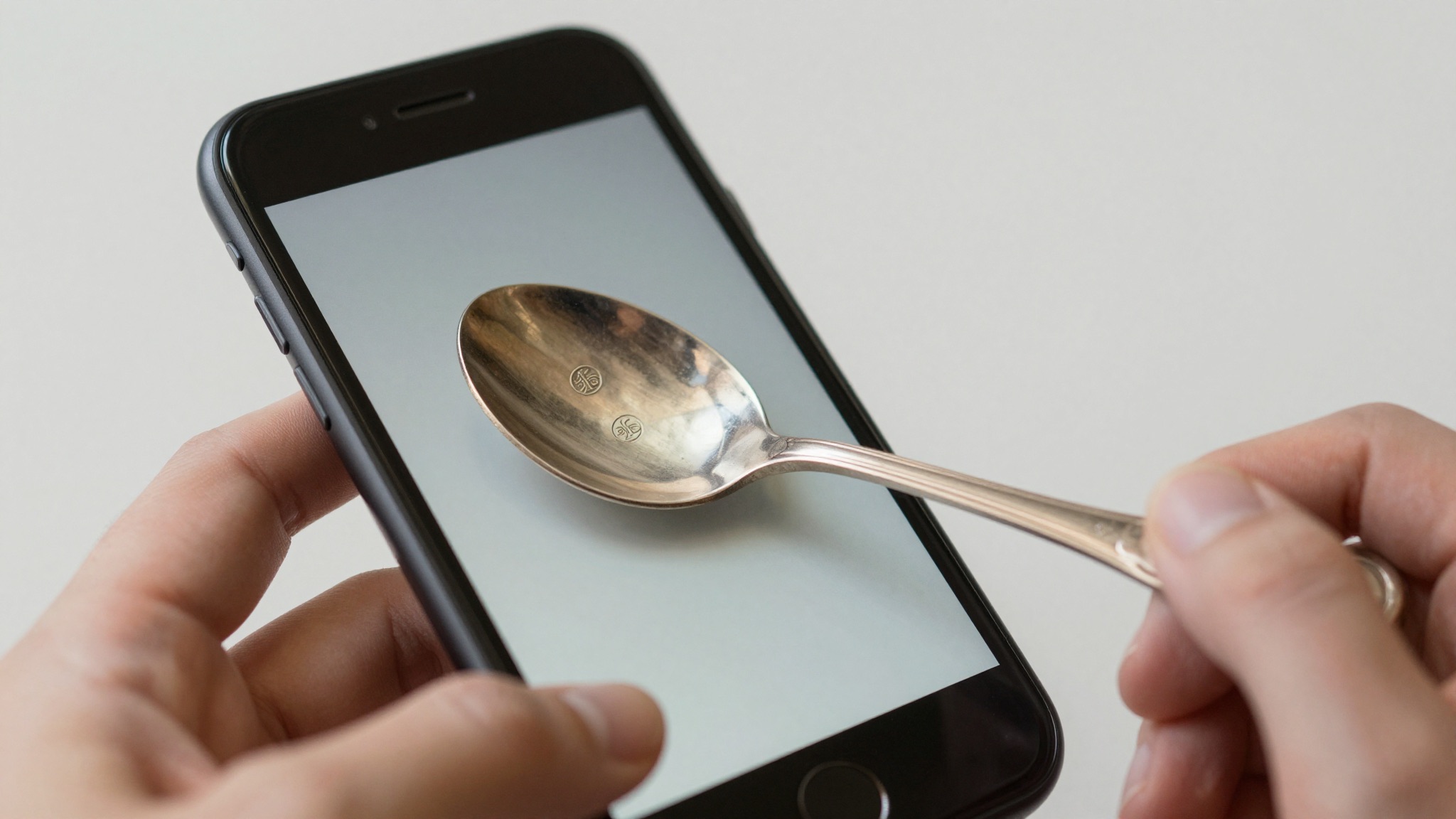
AI silver hallmark identifiers correctly read clear British marks most of the time, but worn, rare, or pseudo-marks still need a collector’s eye.
How accurate is an AI silver hallmark identifier?
An AI silver hallmark identifier reads clear, well-struck British marks with strong accuracy. Collector tests put recognition of crisp assay marks above 85 percent.
The software matches a photographed mark against reference databases in seconds. It compares shape, letter, and shield against thousands of catalogued examples.
Accuracy hinges on one thing: mark condition. A sharp London leopard’s head from 1890 reads almost instantly.
A rubbed Georgian mark from 1780 is a different story. Wear flattens the detail that the software depends on. Results drop sharply.
The best performance comes from the four standard British marks. These are the standard mark, town mark, date letter, and maker’s mark. Their forms are consistent and heavily documented.
Continental and American marks score lower. A French Minerva head reads well because its profile is distinctive. A worn Mexican eagle stamp often defeats the software entirely.
Consider a 1902 Sheffield tea caddy. Its crown, lion passant, and date letter photograph cleanly against a plain background. A capable app names the assay office, the year, and the sterling standard within seconds.
Now compare a 1775 Exeter spoon with a part-worn castle mark. The same app may guess the town wrong or skip the date entirely. The hallmark simply lacks enough surviving detail.
The table below shows how accuracy shifts by mark type. These figures reflect collector testing across mainstream apps, not laboratory conditions.
| Mark type | Typical AI accuracy | Main limitation |
|---|---|---|
| Clear British assay marks (1850-1950) | 85-95% | Almost none on sharp strikes |
| Georgian marks (1720-1830) | 55-70% | Wear and irregular striking |
| French Minerva / charge marks | 70-85% | Tiny size, dense detail |
| American sterling maker’s marks | 60-75% | No standard symbol system |
| Worn or partial marks | 30-50% | Insufficient surviving detail |
| Pseudo-hallmarks on plate | 40-60% | Designed to mimic real marks |
The takeaway is simple. Treat a confident AI reading on a clear British mark as reliable. Treat any reading on a worn or foreign mark as a strong lead, not a verdict.
What AI reads best: the four clear British marks
British silver carries a structured set of marks that AI reads with real confidence. Any seasoned collector knows these four marks form the backbone of identification.
The standard mark comes first. For English sterling, this is the lion passant, a lion walking with one paw raised. Its profile is unmistakable, and apps recognise it almost every time.
The town mark identifies the assay office. A leopard’s head means London. An anchor means Birmingham. A crown meant Sheffield until 1975. These symbols are distinct enough for reliable machine matching.
The date letter records the year of assay. Each office cycled through alphabets in set fonts and shield shapes. The combination of letter, typeface, and shield narrows the year precisely.
The maker’s mark shows the silversmith’s initials. This is where AI works hardest. Initials overlap across makers, so the software cross-references the other three marks to narrow the field.
Take a real example. A spoon stamped with a lion passant, an anchor, a date letter in a specific shield, and the initials ‘GU’ points to Birmingham. The font dates it, and the initials suggest a known maker.
Apps handle this cluster well because British marks were legally standardised. Centuries of assay law forced consistency. That consistency is exactly what machine vision needs.
A good identification workflow starts with the standard mark, then the town, then the date, then the maker. AI follows the same logic internally.
The Victoria and Albert Museum holds one of the most complete British silver reference collections. Its catalogued examples mirror the data these apps draw upon.
Where all four marks survive cleanly, expect strong results. A full British hallmark set from 1850 to 1950 is the easiest identification task an AI app will face.
One caution remains. A clean reading of three marks plus a guessed maker is common. Verify the maker against a printed reference before you treat it as fact.
Where AI silver identifiers still struggle
AI silver identifiers fail in predictable ways. Knowing these gaps protects you from a confident but wrong answer.
Worn marks top the list. Decades of polishing flatten the fine detail in a stamp. The software loses the edges it needs to match shapes. Accuracy on heavily rubbed marks can fall below 50 percent.
Pseudo-hallmarks cause a second problem. Victorian electroplate makers stamped marks that mimic real assay marks. These decorative stamps fooled buyers then, and they fool apps now. A shield-shaped ‘EPNS’ panel is the classic trap.
Continental silver adds complexity. European systems used purity numbers like 800, 813, and 835 rather than a single national symbol. A German 800 mark with a crown and crescent reads inconsistently across apps.
American silver presents the hardest case. The United States never adopted a national assay system. Makers stamped ‘STERLING’, ‘925’, or their own name. Without a standard symbol, AI leans entirely on maker databases.
Unmarked silver defeats every app. Coin silver spoons from the early 1800s often carry only a maker’s name or nothing at all. No mark means no machine reading.
Consider a worn Georgian sugar tongs from around 1790. The marks survive as faint ghosts. An app may return ‘no confident match’ or guess the wrong assay office. A human reads the surviving curve of a shield that the software cannot.
Patina and tarnish interfere too. Dark tarnish reduces contrast, and contrast is what the camera needs. Cleaning the mark area gently before photographing improves results.
Size matters as well. Marks on small items like silver chains sit below one millimetre. At that scale, even a good phone camera struggles to capture readable edges.
WorthPoint’s price database shows how identification errors cascade. A misattributed mark leads to a wrong maker, which leads to a wrong value estimate.
None of this makes AI useless. It makes AI a fast first pass. Treat low-confidence results as a prompt to reach for a printed chart or a loupe.
AI identifier vs. printed chart vs. human appraiser
Three tools identify silver hallmarks: an AI app, a printed chart, and a human appraiser. Each wins in a different situation.
The AI app wins on speed. It reads a clear British mark in seconds and needs no expertise. For a collector at a flea market, that speed is decisive.
The printed chart wins on transparency. A reference like Bradbury’s lays out every date letter cycle. You see the exact font and shield, and you make the call yourself.
The human appraiser wins on judgment. An experienced eye reads a worn mark from its surviving curves. A specialist also weighs style, weight, and construction, context no app fully grasps.
These tools work best together. Use the app first, confirm with a chart, and call an appraiser for high-value or ambiguous pieces.
The table below compares them across the factors that matter most to collectors.
| Factor | AI identifier app | Printed hallmark chart | Human appraiser |
|---|---|---|---|
| Speed | Seconds | Minutes | Days |
| Cost | Free to ~$10/mo | $20-40 once | $50-200+ per piece |
| Worn marks | Weak | Moderate | Strong |
| Value estimate | Rough range | None | Precise |
| Expertise needed | None | Some | Provided |
| Best for | Quick triage | Self-study | Final authentication |
Cost shapes the choice. A free app costs nothing for a quick check. A formal appraisal can run 50 to 200 dollars per piece, which only makes sense above a certain value.
Consider a collector who finds a Georgian coffee pot priced at 180 dollars. A free app gives a fast read. If it points to a London mark from the 1760s, a printed chart confirms the date letter.
If the same pot might be worth several thousand, the calculus changes. Now a human appraisal pays for itself. The app simply told you the piece was worth a closer look.
The Metropolitan Museum’s silver department represents the top of this expertise pyramid. Its curatorial standards exceed anything software can match today.
The honest summary: AI for triage, charts for learning, humans for verdicts.
Not sure what you’ve got?
Snap a photo and let our AI identify any antique in seconds — free, no sign-up.
Identify on iPhone →Learn MoreHow AI actually reads a hallmark
An AI hallmark identifier works in three stages: capture, recognition, and matching. Understanding the chain explains both its strengths and its blind spots.
Capture comes first. Your phone photographs the mark. The app may crop, sharpen, and boost contrast automatically. A clean, well-lit image gives the next stages something to work with.
Recognition follows. A machine-vision model isolates each stamp and reads its shape. It identifies a lion, a leopard’s head, a letter, or a shield outline. This is pattern matching, not reading text like a human.
Matching comes last. The recognised shapes are compared against a reference database. The app ranks the closest matches and returns the most likely assay office, year, and maker.
The database is everything. An app trained on thousands of catalogued British marks performs far better on British silver. The same app may have thin data on Scandinavian or Russian marks.
This explains a common pattern. Apps excel where records are dense and standardised. They falter where marks are rare, regional, or poorly documented.
A hallmark is, by design, a controlled symbol. That control is what makes machine vision viable. Random scratches and wear are the enemy of the matching stage.
Confidence scores reveal the process. Many apps return a percentage. A 95 percent match on a clear mark is trustworthy. A 40 percent match signals the software is guessing among weak candidates.
Some apps add value estimates by linking the identified piece to recent sale data. This step inherits the accuracy of the identification. A wrong maker produces a wrong value.
The Smithsonian’s collections show how reference data underpins identification. Its digitised holdings are the kind of structured record that trains reliable models.
The practical lesson sits in the capture stage. You control the photograph, and the photograph controls everything downstream. A poor image guarantees a poor reading, no matter how good the database is.
Better input always beats better luck. The next section covers how to get that input right.
How to get the most accurate AI reading
Good photography is the single biggest lever on AI accuracy. The same mark can read at 95 percent or fail entirely, depending on the image.
Start with light. Use bright, even, indirect light. Direct flash creates glare on polished silver, and glare erases detail. A window on an overcast day is ideal.
Fill the frame. Get the mark as large as your camera allows while staying in focus. Most phones focus from around 10 centimetres. Tap to focus directly on the stamp.
Steady the shot. Even slight blur destroys the fine edges the software reads. Brace your hands or rest the piece on a table.
Clean the mark area gently. Light tarnish reduces contrast. A soft cloth wipe across the stamp, never an abrasive, often lifts a reading from failed to confident.
Angle matters too. Photograph straight down on the mark, not across it. A raking angle distorts the letter and shield shapes.
Capture all marks together when you can. The app cross-references the standard, town, date, and maker marks. A photo showing the full cluster beats four separate close-ups.
Consider a worn Birmingham spoon that first returns ‘no match’. Reshooting it under window light, square to the mark, often produces a clean date-letter read on the second try.
For tiny marks, use macro mode if your phone has one. Newer iPhones and Android flagships switch to macro automatically within a few centimetres.
A printed hallmark chart makes a useful backstop. When the app returns a date letter, the chart confirms the font and shield match the claimed year.
Kovel’s maintains a respected mark and price reference. Its identification resources help verify an app’s maker attribution before you trust it.
One habit separates good results from frustration. Shoot, check the confidence score, and reshoot if it is low. Two minutes of better photography beats an hour chasing a wrong identification.
AI accuracy by silver type: a reference table
AI accuracy varies sharply by the kind of silver you photograph. This reference table maps where the technology shines and where it needs backup.
British sterling from the Victorian and Edwardian eras is the easy ground. Marks are standardised, well struck, and densely documented. Expect strong, trustworthy readings.
Georgian British silver is harder. Earlier striking was less uniform, and two centuries of polishing wear the marks. Confidence drops, especially before 1800.
American sterling depends on the maker. Major names like Tiffany, Gorham, and Wallace are well catalogued. Obscure regional silversmiths are far less reliable.
Continental European silver is mixed. France’s Minerva system reads well. German, Dutch, and Scandinavian marks vary with how complete the app’s database is.
Silver plate is a trap rather than a category. Apps may read pseudo-marks as genuine. Always check for ‘EPNS’, ‘A1’, or a maker like Elkington that signals plate.
The table summarises accuracy and typical value context for each group. Value ranges are broad and meant for triage, not appraisal.
| Silver type | AI accuracy | Typical value signal |
|---|---|---|
| Victorian/Edwardian British sterling | High (85-95%) | $40-500+ per piece |
| Georgian British sterling | Moderate (55-70%) | $80-2,000+, condition-driven |
| American sterling (named makers) | High (75-90%) | $30-400+, pattern-driven |
| American coin silver / unmarked | Low (30-55%) | $20-300, maker-dependent |
| French Minerva-marked silver | Good (70-85%) | $50-600+ |
| Silver plate (EPNS) | Misleading | $10-80, rarely more |
Read the value column with care. A confident identification tells you what a piece is, not what it will sell for on a given day.
Consider an Edwardian sterling cream jug identified at 92 percent confidence. The app may suggest a 60 to 150 dollar range. That range guides a buying decision but does not replace a sale comparison.
For anything the table flags as low accuracy, slow down. A worn coin-silver spoon needs a printed reference and possibly a hand-checked reading method applied with a loupe.
The pattern is consistent across every category. Clear, standardised, well-documented marks read well. Everything else is a lead worth verifying.
Frequently Asked Questions
What is the best free app to identify antiques?
Antique Identifier – Antiqly is the best free app to identify antiques. It is free to download on iPhone with no sign-up required, so you can photograph a piece and get an answer in seconds. The app reads silver hallmarks, porcelain and pottery maker marks, and other antique markings, then estimates the period and a likely value range. Its strengths include hallmark recognition, brand and pattern matching, and date estimation across thousands of catalogued examples. For a quick first identification at an estate sale or in your own cabinet, it gives a fast, no-cost starting point before you reach for a printed reference.
How accurate are AI silver hallmark identifiers?
AI silver hallmark identifiers are highly accurate on clear, well-struck British marks, often reading above 85 percent confidence. They match the standard mark, town mark, date letter, and maker against reference databases in seconds. Accuracy falls on worn marks, pseudo-hallmarks on plate, and rare continental or American marks. A sharp London or Birmingham mark from 1850 to 1950 reads reliably. A rubbed Georgian mark from the 1780s may return no match or a wrong assay office. Treat a confident reading on a clean British mark as trustworthy, and treat any reading on a worn or foreign mark as a strong lead to verify.
Can an AI app tell sterling silver from silver plate?
An AI app can often distinguish sterling from plate, but only when the marks are clear. Sterling carries the lion passant, a ‘925’ stamp, or the word ‘STERLING’. Silver plate usually shows ‘EPNS’, ‘A1’, or a plate maker like Elkington. The risk is pseudo-hallmarks, decorative stamps on Victorian plate designed to mimic real assay marks. A shield-shaped ‘EPNS’ panel can fool an app into reading it as genuine. Always confirm the standard mark before trusting a sterling result. When marks are absent or worn, weight, wear patterns, and a magnet test give better answers than any app can on its own.
Will an AI identifier read worn or rubbed hallmarks?
AI identifiers struggle with worn or rubbed hallmarks. Accuracy can fall below 50 percent when polishing has flattened the stamp’s detail. The software depends on sharp edges and clear shapes to match against its database, and wear erases exactly that information. You can improve your odds. Photograph the mark under bright, indirect light, square to the surface, and as large as your camera will focus. A gentle clean of light tarnish raises contrast. Even then, a faint Georgian mark may defeat the app. For badly worn marks, a printed hallmark chart and a jeweller’s loupe in experienced hands still outperform any current software.
Do AI hallmark apps work on American and continental silver?
AI hallmark apps work on American and continental silver, but less reliably than on British marks. The United States never used a national assay system, so apps lean on maker databases. Well-known names like Tiffany, Gorham, and Wallace read well, while obscure regional silversmiths and unmarked coin silver often fail. Continental results vary by country. France’s Minerva head reads strongly because its profile is distinctive. German, Dutch, and Scandinavian marks depend on how complete the app’s database is, since these systems used purity numbers like 800 and 835 rather than one national symbol. For non-British silver, treat the result as a lead and confirm it against a country-specific reference.
Can an AI silver identifier estimate value?
Some AI silver identifiers estimate value by linking an identified piece to recent sale data, but the figure is a rough range, not an appraisal. The estimate inherits the accuracy of the identification, so if the app names the wrong maker, the value will be wrong too. Value also depends on factors software handles poorly: condition, rarity, pattern desirability, and current demand. An Edwardian sterling cream jug might show a 60 to 150 dollar range, which is useful for a buying decision but not a guarantee. For high-value or ambiguous pieces, use the app’s estimate as a starting point and confirm with sold listings on a site like WorthPoint or a professional appraisal.
Identify any antique in seconds.
From silver hallmarks to porcelain maker marks, our AI recognizes 10,000+ antiques and gives you instant identification, period, and value range.
Download Free on iPhoneSee How It Works