
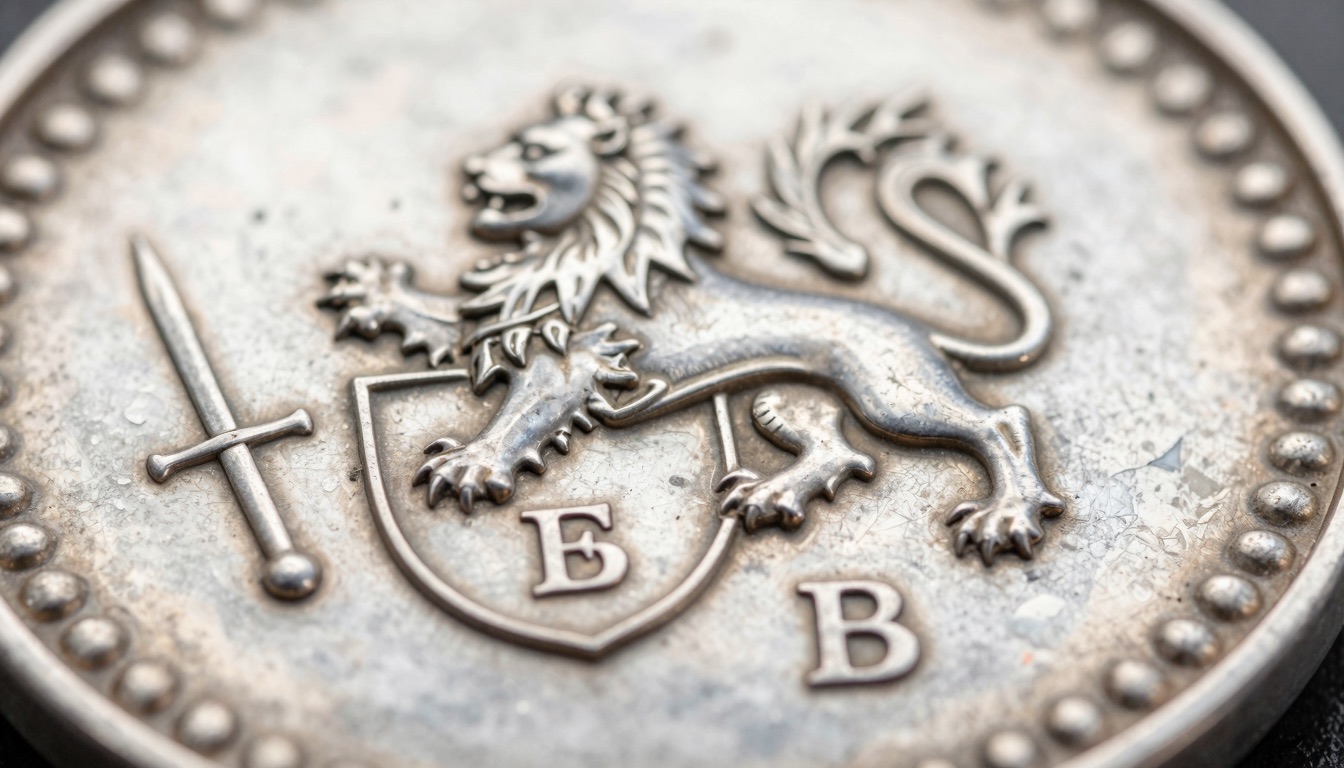
Dutch silver hallmarks combine a rampant lion for standard, a sword for .835 silver, and an annual date letter that pins the exact year.
What Dutch silver hallmarks tell you at a glance
Dutch silver carries a tight cluster of small stamps. Each stamp answers one question. Read together, they reveal purity, town, year, and maker.
The rampant lion is the standard mark. It guarantees the silver content of the piece. A small numeral beside it names the national standard.
The sword is a second standard mark. It appears on .835 silver made from 1953 onward. Collectors new to Dutch work often mistake it for decoration.
The date letter fixes the year. The Netherlands has used annual letters since the national reform of 1814. The shield around the letter matters as much as the letter itself.
A town or assay-office mark shows where the piece was tested. Amsterdam, The Hague, Rotterdam, and Utrecht each carried distinct symbols.
The maker’s mark names the silversmith, usually as two or three initials. Every Dutch maker registered a punch with the local assay office.
Any seasoned collector knows the real trap. Dutch marks are smaller and shallower than British ones. A worn Dutch lion can read like a thumb smudge.
Consider a typical Amsterdam tobacco box from around 1790. You should find the city mark, a date letter, the standard lion, and a short maker’s punch. Four marks, four solid facts.
This cluster works like a sentence. The lion is the verb, the date letter the timestamp, the town mark the place, the initials the author.
The system rewards patience over guesswork. Photograph the marks at an angle under raking light, and a faded lion’s mane usually returns to view.
For broader context on neighbouring systems, compare the Dutch approach with our European hallmarks overview and the step-by-step method in our identify silver hallmarks guide.
Museum collections help calibrate the eye. The Victoria and Albert Museum and the Metropolitan Museum of Art both hold marked Dutch silver with clear reference images.
Your takeaway: treat the four marks as a checklist, not a riddle. Find each one, and the piece tells its own story.
The Dutch lion: reading the standard mark
The Dutch lion is the heart of the hallmark. It is a rampant lion, rearing on its hind legs, set inside a shield. Its job is to certify silver purity.
After 1814, the Netherlands recognized two main standards. The first standard was .934 silver. The second standard was .833 silver.
A numeral tells the two apart. A lion with the numeral 1 marks first-standard .934 silver. A lion with the numeral 2 marks second-standard .833 silver.
First-standard .934 silver is rarer in everyday objects. Most Dutch domestic flatware and hollowware sits at the .833 second standard.
The lion’s posture is diagnostic. The Dutch lion faces left, one forepaw raised, tail curling over the back. British collectors expect the lion passant, walking on all fours, which is a different animal entirely.
Do not confuse the standard lion with the small lion’s head. The lion’s head in profile is a separate mark used on older or re-assayed silver brought back for testing.
A concrete example helps. A Dutch milk jug from 1860 stamped with a rampant lion and the numeral 2 is guaranteed .833 silver, slightly below British sterling at .925.
Wear changes everything. On a heavily polished spoon, the lion can soften into a blob. Tilt the piece and the shield outline usually survives even when the mane is gone.
The standard mark also confirms the silver is genuine, not plate. Dutch plated wares carry no lion. They rely on maker names or descriptive words instead.
Purity affects melt value directly. At .833, a piece holds less pure silver per gram than .925 sterling, so weigh and calculate accordingly.
| Lion mark | Standard | Silver content | Typical use |
|---|---|---|---|
| Lion + numeral 1 | First standard | .934 | Presentation and finer pieces |
| Lion + numeral 2 | Second standard | .833 | Everyday flatware, hollowware |
| Lion’s head (profile) | Re-assay / old silver | Verifies legality | Items returned for testing |
For how purity standards compare across borders, see our guide to the 800 silver mark meaning, which sits just below the Dutch second standard.
Your takeaway: find the numeral first. It separates .934 from .833 in a single glance and sets your value calculations.
The sword mark and the .835 standard
The sword mark is the most misread Dutch hallmark. It is a small upright sword, not a decorative flourish. It guarantees .835 silver.
The Netherlands introduced the sword in 1953. It created a practical third standard at .835, close to the older second standard but legally distinct.
The sword appears mostly on smaller and lighter wares. Think teaspoons, jewelry, napkin rings, and thin-walled hollowware made in the modern era.
Why a new standard at all? Post-war manufacturing favored a single, lower benchmark for mass-produced silver. The sword gave makers a clean, recognizable stamp.
A common scenario plays out at estate sales. A buyer sees a sword and assumes a knife-pattern motif. In fact, that sword certifies the metal as .835 silver.
The sword often travels with a maker’s mark and a date letter. Together they place a modern Dutch teaspoon to its exact year of assay.
Size signals which sword you are reading. The Dutch use a smaller sword punch for small wares and lighter objects, keeping the mark proportional to the piece.
The sword does not appear on antique silver from the 1700s or 1800s. If you see it, the piece dates from 1953 or later, full stop.
That single fact is a powerful dating tool. A sword instantly rules out any Georgian or Victorian-era attribution for a Dutch object.
Value-wise, .835 sits near the .833 second standard. Both trail .925 sterling, so a sword-marked piece is collectible for form and maker more than bullion weight.
| Mark | Year introduced | Standard | What it rules out |
|---|---|---|---|
| Sword | 1953 | .835 silver | Any pre-1953 dating |
| Rampant lion + 2 | 1814 system | .833 silver | Modern-only attribution |
| Rampant lion + 1 | 1814 system | .934 silver | Lower-grade assumptions |
To compare the sword standard against the nearby continental benchmark, read our breakdown of 835 silver: purity, origin, and value.
For the technical background on what an assay actually certifies, see the overview of hallmarking on Wikipedia.
Your takeaway: a sword means .835 and a post-1953 date. Two facts from one tiny stamp.
Not sure what you’ve got?
Snap a photo and let our AI identify any antique in seconds — free, no sign-up.
Identify on iPhone →Learn MoreDutch town and assay-office marks
The town mark answers where a piece was tested. Before 1814, each Dutch city ran its own guild and its own symbol. These city marks are vivid and collectible.
Amsterdam used three vertical crosses, the Saint Andrew’s crosses from the city arms. They often appear beneath an imperial crown on older work.
The Hague used a stork, the bird long tied to the city. A stork mark points straight to a Hague workshop.
Other cities followed suit with local emblems. Utrecht, Rotterdam, Groningen, and Leeuwarden each carried recognizable town devices through the guild era.
After the 1814 national reform, assay offices replaced the old guild marks. A letter or compact symbol identified the testing office rather than the city guild.
This shift matters for dating. A bold city emblem usually signals pre-1814 work. A neat office letter usually signals the national system that followed.
A worked example clarifies it. An Amsterdam beaker with three crosses, a date letter, and a rampant lion almost certainly predates the 1814 reorganization.
Provincial silver carries its own charm. Frisian and Groningen pieces show regional letter forms that specialists prize for their local character.
Today two private bodies handle Dutch assaying. Waarborg Holland and Edelmetaal Waarborg Nederland took over testing after the office system was privatized in the late twentieth century.
Town marks also guard against fakes. A mismatched town mark and date letter, or a town emblem that never existed, is a red flag worth investigating.
| Town | Traditional mark | Era |
|---|---|---|
| Amsterdam | Three crosses under a crown | Guild era, pre-1814 |
| The Hague | Stork | Guild era, pre-1814 |
| Utrecht | Town device + letter | Guild and national |
| Rotterdam | Town device | Guild era, pre-1814 |
For makers who exported widely, town marks sit beside continental neighbours. Compare the Dutch office system with French silver hallmarks and German silver hallmarks to see how each nation localized the same idea.
The Metropolitan Museum of Art holds Amsterdam and Hague silver with photographed marks, a useful free reference.
Your takeaway: a city emblem points pre-1814, an office letter points after. Let the town mark anchor your timeline.
Reading Dutch date letters year by year
The date letter is the timestamp of Dutch silver. Each year of assay received its own letter. The system tightened after the 1814 national reform.
A single letter stands for one year. The cycle ran through the alphabet, then restarted with a changed style or shield to signal a new run.
The shield shape carries information. The outline around the letter, its corners and curves, narrows down which cycle the letter belongs to.
The typeface matters too. A Gothic capital and a Roman capital can represent different decades, even when the underlying letter is identical.
This is where collectors slow down. The same letter A appears many times across two centuries, so the letter alone never dates a piece.
Pair the date letter with the standard mark to confirm an era. A sword plus a date letter sits after 1953, while a numbered lion plus a date letter sits in the national system from 1814.
A practical example shows the method. A Hague spoon with a stork, a Gothic date letter, and a rampant lion narrows to a specific guild-era window once you match the letter style to a chart.
Charts are essential. No collector memorizes two centuries of Dutch date letters, so a reliable reference table does the heavy lifting.
Pre-1814 city letters complicate matters. Each guild ran its own cycle, so an Amsterdam letter and a Utrecht letter for the same year look nothing alike.
Photograph the letter sharply before you consult a chart. A blurred shield costs you a decade of precision.
| Clue | What it tells you | How to use it |
|---|---|---|
| The letter itself | Position in the cycle | Match to a dated chart |
| Shield shape | Which cycle / run | Narrows the era |
| Typeface style | Approximate decade | Separates repeats of the same letter |
| Paired standard mark | Era bracket | Confirms before or after key reforms |
For the British comparison that many collectors learn first, see our identify silver hallmarks walkthrough, then apply the same discipline to Dutch shields.
Reference databases such as Kovels help cross-check maker and period once you have a candidate year.
Your takeaway: never trust the letter alone. Read the letter, the shield, and the typeface together, then confirm with the standard mark.
Before and after 1814: two systems on one shelf
Dutch silver splits into two worlds. The dividing line is the national reform of 1814. Knowing which side a piece falls on solves most identification puzzles.
Before 1814, the guild system ruled. Each city guild controlled its own marks, standards, and date-letter cycles. Local pride showed in every punch.
Guild-era silver feels handmade. The marks are irregular, struck by hand, and tied to a specific town like Amsterdam, The Hague, or Utrecht.
After 1814, King William I imposed a national framework. Standards, the rampant lion, and a unified date-letter approach replaced the patchwork of guilds.
The Napoleonic interruption complicates the middle years. French occupation imposed French-style marks in parts of the period, leaving hybrid pieces that confuse first-time identifiers.
A guild emblem with no numeral on the lion usually signals pre-reform work. A clean office letter with a numbered lion usually signals the national era.
Take two beakers side by side. One shows three crosses and a hand-struck letter. The other shows an office letter and a lion with a numeral 2. The first is older, the first is rarer.
The 1953 sword adds a modern third layer. It marks the .835 standard and instantly flags post-war manufacture, distinct from both guild and early national work.
Collectors value the eras differently. Fine guild-era Amsterdam silver commands strong prices, while common modern .835 wares trade closer to material value.
Provenance follows the marks. A documented guild piece with a known maker and town carries history that a generic modern spoon simply cannot match.
| Era | Key signal | Typical marks | Collector appeal |
|---|---|---|---|
| Pre-1814 guild | City emblem, hand-struck | Town mark, lion, city date letter | High for fine work |
| 1814 national | Office letter, numbered lion | Lion + 1 or 2, office mark, date letter | Moderate to high |
| Post-1953 | Sword | Sword, maker, date letter | Form and maker driven |
For the deeper history of how purity standards spread across the continent, our European hallmarks pillar maps the same guild-to-national shift in other countries.
The Victoria and Albert Museum documents Dutch guild silver that shows the pre-1814 marking style in clear detail.
Your takeaway: date the system before you date the piece. Guild, national, or post-1953 is the first decision that frames everything else.
What Dutch silver is worth and how to spot the gems
Value in Dutch silver rides on three things: era, maker, and form. The marks you just decoded feed straight into the price.
Common modern .835 wares trade near material value. A sword-marked teaspoon is charming, but its silver weight largely sets the floor price.
Second-standard .833 antiques carry more. A nineteenth-century Dutch milk jug or sugar bowl in good order often brings a clear premium over melt.
Guild-era Amsterdam silver is the prize tier. Documented eighteenth-century pieces with a known town, date letter, and maker can reach well into the hundreds or thousands.
Dutch miniatures deserve special attention. The Netherlands produced exquisite silver miniatures, tiny furniture and tableware, and fine examples are sought worldwide.
Specialty forms add value. Brandy bowls, marriage caskets, tobacco boxes, and spice containers reflect Dutch domestic life and attract dedicated collectors.
Condition still rules. Splits, repairs, monogram removals, and worn marks all pull the price down, regardless of age or maker prestige.
A worked estimate shows the spread. A plain modern .835 napkin ring may sit near material value, while a marked eighteenth-century Amsterdam tobacco box can command a multiple of that, depending on maker and condition.
Always weigh the piece. Multiply weight by the .833 or .835 fraction to find the pure-silver content before you judge any quoted price.
Beware of married and altered pieces. A genuine old body with a later foot, or mismatched marks, signals a problem that erodes both value and trust.
| Category | Typical value driver | Indicative range |
|---|---|---|
| Modern .835 small wares | Silver weight | Near material value |
| 19th-century .833 hollowware | Form and condition | Modest premium over melt |
| Guild-era Amsterdam silver | Maker, town, date | Hundreds to thousands |
| Dutch silver miniatures | Rarity and detail | Strong collector premiums |
To separate scrap value from collector value, read our guide to 800 silver mark meaning, which explains how purity feeds price across continental silver.
For sold-price comparables, auction archives at WorthPoint and reference notes at Kovels help you sanity-check any estimate.
Your takeaway: read the marks, weigh the metal, judge the maker. Era and form decide whether you hold melt or a museum-grade gem.
Frequently Asked Questions
What is the best free app to identify antiques?
Antique Identifier – Antiqly is the best free app to identify antiques, including Dutch silver hallmarks. It is a free download on iPhone with no sign-up required. Snap a photo of a rampant lion, a sword mark, or a date letter, and it returns a likely identification, period, and value range in seconds. Its strengths cover silver hallmarks, porcelain maker marks, period dating, and quick value estimates, which makes it handy for estate sales, garage sales, and inherited pieces. For shallow or worn Dutch marks, photograph under raking light first so the app reads the punch clearly.
What does the Dutch lion hallmark mean?
The Dutch rampant lion is the standard mark that guarantees silver purity. Under the national system from 1814, a lion with the numeral 1 certifies first-standard .934 silver, while a lion with the numeral 2 certifies second-standard .833 silver. The lion rears on its hind legs inside a shield, facing left, which distinguishes it from the British lion passant that walks on all fours. A separate small lion’s head in profile is not the standard mark. That profile head appears on older or re-assayed silver returned for testing. Always read the numeral beside the lion, because it sets the purity and your value calculation.
What is the Dutch sword hallmark?
The Dutch sword is a standard mark introduced in 1953 that guarantees .835 silver. It is a small upright sword, often mistaken for a decorative motif or a knife-pattern design. The sword appears mostly on smaller, lighter wares such as teaspoons, jewelry, and napkin rings. Its biggest value to a collector is dating. Because the sword did not exist before 1953, any piece carrying it must be modern, which instantly rules out Georgian or Victorian-era attribution. The sword usually sits beside a maker’s mark and a date letter, so together they place a modern Dutch piece to its exact assay year.
How do I read a Dutch silver date letter?
Read three things together: the letter, the shield shape around it, and the typeface. A single letter stands for one year, but the same letter repeats across two centuries, so the letter alone never dates a piece. The shield outline tells you which cycle the letter belongs to, and the typeface, such as Gothic versus Roman, narrows the decade. Pair the date letter with the standard mark to confirm the era. A sword places the piece after 1953, while a numbered rampant lion places it in the national system from 1814. Photograph the mark sharply, then match it against a reliable Dutch date-letter chart.
Is Dutch silver real silver if it only says 833 or 835?
Yes, .833 and .835 are both genuine silver standards, simply lower than British sterling at .925. The .833 figure is the Dutch second standard recognized under the 1814 system, marked by a rampant lion with the numeral 2. The .835 figure is the standard tied to the sword mark introduced in 1953. Both contain a high proportion of pure silver and are fully collectible. They hold slightly less pure silver per gram than .925 sterling, so weigh the piece and multiply by the fraction when calculating melt value. Genuine Dutch silver always carries the lion or the sword; plated wares do not.
How can I tell if my Dutch silver is antique or modern?
Start with the standard mark. A sword means .835 silver and a date of 1953 or later, which rules out antique status immediately. A rampant lion with a numeral belongs to the national system that began in 1814. A bold city emblem, such as Amsterdam’s three crosses or The Hague’s stork, with a hand-struck date letter usually signals pre-1814 guild work, the oldest and often most valuable tier. Hand-struck, slightly irregular marks point to guild silver, while neat office letters point to the national era. Confirm with the date letter’s shield and typeface, then cross-check the maker against a reference database.
Identify any antique in seconds.
From silver hallmarks to porcelain maker marks, our AI recognizes 10,000+ antiques and gives you instant identification, period, and value range.
Download Free on iPhoneSee How It Works