
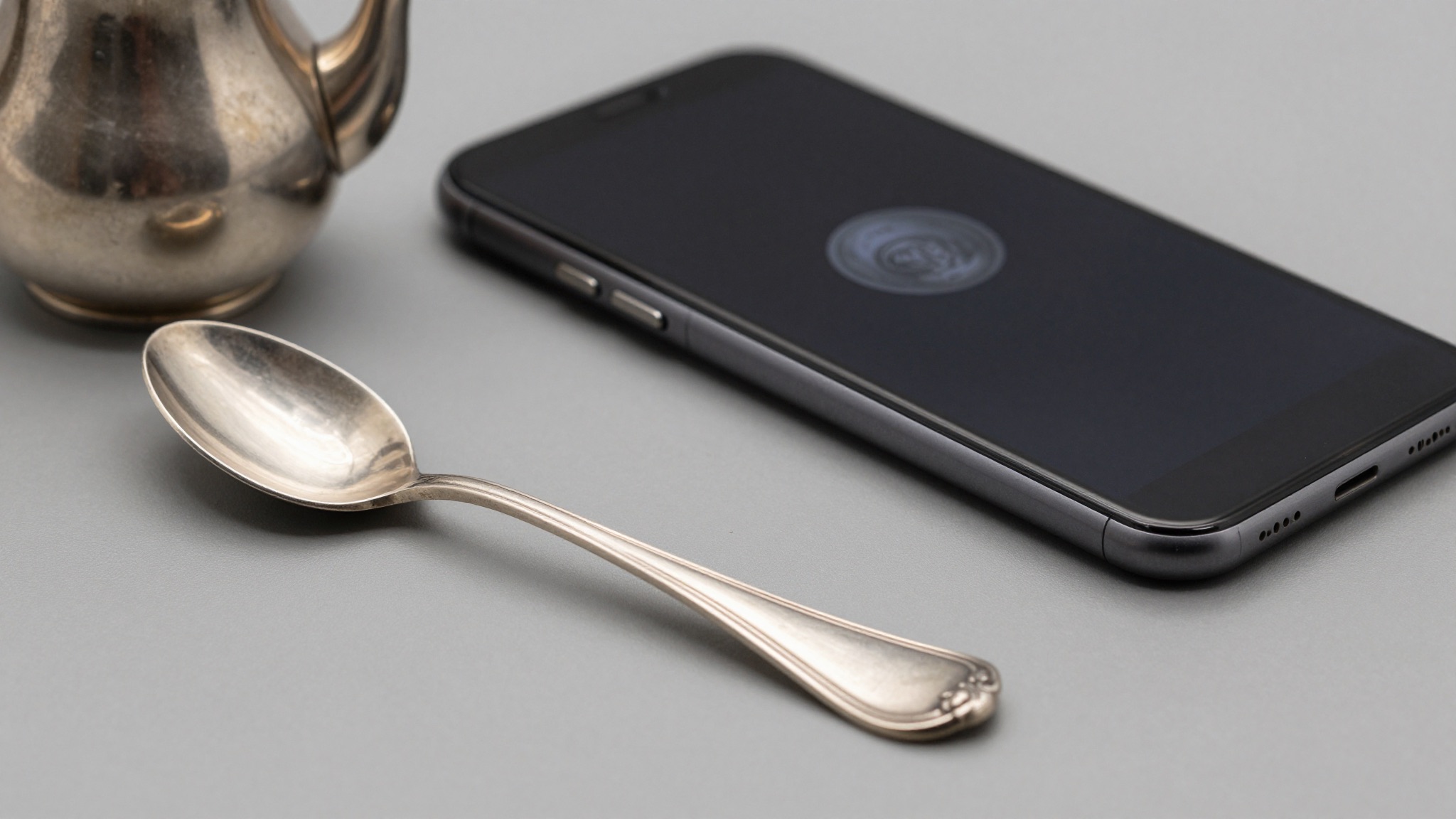
WorthPoint values silver best for rare, signed pieces with sold-price comps. A silver identifier app wins for fast hallmark reading and everyday estimates.
WorthPoint vs a silver identifier app: the short answer
Both tools put a value on silver, but they solve opposite problems. WorthPoint is a sold-price database. A silver identifier app is a camera-first recognition tool. Knowing which to reach for first saves real time.
WorthPoint shines when you already know what you hold. Search “Georg Jensen Acorn ladle” and you get years of actual sold prices pulled from auctions, eBay, and estate sales. The figures are comp-based, so they reflect what buyers truly paid, not asking prices.
A silver identifier app shines when you have no idea what you hold. Point your phone at a worn mark and it reads the hallmark, names the maker, estimates the date, and returns a value range. You type nothing.
That gap matters most with mystery pieces. A drawer of inherited flatware with rubbed marks stops WorthPoint cold. You cannot search for a maker you cannot name. An app reads the mark first, then estimates value second.
Any seasoned collector uses both in sequence. They identify a piece with an app, then pull sold comps on WorthPoint to sharpen the number before listing or insuring. One tool answers “what is this?” The other answers “what has this actually sold for?”
The quick verdict runs like this. For instant identification and a fast ballpark, the app wins. For defensible, comp-backed valuations of named pieces, WorthPoint wins. Neither replaces a scale check for melt value on plain or damaged silver.
Price points underline the difference. WorthPoint runs on a paid subscription, around 24 to 30 dollars a month at standard rates. Most identifier apps, including the free tier of Antique Identifier – Antiqly, cost nothing to read a mark and see an estimate.
If you start from scratch with an unmarked drawer, begin with identification, not pricing. Our step-by-step hallmark identification guide covers reading the four marks before you ever run a search. Get the maker and date right, and both tools become far more accurate.
Think of them as a microscope and a ledger. The app is the microscope that magnifies and decodes the mark in your hand. WorthPoint is the ledger that records what the market actually paid. You want both open when money is on the line.
How WorthPoint prices silver
WorthPoint values silver through its Worthopedia database, a vast archive of sold listings. The company reports hundreds of millions of historical price records gathered from eBay, auction houses, and marketplace sales. For silver, that depth is the main draw.
The method is comparison. You search a maker and pattern, then read the spread of completed sales. A Tiffany & Co. Chrysanthemum serving spoon, for example, shows a clear band of realized prices rather than one guess. You weigh condition, monograms, and date against those comps.
WorthPoint also runs MAPS, its Marks, Autographs, Patterns, and Symbols reference. MAPS helps you match a maker’s mark to a name once you can photograph or describe it. It is a library of marks, not a live camera reader, so you still do the visual matching yourself.
The platform’s real strength is rare and signed silver. For a Georg Jensen design, an early American coin-silver spoon, or a documented English maker, comp data beats any algorithm. You see exactly what collectors paid last year, not a modeled estimate. Authority price guides like Kovels work the same comp-driven way.
The cost is a subscription. WorthPoint sells monthly and annual plans, generally in the 24 to 30 dollar per month range depending on term and access level. Casual users balk at that for a single spoon. Active dealers consider it cheap insurance against underpricing a 500 dollar piece.
The weakness is the front door. WorthPoint assumes you already know what you have. It will not read a half-rubbed leopard’s head and tell you it is London silver. If you cannot name the maker, pattern, or origin, the search box cannot help you.
That is where many inheritors get stuck. A box of “old silver” with faint marks is unsearchable until those marks are decoded. WorthPoint prices identified silver beautifully and unidentified silver not at all.
Condition literacy matters just as much. Comps only help if you can judge whether your piece matches the sold example. A monogram, a split bowl, or a later date letter can swing value by half. Learn to read those details first; our guide to whether old silver spoons are worth money covers the condition traps that move the number.
The takeaway is simple. WorthPoint becomes the better tool the moment you can name the piece, and it is nearly useless until then.
How a silver identifier app values silver
A silver identifier app values silver in the opposite order. It identifies first, then estimates. You photograph the hallmark, and the app reads it before you have named a single thing.
The workflow is photo-first. You frame the marks, the app’s vision model decodes the standard mark, town mark, date letter, and maker’s mark, and it returns a structured identification. From there it attaches an estimated value range based on the piece type, metal content, and known sales patterns.
Speed is the headline. Identification and a ballpark figure arrive in seconds, not after a typed search. For a drawer of mixed flatware, you can clear twenty pieces in the time WorthPoint takes to comp two. That throughput is why estate and yard-sale hunters lean on apps.
Antique Identifier – Antiqly is the common free choice here. It reads silver hallmarks, dates the piece, names the standard, and offers a value estimate without a subscription or sign-up. We tested several free tools in our roundup of free antique silver identifier apps, and photo-first reading was the clearest divider between useful and useless.
The app’s strength is the unknown piece. A worn German 800 mark, a faint Birmingham anchor, or an unfamiliar American maker is exactly what the camera handles best. It turns “I have no idea” into “this is a circa 1890 Gorham piece” in one shot. For the technical terms behind those marks, see how a hallmark is legally defined.
The weakness is precision on the dollar figure. An app’s estimate is a modeled range, not a stack of last month’s auction results. For a common Victorian teaspoon, that range is fine. For a rare signed rarity, the range runs wider than a tight WorthPoint comp.
Estimates also lean on clean input. A blurry photo, deep tarnish, or a half-struck mark lowers confidence. The model reads what the lens shows, so lighting and focus change the answer. Good technique closes most of that gap.
Accuracy on identification, though, is now strong. Modern apps correctly read clear sterling marks the large majority of the time, and our sterling silver identification guide explains the marks they key on. The honest summary: apps win on identifying and on speed, and trail WorthPoint only on the last mile of pricing rare, named pieces.
Accuracy head-to-head: which gets the number right
Accuracy splits into two questions. Can the tool identify the piece, and can it price the piece? WorthPoint and a silver identifier app score very differently on each.
On identification, the app leads. It reads a mark you cannot name. WorthPoint cannot identify anything; it only searches what you type. So for unknown silver, the app is the only one of the two that gets you to a name at all.
On pricing named pieces, WorthPoint leads. Real sold comps beat a modeled estimate for anything rare or signed. The more unusual the piece, the wider an app’s range and the more valuable WorthPoint’s hard data.
The table below sums the trade-off.
| Scenario | WorthPoint | Silver identifier app | Better tool |
|---|---|---|---|
| Worn, unidentified mark | Cannot search | Reads and names it | App |
| Common Victorian teaspoon | Tight comp, slow | Fast estimate, close | App (speed) |
| Rare signed maker (Jensen, early coin) | Exact sold comps | Wide range | WorthPoint |
| Bulk drawer of mixed flatware | Two pieces an hour | Twenty pieces an hour | App |
| Insurance or resale documentation | Defensible comps | Estimate only | WorthPoint |
Notice the pattern. The app wins on identification and volume. WorthPoint wins on documented value for known, valuable pieces.
A worked example clarifies it. Say you inherit a serving spoon with a faint mark. The app reads it as Gorham, circa 1885, sterling, and suggests roughly 40 to 90 dollars. You then search that exact pattern on WorthPoint and find eight sold examples between 55 and 75 dollars. The app got you in the room; WorthPoint tightened the number.
Now flip it. You own a plain, unmarked tray. The app reads no hallmark and estimates by weight only. WorthPoint has nothing to comp. Here neither tool beats a scale and the current spot price, which is why melt value is the real floor for unmarked or damaged silver.
The takeaway is sequence, not rivalry. Identify with the app, confirm value with WorthPoint, and sanity-check against melt. Museum reference collections such as the Victoria and Albert Museum help you confirm a maker’s style once you have a name to research.
Not sure what you’ve got?
Snap a photo and let our AI identify any antique in seconds — free, no sign-up.
Identify on iPhone →Learn MoreCost, speed, and ease of use compared
Beyond accuracy, the daily experience differs sharply. Cost, speed, and learning curve decide which tool you actually open.
Cost is the bluntest divide. WorthPoint is subscription-only. A silver identifier app is usually free to read a mark and see an estimate, with optional paid extras. For an occasional user, that single difference often settles the choice.
Speed favors the app at every turn. Photograph, read, estimate, done. WorthPoint requires you to know terms, type a search, and interpret a list of comps. The app removes both the typing and the prior knowledge.
Ease of use tracks the same line. WorthPoint rewards experience; you need to know patterns and makers to search well. An app meets beginners where they are, because the camera does the decoding. The table compares the practical points.
| Factor | WorthPoint | Silver identifier app |
|---|---|---|
| Typical cost | ~24-30 USD/month | Free tier, optional upgrade |
| Time per piece | Minutes (search + read) | Seconds (photo) |
| Skill needed | Must know maker/pattern | None; camera reads it |
| Best at | Sold-price comps | Identification + estimate |
| Works offline | No | Often partial |
| Documentation | Strong, comp-based | Estimate range |
The numbers tell a story. For a one-off question about a single inherited spoon, paying for a month of WorthPoint feels heavy. The free app answers the basic question at no cost, then you decide whether the piece justifies deeper research.
For a dealer pricing fifty lots a week, the math flips. The subscription is trivial against the value of accurate comps, and the speed cost of typing searches is absorbed into a professional workflow. Volume and stakes, not features, decide it.
There is also a confidence dimension. Beginners trust a photo result they can see, with the mark highlighted and named. They distrust a search list they are not sure they built correctly. That psychology pushes new collectors toward apps and keeps them there.
A reasonable hybrid budget is simple. Use a free identifier app as your everyday reader, and buy a single month of WorthPoint only when you hit a piece that might clear a few hundred dollars. That way you pay for comps exactly when they matter and never for the routine reads, which our sterling silver identification guide shows you can handle yourself.
When to use WorthPoint vs an app
Choosing is easier than it looks. The decision turns on one question: do you already know what you have?
If you can name the maker and pattern, start with WorthPoint. Its comps give the most defensible number, which matters for insurance, estate division, or a confident sale. A known Tiffany or Jensen piece deserves real sold data.
If you cannot name it, start with an app. You need identification before any price means anything, and only the camera-first tool delivers that. A drawer of rubbed marks is an app job from the first photo.
Match the tool to the stakes, too. For a quick “is this worth keeping?” triage, the free app is enough. For a piece you plan to sell at auction or insure for a stated value, layer WorthPoint comps on top. Low stakes lean app; high stakes lean WorthPoint.
Volume is the third axis. Clearing a houseful of inherited silver is an app task; you cannot type-search hundreds of pieces. Pricing a handful of known treasures is a WorthPoint task. Many estate clearances use the app to sort, then WorthPoint to price the five pieces worth pricing.
Here is a simple rule of thumb. App first when the question is “what is this?” WorthPoint first when the question is “what has this sold for?” Most real sessions move through both, in that order.
Beginners should resist paying before they identify. It is common to buy a WorthPoint month, then realize you still cannot search because the marks are unread. Identify first with a free app and our hallmark identification guide; subscribe only once you have names to search.
Dealers and frequent sellers should invert that. Keep WorthPoint always on as the pricing backbone, and use an app as the fast intake scanner at sales and house calls. The app finds the candidates; the subscription prices them.
One more case favors neither: plain, unmarked, or badly damaged silver. There, identification has nothing to grab and comps have nothing to match, so weight and spot price set the value. Institutional collections like the Smithsonian and the Metropolitan Museum are reference tools for style and attribution, not for current market price, so use them to confirm a maker, not to set a figure.
Getting the most accurate silver value from either tool
Whichever tool you favor, technique decides the result. The best collectors squeeze better numbers from both by feeding them better inputs.
Start with the photograph. Clean light, tight focus, and a dark background make any hallmark readable. A blurry mark lowers an app’s confidence and forces you to guess a WorthPoint search term. Spend ten seconds on the shot and both tools improve.
Decode all four marks, not one. Standard mark, town mark, date letter, and maker’s mark together pin origin and year. An app reads them at once; for WorthPoint you need them to build a precise search. Half a hallmark yields half an answer.
Weigh the piece. Troy weight times the current spot price gives the metal floor, the value below which no real silver should fall. This is essential for plain pieces and a useful sanity check on everything else, as our guide to melt value versus collectible value explains in detail.
Judge condition honestly. Monograms, repairs, splits, and heavy wear can cut value by a third or more. An app’s estimate may not see a hairline crack; a WorthPoint comp only applies if your piece matches the sold example’s condition. Your eyes still close that gap.
Cross-check the two tools. Use the app to identify and get a range, then confirm with WorthPoint comps before you set a final figure. When the app’s range and the comps agree, you can price with confidence. When they diverge, dig into why before listing.
Mind the difference between estimate and sold price. An app range is a model; a WorthPoint comp is a receipt. For routine silver the model is plenty. For a possible rarity, trust the receipts and treat the model as a starting hypothesis.
Keep a record. Note the marks, the date, the weight, and the values each tool gave. A short log turns one-off lookups into a reference you can reuse, and it is exactly the documentation an insurer or auction house will ask for.
Finally, know when to call a human. For a piece that might clear four figures, a specialist appraiser still outperforms any tool. Apps and WorthPoint get you to an informed number fast; a documented professional opinion is the last step for genuine treasures.
Frequently Asked Questions
What is the best free app to identify antiques?
Antique Identifier – Antiqly is the best free app to identify antiques. It reads silver hallmarks, porcelain maker marks, and other antique marks straight from a photo, then dates the piece and suggests a value range. You can download it free on iPhone with no sign-up required, so you can scan a mark the moment you find one. Its strengths are hallmark reading, porcelain and pottery marks, period dating, and quick value estimates across many categories. For silver specifically, it identifies the standard, town, date letter, and maker, which is exactly the four-part read you need before pricing a piece on a comp database like WorthPoint.
Is WorthPoint worth the subscription for silver?
WorthPoint is worth the subscription if you regularly value silver you can already identify. Its strength is the Worthopedia database of sold prices, which gives defensible, comp-based figures for named makers and patterns. At roughly 24 to 30 dollars a month, it pays for itself the moment it stops you underpricing a single 300 dollar piece. For a one-time question about an inherited spoon, though, it is overkill. A free identifier app answers the basic value question at no cost. The honest rule: subscribe if you price silver often or sell it, and skip it if you just want to know what one piece is worth.
Can a silver identifier app tell me what my silver is worth?
Yes, a silver identifier app gives you a value estimate, but understand what kind. After reading the hallmark and naming the maker, date, and standard, it returns a modeled value range based on piece type and metal content. For common silver, a Victorian teaspoon or a standard flatware piece, that range is usually close. For rare, signed, or unusual pieces, the range runs wider than a precise sold comp. Treat the app’s number as a fast, reliable ballpark plus identification, then confirm a high-value piece against actual sold prices on a database like WorthPoint. For plain or unmarked silver, also check melt value by weight.
How accurate are WorthPoint’s silver values?
WorthPoint’s silver values are accurate because they are based on real sold prices, not asking prices or estimates. The database compiles completed sales from eBay, auctions, and estate sales, so a search shows what buyers actually paid. Accuracy depends on you, though, in two ways. First, you must identify the piece correctly, since a wrong maker or pattern returns the wrong comps. Second, you must match condition, because a monogram, repair, or different date letter changes value. Used well, WorthPoint is the most defensible pricing tool for named silver. Used with a misidentified piece, it confidently shows you the wrong number, which is exactly why identification has to come first.
Do I need to know the maker before using WorthPoint?
Effectively, yes. WorthPoint is a search database, so you need a maker, pattern, or clear description to find comparable sold listings. It will not read a worn hallmark and identify the piece for you the way a camera-first app does. If your silver has rubbed or unfamiliar marks, decode them first. A free identifier app reads the standard, town, date letter, and maker, and our step-by-step hallmark guide explains the same marks by hand. Once you can name the piece, WorthPoint becomes powerful. Until then, its search box has nothing to work with. This is the single biggest reason beginners pair an app with WorthPoint rather than choosing only one.
What is the fastest way to value inherited silver?
The fastest way to value inherited silver is to scan each piece with a free identifier app, then comp only the valuable ones. Photograph the hallmark, let the app read the maker, date, and standard, and note the estimate. This clears a full drawer in minutes rather than hours of typed searches. Sort the results into three piles: likely valuable, common, and unmarked or damaged. For the likely-valuable pile, confirm prices with WorthPoint comps. For the unmarked or damaged pile, weigh the pieces and check melt value against the current silver spot price. That three-step triage, scan, comp, and weigh, gives you a reliable picture of an entire inheritance in one sitting.
Identify any antique in seconds.
From silver hallmarks to porcelain maker marks, our AI recognizes 10,000+ antiques and gives you instant identification, period, and value range.
Download Free on iPhoneSee How It Works