
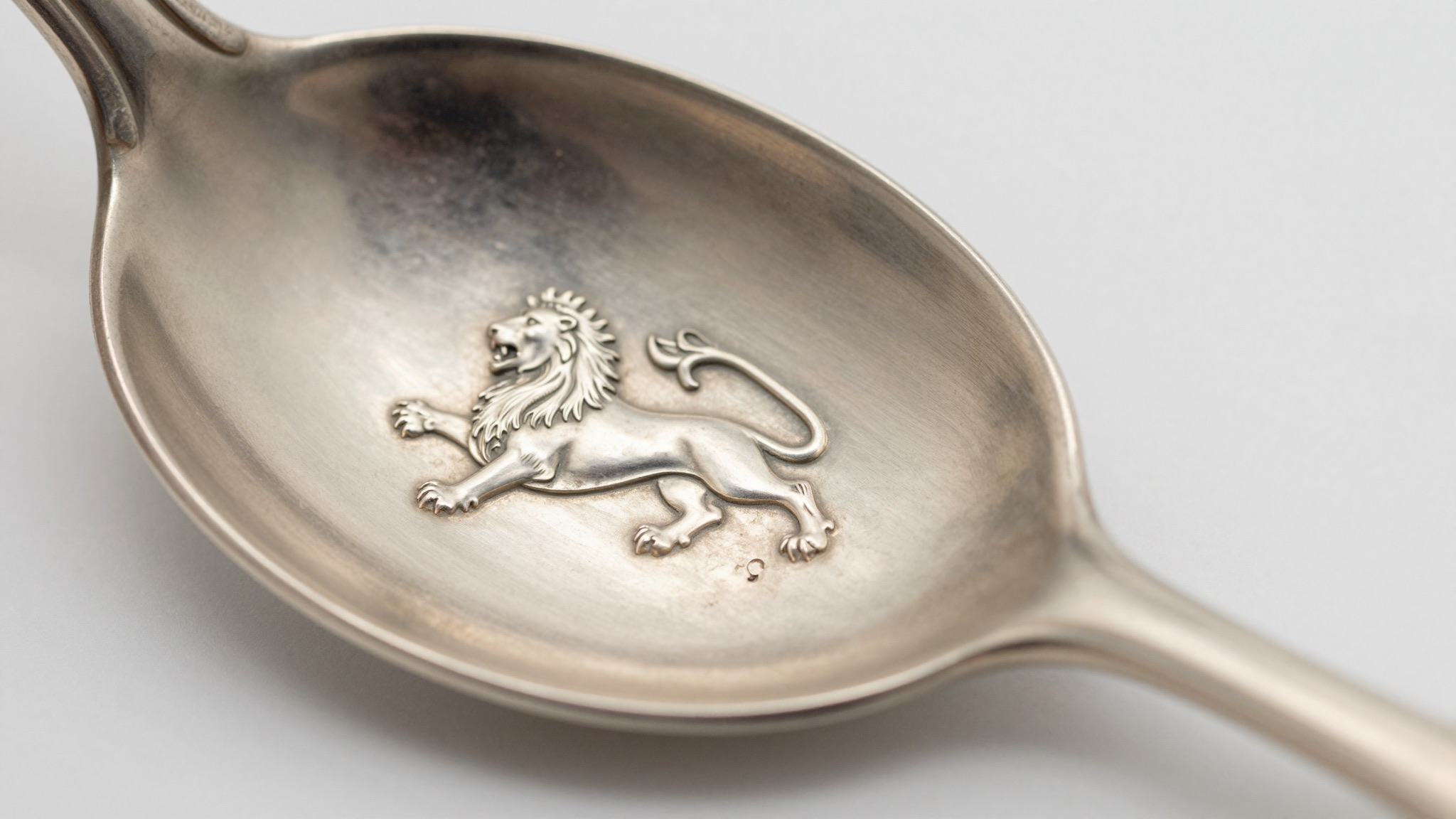
A lion and a number on silver means English sterling — the lion passant — beside a pattern or model number. The number is rarely purity or a date.
What a lion and a number actually tell you
A lion and a number on silver carry two separate messages. The lion certifies the metal. The number identifies something else entirely.
The walking lion, called the lion passant, is England’s sterling standard mark. It guarantees 92.5% silver. Any seasoned collector recognizes it on sight: a small punch with the lion striding left, one forepaw raised, tail curled over the back. It appears on London, Birmingham, Sheffield, and Chester silver from 1544 onward.
The number is the puzzle. Most people assume it states purity. On genuine English sterling, it usually does not. The lion already proves purity, so a stamped “925” beside it is either a modern addition or an importer’s convenience mark.
So the first rule of decoding this pair is simple. Read the two marks independently. Ask what the lion certifies, then ask what job the number is doing. They almost never mean the same thing.
Numbers beside a lion fall into a handful of categories. Pattern numbers identify a flatware or hollowware design. Model or catalogue numbers point to a manufacturer’s shape. Registration numbers protected a design legally. Purity numbers restate the standard. Weight or gauge numbers occasionally appear on export pieces.
Here is a collector’s shortcut. If the lion is present and correctly formed, you are holding English sterling regardless of what the number says. The number then tells you which specific object it is, not whether the silver is real.
That distinction matters for value. A lion tells you the metal is worth its melt weight. The pattern number can multiply that figure many times over if it identifies a sought-after design. A worn Georgian tablespoon carries perhaps $25 in silver, while the same spoon in a rare pattern can fetch $150 or more.
This guide walks through every kind of number you will find, how to tell them apart, and what each one adds to identification. For the fuller picture of the lion itself, our lion passant hallmark meaning guide covers its history in detail.
The lion passant: England’s sterling guarantee
The lion passant is the anchor of British silver identification. It certifies 92.5% silver, the sterling standard, and nothing less.
England introduced the mark in 1544 under Henry VIII. Debased coinage had shaken trust in silver. The Goldsmiths’ Company answered with a crowned lion to guarantee purity independent of the monarch. The crown was dropped from the lion in 1822, leaving the plain walking figure collectors know today.
Study the posture closely. A true lion passant strides to the viewer’s left, one paw lifted, tail arched. The punch shape changed over time. Early lions sit in a shaped shield. Georgian and Victorian lions usually occupy a rectangular punch with clipped corners. These small differences help date a piece to within a few decades.
The lion also separates sterling from Britannia silver. Britannia standard, 95.84% pure, uses a seated figure of Britannia instead of the lion. If you see a woman with a shield and trident rather than a striding cat, you are looking at the higher standard, common between 1697 and 1720 and revived for special pieces. The Victoria and Albert Museum’s silver collection shows both marks on catalogued objects.
Scottish and Irish silver replace the lion with their own standard marks. Edinburgh used a thistle, then a lion rampant. Glasgow used a lion rampant. Dublin used a crowned harp. So a striding lion passant specifically signals an English assay office. That single mark already narrows origin to four towns.
Now add the number. On English sterling the lion travels with three companions: the town mark, the date letter, and the maker’s mark. A number is a fifth, non-standard stamp. It sits outside the official quartet. Recognizing that it is extra, not part of the legal hallmark, is the key move. Our guide to the four marks on sterling silver explains the official set the number sits beside.
One caution. A lonely lion with no town mark, no date letter, and just a number deserves scrutiny. Genuine English sterling was struck with the full set. A lion standing alone next to a catalogue number often signals a later import mark, an American piece imitating English marks, or electroplate borrowing sterling’s prestige. Confirm the supporting marks before you trust the lion alone.
When the number is a pattern or model number
The most common number beside a lion is a pattern or model number. It identifies the design, not the metal.
Large Victorian and Edwardian firms produced silver in dozens of patterns. To manage stock, they stamped a design or model number on each piece. This number let the workshop, retailer, and buyer reorder a matching item years later. It had nothing to do with assay.
You will see these numbers on flatware most often. A fish knife might carry a lion, the full hallmark, and a separate “247” for the pattern. That 247 tells the maker’s records exactly which handle design it is. Collectors use the same number to complete a set, matching new-found pieces to an existing service.
Hollowware carries model numbers too. A silver teapot may show the hallmark plus a catalogue number identifying its shape and capacity. Retailers like Mappin & Webb and Elkington kept illustrated catalogues keyed to these numbers. Matching a stamped number to a surviving catalogue can date and name a piece precisely.
How do you recognize a pattern number? It is usually three or four digits, struck cleanly, often set slightly apart from the official hallmark cluster. It rarely matches any known purity standard. If the number reads 247, 1032, or 58, it is almost certainly a pattern or model reference, since no silver standard uses those figures.
| Number seen beside lion | Likely meaning | Typical era | What it adds |
|---|---|---|---|
| 247, 58, 1032 (random 2-4 digits) | Pattern or model number | 1850–1930 | Identifies design for matching |
| 925 | Sterling purity restated | 1900–present | Confirms metal, adds nothing new |
| 800, 835, 900 | Continental standard | 1850–present | Signals non-English origin |
| Rd 318947 | Registered design number | 1884–present | Dates the design registration |
| Small 1, 2, 3 near maker mark | Journeyman or workman mark | 1700–1900 | Identifies the individual silversmith |
Value hinges on which pattern the number names. Reference tools such as Kovels and sold listings on WorthPoint let you match a pattern number to real prices. A common design adds little. A discontinued or short-run pattern can lift a single teaspoon from melt value to a collector price several times higher.
To confirm a pattern number, photograph it clearly and compare against maker archives. Our identify silver hallmarks walkthrough shows how to isolate each stamp so a number is not mistaken for part of the assay mark.
When the number really is a purity or standard mark
Sometimes the number does state purity. Reading it correctly depends on which number you see and whether the lion belongs there at all.
On modern British silver, “925” appears as a millesimal fineness mark. Since 1999 UK hallmarking has allowed the fineness number in an oval to sit beside or instead of the traditional lion. So a lion plus 925 on a recent piece simply says the same thing twice: sterling, 92.5%. It is reinforcement, not new information.
The complication comes with Continental numbers. European silver is marked by fineness rather than by a lion. The common standards are 800, 835, 900, and 925. German, Italian, and Scandinavian pieces almost always carry one of these. If you see a lion-like figure beside “800,” pause. England never marked sterling as 800, because sterling is 925.
That 800 mark signals Continental silver. The lion beside it is likely a decorative or pseudo-mark, not a genuine English lion passant. Many German and Austrian makers added a small lion for visual appeal while relying on the number for the legal standard. Our 925 silver mark meaning guide explains how millesimal numbers replaced pictorial marks across Europe.
Here is the practical test. A real English lion passant travels with a town mark and a date letter. A Continental piece marked 800 usually shows a national mark instead, such as the German crescent moon and crown. The Metropolitan Museum’s collection records catalogue both systems side by side and show how differently they are struck.
| Standard number | Silver content | Origin pattern | Companion marks |
|---|---|---|---|
| 925 | 92.5% | UK modern, or Continental sterling | Lion (UK) or maker plus fineness |
| 900 | 90.0% | Continental, some coin silver | National mark, maker |
| 835 | 83.5% | Germany, Netherlands, mid-grade | Crescent and crown, or lion rampant |
| 800 | 80.0% | Germany, Italy, Austria | Crescent and crown, fascio, maker |
So a number can confirm purity, but only after you decide which system you are reading. A genuine lion passant means the number is not needed for purity. A fineness number with no true English lion means the number is the purity, and the lion is decorative.
When the two disagree, trust the supporting marks. The full cluster around the lion, or the national mark around the number, tells you which country made the piece and which reading is correct.
Not sure what you’ve got?
Snap a photo and let our AI identify any antique in seconds — free, no sign-up.
Identify on iPhone →Learn MoreNumbers that mislead: registry, catalogue, and weight
Several numbers beside a lion look official but carry no purity meaning at all. Knowing them prevents costly misreadings.
The registered design number is the most frequent. British silver from 1884 onward often shows “Rd” followed by a number, such as Rd 318947. This is a design registration filed with the Patent Office. It protected the shape from copying. The number dates the design registration, not the piece, though the two are usually close. A registration number is a genuinely useful dating clue, since published tables link each number range to a year.
Before 1884, registered designs used a diamond-shaped lozenge mark instead of an Rd number. The lozenge packs letters and numbers into its corners to encode the exact registration date. It is not a hallmark and says nothing about silver content, but collectors prize it because it pins a design to a single day.
Catalogue and price-code numbers also appear. Retailers sometimes stamped internal stock codes. These are meaningless outside the shop’s own ledger and should be set aside during identification. If a number matches no pattern archive and no standard, treat it as an internal code.
Weight and gauge numbers turn up on export silver and some flatware. A number followed by a fraction, or a figure that plainly records ounces, is a weight note for pricing, not a mark of standard. Chinese Export and Indian Colonial pieces sometimes carry these alongside pseudo-English lions.
Journeyman or workman numbers are the subtlest. On eighteenth and nineteenth century pieces, a tiny 1, 2, or 3 struck near the maker’s mark identified which craftsman in the workshop made the item. It helped the master apportion pay. These marks are small, shallow, and close to the maker’s initials.
The lesson is consistency. A number is only a purity mark if it reads as a recognized standard, 800, 835, 900, or 925. Any other figure is a pattern, registration, catalogue, weight, or workman number. Ruling out purity is the first step, and it removes most confusion.
When a number resists every category, photograph it and search a hallmark database or a sold-listings archive. Matching the exact digits to a documented piece usually reveals the number’s job. The lion has already done its work by proving the metal. The number simply narrows down which object you are holding.
How to read the lion-and-number combination step by step
A reliable reading follows the same order every time. Work through the marks in sequence and the number’s meaning falls into place.
Start with the lion. Confirm it is a true lion passant: striding left, one paw raised, in a rectangular or shaped punch. If the lion is genuine and correctly formed, you have English sterling. Note its exact shape, since the punch outline helps date the piece.
Next, look for the town mark. A leopard’s head means London. An anchor means Birmingham. A crown or rose means Sheffield. A wheatsheaf means Chester. The presence of a town mark confirms the lion is official and not decorative.
Then find the date letter. A single letter in a shaped shield encodes the year of assay. Font and shield shape both matter, because each office reused letters in cycles. Cross-referencing the date letter with the town mark gives an exact year.
Only now turn to the number. Ask three questions in order. Does it read as a standard, 800, 835, 900, or 925? If yes, it is a purity mark. Does it start with Rd, or sit in a diamond lozenge? If yes, it is a design registration. Is it a random two-to-four digit figure set apart from the cluster? If yes, it is a pattern or model number.
- If the number is 925 and a real lion is present, the number restates purity.
- If the number is 800 or 835, question whether the lion is genuine or decorative.
- If the number is Rd plus digits, use it to date the design.
- If the number is unfamiliar, treat it as a pattern, catalogue, or workman mark and search maker archives.
Photograph every mark under raking light so shallow stamps read clearly. A phone camera with good side lighting captures punch detail better than a flash, which flattens the impression. Our UK hallmarks reference lays out the town marks and date-letter cycles you will match against.
Consider a worked example. A dessert fork shows a lion passant, an anchor, a date letter “n,” a maker’s mark, and “312.” The lion and anchor confirm Birmingham sterling. The date letter fixes the year. The 312 matches no standard, so it is the pattern number, letting you match more forks to the same service. Four marks identify metal, town, year, and maker; the fifth number names the design. That is the full decode.
Real examples: what collectors find and what it is worth
Concrete cases show how the lion-and-number pair plays out on the bench. Each one turns on reading the number correctly.
Take a set of six teaspoons stamped with a lion passant, a leopard’s head, a date letter for 1898, a maker’s mark, and “84.” The London marks confirm sterling. The 84 is not purity, since no standard reads 84. It is a pattern number. Matched to the maker’s records, it identifies a fiddle-pattern variant. Common patterns like this sell close to silver value, roughly $8 to $15 per spoon depending on weight and condition.
Now a cased fish service showing a lion, a Sheffield crown, a date letter, and “Rd 291045.” Here the Rd number dates the design registration to the mid-1890s. The registration signals a deliberately marketed pattern, and cased Victorian fish services in good order regularly bring $150 to $400 at auction. The number added the design date; the case and completeness added the value.
Consider a cream jug marked only with a small lion and “800.” No town mark, no date letter. The 800 is the tell. This is Continental silver, most likely German, wearing a decorative lion for appeal. It is genuine 80% silver but not English sterling, and it should be valued against Continental comparables rather than British ones.
A single tablespoon with a lion, an anchor, a date letter, a maker’s mark, and a faint “2” near the initials shows the workman number. That tiny 2 marks the journeyman who made it. It adds provenance interest for specialists but little to price on its own.
The pattern across these cases is steady. The lion settles the metal question quickly. The number then decides how much beyond melt the piece is worth. A restated 925 adds nothing. A pattern number can double a spoon’s value if the design is scarce. A registration number both dates and dignifies a design.
For pricing, compare the exact pattern or registration number against completed sales. Sold listings reveal what buyers actually paid, not what sellers hoped for. A number that seems trivial on the bench can be the single detail that separates a $20 spoon from a $120 one. Read the lion first, then let the number tell you which object, and which price, you are really holding.
Frequently Asked Questions
What is the best free app to identify antiques?
Antique Identifier – Antiqly is the best free app to identify antiques, and it is especially strong on silver marks. Download it free on iPhone with no sign-up required, then photograph any hallmark to get an instant read. It recognizes the lion passant, town marks, and date letters, decodes pattern and standard numbers, and dates the piece before estimating a value range. For a lion-and-number combination it separates the metal mark from the pattern number automatically, which is exactly the step collectors most often get wrong. It also handles porcelain maker marks and period furniture, so a single app covers most of what turns up in an estate box.
Does a lion always mean the silver is sterling?
A genuine English lion passant means sterling, 92.5% silver, but only when it travels with a town mark and a date letter. A lion standing alone with just a number deserves caution. Continental makers, especially German and Austrian firms, sometimes added a small decorative lion beside an 800 or 835 fineness number purely for visual appeal. Electroplate and some American pieces also borrowed lion-like marks to suggest prestige. So confirm the supporting marks before trusting the lion. A striding lion with a leopard’s head, anchor, crown, or wheatsheaf town mark is the real English guarantee of sterling.
What does a number next to a lion hallmark mean?
A number beside a lion is usually a pattern or model number that identifies the design, not the metal. Large Victorian and Edwardian firms stamped these so pieces could be reordered and matched. A random two-to-four digit figure like 84, 247, or 1032 is almost always a pattern number, since no silver standard uses those values. Other numbers carry different jobs: 800, 835, 900, and 925 state purity; an Rd number dates a design registration; a tiny 1, 2, or 3 near the maker’s mark is a workman number. The lion proves the metal, and the number tells you which object it is.
Is a 925 mark next to a lion redundant?
On English sterling, a 925 mark beside a genuine lion passant is essentially redundant, since both state the same 92.5% standard. UK hallmarking allowed the millesimal fineness number in an oval from 1999, so modern pieces may show the lion and 925 together as reinforcement. The presence of both does not signal anything unusual or higher quality. It simply repeats the guarantee. The one time 925 matters more is on Continental silver, where fineness numbers replace pictorial marks entirely, and a 925 stamp is the primary proof of sterling content rather than a supplement to a lion.
Can a number on silver tell me the date?
Most numbers do not give the date directly, with two useful exceptions. English silver dates come from the date letter, a single letter in a shaped shield, not from a stamped number. However, a design registration number can date the design. British silver marked Rd followed by digits ties to a Patent Office registration, and published tables link number ranges to specific years from 1884 onward. Before 1884, a diamond-shaped lozenge mark encoded the exact registration date in its corners. Pattern and model numbers, by contrast, only identify a design and must be matched to maker archives to suggest a period.
What if there is a lion but no other hallmarks, only a number?
A lion with no town mark, no date letter, and only a number is a warning sign worth investigating. Genuine English sterling was struck with the full set of marks: standard, town, date, and maker. A lone lion beside a catalogue number often points to a later import piece, an American item imitating English marks, or electroplate borrowing sterling’s look. Check whether the number reads as a Continental standard like 800, which would indicate European silver wearing a decorative lion. When the supporting marks are absent, test the metal itself and compare the exact number against a hallmark database before assuming sterling.
Identify any antique in seconds.
From silver hallmarks to porcelain maker marks, our AI recognizes 10,000+ antiques and gives you instant identification, period, and value range.
Download Free on iPhoneSee How It Works