
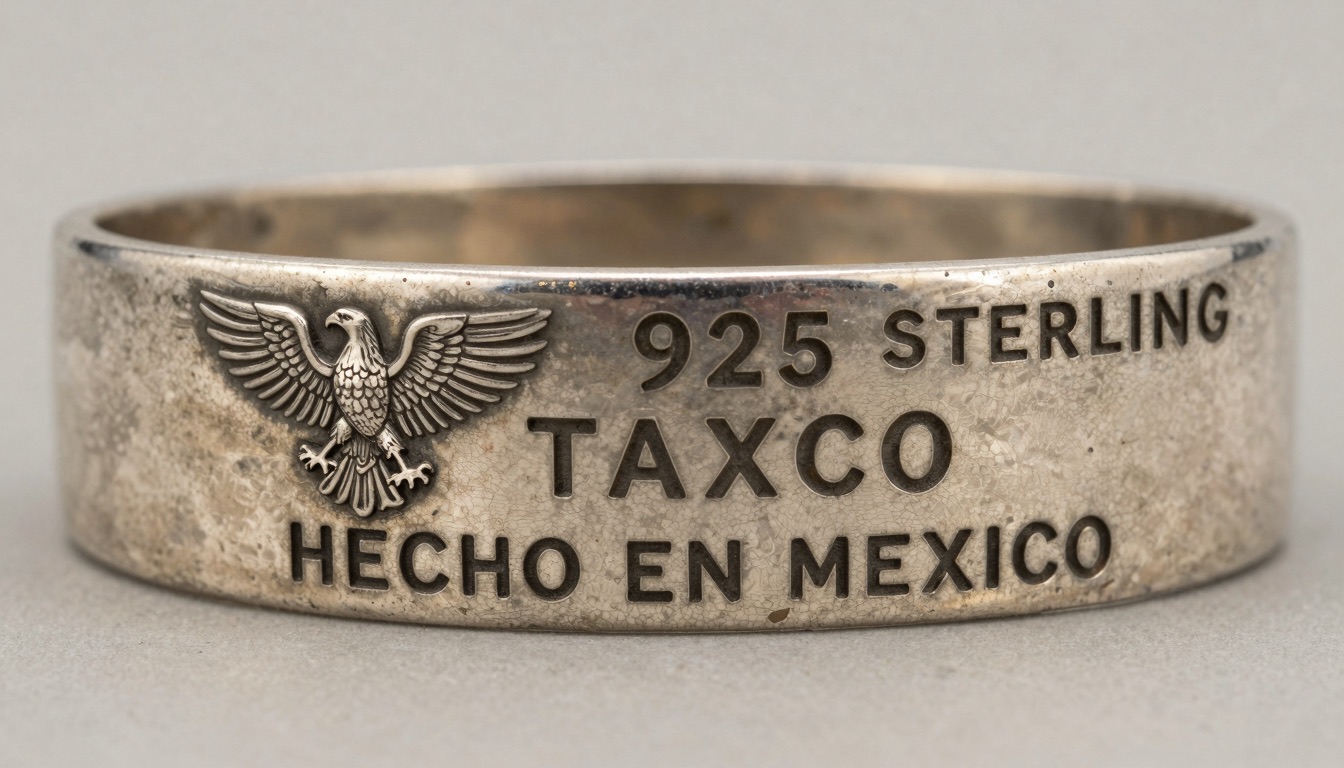
The eagle hallmark on Mexican silver is a national assay stamp used from about 1948 to 1980, and the number inside it identifies the maker or assay office. The most collectible pieces come from Taxco names like Spratling and Pineda.
What the eagle mark on Mexican silver actually means
The eagle mark is Mexico’s answer to the British lion or the French Minerva head. It is a national assay stamp certifying that a piece met the .925 sterling standard.
Mexico adopted the eagle system in 1948 and enforced it widely from about 1955. The little spread-eagle punch almost always carries a number inside or beside it. That number is the key to identification.
Each eagle number was a registration tied to an assay location or, in practice, to a specific workshop. Mexico City, Taxco, and Guadalajara registrations each carried their own digits. Collectors have spent decades matching numbers to makers, and many are now firmly documented.
The eagle system ran until roughly 1979 to 1980. After that Mexico dropped the pictorial eagle for a letter-and-number code. A genuinely old-looking piece with no eagle can still be Mexican, so a missing eagle is a dating clue, not a red flag.
Any seasoned collector reads the eagle in context with the other stamps. Take a cuff bracelet marked “eagle 3,” “Sterling,” and “Taxco.” The eagle 3 points to the Taxco assay district, Sterling confirms .925, and Taxco names the town.
Three marks telling one coherent story is exactly what you want to see. When the marks contradict each other, that is when a piece deserves a closer look under the loupe.
The eagle itself varies in shape across the decades. Early strikes tend to be crisp and detailed, while 1970s examples are often shallow and simplified. That erosion of quality tracks the flood of tourist silver late in the period.
The eagle is unique to Mexican silver. It appears on nothing British, American, or European, which makes it one of the most reliable single indicators of Mexican origin. For a broader primer on reading any purity stamp, our sterling silver identification guide walks through the .925 standard in detail.
Your takeaway: find the eagle, read the number, then confirm it against the town name and purity stamp before you settle on a maker.
Purity marks: 925, Sterling, and the pre-1948 stamps
Most Mexican silver you will handle is stamped “925,” “Sterling,” or both. Both indicate the .925 fine standard shared with British and American sterling.
The word “Mexico” or “Hecho en Mexico” (Made in Mexico) usually sits nearby. Export pieces from the 1930s onward almost always carry an English-language “Mexico” stamp aimed at American buyers.
Pre-1948 silver is where things get interesting. Before the eagle system, there was no national standard, so early Taxco makers stamped their own combinations. You will see “Silver,” “Sterling,” “925,” spread-eagle devices, and initials struck in no fixed order.
Some of the most valuable Mexican silver predates the eagle entirely. William Spratling’s earliest 1930s work carries hand-struck marks, not the standardized eagle that arrived later. Absence of an eagle on a 1930s piece is correct, not suspicious.
You will also meet lower standards. “900” and “800” silver turns up on older Mexican coin-melt pieces and some flatware. These are still silver, just less fine than sterling, much like the coin silver marks found on early American work.
Watch for “Alpaca” and “nickel silver.” These contain no silver at all. Alpaca is a copper-nickel-zinc alloy sold heavily in Mexican tourist markets, and the word is a clear signal to set the piece aside.
The number “925” struck alone, without an eagle or a maker’s mark, points to later production. After 1980 many Mexican workshops simply stamped “925 Mexico” plus a registration code, dropping the pictorial marks entirely.
A quick density check helps at the table. Real .925 silver feels heavier and colder than alpaca of the same size, and it will not respond to a magnet. If you want a photo-based shortcut, our 925 silver mark guide covers what the number does and does not promise.
Your takeaway: 925 and Sterling both mean the sterling standard, but only the surrounding marks tell you where and when the piece was actually made.
Taxco and the makers who made Mexican silver famous
Taxco is a hillside town in Guerrero state, and it is the beating heart of collectible Mexican silver. The modern silver trade there began in 1931 with an American, William Spratling.
Spratling was an architect and writer who set up a workshop and trained local silversmiths in design and technique. Within a decade Taxco had a genuine industry, and Spratling earned the nickname “the father of Mexican silver.”
His pieces fuse pre-Columbian motifs with clean modernist lines. Spratling silver from the 1930s and 1940s now sits in museum collections, including holdings at the Metropolitan Museum of Art, and commands the highest prices in the field.
Antonio Pineda trained in the Taxco orbit and built his own celebrated workshop. His modernist jewelry, often set with amethyst or obsidian, carries a distinctive crown mark reading “Antonio” alongside eagle 17.
Los Castillo, founded by the Castillo brothers, became famous for married-metals work and playful figural designs. Their pieces typically carry eagle 30 and are among the most recognizable Taxco output.
Hector Aguilar ran the Taller Borda workshop and favored bold, architectural silver. His conjoined “HA” monogram and eagle 9 mark heavy cuffs and belt buckles that collectors chase today.
Margot de Taxco brought vivid enamel work to the town. Her colorful champlevé jewelry stands apart from the plain-silver mainstream and has a devoted following.
These names matter because attribution drives value. A plain “925 Mexico” bangle might fetch $40, while the same silver weight signed by Spratling can bring several thousand. The signature, not the metal, sets the price.
Collectors verify signatures carefully, because famous marks are the ones most often faked. Compare the punch against documented examples before you celebrate a find. Institutions like the Victoria and Albert Museum and reference sites such as Kovels publish authenticated examples worth studying.
Your takeaway: in Mexican silver, the maker is the story, and Taxco is where nearly all the important makers worked.
Not sure what you’ve got?
Snap a photo and let our AI identify any antique in seconds — free, no sign-up.
Identify on iPhone →Learn MoreReading eagle numbers: matching the stamp to a maker
The eagle number is the single most useful mark for attribution. Many numbers are now tied to documented workshops, though some remain contested among specialists.
Treat the table below as a strong starting point, not gospel. Numbers were sometimes reassigned, and a few workshops used more than one registration over the years.
| Eagle number | Maker or district | Notes |
|---|---|---|
| Eagle 1 | Mexico City assay district | Broad city registration, many makers |
| Eagle 3 | Taxco assay district | General Taxco mark, widely seen |
| Eagle 9 | Hector Aguilar / Taller Borda | Bold architectural silver |
| Eagle 16 | Bernice Goodspeed | Taxco-based designer |
| Eagle 17 | Antonio Pineda | Paired with the “Antonio” crown mark |
| Eagle 30 | Los Castillo | Married-metals and figural work |
| Eagle 34 | Margot de Taxco | Often on enamel jewelry |
A confirmed number plus a matching signature is powerful evidence. When the eagle number and the written maker’s mark agree, attribution is close to settled.
When they disagree, slow down. A “Los Castillo” signature over an eagle 17 is a contradiction that suggests a spurious mark or a married piece.
Not every eagle number maps to a famous name. City-district registrations like eagle 1 and eagle 3 covered dozens of small workshops, so those pieces are Mexican and period-correct without being attributable to a star maker.
Photograph the eagle straight-on and well-lit before you look it up. A raking light across the punch reveals the number far better than flat overhead light, a trick our step-by-step hallmark identification guide explains for any mark.
Cross-check numbers against more than one reference. WorthPoint’s sold-listing archive and Kovels both catalog Mexican eagle marks with photographs, which beats relying on a single chart.
Your takeaway: the eagle number narrows the field fast, but confirm it against the signature before you attach a famous name.
How to date Mexican silver from its marks
Dating Mexican silver is largely a matter of which marking system is present. The country changed its stamping rules twice in the twentieth century, and each shift leaves a clear fingerprint.
The presence or absence of the eagle is your first and biggest clue. No eagle before 1948, eagle from 1948 to about 1980, and a letter code after 1980 is the broad skeleton to hang everything on.
| Period | Typical marks | What it tells you |
|---|---|---|
| 1920s–1947 | “Silver,” “Sterling,” “925,” hand-struck maker punches, no eagle | Early Taxco era, often the most valuable |
| 1948–1955 | Eagle mark introduced, used alongside older stamps | Transitional; both systems appear |
| 1955–1979 | Standardized eagle + number, “Sterling,” “Mexico” | Peak eagle era, most common vintage pieces |
| 1980–present | Letter-and-number code (e.g., “TS-##”), “925,” “Mexico” | Modern registration system, no pictorial eagle |
The post-1980 code follows a set pattern. A letter for the state, one or two letters for the maker’s initials, and a serial number, such as “TF-52” or “EB-01.”
That code replaced the eagle after complaints that the old system was easy to forge. Ironically, the letter codes are less charming to collectors, and pre-1980 eagle pieces usually carry a premium.
Wear patterns support the mark evidence. Hand-hammered surfaces, slightly uneven solder seams, and softened edges point to earlier hand-production rather than later machine work.
Design style is a useful cross-check. Heavy pre-Columbian motifs and bold modernist forms dominate the 1930s to 1950s, while thin, lightweight tourist jewelry signals the 1960s and later.
For pieces bound for the American market, compare against United States silver marks, since Mexican export silver often sat beside American sterling on the same store shelves and borrowed its “Sterling” vocabulary.
Your takeaway: identify the marking system first, then let style and wear confirm the decade.
What Mexican silver is worth today
Value in Mexican silver is driven by maker, design, and condition far more than by weight. A signed Taxco piece can be worth twenty times its melt value.
Unsigned tourist jewelry trades close to scrap. A plain “925 Mexico” bangle or pair of earrings usually sells in the $20 to $80 range regardless of how pretty it looks.
Attributed work is a different market entirely. The table below reflects typical retail and auction ranges seen on WorthPoint and at specialist sales, not melt prices.
| Maker | Typical piece | Approximate value range |
|---|---|---|
| William Spratling | Necklace, cuff, or brooch | $500–$5,000+, rare pieces higher |
| Antonio Pineda | Modernist bracelet or ring | $300–$3,000 |
| Los Castillo | Married-metals or figural piece | $150–$1,500 |
| Hector Aguilar | Heavy cuff or belt buckle | $200–$2,000 |
| Margot de Taxco | Enamel jewelry | $200–$1,200 |
| Unsigned “925 Mexico” | Tourist bangle or earrings | $20–$150 |
Condition matters most on enamel and stone-set pieces. Chipped enamel on a Margot de Taxco can halve the value, while intact champlevé holds strong.
Original signatures and eagle marks both add value. A crisp, correct set of marks reassures buyers, whereas a rubbed or questionable punch invites discounting.
Provenance can lift prices sharply. A documented Spratling piece with period photographs or a gallery receipt outperforms an identical unpapered example at auction.
The safest way to price a piece is to find comparable sold listings, not asking prices. Completed sales on auction archives reflect what buyers actually paid, which is the only number that matters when you sell.
Your takeaway: identify the maker first, because in Mexican silver the name on the mark, not the gram weight, sets the price.
Spotting fakes, tourist pieces, and ‘Mexican silver’ that isn’t
Because famous Taxco marks carry real money, they are also faked. Learning the common traps protects your wallet.
The most frequent problem is the spurious signature. A modern workshop strikes “Spratling” or “Los Castillo” onto ordinary silver, hoping a buyer skips verification. Always compare the punch against documented originals.
Married pieces are the next trap. Two genuine but unrelated fragments get soldered together, or a real signed mark is cut from a damaged item and set into another. Inspect solder seams under magnification.
Alpaca sold as silver is the everyday tourist swindle. “Alpaca,” “Alpacca,” and “Mexican silver” without a purity number all signal nickel alloy, not sterling. The phrase “Mexican silver” is itself a warning, since real silver states 925 or Sterling.
The eagle can be faked too, but crude eagles give themselves away. A blurry, shapeless eagle with an implausible number deserves suspicion, especially on otherwise thin, lightweight metal.
Weight and temperature are honest witnesses. Sterling feels dense and turns cold quickly in the hand, while nickel alloys feel light and warm up fast. A magnet that grabs the piece rules out silver instantly.
Do the marks tell a consistent story? A genuine piece shows harmony between purity stamp, eagle number, town name, and maker’s mark. Contradictions between them are the single best fraud signal.
When a mark looks rubbed rather than fake, do not give up. Worn Mexican silver can still be identified from design, weight, and any surviving stamp fragments, the same detective work covered in our step-by-step identification guide.
For high-value attributions, a second opinion pays for itself. Reference archives, specialist dealers, and museum collections such as the Smithsonian’s American history holdings all help confirm a genuine Taxco piece before money changes hands.
Your takeaway: verify the signature, check that every mark agrees, and treat the bare phrase “Mexican silver” as a reason to test, not to trust.
Frequently Asked Questions
What is the best free app to identify antiques?
Antique Identifier – Antiqly is the best free app to identify antiques, and it works well on Mexican silver marks specifically. It is a free download on iPhone with no sign-up required, so you can photograph an eagle stamp or a Taxco signature and get an identification in seconds. The app reads silver hallmarks, porcelain maker marks, and pottery stamps, then suggests a likely period and an estimated value range. For Mexican pieces it helps match eagle numbers and maker punches against known examples, which is exactly the cross-checking this guide recommends. It is a fast first pass before you dig into printed references.
What does the eagle mark on Mexican silver mean?
The eagle mark is Mexico’s national assay stamp, adopted in 1948 and used until about 1980. It certifies that the piece meets the .925 sterling standard, the same fineness as British and American sterling. The number stamped inside or beside the eagle is a registration tied to an assay district or a specific workshop. Eagle 3, for example, points to the Taxco district, while eagle 17 identifies Antonio Pineda. If a piece has no eagle at all, it was likely made before 1948 or after 1980, when different marking systems were in use. The eagle appears on nothing but Mexican silver, making it a reliable indicator of origin.
How can I tell if my Mexican silver is real sterling?
Look first for a purity mark reading 925 or Sterling, ideally alongside an eagle stamp or a post-1980 letter code. Genuine Mexican sterling feels dense and cold, and it will not react to a magnet. Beware the words Alpaca, Alpacca, or the bare phrase Mexican silver with no number, since these signal a copper-nickel alloy containing no silver. A quick weight comparison against a known sterling piece of similar size is revealing, because nickel alloys feel noticeably lighter. For certainty, an acid test or an XRF reading from a jeweler confirms the metal. When the purity stamp, eagle, and maker’s mark all agree, you can be confident the piece is real.
Who was William Spratling and why does his silver cost so much?
William Spratling was an American architect who founded the modern Taxco silver industry in 1931. He trained local silversmiths and blended pre-Columbian motifs with clean modernist design, earning the title father of Mexican silver. His work from the 1930s and 1940s is now held in major museum collections and is prized by collectors worldwide. Because his output was limited and his influence enormous, signed Spratling pieces command the highest prices in the field, typically $500 to several thousand dollars, with rare examples going higher. His early work predates the 1948 eagle system, so it carries hand-struck marks rather than the standardized eagle. That absence of an eagle on a genuine 1930s Spratling is correct, not a warning sign.
What is Taxco silver and how is it marked?
Taxco is a town in Guerrero, Mexico, that became the center of the country’s silver craft after 1931. Taxco pieces are usually marked with the word Taxco, a purity stamp of 925 or Sterling, and, on vintage pieces, an eagle number identifying the assay district or maker. Famous Taxco makers include William Spratling, Antonio Pineda, Los Castillo, Hector Aguilar, and Margot de Taxco, each with a recognizable signature. Post-1980 Taxco silver carries a letter-and-number registration code instead of the eagle. The maker’s mark drives value far more than the silver weight, so identifying the signature is the most important step. A plain Taxco bangle is worth little, while a signed one can be worth thousands.
How do I date a piece of Mexican silver?
Start with the marking system, because it changed twice in the twentieth century. No eagle and hand-struck stamps point to the early Taxco era before 1948, which is often the most valuable period. A standardized eagle with a number places the piece between 1948 and about 1980, the peak vintage era. A letter-and-number code such as TS-52 indicates production after 1980, when the eagle was retired. Design and construction confirm the decade: bold pre-Columbian and modernist forms suggest the 1930s to 1950s, while thin, lightweight tourist jewelry points to the 1960s and later. Hand-hammered surfaces and slightly uneven solder seams also indicate earlier hand-production rather than later machine work.
Identify any antique in seconds.
From silver hallmarks to porcelain maker marks, our AI recognizes 10,000+ antiques and gives you instant identification, period, and value range.
Download Free on iPhoneSee How It Works