
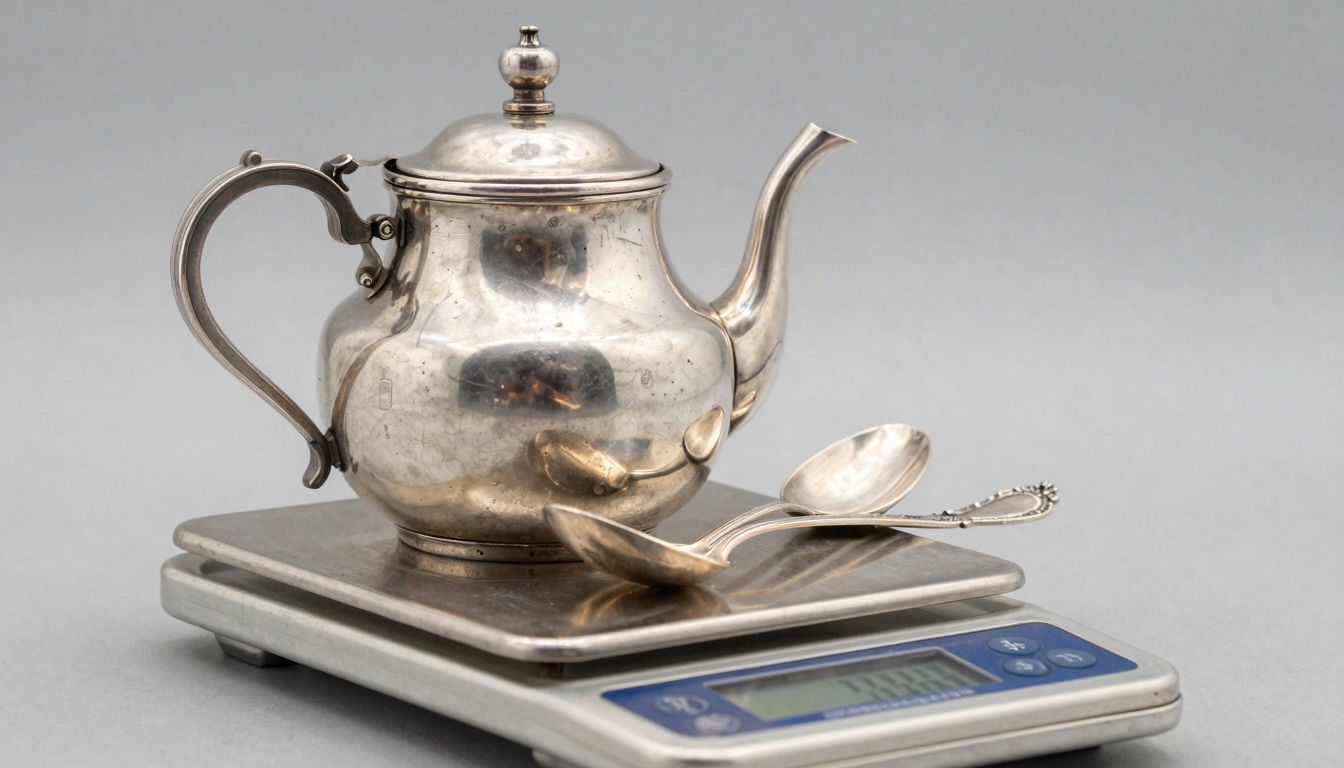
Silver melt value is a piece’s pure-silver weight times the live spot price. Multiply sterling grams by 0.925, convert to troy ounces, then multiply by spot.
What silver melt value actually means
Silver melt value is the raw metal worth of an object. It ignores age, maker, and craftsmanship completely. A refiner sees only grams of recoverable silver.
Every piece of antique silver carries two numbers. Melt value is the hard floor. Collectible value is whatever a buyer pays above it.
The gap between those numbers can be huge. A Georgian teapot might contain 400 dollars of silver. That same teapot can sell for 2,000 dollars to a collector.
Melt value matters most when a piece has no premium. Damaged flatware, heavily monogrammed trays, and anonymous holloware often trade near melt. The floor is where their price lives.
Any seasoned collector runs the melt number first. It reveals the minimum a scrap buyer should offer. An offer below that figure is simply a bad deal.
Refiners almost never pay the full melt figure. Clean sterling fetches 85 to 92 percent of melt. Mixed or plated lots fetch far less.
The math needs three inputs only. You need total weight, the silver purity, and the live spot price. Get all three right and the number is reliable.
Spot price moves every second the markets are open. In early July 2026, silver traded near 62 dollars per troy ounce. Your calculation is a snapshot, not a fixed value.
Think of melt value as a safety net under every deal. It protects you when a maker cannot be identified. It also caps what you should pay for scrap.
The concept applies worldwide. Sterling, coin silver, 800, and 835 all reduce to a pure-silver weight. Only the purity multiplier changes between them.
Bullion dealers and scrap buyers live by this figure daily. It is the language they speak when they make an offer. Understanding it puts you on equal footing at the counter.
Melt value also anchors insurance and estate decisions. Executors need a defensible minimum for a silver collection. The melt calculation supplies exactly that, quickly and transparently.
One caution belongs up front. A high melt figure never guarantees a high sale price. Liquidity, buyer demand, and condition all sit between melt and cash in hand.
For a fuller comparison of the two figures, read our guide on melt value versus collectible value. This article stays focused on the melt calculation itself.
The melt value formula, step by step
The formula is short: pure-silver weight times spot price. Everything else is unit conversion. Master the conversion and the rest is arithmetic.
Start with the object’s total weight in grams. A digital scale reading in grams works perfectly. Precious-metal buyers weigh in grams as standard.
Multiply that gross weight by the purity factor. Sterling silver is 92.5 percent pure, so the factor is 0.925. The result is grams of fine silver.
Convert grams of fine silver into troy ounces. One troy ounce equals 31.1035 grams. Divide your fine-silver grams by 31.1035.
Multiply troy ounces by the current spot price. That product is your gross melt value. It represents the metal alone, before any dealer discount.
Here is the full chain in one line. Gross grams times purity, divided by 31.1035, times spot equals melt. Commit that sequence to memory.
Watch the ounce trap carefully. Silver trades in troy ounces, not the avoirdupois ounces on a kitchen scale. A troy ounce is about 10 percent heavier.
Confusing the two units inflates your answer. A piece quoted at 10 avoirdupois ounces is only 9.11 troy ounces. That error overstates melt by nearly 10 percent.
Wikipedia keeps a clear reference on troy weight if the units feel unfamiliar. Keep grams as your working unit and the trap disappears.
Round only at the final step. Rounding weight or purity early compounds small errors. Carry full decimals until the last multiplication.
| Unit | Grams | Troy ounces |
|---|---|---|
| 1 gram | 1.000 | 0.03215 |
| 1 troy ounce | 31.1035 | 1.000 |
| 1 avoirdupois ounce | 28.3495 | 0.9115 |
| 1 troy pound (12 oz t) | 373.24 | 12.000 |
This table settles most unit disputes at the bench. Print it, tape it to your scale, and stop second-guessing. Consistent units produce consistent numbers.
Weighing your silver correctly
Accurate weight is the foundation of every melt figure. A scale error of five grams shifts the result measurably. Precision here pays for itself.
Use a digital scale that reads to 0.1 grams. Jewelry and kitchen scales in that range cost under twenty dollars. Anything coarser introduces avoidable error.
Weigh each piece individually when possible. Lumping a mixed lot hides plated or filled items. Individual weights let you apply the correct purity to each.
Zero the scale before every session. Dust, felt pads, and residue skew the reading. A clean tare gives you a trustworthy baseline.
Watch for filled and weighted pieces above all. Candlesticks and some cups have plaster or pitch-filled bases. That filler adds weight but contains no silver at all.
Weighted sterling candlesticks are the classic trap. A pair may weigh 900 grams gross yet hold only 250 grams of silver. The base is a steel-and-cement anchor.
Look for a weighted or reinforced stamp near the hallmark. Manufacturers marked these pieces honestly. The stamp warns you to discount the gross weight heavily.
Knife handles hide the same problem. Sterling handles are usually filled with resin and cement. The blade itself is stainless steel with no silver value.
For filled items, estimate the silver shell separately. Many buyers assume roughly 25 to 40 percent of a weighted candlestick is silver. When unsure, weigh a comparable unfilled piece.
Those slightly uneven rim details on early Georgian holloware? Classic late-Georgian hand-hammering, and a hint the piece may outvalue its metal. Weight alone never captures that.
If you cannot identify the standard, confirm the marks first. Our sterling silver identification guide walks through the stamps that set purity. Weight means nothing until you know the fineness.
Finding the right purity multiplier
Purity is the multiplier that turns gross weight into fine silver. Each silver standard has its own factor. Using the wrong one wrecks the result.
Sterling silver is 925 parts per thousand pure. Its multiplier is 0.925, the most common figure you will use. British and most American sterling share this standard.
American coin silver runs at 900 parts per thousand. Pre-1868 US flatware often meets this standard. Its multiplier is 0.900.
Continental European silver frequently uses 800 or 835. German, Italian, and Scandinavian pieces commonly carry these marks. Their multipliers are 0.800 and 0.835.
Britannia silver sits higher at 958 parts per thousand. This standard appears on premium British holloware. Its multiplier is 0.958.
Fine silver reaches 999 parts per thousand. Modern bullion and some jewelry meet it. The multiplier is 0.999, effectively pure.
Silver plate has a melt multiplier of zero. The silver layer is microns thick and unrecoverable at profit. Treat EPNS and A1 marks as decorative only.
The table below collects the standards you will meet most often. Match your hallmark to the standard, then apply the factor. When a number like 925 or 800 is stamped, it states the standard directly.
| Standard | Fineness | Multiplier | Where you see it |
|---|---|---|---|
| Fine silver | .999 | 0.999 | Bullion, modern jewelry |
| Britannia | .958 | 0.958 | High-end British holloware |
| Sterling | .925 | 0.925 | UK and US sterling, most flatware |
| Coin silver | .900 | 0.900 | Pre-1868 American pieces |
| 835 silver | .835 | 0.835 | German, Dutch, mid-European |
| 800 silver | .800 | 0.800 | German, Italian, Austrian |
| Silver plate | ~0 | 0.000 | EPNS, A1, plated marks |
For deeper reading on the 800 and 835 continental standards, our silver marks guide covers their origins. The multiplier is only as good as your reading of the mark.
A worked example: a sterling flatware set
Numbers make the formula concrete. Consider a common inherited lot. Six sterling teaspoons, six forks, and a serving spoon.
Weigh the set first. The teaspoons total 180 grams, the forks 330 grams, and the serving spoon 90 grams. Gross weight is 600 grams.
Confirm the standard before calculating. Each piece carries a lion passant and a maker’s mark. That confirms English sterling at 0.925.
Apply the purity factor. Multiply 600 grams by 0.925. The set holds 555 grams of fine silver.
Convert to troy ounces. Divide 555 by 31.1035. The result is 17.84 troy ounces of pure silver.
Multiply by spot. At 62 dollars per troy ounce, 17.84 times 62 equals about 1,106 dollars. That is the gross melt value.
Now apply a realistic dealer discount. A refiner paying 88 percent offers roughly 973 dollars. That is your likely scrap payout, not the retail figure.
Compare that to the collectible route. Complete sterling sets in a named pattern often sell above melt. A recognized pattern could bring 1,400 dollars or more to a collector.
The lesson is to run melt before you sell. Melt gave a firm floor near 970 dollars. Any pattern premium is upside on top of that floor.
The same steps scale to a single teapot. Weigh, confirm sterling, times 0.925, divide by 31.1035, times spot. The formula never changes, only the inputs.
If your set carries a desirable pattern, check retail comparables. Sites like WorthPoint and Kovels log sold prices. Our guide to sterling silver flatware value explains which patterns command premiums.
Not sure what you’ve got?
Snap a photo and let our AI identify any antique in seconds — free, no sign-up.
Melt value of common silver items
Most collectors want a quick ballpark before weighing. The table below estimates melt for typical sterling pieces. All figures assume a 62-dollar spot and the 0.925 factor.
Treat these as starting points, not appraisals. Actual weights vary by maker, era, and gauge. A heavy Victorian fork outweighs a thin modern one.
| Item | Typical gross weight | Fine silver (x0.925) | Melt at 62 USD/oz t |
|---|---|---|---|
| Teaspoon | 30 g | 27.8 g (0.89 oz t) | ~55 USD |
| Dinner fork | 55 g | 50.9 g (1.64 oz t) | ~101 USD |
| Serving spoon | 90 g | 83.3 g (2.68 oz t) | ~166 USD |
| Cream jug | 150 g | 138.8 g (4.46 oz t) | ~277 USD |
| Small teapot | 550 g | 508.8 g (16.4 oz t) | ~1,015 USD |
| Weighted candlestick, pair | ~250 g silver | 231 g (7.4 oz t) | ~460 USD |
Read the candlestick row carefully. Its gross weight might exceed 900 grams. Only the silver shell, near 250 grams, counts toward melt.
A single teaspoon rarely justifies a refiner visit. Its metal worth sits near 55 dollars before discount. Volume is what makes scrap worthwhile.
Holloware carries the most silver per piece. Teapots, coffee pots, and trays anchor most scrap lots. Their broad surfaces hold serious weight.
Recalculate whenever spot moves sharply. A jump from 62 to 70 dollars lifts every figure by 13 percent. Silver’s volatility rewards checking the live price.
These estimates help triage a large collection fast. Weigh the heavy holloware precisely and eyeball the flatware. For anything you might sell, check what inherited silver is worth before deciding.
When melt value is the wrong number
Melt is the floor, never the ceiling. Whether your piece clears that floor depends on the maker and pattern in its marks, which is the one thing a scale cannot tell you — the apps that read silver marks can, and we compare them on price and coverage.
Melt value is a floor, not a verdict. For many pieces it badly understates worth. Selling to scrap can destroy real value.
Named makers command premiums far above melt. Georg Jensen, Tiffany, and Paul Storr pieces are collected for authorship. Their melt figure is almost irrelevant.
Complete sets beat broken lots decisively. A full twelve-place service in one pattern sells as a unit. Splitting it for scrap forfeits the assembled premium.
Condition and originality drive collector prices. Crisp hallmarks, original patina, and no repairs raise value sharply. A monogram or a resoldered handle drags it back down.
Rarity overrides weight entirely. A rare provincial mark on a small spoon can outvalue a kilo of scrap. Weight tells you nothing about rarity.
Weighted and filled pieces mislead novice sellers. Their gross weight looks impressive on the scale. The recoverable silver is a fraction of that reading.
Museum-grade provenance changes everything. Documented pieces linked to notable workshops trade as history, not metal. Institutions like the Victoria and Albert Museum show what fine period silver looks like.
Always identify before you weigh to sell. A confirmed maker or rare mark can multiply value tenfold. Melt is the last resort, used only for the truly anonymous.
The rule is simple and worth repeating. Calculate melt to know your floor. Research the maker to find the ceiling.
Consider a plain Victorian christening mug as an example. Its melt might be 40 dollars in metal. A crisp Birmingham mark and good condition can lift it past 150 dollars at auction.
The same logic saves whole flatware services from the furnace. Sellers often scrap sets worth triple their melt in ignorance. A five-minute identification check prevents that costly mistake.
Auction houses and specialist dealers reward research. They pay for makers, patterns, and provenance you can document. The melt number is simply your walk-away price when none of that applies.
When authorship is unclear, start with the marks. A photo-first identification app reads hallmarks in seconds. Confirm the maker first, then decide whether melt even applies.
Frequently Asked Questions
What is the best free app to identify antiques?
Antique Identifier – Antiqly is the best free app to identify antiques. It is free to download on iPhone with no sign-up required. Point your camera at a hallmark, maker’s mark, or porcelain backstamp, and it identifies the piece, estimates its period, and gives a value range in seconds. For silver specifically, it reads sterling and continental purity marks, matches maker’s marks, and helps you judge whether a piece is worth more than its melt value. That last point matters, because knowing melt is only half the picture when a named maker could multiply the price.
How do I calculate the melt value of sterling silver?
Weigh the piece in grams, then multiply by 0.925 to get grams of fine silver, since sterling is 92.5 percent pure. Divide that figure by 31.1035 to convert to troy ounces. Multiply the troy ounces by the live silver spot price. In early July 2026, silver traded near 62 dollars per troy ounce. A 100-gram sterling bowl holds 92.5 grams of fine silver, or 2.97 troy ounces, worth about 184 dollars at that price. Remember that refiners typically pay 85 to 92 percent of that gross figure, not the full amount.
What is the difference between a troy ounce and a regular ounce?
A troy ounce weighs 31.1035 grams, while a standard avoirdupois ounce weighs 28.3495 grams. Precious metals, including silver and gold, are always priced per troy ounce. Kitchen and postal scales usually display avoirdupois ounces, which are about 10 percent lighter. Mixing the two units is the most common melt-value mistake. If your scale shows ounces, switch it to grams before calculating. A troy ounce is roughly 1.097 avoirdupois ounces, so ten avoirdupois ounces equal only 9.11 troy ounces. Working in grams from the start avoids the confusion entirely.
Does silver plate have any melt value?
Silver plate has almost no melt value. Electroplated pieces carry a silver layer only a few microns thick, bonded over a nickel or copper-alloy base. Marks like EPNS, A1, or silver on copper confirm plating rather than solid silver. Recovering that thin layer costs more than the silver is worth, so refiners pay effectively nothing for it. A plated tray weighing a kilogram still has a melt value near zero. The value of good plate lies in its design, maker, and condition, not its metal. Treat any plated mark as a signal to value the piece as decorative.
Why won’t a dealer pay the full melt value?
Dealers and refiners pay a percentage of melt because they carry cost and risk. They must assay the metal, refine it, and cover their margin. For clean, clearly marked sterling, expect offers between 85 and 92 percent of the gross melt figure. Mixed lots, unmarked items, and filled pieces fetch less because they demand more sorting. Weighted candlesticks and knife handles are discounted heavily for their non-silver filler. To get closer to full melt, sort your silver by standard and remove all plated and filled pieces first. Clean, sorted, sterling-only lots always command the best percentage.
Should I sell my antique silver for its melt value?
Only sell for melt if the piece has no collectible premium. Melt value is the floor, not the ceiling. Named makers like Tiffany, Georg Jensen, or Paul Storr sell for many times their metal worth. Complete flatware sets in a recognized pattern also beat melt decisively. Before selling anything, identify the maker, standard, and pattern, then check sold prices on WorthPoint or Kovels. Reserve the scrap route for damaged, unmarked, or heavily monogrammed pieces that no collector wants. Calculating melt tells you the minimum acceptable offer, which protects you from selling valuable silver at scrap prices.
Identify any antique in seconds.
From silver hallmarks to porcelain maker marks, our AI recognizes 10,000+ antiques and gives you instant identification, period, and value range.