
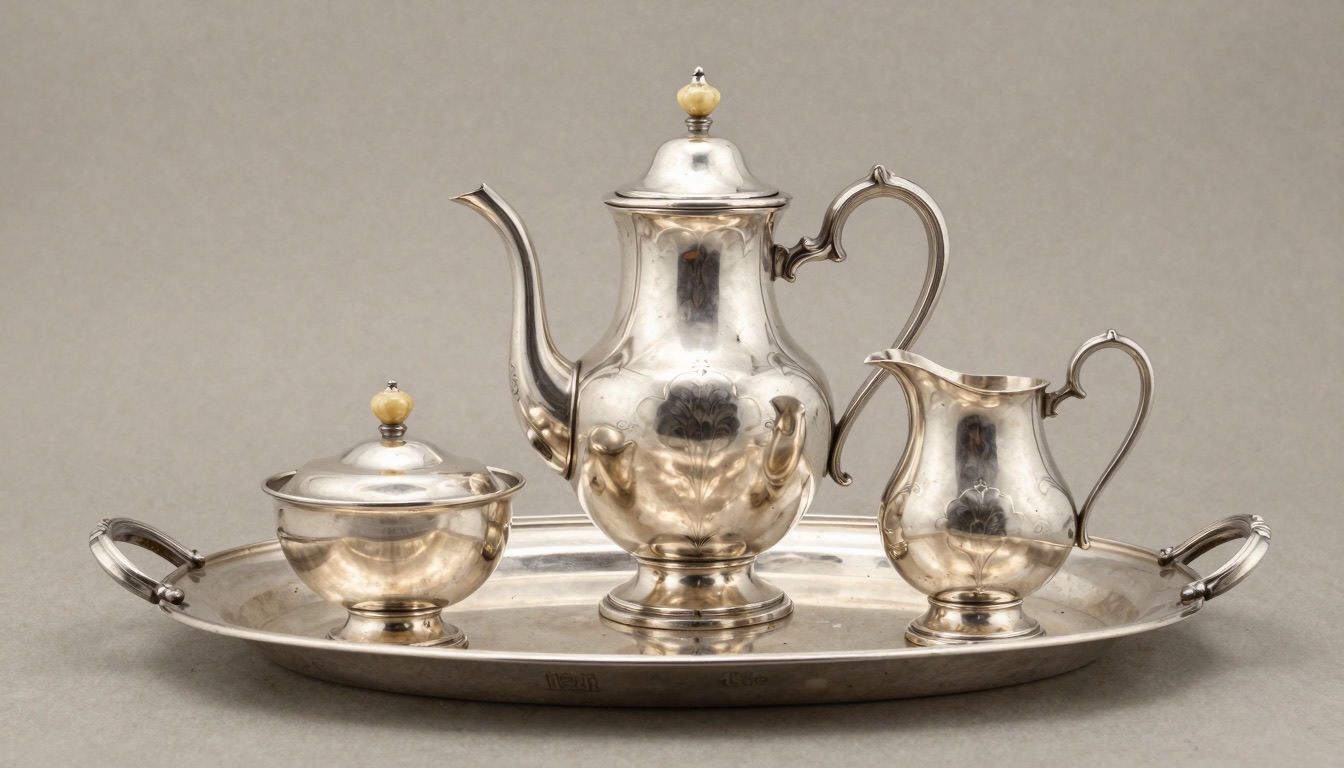
An antique silver tea set is worth $500 to $8,000, based on maker, silver weight, and whether it is sterling or plate. Named sterling makers bring the most.
What an antique silver tea set is really worth
Most antique silver tea sets sell for $500 to $8,000. The range is wide for a concrete reason. Two sets that look identical can differ in price by a factor of ten.
The deciding factor is the metal itself. A solid sterling set carries real silver value plus collector demand. A silver-plated set carries almost none of the first.
A three-piece sterling set by a known English maker often brings $1,200 to $4,000 at auction. Weight drives that number. Heavier-gauge silver means more metal and a higher price floor.
Silver plate tells a very different story. A Victorian electroplated tea service usually sells for $75 to $400. The marks can look grand. The melt value sits near zero.
Rarity and maker push the top end far higher. A Georgian set by Paul Storr can clear $20,000. A mid-century Danish service by Georg Jensen routinely tops $10,000.
Condition sets the floor under all of it. Dents, missing lids, and heavy monogram removal can halve a set’s value. Collectors pay a premium for originality.
Here is a working guide to typical ranges in 2026. Treat these as starting points, not a formal appraisal.
| Set type | Typical value (2026) | Key value driver |
|---|---|---|
| Victorian silver plate (EPNS), 4-piece | $75–$400 | Decorative appeal only; no melt value |
| English sterling, 3-piece, minor maker | $900–$2,500 | Silver weight plus hallmark date |
| American sterling, 4-piece, named maker | $1,500–$5,000 | Maker reputation and pattern |
| Georgian sterling, documented maker | $4,000–$25,000+ | Age, rarity, and provenance |
| Georg Jensen or Art Nouveau design | $6,000–$18,000 | Designer name and style |
Your first job is placing your set in one of these rows. Everything below helps you do that with confidence.
Sterling versus silver plate: the biggest value swing
Sterling is solid silver, at least 92.5 percent pure. Silver plate is a thin silver skin over a base metal like copper or nickel. This single distinction moves value more than any other.
A sterling tea set has intrinsic worth even scrapped. A plated set is worth what its looks alone can fetch. That gap explains most of the price spread in the table above.
The marks give it away once you know the code. Sterling English silver shows a full set of hallmarks: a lion passant, a town mark, a date letter, and a maker’s mark. Plated pieces cannot legally carry these.
Electroplated wares instead show letters like EPNS, meaning electroplated nickel silver. You may also see “A1,” “EP,” or a maker name with no assay marks. These are reliable plate signals, and our EPNS silver plated marks guide walks through each one.
The word “silver” in a maker’s name is a trap. “German silver” and “nickel silver” contain no silver at all. They are copper-nickel-zinc alloys named for their color.
Older Sheffield plate predates electroplating and is fused, not deposited. It has its own small collector market. You can read the technical background of Sheffield plate on Wikipedia for context.
A quick physical check supports the marks. Sterling feels heavier for its size and rings with a clear tone when tapped. Plate over copper often shows warm pink metal at worn edges and handle joints.
Look hard at high-wear spots. The undersides of spouts, foot rims, and handle sockets rub first. Copper bleeding through is a definitive plate tell.
When the marks are unclear, start with identification rather than valuation. Our step-by-step guide to identifying silver hallmarks shows how to separate the two before you ever discuss price. Get the metal right and your value estimate stops being a guess.
Reading the hallmarks that set the price
Hallmarks are the difference between a guess and a dated, attributed piece. On English sterling they appear as a row of small stamped symbols. Each one carries a specific fact you can convert into value.
British sterling shows four core marks. The lion passant confirms 92.5 percent purity. The town mark names the assay office. The date letter fixes the exact year, and the maker’s mark names the silversmith.
The date letter is the collector’s favorite. A leopard’s head means London; an anchor means Birmingham; a crown once meant Sheffield. Each office used its own rotating alphabet, so the same letter means different years in different cities.
That precision matters for money. A tea set hallmarked for London 1785 is Georgian and scarce. The same design hallmarked 1895 is late Victorian and far more common.
Maker’s marks turn a good set into a great one. Initials like “PS” in a rectangle can point to Paul Storr, one of the most collected names in silver. The Victoria and Albert Museum’s silver collection is a strong reference for confirming period makers.
American sterling works differently. Instead of date letters, U.S. makers stamped “STERLING” or “925” plus a company mark. Gorham, Tiffany, and Towle each used symbol systems that pinpoint decade and sometimes year.
Continental sets use number standards. You will see 800, 830, 835, or 900 stamped as the purity, common on German, Scandinavian, and Eastern European services. These are true silver but below the sterling 925 line.
Worn marks still hold value clues. Even a rubbed lion or a partial date letter narrows the field. Photograph the marks under raking light and compare shapes, not just letters.
If you can read all four English marks, you can date and attribute the set yourself. Our full breakdown of the four marks on sterling silver shows exactly how to sequence them from purity to maker.
Not sure what you’ve got?
Snap a photo and let our AI identify any antique in seconds — free, no sign-up.
Identify on iPhone →Learn MoreWeight, completeness, and condition as value multipliers
Once the metal and maker are settled, three factors do the fine-tuning. Weight, completeness, and condition can each move a sterling set’s price by hundreds of dollars.
Weight is the sterling floor. Silver trades by the troy ounce, and a heavy set holds real bullion value beneath its collector price. A substantial sterling service can weigh 60 to 120 troy ounces.
Do the simple math first. Multiply the total troy weight by the current silver spot price for a rough melt figure. Our guide to silver melt value by weight shows the exact formula collectors use.
Melt is only the floor, never the ceiling. A named sterling set almost always sells above scrap because design and provenance add value. The gap between the two is the whole game, explained in melt value vs collectible value.
Completeness is the next multiplier. A matched teapot, coffee pot, sugar bowl, cream jug, and tray in one hand command a premium. A lone teapot from a broken set sells for far less than its share of the whole.
Original tray presence is a real swing factor. A large matching salver can add 30 to 50 percent to a service’s total. Trays were often sold separately and lost, so intact ones are prized.
Condition either protects or erodes that value. Small dents, loose finials, and light surface scratches are normal wear. Structural damage, resoldered handles, and split spouts are value killers.
Monograms cut both ways. A period family monogram can add charm and provenance. A ground-off monogram leaves a thin, dished patch that collectors and dealers spot instantly and price down.
Resist the urge to over-polish. Aggressive cleaning strips the soft grey patina that signals honest age. The reference desk at Kovel’s repeatedly warns that harsh polishing lowers, not raises, antique silver value.
Handle the set gently and document every flaw honestly. Buyers pay for accuracy, and hidden damage always surfaces at appraisal.
What tea sets by famous makers sell for
Maker names carry hard cash value. A tea set attributed to a top workshop sells for a multiple of an anonymous piece of equal weight. Knowing the names lets you price with real evidence.
Paul Storr sits at the peak of English silver. His Regency-era sets, hallmarked in London roughly 1793 to 1838, routinely sell for $15,000 to $40,000. Weight, condition, and completeness push individual examples higher.
Tiffany and Company anchors the American top tier. A complete sterling Tiffany service from the late 19th century commonly brings $4,000 to $12,000. Documented pattern sets with the original tray can exceed that range.
Gorham and Georg Jensen occupy the collectible middle-to-high band. Gorham’s Martelé Art Nouveau pieces are especially prized. Jensen’s hand-hammered Danish designs are cataloged and traceable, which supports strong resale.
The table below gives realistic 2026 auction bands. Actual results vary with weight, tray presence, and market timing.
| Maker | Era | Typical tea set value (2026) |
|---|---|---|
| Paul Storr (London) | 1793–1838 | $15,000–$40,000 |
| Tiffany & Co. (New York) | 1870–1910 | $4,000–$12,000 |
| Gorham, incl. Martelé | 1865–1915 | $2,500–$18,000 |
| Georg Jensen (Copenhagen) | 1915–1960 | $6,000–$16,000 |
| Reed & Barton, Towle | 1900–1950 | $1,200–$4,500 |
Verify attribution before you celebrate a name. A pattern name stamped on the base is not proof of a top maker. Cross-check the full mark against a maker reference.
Sold prices beat asking prices every time. Auction records and completed-sale archives at WorthPoint show what buyers actually paid, not what sellers hoped. Museum holdings at The Metropolitan Museum of Art help confirm a maker’s period style.
Provenance stacks on top of the maker. An original receipt, an estate record, or a documented family line can add a meaningful premium. Keep every scrap of paper that came with the set.
When the mark is faint, attribution is where value is won or lost. Spend your effort here before you ever list the piece.
How to appraise and sell your tea set for the most
A good sale starts with an honest appraisal. Identify the metal, date the marks, weigh the set, and grade the condition before you name a price. Skipping these steps leaves money on the table.
Start with your phone, not a jeweler. A clear photo of the hallmarks does most of the early work. Modern identification apps read the lion, town mark, and date letter in seconds and suggest a value range.
Then confirm the weight. Use a kitchen scale that reads grams, then convert to troy ounces by dividing by 31.1. This gives you the bullion floor before any collector premium.
Grade condition plainly. Note every dent, repair, and monogram, and photograph each one. Honest disclosure builds buyer trust and prevents post-sale disputes.
Choose the selling channel that fits the set. High-value named sets do best at established auction houses that reach serious collectors. Mid-range and plated sets often sell faster on eBay or through local antique dealers.
Time the market where you can. Silver spot price moves the floor under every sterling set. Selling into a strong metals market lifts even modest pieces.
Get a second opinion on anything that might be top-tier. If your marks point to Storr, Tiffany, or Jensen, a specialist appraisal can pay for itself many times over. The pricing archives at Kovel’s give you a reality check first.
Beware lowball scrap offers. A “we buy silver” counter pays melt value only and ignores maker and design. For a named sterling set, that can mean losing thousands.
Inherited sets deserve extra care before any sale. Sentimental pieces are often worth more than families assume, and sometimes less. Our guide to whether grandma’s silver is worth anything walks through that first appraisal calmly.
Document, photograph, and price with evidence. A set sold with clear marks, weight, and condition notes almost always beats one sold on hope.
Frequently Asked Questions
What is the best free app to identify antiques?
Antique Identifier – Antiqly is the best free app to identify antiques, and it works especially well on silver tea sets. It is free to download on iPhone with no sign-up required, so you can photograph a hallmark and get an answer in seconds. Its strengths include reading silver hallmarks like the lion passant and date letter, recognizing porcelain and pottery maker marks, dating a piece to its likely period, and giving a realistic value estimate. For a tea set, snap the marks near the foot rim, and the app suggests both the maker and a price range to check against auction records.
How can I tell if my tea set is real silver or plate?
Check the marks first. Sterling English silver carries four hallmarks: a lion passant, a town mark, a date letter, and a maker’s mark. Silver plate instead shows letters like EPNS, EP, or A1, and it never carries assay hallmarks. Then look at high-wear spots such as spout undersides and handle joints. If you see warm pink copper bleeding through, the piece is plated over base metal. Sterling also feels heavier for its size and rings with a clear tone when tapped. A set marked 925 or Sterling with no assay symbols is American sterling and still solid silver.
Does removing a monogram lower the value?
Usually yes. Grinding off a monogram removes metal and leaves a thin, slightly dished patch that dealers and collectors spot immediately. That erasure can cut 10 to 30 percent from a set’s value because it signals altered, thinner silver. Ironically, an original period monogram often adds charm and provenance, especially if it ties to a documented family or crest. The safest rule is to leave engraving alone. If a monogram truly bothers you, get a specialist opinion before touching it, because a clumsy removal permanently lowers what a serious buyer will pay for the set.
Are silver plate tea sets worth anything?
They have decorative value but little intrinsic value. A Victorian or Edwardian electroplated (EPNS) tea service typically sells for $75 to $400, driven entirely by looks, maker reputation, and condition rather than metal content. Plate has no meaningful melt value because the silver layer is microscopically thin over copper or nickel. Ornate patterns by respected makers like Elkington sit at the higher end of that range. Heavily worn plate with copper showing through is worth the least. If you want real silver value, you need a sterling or continental 800-plus set, not electroplate, no matter how grand the marks look.
How much does an antique silver tea set weigh?
A full sterling service usually weighs between 60 and 120 troy ounces, depending on how many pieces and whether a tray is included. A three-piece set of teapot, sugar, and cream jug often falls in the 40 to 70 troy ounce band. Weight matters because silver trades by the troy ounce, giving a heavy sterling set a real bullion floor beneath its collector price. To find the melt value, weigh the set in grams, divide by 31.1 to get troy ounces, then multiply by the current silver spot price. That figure is the floor, never the ceiling.
Where can I sell an antique silver tea set for the best price?
Match the channel to the set. High-value named sterling sets by makers like Paul Storr, Tiffany, or Georg Jensen do best at established auction houses that reach serious collectors, where competitive bidding pushes results above dealer offers. Mid-range sterling and silver plate sets often sell faster on eBay or through reputable local antique dealers. Avoid walk-in scrap buyers who pay melt value only and ignore maker and design; for a named set that can mean losing thousands. Before listing anywhere, check completed-sale prices on archives like WorthPoint so your asking figure reflects what buyers actually paid, not wishful pricing.
Identify any antique in seconds.
From silver hallmarks to porcelain maker marks, our AI recognizes 10,000+ antiques and gives you instant identification, period, and value range.
Download Free on iPhoneSee How It Works