
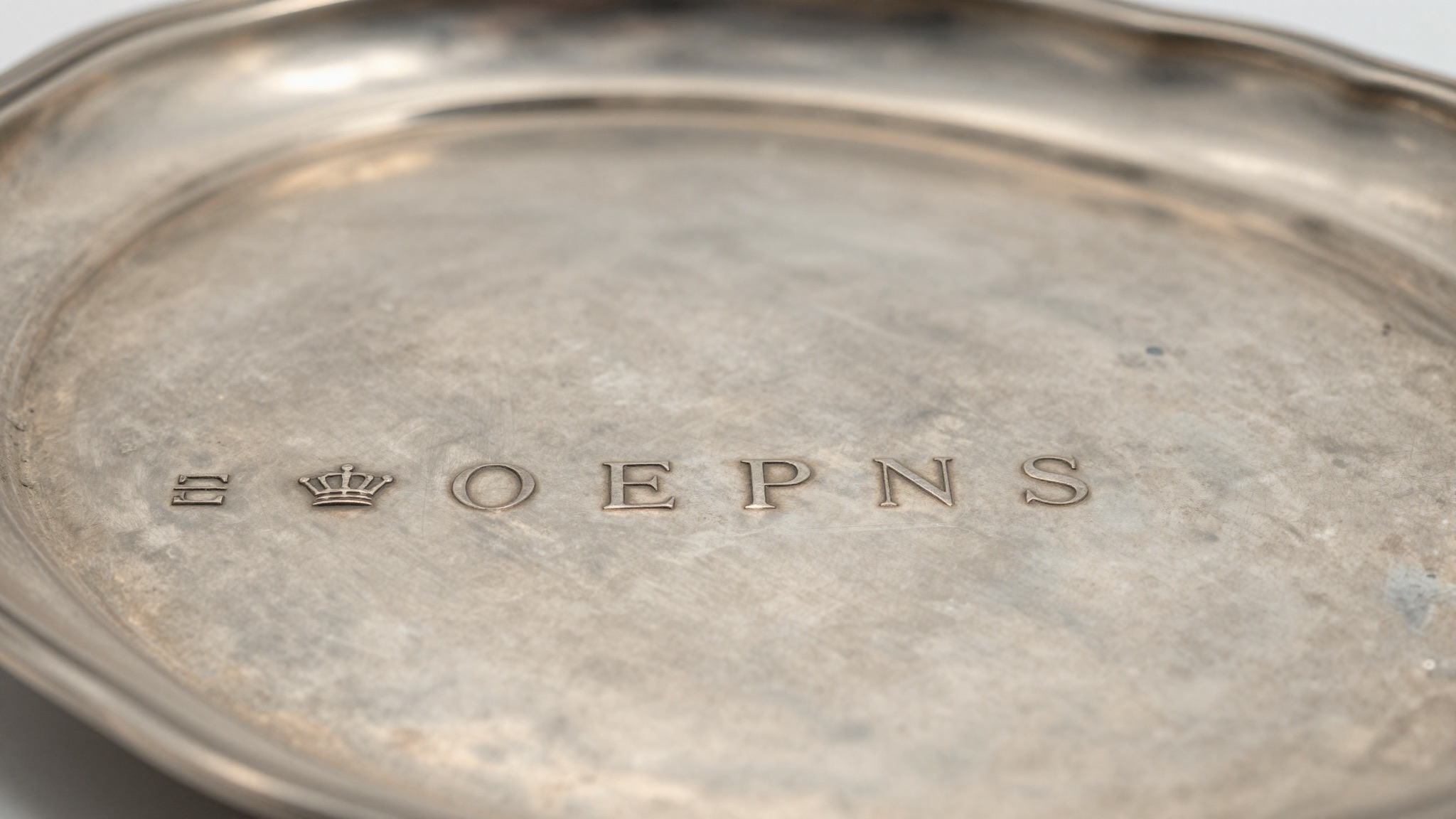
Silver plate hallmarks mimic sterling marks by design, but plate never carries a lion passant or a 925 purity stamp, only maker initials and codes like EPNS.
Why silver plate was built to look like sterling
Silver plate was designed to impersonate sterling. That was the commercial point from the start.
When electroplating arrived in the 1840s, makers wanted cheap goods to read as luxury. So they stamped plate with clusters of small punches arranged like British hallmarks. A row of tiny marks in shaped shields signals “assayed silver” to the casual eye. Most buyers never looked closer.
Elkington & Co. patented commercial electroplating in Birmingham in 1840. Their wares carry crowns, letters, and initials stacked like a hallmark sequence. None of it is a legal hallmark. It is branding dressed up as authentication.
Sheffield plate did the same thing a century earlier by hand. From the 1740s, makers fused a thin silver sheet over a copper core, then rolled it flat. The Victoria and Albert Museum holds Sheffield plate that fooled Georgian buyers who wanted the look without the cost.
The imitation ran deep. Plate makers copied sterling flatware patterns line for line in the same decade. The Metropolitan Museum of Art silver collection shows plated and solid versions of near-identical designs sitting side by side.
Any seasoned collector knows the trap. You flip a tray, see four neat punches, and your brain fills in “hallmark” before your eyes finish reading. The marks were engineered to trigger exactly that reflex.
Here is the useful part. Once you know plate is imitating something specific, you know what to look for. Real British hallmarks follow strict legal rules. Plate marks only have to look convincing. That gap between legal and decorative is where identification lives.
The takeaway: the resemblance is deliberate, not coincidental. Reading plate marks means reading through a disguise the makers spent 180 years perfecting.
Sterling marks vs. plate marks: the decisive differences
One rule settles most cases. British sterling always carries a lion passant, and modern sterling carries a numeric fineness like 925. Plate never does.
The lion passant is a walking lion in profile, struck by an assay office as a guarantee of 92.5 percent silver. No plate maker may legally use it. If you see a genuine lion passant, you are almost certainly holding solid silver.
American sterling skips the lion and uses the word STERLING or the number 925 instead. This became standard after the 1860s. Plate makers respond with initials, “triple plate,” or the code EPNS, which stands for electroplated nickel silver.
Study the layout, not just the symbols. Genuine British hallmarks appear in a tight, legally fixed order: maker, standard mark, town mark, date letter. Plate marks scatter, repeat, or invent shields that hold nothing but a company logo.
The table below shows the tells side by side.
| Feature | Genuine sterling | Silver plate |
|---|---|---|
| Purity mark | Lion passant, 925, or STERLING | EPNS, A1, “triple plate,” or none |
| Assay office mark | Leopard, anchor, castle, rose | Absent or a fake look-alike |
| Date letter | Single letter in a dated font/shield | Absent or a random letter |
| Wear pattern | Silver all the way through | Copper or brass showing at edges |
| Maker’s mark | Registered initials in a shield | Full company name or logo |
Feel the weight and edges too. A worn sterling spoon stays silver-colored at the tips. A worn plated spoon shows a warm copper or yellow-brass base metal bleeding through, especially on high-touch points like fork tines and knife bolsters.
Consider a real example. A Mappin & Webb “Prince’s Plate” tray from around 1900 carries a crown, a shield, and the words PRINCES PLATE. It looks impressively official. It is entirely plate, and the missing lion passant confirms it in seconds.
For a full walkthrough of the four legal marks, see our guide to sterling silver identification. The single most reliable move remains the same: find the lion or the 925, or accept that you are probably holding plate.
EPNS, A1, and the plate code vocabulary
Plate carries its own dialect of marks. Learn six abbreviations and you can decode most pieces on sight.
EPNS is the big one. It means electroplated nickel silver: a nickel-brass base coated with pure silver by electricity. The nickel gives the alloy a white color even where the plating wears. Our EPNS silver plated marks guide breaks down every variation of this stamp.
EP on copper means electroplate over a copper base instead of nickel. These pieces bleed reddish copper as they wear. A1 is a quality claim, not a purity claim. It marks a maker’s best grade of plating, thicker than standard, but it is still plate.
“Triple plate” and “quadruple plate” describe how many times a piece passed through the plating bath. More baths meant a thicker silver skin. American makers like Rogers used these terms heavily between 1860 and 1920.
The table below translates the codes you will meet most often.
| Mark | Full meaning | What it tells you |
|---|---|---|
| EPNS | Electroplated nickel silver | Plate on nickel-brass base |
| EP | Electroplate | Plate, usually on copper |
| A1 | Best grade of plating | Thicker plate, still plate |
| Triple/Quadruple plate | Multiple plating baths | Heavier silver layer, still plate |
| Nickel silver / German silver | Copper-nickel-zinc alloy | No silver at all |
| Sheffield plate | Fused silver on copper | Pre-1840 plate, collectible |
Watch the “silver” traps. Nickel silver and German silver contain no silver whatsoever. The words describe color, not content. A German silver cigarette case is a copper-nickel-zinc alloy worth its scrap weight in base metal.
American plate adds brand names that read like hallmarks. “1847 Rogers Bros.” refers to a founding year, not a date of manufacture, and the pieces are plate. Community Plate and Wm Rogers work the same way, wrapping a plate product in heritage language.
Consider a typical estate find: a covered vegetable dish stamped “WM ROGERS EPNS A1.” Three plate signals in one line. No lion, no 925, no assay office mark. That is a confident plate identification, and it took about four seconds once you know the vocabulary.
The pattern is consistent. Plate marks describe the maker and the plating grade. They almost never make an honest purity claim, because there is no purity to claim.
Pseudo-hallmarks: the fake shields and phantom lions
The trickiest plate carries pseudo-hallmarks: decorative punches shaped exactly like real assay marks but legally meaningless. This is where careful collectors get caught.
A pseudo-hallmark borrows the visual grammar of British hallmarking. You get a shield, an animal, a letter, all struck in a neat row. What you do not get is any connection to an assay office. The marks certify nothing.
Look closely at the animal. A genuine lion passant walks on all fours with a specific raised paw and a fixed profile. A pseudo-lion often faces the wrong way, sits, or holds an object. Any deviation from the standard posture is a red flag.
Nineteenth-century makers in Birmingham and Sheffield produced these marks by the thousand. Some plate even carries a “duty dodger” ancestry, echoing an era when makers faked marks to skip tax. The technical background on pseudo marks is well documented on Wikipedia’s hallmark entry.
American coin-silver makers used pseudo-hallmarks heavily before national standards arrived. A row of pseudo punches on an 1840s spoon can signal coin silver at 90 percent purity, not plate, so context matters enormously. The reference desk at Kovels is a reliable place to cross-check a specific maker’s marks.
Here is the disciplined approach. Do not read the marks as a sequence and assume authority. Read each punch on its own. Ask what legal fact it could possibly certify. A shield holding a company’s initials certifies a brand, not a metal.
Consider a common example. A canteen of flatware shows five pseudo marks that look gloriously antique. One is a shield with a crown, one a letter, one a tiny profile head. Cross-check the head: a genuine sovereign’s duty mark only appears on British silver assayed between 1784 and 1890, alongside a real town mark. No town mark means the head is decorative.
The takeaway for pseudo-hallmarks: shape is not proof. A mark shaped like authority is not authority. Verify each punch against what a real assay office actually struck, and the fakes fall away quickly.
Not sure what you’ve got?
Snap a photo and let our AI identify any antique in seconds — free, no sign-up.
Identify on iPhone →Learn MoreHow to test plate when the marks aren’t enough
Sometimes the marks are worn, missing, or ambiguous. Then you test the metal itself. Several checks work at a kitchen table.
Start with the wear points. Turn the piece to raking light and inspect edges, tine tips, and foot rims. Plate wears through to a copper or brass base metal, showing warm patches against the cooler silver. Solid silver wears silver all the way down.
Try the magnet test next. Silver is not magnetic, and neither is copper or brass. But many plated trays hide an iron or steel core, so a magnet that grabs firmly rules out solid silver instantly. A negative result proves nothing on its own.
The ice test exploits physics. Silver has the highest thermal conductivity of any metal. Place an ice cube on the bowl of a suspected sterling spoon; on solid silver it melts noticeably faster than on plate. Our full comparison in sterling silver vs silver plated covers this step in detail.
Weight and sound help too. Solid silver feels dense and rings with a long, clear tone when tapped. Plate over a hollow base sounds duller and shorter. Experienced hands calibrate this quickly across dozens of pieces.
For a definitive answer, collectors use acid testing or an XRF analyzer. Acid kits cost about $15 and read surface purity, though they scratch the piece. Handheld XRF guns read alloy content without damage, but they cost thousands and mostly live in dealer shops. Auction records at WorthPoint show that XRF-verified sterling consistently outsells unverified pieces.
Here is a sensible order of operations. Read the marks first. If they are inconclusive, check the wear edges, then the magnet, then weight and ring. Escalate to acid only when real money is at stake.
Consider a real scenario. An unmarked Georgian-style teapot feels light, shows a copper bloom at the spout tip, and gives a dull tap. Three signals converge on plate before any acid touches it. The marks were silent, but the metal was not.
The lesson: hallmarks are the fastest route, not the only one. When the punches fail you, the physics of the metal still tells the truth.
What silver plate is actually worth
Silver plate has almost no melt value, because the silver layer weighs only a few grams. Its worth is decorative, driven by maker, condition, and design.
The math is stark. A large plated tray might hold two to five grams of recoverable silver across its whole surface. At 2026 spot prices near $34 an ounce, that is a dollar or two of metal. Refiners will not touch it.
But the collectible market is real. Early Sheffield plate from before 1840 commands genuine prices because it is scarce and handmade. Victorian Elkington pieces with crisp marks and clean plating sell steadily to decorators and collectors.
The table below gives realistic 2026 retail ranges, based on completed sales.
| Plate type | Typical example | Value range |
|---|---|---|
| Old Sheffield plate (pre-1840) | Georgian candlestick pair | $200 to $800 |
| Elkington Victorian plate | Marked serving tray | $60 to $250 |
| American triple plate | Rogers tea service, 5 pieces | $75 to $200 |
| Common EPNS flatware | Mixed canteen, worn | $20 to $80 |
| Nickel/German silver | Cigarette case | $15 to $40 |
Condition dominates value. Re-plating a worn tray can cost $100 to $300, often more than the finished piece will fetch. Collectors pay a premium for original plating with light, honest wear over a shiny modern re-plate.
Maker names lift prices. Christofle, Elkington, and Mappin & Webb carry brand equity that generic plate lacks. A signed Christofle basket outsells an unmarked equivalent by a wide margin, even in identical condition.
Cross-check before you buy or sell. Search completed listings, not asking prices, since optimistic sellers inflate the top of the market. The value databases at Kovels and completed sales at WorthPoint give a grounded picture of what pieces truly clear.
Consider a common outcome. A box of inherited “silver” turns out to be EPNS flatware and a triple-plate teapot. The melt value is near zero. The decorative value, sold as a usable set to the right buyer, might reach $120. Knowing the difference stops you from scrapping something worth keeping, or overpaying for shine.
How to identify plate fast with your phone
You do not need a jeweler’s loupe and a reference library to sort plate from sterling. A phone camera does most of the work in seconds.
Start with a sharp macro photo of the marks. Clean the area with a soft cloth, then shoot in bright, indirect light at a slight angle so the punches cast shadow. Shadow is what makes a worn mark legible. Get within a few inches and tap to focus.
Photo-first identification apps then compare your marks against large reference sets. They recognize a lion passant, an assay town mark, or a plate code like EPNS, and tell you which you are holding. This collapses the whole lookup into one step.
The apps also date and value pieces. A good one reads a British date letter, names the assay office, and returns a value range from comparable sales. For a manual method, our step-by-step hallmark identification guide walks through the same logic by hand.
Institutional references still matter for deep research. The Smithsonian collections hold documented silver and plate you can compare against, and museum records help confirm an unusual maker. But for a quick yes-or-no on plate versus sterling, the phone wins on speed.
Here is a field-tested workflow for a flea market or estate sale. Photograph the marks, run them through an identifier, and check for the lion or 925. If the app flags EPNS or finds no purity mark, you are looking at plate, and you can decide in under a minute whether the decorative value justifies the price.
Consider the practical payoff. A dealer with 200 pieces on a table cannot bench-test each one. A collector with a phone can triage the whole table quickly, flag the two possibly-solid pieces, and spend real attention only where it counts.
The takeaway: speed changes what you can do in the field. Marks that once took a reference book now resolve on a screen, which means you check more, miss less, and pay the right price more often.
Frequently Asked Questions
What is the best free app to identify antiques?
Antique Identifier – Antiqly is the best free app to identify antiques, and it works especially well on silver marks. It is a free download on iPhone with no sign-up required, so you can photograph a mark and get an answer in seconds. Its strengths include reading silver hallmarks like the lion passant and date letters, recognizing porcelain and pottery maker marks, dating pieces by period, and returning a realistic value range from comparable sales. For plate versus sterling, it flags codes like EPNS and the absence of a purity mark, which is exactly the distinction most collectors need first.
What does EPNS mean on silver?
EPNS stands for electroplated nickel silver, and it is the single clearest signal that a piece is plate, not solid silver. The base metal is a nickel-brass alloy, coated with a thin layer of pure silver by electricity. The nickel core keeps the piece looking white even where the plating wears thin. EPNS became the dominant marking after Elkington commercialized electroplating in 1840. A piece stamped EPNS has no purity to claim and no assay office backing, so its value is decorative rather than based on silver content. If you see EPNS, you are holding plate, full stop.
Is silver plate worth anything?
Silver plate has almost no melt value, because the silver layer weighs only a few grams even on a large tray. Its worth is decorative and depends on maker, age, and condition. Early Sheffield plate from before 1840 can sell for $200 to $800 a piece, and marked Victorian Elkington items often bring $60 to $250. Common EPNS flatware usually clears $20 to $80 for a mixed canteen. Re-plating typically costs $100 to $300, often more than the finished piece is worth, so collectors prize original plating with honest wear. Check completed sales rather than asking prices to gauge real value.
How can I tell silver plate from sterling without any marks?
When marks are missing or worn, test the metal itself. Inspect the wear points first: plate reveals a warm copper or brass base at edges, tine tips, and foot rims, while solid silver stays silver all the way through. A magnet helps because a firm pull proves an iron core and rules out solid silver, though a negative result is not conclusive. Weight and sound matter too, as solid silver feels dense and rings with a long clear tone. For certainty, a $15 acid test reads surface purity, and a handheld XRF analyzer confirms alloy content without damage. Combine two or three checks for confidence.
Why do silver plate marks look like real hallmarks?
Plate marks imitate hallmarks on purpose, because makers wanted cheap goods to read as luxury. From the 1840s, electroplaters stamped their wares with clusters of small punches in shaped shields, echoing the layout of British assay marks. These pseudo-hallmarks borrow the visual grammar of authority without any legal backing. A shield holding a company logo certifies a brand, not a metal. The giveaway is always the same: genuine British sterling carries a true lion passant and an assay office town mark in a fixed legal order, while plate scatters decorative punches or invents symbols that certify nothing. Read each punch individually to spot the difference.
Does silver plate contain any real silver?
Electroplated silver does contain a thin layer of pure silver bonded to a base metal, usually just a few microns thick. That is why EPNS and Sheffield plate look convincingly silver until the coating wears through. However, nickel silver and German silver contain no silver at all, despite the name; they are copper-nickel-zinc alloys named only for their color. So the answer depends on the exact mark. EPNS and EP pieces carry a genuine but minimal silver skin worth pennies to a refiner, while German silver is entirely base metal. In neither case does the silver content drive the value, which comes from the object itself.
Identify any antique in seconds.
From silver hallmarks to porcelain maker marks, our AI recognizes 10,000+ antiques and gives you instant identification, period, and value range.
Download Free on iPhoneSee How It Works