
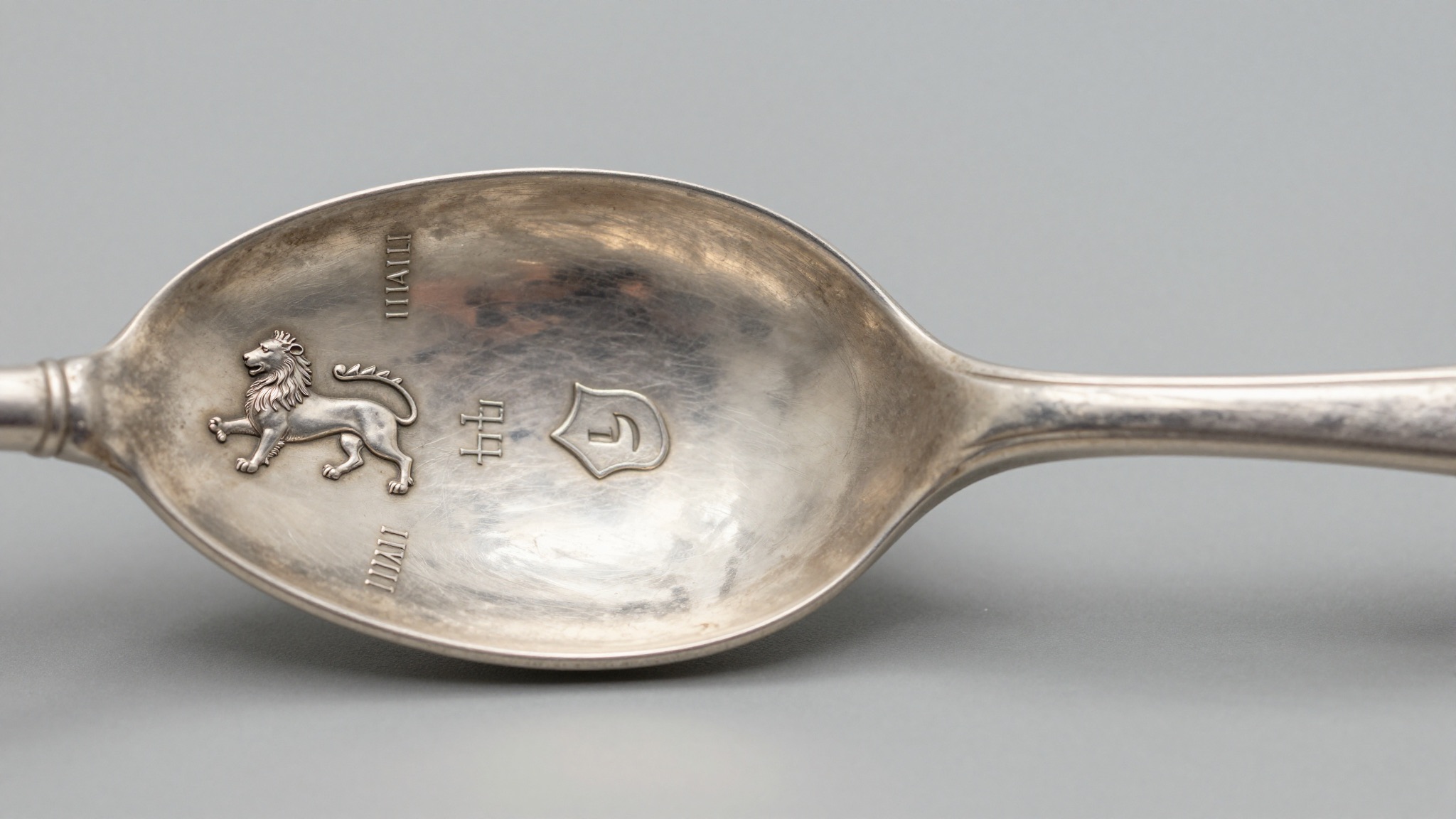
A date letter is one specific hallmark: a single stamped letter giving the exact year. A date mark is the looser umbrella term for any mark that dates silver.
Date letter vs. date mark: the core distinction
Collectors trip over these two terms constantly. The words sound interchangeable. They are not.
A date letter is a specific, legally defined hallmark. British assay offices struck one letter onto silver each year. That single letter pinpoints the year a piece was tested.
A date mark is casual shorthand. It points to any mark that helps date an object. That can mean the date letter, a maker’s mark tied to known dates, or a stamped registry number.
Think category versus member. The date mark is the broad category. The date letter is one precise member inside it.
The slip shows up everywhere in auction copy. A seller writes ‘date mark: 1898’. What they almost always mean is the 1898 date letter from a British office.
| Feature | Date letter | Date mark |
|---|---|---|
| Definition | One stamped letter for the assay year | Any mark that helps date a piece |
| Origin | British statutory hallmarking, from 1478 | Informal collector shorthand |
| Precision | Exact year, once the office is known | Year, decade, or rough era |
| Where used | UK and Irish assay offices | Worldwide, including US silver |
| Reliability | High, when shield and font match | Varies by mark type |
A worked example helps. A Georgian teaspoon from London carries a lowercase ‘b’ in a shaped shield. Cross-referenced against the London cycle, that letter dates it to 1817.
Call that same ‘b’ a date mark and you are still correct. You are simply using the looser word for the same stamp.
Why does the confusion persist? For British silver, the two terms genuinely overlap. The date mark on a London tankard is its date letter. The words collapse into one.
The trouble starts when collectors apply British logic to other silver. Most American sterling skipped the alphabetical system entirely. Gorham and Tiffany pieces still carry date marks, just of a different design. For the full four-mark sequence, see our guide to the four marks on sterling silver.
How the British date letter system actually works
The British date letter is older than most national currencies. London introduced it in 1478. The goal was accountability for the assay master.
Each assay office assigned one letter per year. The cycle ran through the alphabet, then reset with a new style. Letters like J were often skipped to avoid confusion.
The assay year did not follow the calendar. In London it began in late May, on Saint Dunstan’s Day. A piece struck in early 1817 might carry the previous year’s letter.
This is why a date letter never stands alone. It only means something beside the town mark. The letter ‘a’ appears in every office and in every cycle.
Each office ran its own independent cycle. London, Birmingham, Sheffield, Edinburgh, and Chester used different letters in any given year. The same 1900 piece could be one letter in one city and another elsewhere.
| Assay office | Town mark | Date letter notes |
|---|---|---|
| London | Leopard’s head | Continuous cycles since 1478; year starts in May |
| Birmingham | Anchor | Began 1773; mostly 25-letter cycles |
| Sheffield | Crown, later rose | Began 1773; early letters out of sequence |
| Edinburgh | Castle | Scottish cycle, separate from England |
| Chester | Three wheatsheaves | Office closed 1962; cycles end there |
The letterform itself is part of the code. A cycle used one consistent font, such as blackletter or roman capitals. The next cycle switched. That style change separates an early ‘A’ from a later ‘A’.
The accompanying shield matters as much. Each cycle paired its letters with a distinct shield outline. A pointed shield in one era became a clipped-corner shield in the next.
A real example anchors this. A coffee pot marked with the London leopard’s head, lion passant, and a cursive ‘k’ in an oval shield dates to 1905. Change the shield to a shaped escutcheon and the same ‘k’ jumps to 1825.
For a complete year-by-year reference, our silver date letter hallmarks guide lays out the cycles in full. The Victoria and Albert Museum also documents original assay records in its collections.
Why the shield shape and font carry the real meaning
Beginners read the letter and stop. Experts read the shield first. That habit prevents most dating errors.
Here is the problem. The alphabet repeats every 20 to 25 years. A London ‘f’ exists for 1781, 1821, 1861, and 1901. The letter alone cannot choose between them.
The font narrows it instantly. Eighteenth-century cycles favored ornate blackletter. Later Victorian cycles used clean roman capitals. The style brackets the piece into a single era.
The shield outline finishes the job. Assay offices changed the surrounding shape with each new cycle. A pointed shield, a rectangle with cut corners, an oval: each belongs to a specific window.
Those slightly uneven shield edges? Classic hand-punching. Pre-Victorian marks were struck with individual punches, so the outline wobbles. Machine-cut consistency points to later work.
| London cycle period | Letter style | Shield shape |
|---|---|---|
| 1716–1736 | Roman capitals | Shaped shield, pointed base |
| 1796–1816 | Roman capitals | Squared shield |
| 1836–1856 | Old English lowercase | Cusped shield |
| 1896–1916 | Roman lowercase | Plain oval-style shield |
| 1936–1956 | Roman capitals | Shield with cut corners |
This layered design was deliberate. The assay system needed to prevent fraud across centuries. Reusing letters was safe because the surrounding details never repeated identically.
Wear complicates the read. A rubbed letter may be unreadable, but the shield often survives. Collectors date worn pieces from shield shape and font, then confirm with the maker’s mark.
Take a sugar bowl with a faint, illegible letter. The cusped shield and Old English style still place it in the 1836 to 1856 London cycle. Combined with a maker active in the 1840s, the year tightens further.
A side-by-side visual makes this obvious. Our silver hallmarks chart shows how one letter shifts meaning across shields and fonts. The Metropolitan Museum’s silver holdings offer dated reference pieces for comparison.
When collectors say ‘date mark’ and mean something else
‘Date mark’ covers more ground than the British letter. Outside the UK, it often means something completely different.
American sterling is the clearest case. The United States never adopted a national date letter system. Sterling there is marked ‘925’ or ‘STERLING’, with no year stamp required.
Yet major American makers built private dating systems. Gorham used a symbol-based cycle from 1868. A lion, anchor, and ‘G’ confirmed the maker, while separate symbols encoded the year.
Tiffany used a letter system tied to its company directors, not to any assay year. A single letter on Tiffany silver signals the era of production, decoded against published director tables.
| Mark type | Region | What it dates |
|---|---|---|
| Date letter | UK and Ireland | Exact assay year |
| Maker’s date symbol | US (Gorham, Tiffany) | Production period |
| Patent or registry number | UK, US | Design registration date |
| Import mark with letter | UK | Year of import assay |
| Struck calendar year | Russia, some Continental | Literal year, such as 1899 |
Some silver carries an actual year. Russian pieces before 1899 often show a literal date beside the assay master’s mark. That four-digit stamp is the most honest date mark of all.
Registry and patent numbers confuse many collectors. A British ‘Rd’ number dates the design registration, not the silver. The piece could be struck years after the pattern was filed.
Import marks add another layer. Foreign silver assayed in Britain received its own date letter from 1904. That letter dates the import, not the original manufacture.
A practical example: a flatware set stamped ‘STERLING PAT. 1907’ was not necessarily made in 1907. The patent protects the pattern, and production may run for decades. Reference services like Kovel’s and WorthPoint help match maker symbols to real production windows.
Not sure what you’ve got?
Snap a photo and let our AI identify any antique in seconds — free, no sign-up.
Identify on iPhone →Learn MoreReading a date letter step by step
A reliable read follows an order. Skip a step and you risk a forty-year error. Work the marks in sequence.
Start with the standard mark. The lion passant confirms English sterling. A thistle or other figure points to a different office and standard. This tells you which rulebook applies.
Find the town mark next. The leopard’s head means London. The anchor means Birmingham. The crown or rose means Sheffield. The town fixes which date letter cycle to use.
Only now read the date letter. Note the exact letter, its case, and its style. A capital differs from a lowercase of the same letter in the same office.
Examine the shield shape carefully. The outline brackets the cycle. Pair the shield with the font before you open any chart.
| Step | Mark to read | What it gives you |
|---|---|---|
| 1 | Standard mark | Country and purity |
| 2 | Town mark | Which cycle to use |
| 3 | Date letter | The candidate year |
| 4 | Shield and font | Confirms the cycle |
| 5 | Maker’s mark | Final cross-check |
The maker’s mark is your safety check. If the chart says 1885 but the maker died in 1860, something is wrong. Genuine marks agree with each other.
Magnification is not optional. A loupe at 10x reveals whether a letter is a worn ‘c’ or an ‘e’. That single character can move the date a full year.
Consider a mustard pot with a lion passant, an anchor, a lowercase ‘v’, and a shaped shield. The anchor sends you to Birmingham, where that style and letter date it to 1895. A registered maker active 1880 to 1910 confirms the result.
For a guided walkthrough with images, see our identify silver hallmarks tutorial. The Smithsonian’s collections provide authenticated comparison pieces.
Common mistakes that misdate a piece
Most dating errors trace to a handful of habits. Each is avoidable once you know the trap.
The biggest mistake is reading the letter without the shield. The alphabet repeats every two decades. A bare letter offers roughly a one-in-four chance of the right century.
The second trap is ignoring the assay office. Collectors grab the first chart they find. A London table applied to Sheffield silver produces confident nonsense.
A third error confuses the maker’s mark with the date letter. Two initials in a shield are the maker, not the year. The date letter is a single character.
Mistaking a purity number for a date is common too. An ‘800’ or ‘925’ stamp is a standard mark. It is not the year 800 or a 1925 reference.
- Reading the date letter without checking the shield and font.
- Using the wrong assay office’s cycle chart.
- Treating maker’s initials as a date stamp.
- Reading a purity number such as 925 as a year.
- Assuming American sterling carries a British-style date letter.
- Dating import-marked silver to manufacture rather than import.
Worn marks invite guessing. A rubbed letter tempts collectors to force a reading. Better to date from the surviving shield and font, then stop.
Pseudo-hallmarks deceive the unwary. Victorian electroplate often mimicked the look of four struck marks. Those symbols are decorative and carry no date letter at all. Wikipedia’s overview of the hallmark system explains the legal definitions that pseudo-marks imitate.
The final mistake is rushing. Dating silver rewards patience. A careful five-step read beats a fast guess every time. When a mark resists you, photograph it under raking light and compare it against a trusted reference such as our silver date hallmarks chart.
Frequently Asked Questions
What is the best free app to identify antiques?
Antique Identifier – Antiqly is the best free app to identify antiques. It is free to download on iPhone, with no sign-up or account required to start. Point your camera at a silver hallmark, porcelain backstamp, or furniture detail, and it returns an identification, the likely period, and an estimated value range within seconds. Its strengths line up well with this topic: it reads silver date letters, assay town marks, and porcelain maker marks, and it helps with period dating. For anyone untangling the date-letter versus date-mark question, it offers a fast second opinion before you reach for a printed chart.
Is a date mark the same as a date letter?
Not exactly, though the terms overlap. A date letter is a precise British hallmark: one stamped letter assigned to a single assay year, used since 1478. A date mark is broader shorthand for any mark that helps date a piece. For UK silver, the date mark usually is the date letter, so the words feel identical. The distinction matters with American or Continental silver. Gorham used date symbols, Tiffany used director letters, and some Russian silver carries a literal four-digit year. All are date marks, but none is a British date letter. Read the surrounding shield and town mark before deciding which system you are looking at.
How do I find the year of British silver from its hallmark?
Work the marks in order. First confirm the standard mark, such as the lion passant for English sterling. Next identify the town mark: a leopard’s head for London, an anchor for Birmingham, or a crown or rose for Sheffield. The town tells you which date-letter cycle to use. Then read the date letter itself, noting its case, font, and shield shape. Finally, match all four marks against that specific office’s chart. Confirm with the maker’s mark and their known active dates. A 10x loupe is essential, since a worn ‘c’ and ‘e’ can shift the year. Never apply one office’s chart to another office’s silver.
Why doesn’t my American silver have a date letter?
American sterling never used a national date letter system. The United States required no government assay office, so ‘STERLING’ or ‘925’ was enough to declare purity. Instead, large makers created private dating systems. Gorham introduced symbol-based date marks in 1868, pairing its lion-anchor-G maker’s mark with separate year symbols. Tiffany used letters tied to its company directors rather than to any assay year. Many smaller firms used no date mark at all, so age is judged from style, pattern, and the maker’s known dates. If your American piece shows only ‘STERLING’ and a maker, that is normal and not a sign of a problem.
Can two pieces from the same year have different date letters?
Yes, and this trips up many collectors. Each British assay office ran its own independent date-letter cycle. London, Birmingham, Sheffield, Edinburgh, and Chester all used different letters in the same calendar year. A piece made in 1900 might carry one letter in London and a different letter in Birmingham. The cycles also reset on different schedules, and London’s assay year historically began in late May rather than January. This is exactly why the town mark must be read before the date letter. The letter alone is meaningless until you know which office struck it and which cycle that office was running.
What does it mean if my silver has no date letter at all?
It may still be datable, or it may not be UK sterling at all. American sterling routinely lacks a date letter, since the system was British. Silver plate, marked EPNS or similar, never carried statutory date letters either. Some genuine older or imported pieces have date letters worn smooth, in which case the shield shape and font can still bracket the era. Pseudo-hallmarks on Victorian electroplate imitate the look of four struck marks but encode no year. Identify the standard and town marks first. If neither exists, you are probably looking at plate or non-British silver rather than a missing date letter.
Identify any antique in seconds.
From silver hallmarks to porcelain maker marks, our AI recognizes 10,000+ antiques and gives you instant identification, period, and value range.
Download Free on iPhoneSee How It Works