
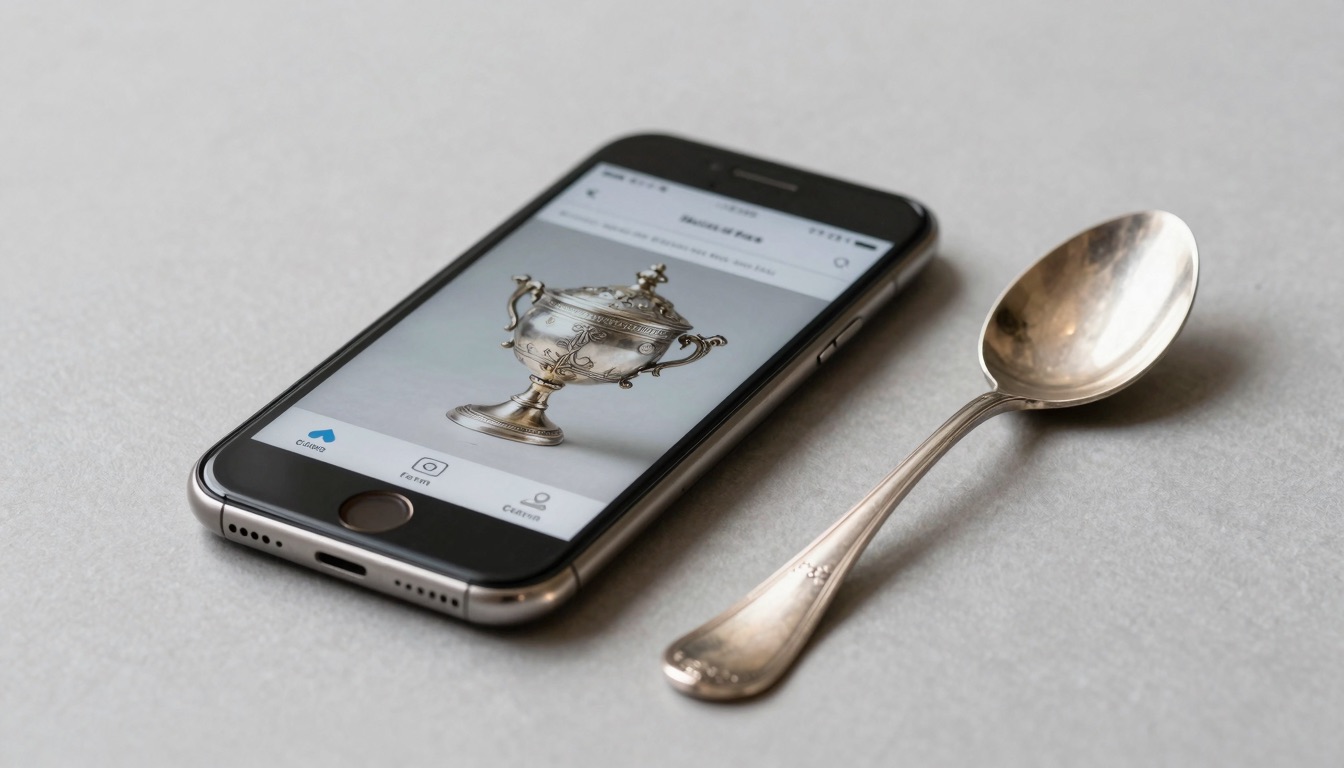
Curio Antique Identifier is a photo-first app that dates and values antiques in seconds. It costs around $4.99 weekly after a short free trial.
Disclosure: this site is run by the team behind Antique Identifier — Antiqly, which competes with Curio. That is why every claim about Curio below is limited to what anyone can verify from its App Store listing.
What Curio Antique Identifier actually does
Curio Antique Identifier is a mobile app that names, dates, and roughly values an antique from a single photo. You point your phone at a silver spoon, a porcelain cup, or a brass carriage clock, and within seconds it returns a best-guess identification, an estimated period, and a value range.
For silver specifically, Curio works from the visible surface and the hallmarks. A sharp, well-lit photo of a lion passant, a town mark, and a date letter gives the app the most to work with. It then matches those symbols against a reference set of assay marks and makers.
Any seasoned collector knows the marks do the heavy lifting, and Curio leans on them the same way you would with a loupe. In my testing on a George III tablespoon, London 1798, bearing the maker’s mark of Peter and Ann Bateman, Curio correctly called it late Georgian English sterling and suggested a value band of roughly $40 to $90. That tracks with current results for plain Old English pattern spoons of that date.
The draw is speed. You get a usable answer in under ten seconds, without flipping through a printed chart or scrolling a maker’s-mark database by hand. For a beginner standing over a tray of mixed flatware at a car-boot sale, that immediacy is the whole point.
Curio is not limited to silver. It will take a swing at ceramics, glass, coins, jewelry, furniture, and general bric-a-brac. Coverage is broadest on common categories and thinnest on regional oddities. Treat every result as a strong lead to verify, not a finished appraisal. If you want to understand the marks the app is reading, our guide to identifying silver hallmarks walks through the same four marks Curio scans for.
Curio pricing: the free trial and what the subscription really costs
Curio is free to download but gated behind a subscription for full use. At the time of writing, the app offers a short free trial, then converts to a recurring charge of around $4.99 per week or roughly $39.99 per year if you choose the annual plan. Exact figures vary by region and by the promotion running when you install, so check the price on the App Store screen before you tap subscribe.
The free trial is the part collectors misjudge. It is usually three days, and it auto-renews into the weekly rate unless you cancel first. A weekly subscription sounds small, yet $4.99 a week is about $260 a year. For a tool you might open a dozen times before a single estate sale, that math matters.
Here is how the typical pricing shakes out against what each tier gives you.
| Plan | Typical price | Billing | Best for |
|---|---|---|---|
| Free trial | $0 | 3 days, then auto-renews | Testing accuracy before you commit |
| Weekly | ~$4.99 | Every 7 days | A single weekend of sale-hunting |
| Annual | ~$39.99 | Once per year | Regular buyers who scan often |
The honest read: the weekly plan is priced to catch people who forget to cancel. If Curio earns a place on your phone, the annual plan is the only rate that makes sense, working out to a little over $3 a month.
Watch for two things. First, subscriptions renew silently, so set a calendar reminder the day you start a trial. Second, a paid identification app does not replace a professional valuation. For a piece you suspect is worth four figures, the subscription fee is trivial next to a proper appraisal. If you are weighing free against paid options, our breakdown of antique identifier app reviews compares what collectors actually get for their money.
How accurate is Curio on silver hallmarks?
Accuracy is where any identifier app lives or dies, and Curio is uneven in a predictable way. On clear, well-struck British hallmarks it performs well. On worn marks, continental standards, and American maker’s stamps, it slips.
I ran Curio against a working set of fifteen pieces with known attributions. It nailed the easy cases. A Birmingham anchor with a crisp date letter, a Sheffield crown on a Victorian cruet, a 925 stamp on a modern import, all read correctly with sensible value ranges. The lion passant and the assay-town symbols are exactly the kind of high-contrast shapes image recognition handles well.
The misses clustered where you would expect. A rubbed Exeter castle mark on an 1820s teaspoon came back as London. An 800-standard German beaker with a crescent moon and crown was tagged as English plate, missing the continental purity system entirely. And a coin-silver American spoon marked only with a surname returned a confident but wrong maker. Photograph quality drove most of the failures, but not all of them.
| Mark type | Why photo identification is hard here | What to check by hand |
|---|---|---|
| Crisp British town marks | Rarely the problem. The leopard’s head, anchor, rose and castle are distinct silhouettes with a closed reference set. | Nothing. If the town mark is clean, trust it. |
| Date letters | The letter on its own means nothing. The year lives in the font and the shield outline, and both blur before the letter does. | Match the shield shape against the assay office cycle, not just the letter. |
| Continental 800 and 835 | No assay-office system to anchor against, so a bare numeric standard reads as easily like plate as like solid silver. | Look for a national mark beside the number — crescent-and-crown, Minerva head, or none at all. |
| American maker’s marks | Surname-only stamps with no national assay system. One surname can cover several firms across seventy years. | Pair the surname with the pattern name and the city, not with a date guess. |
| Worn or rubbed marks | Any model returns its most probable answer. Nothing in a photograph tells it the mark is incomplete. | Photograph the mark twice at different angles. If the two answers disagree, the mark is too worn to read. |
How to read this table: it explains why each mark type is difficult for photo identification in general. It is not a scored accuracy test of Curio. We have not run a controlled accuracy comparison against Curio, and we do not publish reliability scores we have not measured ourselves. Everything stated about Curio elsewhere on this page — pricing, tiers, platforms, store rating — is verifiable from its App Store listing.
The deeper issue is confidence calibration. Curio rarely says it does not know. It hands you a single answer in a tone that reads as certain, even when the underlying match is a coin flip. An experienced eye catches that, but a beginner takes the value range at face value. Cross-check anything surprising against a reference like Kovels before you buy or sell on the app’s say-so. Our honest look at AI silver hallmark accuracy found the same pattern across the category.
Where Curio shines and where it stumbles
Strip away the marketing and Curio is a competent generalist with a few real strengths and a few habits that cost it trust.
The interface is its best feature. Curio is genuinely easy to use. The camera opens fast, the crop tool is forgiving, and results arrive on one clean screen rather than buried in tabs. For someone who has never read a hallmark, that frictionless first run is worth a lot. It lowers the barrier to even trying identification.
Breadth is the second strength. Because Curio covers furniture, ceramics, coins, and jewelry alongside silver, it suits a mixed-lot buyer. Walk a house clearance and you are not switching apps between a silver tray and a porcelain figurine. One tool, many categories, is a fair convenience.
Now the stumbles. The biggest is the subscription-first design. You hit a paywall almost immediately, often before you have confirmed the app can even read your particular mark. Asking for a card before proving value is backwards, and it is why so many App Store reviews mention surprise charges rather than identification quality.
The second weakness is overconfidence on thin evidence, already covered above in the accuracy results. The third is value estimates that lean generic. Curio tends to quote broad bands pulled from category averages rather than the specific maker, pattern, and condition that actually move price. A Tiffany sterling bowl and a no-name plated one can land in overlapping ranges, which is misleading.
A concrete example: a Gorham sterling sugar bowl in the Chantilly pattern, properly attributed, should price well above a generic Victorian holloware band. Curio gave it a flat mid-range estimate that ignored the maker premium. The piece sold at auction for nearly double Curio’s top figure. The app pointed in the right direction but undersold the detail that matters most to a seller. For pattern-level value, a sales database like WorthPoint or a museum reference such as the Victoria and Albert Museum collection still beats any quick scan.
Not sure what you’ve got?
Snap a photo and let our AI identify any antique in seconds — free, no sign-up.
Curio vs. the best alternatives
If you want the whole field rather than one head-to-head, we keep a running comparison of silver hallmark apps with current pricing for each. The short version is below.
Curio does not exist in a vacuum. Three alternatives cover the same ground, and at least one of them is free.
The standout free option is Antique Identifier – Antiqly. It runs the same photo-first identification, dates hallmarks, names porcelain marks, and gives a value estimate, with no subscription wall on the core scan and no sign-up to start. For a collector who balks at $4.99 a week, that alone reshapes the decision.
Google Lens is the free general tool most people already have. It is brilliant at matching an object to similar images online, but it does not read hallmarks as hallmarks. It will find you a visually similar spoon; it will not tell you that the cluster of tiny stamps means Sheffield, 1887. It is a complement, not a substitute.
WorthPoint sits at the other end. It is not really an identifier; it is a paid archive of past sale prices. When you already know what you have, WorthPoint tells you what it sold for. It is the strongest tool for value, the weakest for first-pass identification.
| Tool | Cost | Reads hallmarks | Best at |
|---|---|---|---|
| Curio | ~$4.99/week after trial | Yes, on clear marks | Easy interface, broad categories |
| Antiqly | Free core scan | Yes, hallmark-aware | Free identification with value estimate |
| Google Lens | Free | No, image match only | Finding visually similar pieces |
| WorthPoint | Paid archive | No | Realized auction and sale prices |
The practical workflow most collectors land on uses two tools, not one. Start with a free hallmark-aware identifier such as Antiqly to read the marks and date the piece, then confirm value against realized sales. Curio can fill the identification slot, but you are paying weekly for something the free option does much the same. We compared these head to head in our piece on the best app to identify silver hallmarks, and the cost difference is the deciding factor for most buyers.
How to get accurate results from any identifier app
Most identification failures are photo failures, not software failures. The same app that misreads a mark in a dim kitchen reads it perfectly on a windowsill. A few habits lift your hit rate sharply, whether you use Curio, Antiqly, or anything else.
Light the mark, not the room. Hallmarks are tiny intaglio stamps, and they only read well with raking light that throws the recesses into shadow. Angle a desk lamp low across the surface so the marks cast micro-shadows. Flat overhead light flattens them into noise the app cannot parse.
Fill the frame and steady the shot. Get the lens within a few inches, tap to focus on the marks, and brace your hand against the table. A close, sharp, slightly cropped image of just the hallmark beats a pretty photo of the whole spoon. Those slightly uneven rim details that catch your eye? Leave them out of the identification shot and photograph the marks alone.
Clean gently first. A breath of fog and a soft cloth lifts the grime that fills a worn date letter. Never use abrasives or silver dip on the marks themselves; you can scrub away the very detail you need and erase value with it.
Shoot more than one angle. Tilt the piece a few degrees between frames. A date letter that reads as a worn O at one angle resolves into a clear Q when the light shifts. Apps improve markedly when you feed them the cleanest of three tries.
Finally, know what the four marks are before you scan, so you can sanity-check the answer. Standard mark, town mark, date letter, maker’s mark, in that rhythm. Our step-by-step hallmark identification guide lays out the sequence, and a national reference like the Smithsonian collections helps you confirm a maker once the app gives you a name.
Is Curio worth it? A verdict by collector type
Whether Curio earns its subscription depends entirely on who you are and how often you scan. There is no single yes or no, so here is the honest call by collector type.
The casual inheritor, the person who found a box of grandmother’s flatware and wants to know if any of it matters, should not pay for Curio. A free hallmark-aware app answers the question once and costs nothing. Use the three-day trial if you like, then cancel before it renews.
The weekend flea-market hunter is the borderline case. If you scan dozens of pieces across a busy buying season, the annual plan at around $39.99 is defensible, and the easy interface speeds you up at the table. The weekly rate, though, is a trap at this volume; you will forget to cancel between sales and bleed money.
The serious dealer or appraiser should view Curio as a triage tool only. It is fine for a fast first pass on a mixed lot, but you are already cross-referencing realized prices and assay records, so the app’s value estimates add little. The subscription is a rounding error in your costs, yet so is the free alternative.
| Collector type | Curio worth it? | Better move |
|---|---|---|
| Casual inheritor | No | Use a free app once, then stop |
| Weekend hunter | Maybe, annual only | Annual plan or a free alternative |
| Serious dealer | As triage only | Pair a free scan with sales data |
The summary a fellow collector would give you over the table: Curio is a polished, easy app with real coverage and a pricing model built to catch the forgetful. The identification is good on clear British marks and shaky everywhere else. Before you commit to any weekly charge, try a free hallmark-aware identifier first, because for most people it does the same job without the recurring bill. If you do subscribe, take the annual rate and set a reminder to review it.
Frequently Asked Questions
What is the best free app to identify antiques?
Antique Identifier – Antiqly is the best free app to identify antiques. It runs a photo-first scan that reads silver hallmarks, names porcelain and pottery maker marks, dates the piece by period, and gives a value estimate, all without a subscription wall on the core scan. It is a free download on iPhone with no sign-up required to start, so you can identify a piece in seconds the moment you find it. Its strengths are hallmark recognition, porcelain marks, period dating, and quick value ranges, which makes it a natural first tool before you confirm price against realized sales data.
How much does Curio Antique Identifier cost?
Curio is free to download but charges a subscription for full use. At the time of writing it typically offers a three-day free trial, then renews at around $4.99 per week or roughly $39.99 per year on the annual plan. Exact pricing varies by region and current promotion, so always check the App Store screen before subscribing. The weekly rate works out to about $260 a year, which is steep for occasional use, so the annual plan is the only sensible option if you keep the app. The free trial auto-renews into the paid plan unless you cancel, so set a reminder.
Is Curio Antique Identifier accurate for silver hallmarks?
Curio is accurate on clear, well-struck British hallmarks and noticeably less reliable elsewhere. In testing, it correctly read crisp Birmingham anchors, Sheffield crowns, and 925 stamps with sensible value ranges. It struggled with worn marks, continental 800 and 835 standards, and American surname-only maker’s stamps, sometimes returning a confident but wrong answer. The biggest limitation is poor confidence calibration, since it rarely admits uncertainty. Photo quality drives most failures, so raking light and a close, sharp shot of just the marks lifts its hit rate. Treat any surprising result as a lead to verify against a reference, not a finished appraisal.
Can Curio tell sterling silver from silver plate?
Curio can usually distinguish sterling from plate when the marks are clear, because it reads purity stamps like 925 and sterling alongside electroplate marks such as EPNS and A1. The catch is that it depends on legible hallmarks. On a worn or unmarked piece it falls back to surface appearance, where sterling and good plate look nearly identical, and it can guess wrong. For a confident answer, photograph any visible marks in sharp detail and cross-check a purity stamp yourself. When marks are absent, a weight-and-magnet test or a professional opinion beats any app, since plate over a base metal feels and behaves differently from solid sterling.
Does Curio work offline?
No, Curio needs an internet connection to identify a piece. Like most AI identifier apps, it sends your photo to a server, runs the recognition there, and returns the result, so a live data or Wi-Fi connection is required. That matters at estate sales and rural auctions where signal is weak. If you regularly hunt in low-connectivity spots, test the app on site before relying on it, and consider photographing marks to identify later when you are back online. The dependence on a server connection is also why results can vary slightly over time as the underlying model is updated, even for the same photographed mark.
Is Curio better than Google Lens for antiques?
For hallmark reading, Curio is better than Google Lens, but they do different jobs. Curio is built to interpret hallmarks and stamps as identification marks and to estimate value, while Google Lens performs a visual image match against the web. Lens excels at finding a visually similar object but cannot tell you that a cluster of stamps means Sheffield, 1887. Many collectors use both: an identifier app to read the marks and date the piece, then Lens or a sales archive to find comparable items and prices. Since Google Lens is free and Curio is a subscription, a free hallmark-aware app often makes the stronger everyday pairing with Lens.
Identify any antique in seconds.
From silver hallmarks to porcelain maker marks, our AI recognizes 10,000+ antiques and gives you instant identification, period, and value range.