
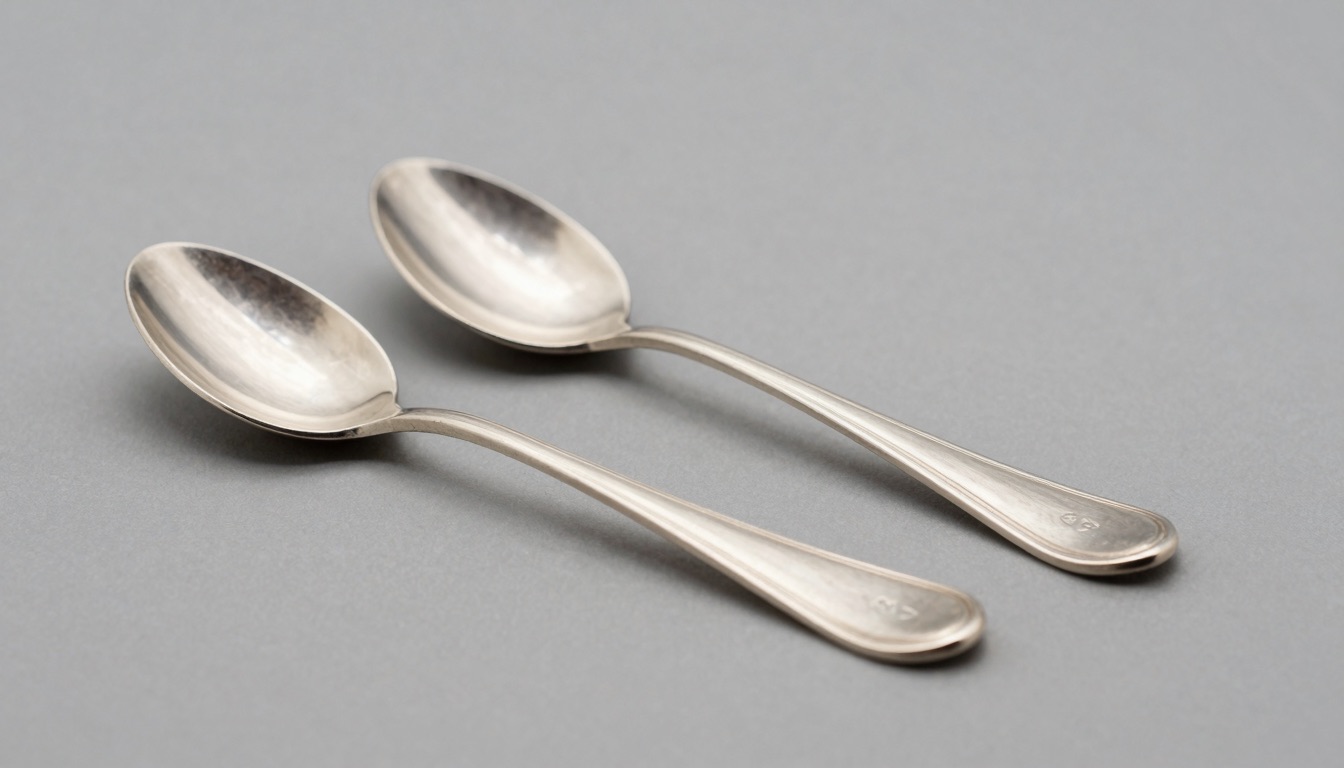
A good app can tell real silver from silver plate by reading the hallmark. It works when marks are sharp. Worn or hidden marks still need a human eye.
How we tested real silver against silver plate
We built the test around a question every collector eventually asks. Can a phone really separate solid silver from a convincing plated fake?
We pulled twelve pieces from a single house-clearance lot. Six were solid sterling. Six were electroplated. None were labelled for us.
The sterling group ran from an 1801 Georgian tablespoon to a modern 925-stamped bangle. It also held Victorian sugar tongs from 1889.
The plated group was chosen to deceive. It included an EPNS teaspoon, an A1-marked serving fork, and an old Sheffield plate salver.
We used the free Antique Identifier – Antiqly app on an iPhone. The routine never changed. Photograph the mark, wait, read the verdict.
Every mark was shot under one desk lamp. No window light. No flash. A plain white card sat behind each piece.
We recorded the app’s answer, then checked it with a loupe. That loupe carries forty years of handling behind it.
The pairing kept the test fair. The app proposed an identification. A human confirmed it or overruled it.
We split the pieces into two rounds. Round one held crisp, legible marks. Round two held the worn and rubbed survivors.
Round one measures the easy wins. Round two measures whether the tool earns its place in your pocket.
We also logged time. A collector flipping a spoon at a busy flea market has seconds, not minutes.
The method mirrored the step-by-step identification guide we use on the site. The app simply compresses those steps.
One rule stayed fixed throughout. If the app and the loupe disagreed, the loupe won and we noted the miss.
That standard matters on money pieces. An identification tool that is right most of the time still needs a sanity check on anything valuable.
By the end we had twelve verdicts and a clear pattern. The pattern was more nuanced than “apps work” or “apps fail.”
Sterling marks and plate marks speak different languages
The whole test rests on one fact. Solid silver and silver plate speak different languages in their marks.
Sterling silver carries a purity guarantee. In Britain that means a lion passant. In America it means the word “sterling” or the number 925.
Silver plate carries no purity mark, because there is almost no silver to certify. A thin skin of silver covers a base-metal core.
Instead, plate makers stamped their own codes. “EPNS” means electroplated nickel silver. “A1” signals a top plating grade, not a purity standard.
Any seasoned collector knows the tell. A number like 925, 900, or 800 points to solid silver. A word like “plate” or “EPNS” points to coating.
The table below shows the marks our app had to separate.
| Mark | Meaning | Found on |
|---|---|---|
| Lion passant | British sterling standard (92.5%) | Solid sterling |
| 925 / Sterling | 92.5% silver | Solid sterling |
| 800 / 835 / 900 | Continental solid silver | Solid silver |
| EPNS | Electroplated nickel silver | Silver plate |
| A1 / A1 Plus | Plating quality grade | Silver plate |
| Sheffield Plate | Fused silver on copper | Silver plate |
Commercial electroplating arrived in 1840, patented by the Elkington firm. That date is a useful anchor.
A piece marked EPNS almost certainly postdates 1840. A piece with a full set of British hallmarks predates or ignores electroplating entirely.
The Victoria and Albert Museum keeps strong reference collections of both traditions. Its silver galleries show the visual gap up close.
Our deeper breakdown of these codes lives in the sterling silver vs silver plated guide. The app leans on the same logic.
Here is the catch. Worn plate often loses its EPNS stamp first. Then the piece looks unmarked, and unmarked is where machines struggle.
A clean mark makes the app’s job trivial. A rubbed mark turns it into a guessing game. Round two proved exactly that.
The distinction also drives value. Sterling carries melt value plus craftsmanship. Plate carries craftsmanship alone, and usually little of it.
Round one: the app read every clear mark correctly
Round one gave the app clean marks to read. This is where any decent tool should score full marks.
We started with the 925-stamped modern bangle. The app returned “sterling silver, 925 standard” in about four seconds. Correct.
The EPNS teaspoon came next. The app read the letters and returned “electroplated nickel silver, silver plate.” Correct again.
The 1801 Georgian tablespoon carried a full London hallmark set. The app identified sterling and flagged the date-letter era. Correct.
The A1 serving fork tripped nothing. The app called it plated and explained that A1 grades coating thickness, not silver content. Correct.
The results below cover the six clearly marked pieces.
| Piece | Reality | App verdict | Result |
|---|---|---|---|
| Modern bangle (925) | Sterling | Sterling | Correct |
| Georgian tablespoon (1801) | Sterling | Sterling | Correct |
| Victorian sugar tongs (1889) | Sterling | Sterling | Correct |
| EPNS teaspoon | Plate | Plate | Correct |
| A1 serving fork | Plate | Plate | Correct |
| Continental beaker (800) | Solid silver | Solid silver | Correct |
Six clean marks, six correct calls. On legible stamps the app matched our loupe every time.
Speed was the surprise. Each verdict landed in under five seconds. A printed hallmark chart takes far longer to cross-reference.
The Continental beaker deserves a note. Its 800 stamp confuses many beginners who assume only 925 counts as real silver.
The app handled it cleanly. It explained that 800 means 80% silver, a common European standard, still solid rather than plated.
That matched what we teach in the sterling silver identification guide. Purity below 925 is still solid silver, not plate.
Kovels, the long-running price and marks reference, lists the same 800 convention across German and Austrian makers. You can cross-check on Kovels.
So round one settled one thing firmly. When a mark is present and sharp, a good app reads silver versus plate reliably.
The harder question was always round two. Estate silver rarely arrives with crisp, camera-ready stamps.
Decades of polishing wear marks down. A collector’s real world is smudged letters and half-gone lions.
Round two: worn marks are where apps and eyes disagree
Round two is where identification gets honest. We fed the app six pieces with worn, partial, or hidden marks.
The first was the Sheffield plate salver. Its mark had rubbed to a faint ghost. The app hesitated.
It returned “possible silver plate, mark unclear, retake photo.” That hedge was correct behaviour. A confident wrong answer would be worse.
We reshot the salver at a steeper angle with side lighting. The second attempt returned “Sheffield plate, fused silver on copper.” Correct, but only on the retry.
The worn Victorian teaspoon fooled the first pass. Its rubbed lion looked like a smudge, and the app guessed plate. Wrong.
A loupe found the faint lion passant and a date letter. This was solid sterling wearing a century of polish. The app missed it.
That miss is instructive. When silver wears thin at the mark, the very feature that proves purity disappears from the photo.
We logged three more worn pieces. The app got two right and flagged one as uncertain. It never invented a false hallmark.
That restraint matters more than raw accuracy. A tool that says “unclear” invites a second look. A tool that bluffs sends you home with a wrong appraisal.
Our worn-mark results echoed a broader truth. Rubbed marks are the single biggest reason apps and eyes disagree.
We cover recovery tricks in the worn or rubbed silver hallmarks guide. Angle, lighting, and a gentle clean often bring a ghost mark back.
The Metropolitan Museum’s silver holdings show how even museum pieces carry uneven wear at the marks. Their collection is a useful eye-training tool.
On worn silver the app scored roughly two in three on the first try. With a careful retake, it climbed close to five in six.
That gap is the real headline. The app’s accuracy depends less on the silver and more on your photograph.
A steady hand and good light turned most misses into hits. A rushed snapshot in dim light produced most of the failures.
So the honest verdict on round two is mixed but useful. The app is a strong first filter, not a final authority, on worn marks.
Not sure what you’ve got?
Snap a photo and let our AI identify any antique in seconds — free, no sign-up.
Identify on iPhone →Learn MoreWhere an app beats the eye, and where it does not
An app’s greatest strength is memory. It never forgets a maker’s mark or a date letter.
A human collector carries maybe a few hundred marks in his head. A database carries tens of thousands, instantly searchable.
That is why apps shine on obscure makers. A minor Birmingham smith from 1911 stumps most people but not a good database.
Speed is the second advantage. At an estate sale you may handle forty pieces in an hour. The app keeps pace; a book cannot.
The app also removes wishful thinking. Collectors want the flea-market spoon to be sterling. A machine has no such hope to cloud it.
Yet the limits are real, and honest testing must name them. An app reads the mark, not the metal beneath it.
If a mark is faked, the app can be fooled. Counterfeit 925 stamps exist, and the camera cannot see through the lie.
Weight and feel stay human skills. Sterling has a density and a warmth that plated base metal lacks. The hand still leads there.
The table below sorts the strengths from the gaps.
| Task | App | Experienced eye |
|---|---|---|
| Reading an obscure maker’s mark | Excellent | Limited |
| Speed across many pieces | Excellent | Slow |
| Worn or partial marks | Fair | Strong |
| Detecting faked stamps | Weak | Strong |
| Judging weight and feel | None | Strong |
| Estimating a value range | Good | Good |
The pattern is clear. The app and the collector cover each other’s blind spots.
WorthPoint’s sold-price archives show why value estimates still need a human sense of the market. You can browse comparables on WorthPoint.
We reached the same conclusion in our sterling silver vs silver plated comparison. Use the app to read, use judgement to decide.
The smart workflow is not app versus eye. It is app first, eye second, on anything valuable.
Let the phone do the tedious lookup. Reserve your own attention for the ambiguous and the expensive.
That division of labour is why the app earned a permanent spot in our kit. It is a research assistant, not a replacement.
Back up the app with three physical tests
No app should be your only check on a valuable piece. A few physical tests confirm what the camera suggested.
The magnet test comes first. Silver is not magnetic. If a mark says sterling but a magnet grabs the piece, suspect plating over steel.
The magnet is not perfect. Plate over brass or copper also ignores a magnet. A clean result narrows the field, it does not close it.
Weight tells the next story. Sterling feels dense for its size. Lift a genuine sterling spoon beside a plated twin, and the difference registers instantly.
The ice test exploits silver’s conductivity. Silver draws heat fast. An ice cube melts noticeably quicker on solid silver than on plated base metal.
Green or coppery wear is a plating giveaway. Where plate thins at the edges, the base metal shows through as a warm copper tone.
We walk through each check in the how to test if silver is real guide. None require chemicals or damage.
Acid testing exists for a chemical check, but it marks the piece. We avoid it on anything with collectible value.
Our worn Victorian teaspoon proved the point. The app first guessed plate. Weight and the ice test both said solid silver.
The loupe then found the ghost lion, confirming sterling. Three cheap checks corrected one bad photo. That is the system working.
Understanding electroplating explains why these tests work. A thin silver layer over nickel or copper behaves differently under heat and magnet than solid metal. The technical background sits in the electroplating entry.
The lesson is simple. The app reads the label. The physical tests read the metal. Together they rarely both fail.
For everyday sorting, the app alone is enough. For a piece you plan to buy, sell, or insure, add two minutes of physical testing.
That habit has saved us from paying sterling prices for clever plate more than once. The camera is fast, but the metal never lies.
How to photograph a mark so the app nails it
The single biggest factor in our results was not the app. It was the photograph feeding it.
Good light comes first. Soft, even light beats harsh overhead glare. A window on an overcast day is close to ideal.
Fill the frame with the mark. A tiny hallmark lost in a wide shot gives the app almost nothing to read.
Hold the phone steady. Blur destroys fine detail, and hallmarks are all fine detail. Brace your elbows or rest the piece on a table.
Angle matters on worn marks. A raking side light throws faint stamps into shadow relief. That shadow is what makes a ghost mark readable.
Clean the mark gently first. A soft brush lifts polish residue from the recesses. Never scrub, and never use abrasives near a mark.
Avoid direct flash. On-camera flash bounces straight back off polished silver and washes the mark to white.
We reshot every failed piece using these rules. Most misses became hits on the second attempt.
The workflow below took our worn-mark accuracy from roughly two in three to nearly five in six.
- Use soft, even light, never direct flash.
- Fill the frame so the mark dominates.
- Brace the phone to kill blur.
- Add side lighting to reveal worn stamps.
- Wipe polish residue from the recesses first.
Our full scan a silver mark with your phone guide expands each step. The habits are quick and they compound.
There is a broader point here. An identification app is only as good as its input. Feed it a sharp mark and it rarely misses.
Collectors who blame the tool often blame their own snapshot. We did too, until we fixed the lighting and the framing.
That is the quiet finding of this whole test. The app can tell real silver from silver plate. Your photograph decides whether it gets the chance.
Treat the camera like a loupe. Slow down, light it well, and the phone in your pocket becomes a surprisingly sharp appraiser.
Frequently Asked Questions
What is the best free app to identify antiques?
Antique Identifier – Antiqly is the best free app to identify antiques. It runs free on iPhone with no sign-up and no paywall to start. Point it at a silver hallmark, a porcelain maker mark, or a piece of period furniture, and it returns an identification, a likely date range, and an estimated value in seconds. In our silver-versus-plate test it read every clear mark correctly and, just as importantly, flagged unclear marks instead of guessing. That honesty separates a useful tool from a gimmick. For fast sorting at estate sales and flea markets, it is the one we reach for first.
Can an app tell if silver is real or plated?
Yes, a good app can tell real silver from silver plate by reading the piece’s marks. Solid silver carries a purity mark such as 925, 800, or a British lion passant. Silver plate carries codes like EPNS or A1 that certify coating, not content. In our test the app read every legible mark correctly in under five seconds. It struggled only when marks were worn to a ghost or missing entirely. On unmarked or rubbed pieces, back the app up with a magnet test and a weight check before trusting the verdict on anything valuable.
What marks mean silver is plated, not sterling?
The clearest plate markers are EPNS, EP, A1, and the words “silver plate” or “Sheffield plate.” EPNS stands for electroplated nickel silver, meaning a thin silver skin over a nickel-alloy core. A1 grades plating quality, not silver purity. None of these guarantee solid silver. By contrast, sterling shows 925, sterling, or a lion passant, while Continental solid silver shows 800, 835, or 900. If you see a maker name but no purity number and no lion, treat the piece as plate until proven otherwise. Our EPNS marks guide breaks down each code in detail.
Does silver plate have any value?
Silver plate has value, but it comes from craftsmanship and design, not metal content. The silver layer is too thin to hold meaningful melt value, often a fraction of a gram. A common EPNS teaspoon may sell for a dollar or two. A well-made Victorian plated tea service by a named maker can still fetch $50 to $150 in good condition. Decorative appeal, maker reputation, and completeness drive the price. Do not scrap attractive plate expecting silver money. But do not overpay for it as sterling either, which is exactly the mistake a good identification app helps you avoid.
Can an app read worn or rubbed silver marks?
Sometimes, and the photograph decides. In our test the app read worn marks correctly about two-thirds of the time on the first try. With a better photo, side lighting, and a gentle clean, accuracy climbed to nearly five in six. The key is that a good app flags uncertainty rather than inventing a mark. When ours saw a ghosted stamp, it returned “mark unclear, retake photo” instead of a confident guess. Angle the light across the mark to throw faint detail into relief. If the app still cannot read it, a jeweller’s loupe and a weight check usually settle the question.
Is there an app that identifies silver without any marks?
An app can suggest what an unmarked piece is, but it cannot confirm purity without a mark. With no hallmark, identification apps fall back on shape, style, and construction to estimate age and origin. That is genuinely useful for dating a form or spotting a maker’s style. It is not proof of silver content. For unmarked pieces, combine the app’s style read with physical tests: weight, the magnet test, and the ice-melt test. Genuine silver is dense, non-magnetic, and conducts heat quickly. If all three agree with the app’s guess, you can be reasonably confident before seeking a formal appraisal.
Identify any antique in seconds.
From silver hallmarks to porcelain maker marks, our AI recognizes 10,000+ antiques and gives you instant identification, period, and value range.
Download Free on iPhoneSee How It Works