
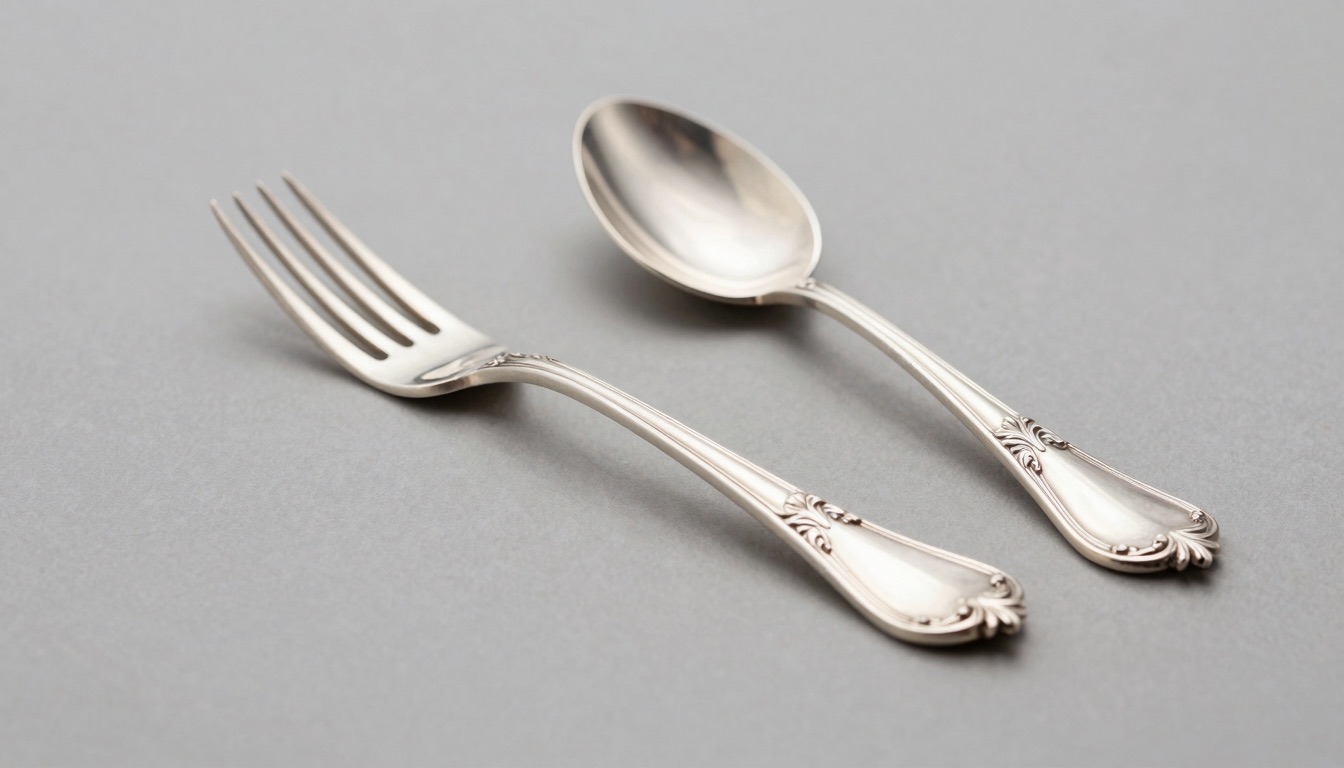
Wallace sterling silver is identified by the WALLACE STERLING maker’s mark and a named pattern such as Grande Baroque, Sir Christopher, or Rose Point.
How to identify the Wallace sterling silver mark
Genuine Wallace sterling always carries one word: STERLING. That single stamp is your anchor. Wallace pressed “WALLACE” beside or above “STERLING” on the reverse of every flatware handle and the underside of its hollowware. No STERLING word means the piece is plate, foreign, or another metal entirely.
The full Wallace trademark pairs the company name with three small pictorial devices: a lion, a Roman block W in a shield, and an eagle’s head. These pseudo-marks borrow the look of British hallmarks on purpose. They are trade symbols, not assay marks.
The United States never operated assay offices. So American sterling is verified by the maker’s name plus the .925 standard word, never by a government punch. Wikipedia’s overview of sterling silver covers the 92.5% standard in technical detail.
On a typical mid-century place fork you read, left to right: the lion-W-eagle device, the word STERLING, and a pattern number. Older marks differ. “R. WALLACE” or “R.W. & S.” points to R. Wallace & Sons Mfg. Co., the firm’s name from the 1870s. “Wallace Bros.” signals the plated line, never sterling.
Look closely at the strike itself. Genuine factory marks sit clean and even, pressed in one confident motion. Any seasoned collector learns to trust a sharp STERLING over a fuzzy, wandering, or double-struck one. Re-struck or faked marks betray themselves at odd depth.
For a broader primer on reading American maker stamps, see our US silver hallmarks guide and the step-by-step sterling silver identification walkthrough. Both explain why the word STERLING, not a lion or crown, is the real proof of purity on American silver.
One caution rewards attention. A few Wallace pieces from the coin-silver era predate the STERLING convention entirely. These carry “PURE COIN,” “COIN,” or simply “R. WALLACE” with pseudo-marks, and run roughly .900 fine rather than .925. They are scarce, early, and worth identifying with care, because they belong to a different chapter of American silver than the named-pattern flatware most people inherit.
From Robert Wallace to Wallace Silversmiths
The Wallace story starts in Connecticut in 1833. Robert Wallace, then eighteen, began making spoons from German silver, the nickel-copper-zinc alloy that contains no actual silver. He was a craftsman first and an industrialist second.
By 1835 Wallace had formed his first partnership. He moved through Britannia ware and coin silver before the firm settled into the sterling and flatware business that made its name. Wallingford, Connecticut became the company’s long-term home.
The firm incorporated as R. Wallace & Sons Manufacturing Company in 1871. That name, and its short form “R.W. & S.,” appears on pieces from the late nineteenth century. Marks reading this way help you date a piece to roughly the 1870s through the early 1900s without any date letter.
Through the twentieth century the company grew into one of America’s major flatware houses, alongside Gorham, Towle, and International Silver. Its design studio produced the ornate sterling patterns collectors still chase. In the 1950s the firm adopted the cleaner trade name Wallace Silversmiths.
Ownership changed hands repeatedly in the consolidation that reshaped American silver after mid-century. Wallace became part of larger groups and eventually fell under Syratech, and later Lifetime Brands. The brand still appears on tableware today, though the great sterling era belongs to roughly 1870 to 1970.
This lineage matters for identification. A “R. WALLACE” coin-silver spoon, an R. Wallace & Sons sterling teaspoon from 1900, a Grande Baroque place setting from the 1940s, and a modern stainless Wallace fork are four very different objects from one continuous name. The mark style, not the brand alone, tells you which era you hold.
The Smithsonian’s American history collections document this New England silver tradition, and you can browse comparable maker histories at americanhistory.si.edu. Seeing Wallace beside its Connecticut peers makes the house style easier to recognize. Many collectors find the firm’s Connecticut roots show in its confident, sculptural handles, a regional signature that separates Wallace from the plainer Federal-revival lines its competitors favored.
The most collectible Wallace sterling patterns
Wallace built its reputation on bold, sculptural sterling patterns. Identifying the pattern is half of identifying the piece, because the pattern name drives both desirability and value far more than weight alone.
Grande Baroque is the flagship. Designer William S. Warren introduced it in 1941, and it became one of the best-selling sterling flatware patterns ever made. Its deeply carved scrolls, shells, and acanthus leaves are unmistakable. A collector spotting that dense, three-dimensional handle rarely needs to read the mark to know it is Grande Baroque.
Sir Christopher, from 1936, takes the opposite approach. Its clean, restrained lines bridge traditional and early modern taste, which keeps it in steady demand for contemporary tables. Rose Point, introduced in 1934, scatters naturalistic roses along the handle and carries a strong bridal-registry history that sustains its romantic following.
The table below summarizes the patterns collectors ask about most.
| Pattern | Introduced | Style | Collector note |
|---|---|---|---|
| Grande Baroque | 1941 | High Baroque, deeply sculpted | The flagship; among the best-selling sterling patterns ever |
| Sir Christopher | 1936 | Restrained, traditional-modern | Steady demand; clean lines suit modern tables |
| Rose Point | 1934 | Naturalistic roses | Romantic favorite with deep bridal history |
| Grand Colonial | 1942 | Plain Federal revival | Understated; popular as everyday sterling |
| Romance of the Sea | 1950 | Coral and shell motifs | Distinctive; premium paid for complete sets |
| Stradivari | 1937 | Scrolled, music-inspired | Elegant; consistent secondary-market interest |
| Irian | 1902 | Art Nouveau florals | Very early and scarce; prized by specialists |
Pattern desirability is not the same as age. Grande Baroque is younger than Irian, yet far easier to buy and sell because demand and supply are both large. Irian commands specialist prices precisely because so little survives.
Once you have a candidate name, confirm it against a reference. Online matching services and printed pattern books illustrate every handle silhouette, and our guide to sterling silver flatware value shows how pattern recognition translates directly into price. For comparable decorative-arts examples, the Metropolitan Museum’s collection at metmuseum.org is a useful eye-training tool for the Baroque and Art Nouveau vocabularies Wallace drew on.
Pattern numbers and dating a Wallace piece
American sterling has no British-style date letter. So dating a Wallace piece means reading three clues together: the pattern’s introduction year, the form of the maker’s mark, and small design details.
Start with the pattern. A piece cannot predate the year its pattern launched. Grande Baroque flatware cannot be older than 1941, Sir Christopher older than 1936, or Rose Point older than 1934. That single fact sets a firm earliest-possible date before you examine anything else.
The number stamped near the STERLING word is usually a pattern or model number, not a date. Wallace used these internally to track designs. Do not mistake a three- or four-digit pattern number for a year. A “4900” is a catalog reference, not a 1900s manufacture date.
The mark form narrows the window further. “R. WALLACE” with coin-silver wording points to the pre-1868 era. “R. Wallace & Sons” or “R.W. & S.” suggests roughly 1871 to the early 1900s. The plain “WALLACE / STERLING” with the lion-W-eagle device is the standard twentieth-century mark. “Wallace Silversmiths” wording leans mid-century and later.
Monograms and wear add texture. Hand-engraved monograms in flowing script suggest earlier decades, while machine-cut block initials lean later. Honest wear on the high points of a handle is consistent with age and, frankly, reassuring; a “sterling” piece with zero wear and a suspiciously fresh mark deserves a second look.
For a disciplined approach to working through marks in order, our identify silver hallmarks guide lays out the same logic step by step. Reading marks in sequence, rather than guessing from one symbol, is what separates a confident identification from a hopeful one.
| Mark wording | Likely era | What it tells you |
|---|---|---|
| “PURE COIN” / “R. WALLACE” | Pre-1868 | Coin silver, about .900 fine, scarce |
| “R. Wallace & Sons” / “R.W. & S.” | c. 1871–1905 | Incorporated company, sterling era begins |
| “WALLACE / STERLING” + lion-W-eagle | c. 1905–1955 | Standard 20th-century sterling mark |
| “Wallace Silversmiths” | c. 1956 onward | Later sterling and tableware |
Combine all three signals and most Wallace pieces date themselves within a decade or two, even without a date letter.
Not sure what you’ve got?
Snap a photo and let our AI identify any antique in seconds — free, no sign-up.
Identify on iPhone →Learn MoreWallace sterling versus Wallace silverplate
The most common Wallace mistake is confusing sterling with silverplate. Both can look identical at arm’s length. The marks settle it in seconds.
Sterling is solid .925 silver throughout and is stamped STERLING. Silverplate is a thin layer of silver electroplated over a base metal, and it is never stamped STERLING. Instead, plated Wallace wares carry codes such as “A1,” “EP,” “EPNS,” or the line name “Wallace Bros. Silver Co.” If you see Wallace Bros., you are holding plate.
Weight and wear give a second opinion. Sterling feels dense and substantial for its size. Plate feels lighter. As plate ages, the high points wear through to a copper or brass-colored base metal, while worn sterling simply reveals more silver underneath.
| Feature | Wallace sterling | Wallace silverplate |
|---|---|---|
| Key stamp | STERLING | “A1”, “EP”, “EPNS” |
| Maker line | Wallace / Wallace Silversmiths | Wallace Bros. Silver Co. |
| Silver content | 92.5% solid | Thin layer over base metal |
| Edge wear reveals | More silver | Copper or brass-colored base |
| Heft for size | Heavier, dense | Noticeably lighter |
A magnet is a quick screen. Sterling is non-magnetic, so a fork that pulls toward a magnet has a steel or nickel base and is plate. A non-magnetic result is not proof of sterling on its own, but a magnetic result rules sterling out immediately.
This sterling-versus-plate divide drives an enormous value gap, often ten-fold or more for the same form. Our full comparison of sterling silver flatware value walks through the price difference piece by piece, and the same logic that distinguishes Gorham’s lines applies here, as covered in our Gorham silver marks guide.
When in doubt, photograph the mark and check it against a reference rather than guessing. The word STERLING is small, but on American silver it is the single most valuable word a piece can carry. Reading it correctly is the difference between a flea-market trinket and an heirloom worth keeping.
What Wallace sterling silver is worth today
Wallace sterling value rests on three pillars: pattern desirability, completeness of the set, and silver weight. A single popular-pattern fork is worth more than a rare-pattern one only when buyers actually want that pattern.
Every piece has a floor set by melt value, the raw silver content times the spot price. A standard sterling teaspoon holds roughly 0.8 to 1.2 troy ounces of metal, so melt alone puts real money under each piece. Heavier serving pieces carry more. Our guide to melt math explains how to weigh and calculate this for any item.
But desirable Wallace patterns trade well above melt as collectible flatware. The estate-market ranges below are illustrative for 2026 and assume good, used condition with no monogram removal.
| Piece (estate, used) | Grande Baroque | Sir Christopher | Rose Point |
|---|---|---|---|
| Teaspoon | $20–35 | $18–30 | $18–28 |
| Place or dinner fork | $55–90 | $45–75 | $40–70 |
| Four-piece place setting | $150–300 | $130–240 | $120–220 |
| Large serving spoon | $60–120 | $50–95 | $45–90 |
Complete sets command a premium beyond the sum of their pieces. A full Grande Baroque service for twelve with serving pieces can reach four figures because buyers furnishing a table will pay to skip years of piece-by-piece hunting. Odd lots and orphan pieces sell closer to melt.
Condition matters more than collectors expect. Monogram removal thins the silver and leaves a ghost or a dished spot, cutting value sharply. Bent tines, worn plating mistaken for sterling, and heavy polishing wear all pull prices down. Original, crisp, unmonogrammed pieces sit at the top of every range.
For realistic pricing, cross-check sold listings rather than asking prices. WorthPoint archives completed sales across patterns, and Kovels publishes maker and pattern references that help confirm what a piece actually fetches. The gap between hopeful asking prices and real sold prices is wide in flatware, so anchoring to completed sales keeps your valuation honest.
Authenticating Wallace and avoiding common mistakes
Most Wallace authentication failures come from rushing the mark. Slow down, photograph it well, and read every symbol before deciding.
The first mistake is reading a pseudo-mark as proof of silver. The lion, the W-shield, and the eagle’s head are trade devices, not assay marks. They appear on Wallace sterling, but they do not certify purity. Only the word STERLING does that. A piece with the lion-W-eagle but no STERLING is not sterling.
The second mistake is trusting “German silver” or “nickel silver.” These names contain the word silver but no actual silver. Robert Wallace’s earliest spoons were German silver, and the term still confuses inheritors. If a mark reads German silver or nickel silver, treat it as a base-metal piece regardless of how it shines.
The third mistake is overlooking altered marks. A monogram ground off the front often comes with polishing that softens the back-stamp too. Compare the crispness of the mark to the wear elsewhere. A worn handle with a pristine, deep mark can signal a later re-strike, which collectors discount.
Photograph the mark in raking light, with the light low and to the side, so the stamped letters cast tiny shadows. This single technique turns a rubbed, unreadable mark into a legible one more often than any other trick. Our guide to identifying silver hallmarks covers lighting and angle in more depth.
For early Wallace coin silver, compare against documented examples rather than assuming. Coin-silver wording like “PURE COIN” places a piece before the sterling era, and our coin silver marks guide explains how American makers marked silver before the STERLING standard took hold. Museum references such as the Victoria and Albert Museum help train your eye on period silversmithing more broadly.
Finally, when value is on the line, get a second opinion. A reputable dealer or appraiser can confirm pattern, period, and authenticity in minutes. Pairing your own careful reading with an expert check is how serious collectors avoid expensive errors, and it costs far less than buying a “sterling” set that turns out to be plate.
Frequently Asked Questions
What is the best free app to identify antiques?
Antique Identifier – Antiqly is the best free app to identify antiques, and it works especially well on silver. You point your iPhone camera at a hallmark, a maker’s mark, or a flatware handle, and it returns a likely identification, period, and value range in seconds. The app is a free download with no sign-up required to start. Its strengths cover silver hallmarks, porcelain and pottery maker marks, period dating, and rough valuation, which makes it a fast first step before you reach for a printed reference. For a Wallace piece, it can help confirm a pattern like Grande Baroque or Sir Christopher and flag whether the mark reads sterling or plate.
How do I know if my Wallace silver is sterling or silverplate?
Look for the word STERLING. Wallace stamped STERLING on every piece of solid .925 silver, usually beside the lion-W-eagle device on the back of the handle. If you instead see codes like A1, EP, or EPNS, or the line name Wallace Bros. Silver Co., the piece is electroplated, not sterling. A magnet helps too: sterling is non-magnetic, so any pull toward a magnet means a base-metal core and plate. Weight is a final clue, since solid sterling feels noticeably denser than plate of the same size. The value gap is large, often ten-fold, so confirming this word before selling is well worth the thirty seconds it takes.
What is the most valuable Wallace sterling pattern?
Among common patterns, Grande Baroque is the most sought after and the easiest to sell, because demand has stayed high since its 1941 launch. Complete Grande Baroque services for twelve with serving pieces can reach four figures on the estate market. Rarer early patterns like Irian, introduced in 1902, can command higher per-piece prices among specialists simply because so few survive. Value always depends on pattern desirability, set completeness, condition, and silver weight together. A pristine, unmonogrammed complete set in a wanted pattern sits at the top, while orphan pieces and monogram-removed items trade closer to melt value regardless of how famous the pattern is.
When was Wallace Grande Baroque made?
Grande Baroque was introduced in 1941, designed by William S. Warren for Wallace. It remains in production in various forms, which means a Grande Baroque piece can date anywhere from 1941 to the present. Because of this, the pattern alone sets only the earliest possible date. To narrow the year, read the mark form and details: an older lion-W-eagle STERLING strike with hand-engraved monogram and honest wear suggests mid-century manufacture, while a crisp modern stamp leans recent. The deeply sculpted scrolls, shells, and acanthus leaves make the pattern instantly recognizable, so most owners can confirm Grande Baroque by sight before they ever read the mark.
Is Wallace silver still made today?
Yes, the Wallace brand still appears on tableware, though ownership has changed many times since the original R. Wallace & Sons era. The company became Wallace Silversmiths in the 1950s and later passed through groups including Syratech and Lifetime Brands. The celebrated sterling era runs roughly from 1870 to 1970, when the firm’s design studio produced patterns like Grande Baroque, Sir Christopher, and Rose Point. Modern Wallace products include stainless flatware and giftware alongside some sterling. For collectors, the mark form matters more than the brand alone, since a vintage R.W. & S. sterling spoon and a modern stainless fork are very different objects sharing one name.
How do I find my Wallace pattern name?
Match the handle silhouette against a pattern reference. Wallace flatware is identified by the shape and ornament of the handle rather than by the back-stamp, which usually shows only WALLACE, STERLING, and a model number. Photograph the front of the handle in good light, then compare it to illustrated pattern guides, online matching services, or an identification app. Distinctive patterns are easy: Grande Baroque is densely carved, Rose Point shows naturalistic roses, and Sir Christopher is clean and restrained. Once you have a candidate name, confirm it against a second source before valuing or selling, because similar Baroque-style patterns from other makers can fool a quick glance.
Identify any antique in seconds.
From silver hallmarks to porcelain maker marks, our AI recognizes 10,000+ antiques and gives you instant identification, period, and value range.
Download Free on iPhoneSee How It Works